
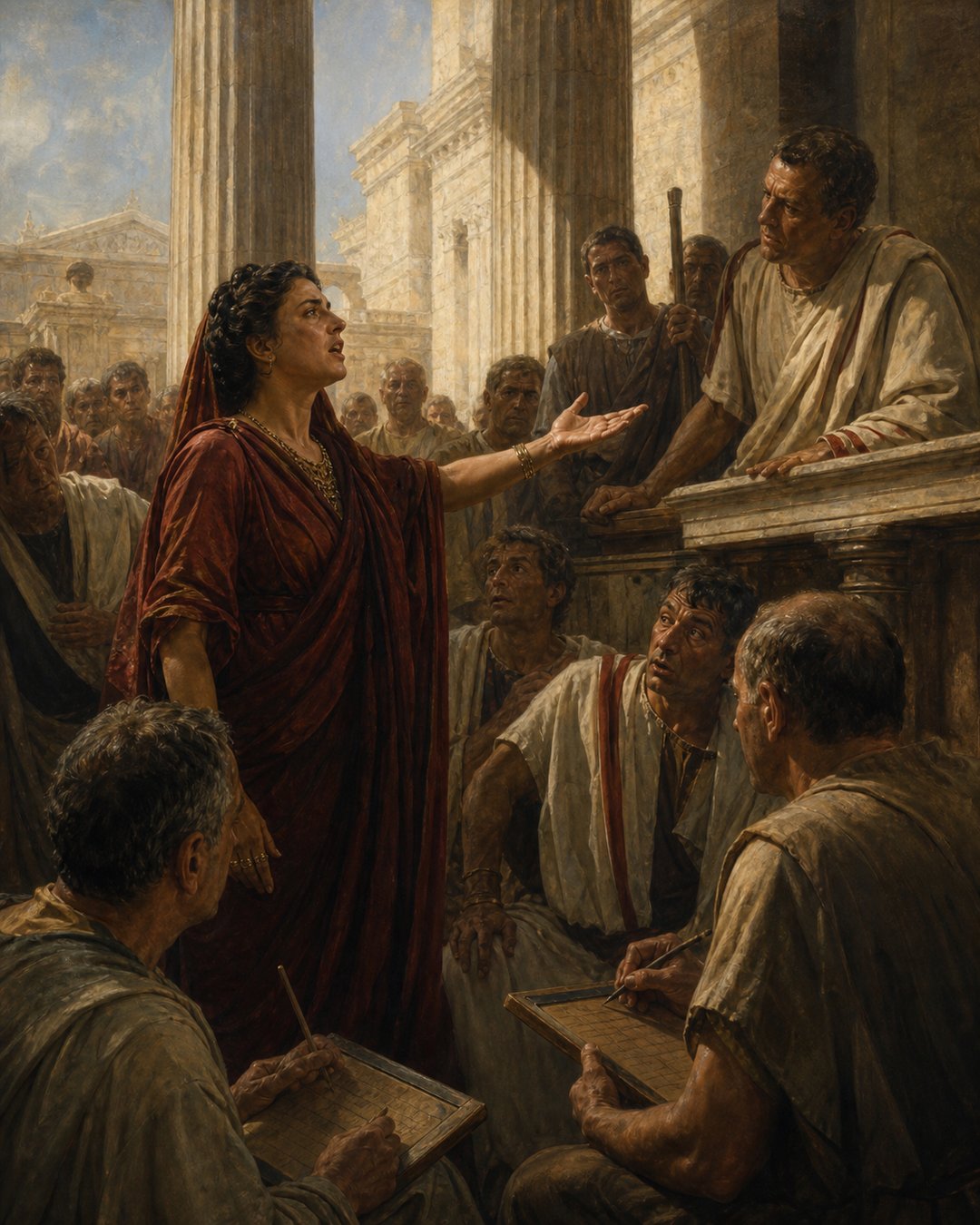
A woman stands before a Roman praetor and refuses to let someone else turn her dispute into acceptable male speech. She returns with another case, and then another. We do not possess her words. What survives is the irritation of the men who remembered hearing them.
Her name was Gaia Afrania. The later legal tradition calls her Carfania, while a short biographical tradition identifies her as the wife of the senator Licinius Buccio and places her death in 48 BC. She lived at the violent end of the Republic, when political authority, personal connections and courtroom performance were impossible to separate cleanly.
Afrania’s importance does not rest on winning a famous constitutional judgment. It rests on something more ordinary and more disruptive: she often brought suits and pleaded them herself before the praetor. Roman writers converted that persistence into an origin story for a restriction on women appearing in court for other people. The result lets us watch a legal boundary being explained through one person’s damaged reputation.
The tribunal had rules about who could speak
Roman legal procedure did not treat every appearance before a magistrate as the same act. In the section preserved as Digest Book 3, Title 1, the jurist Ulpian explains the right of application to a court. To apply was to state one’s own wish or a friend’s before a magistrate with jurisdiction, or to oppose the wish of another. Those alternatives mattered.
The praetor’s scheme separated people into classes. Some were forbidden to make an application at all. Some could apply only in their own behalf. Others could act both for themselves and for permitted third parties. The categories were not a philosophical declaration about equality. They were administrative controls over access, representation and the dignity of the magistrate’s court.
That setting changes how Afrania’s story should be read. Saying that a woman “went to court” blurs the crucial procedural question: was she speaking for herself, or was she presenting another person’s position? The rule attached to Carfania in the Digest concerns appearing for others. It does not say that women could never bring their own interests before the praetor.
The distinction resembles the precision visible in Rome’s other procedural boundaries. A rule could assign a fixed consequence, as in the strange case of the twenty-five-as slap, without expressing a complete moral theory. Here too, the legal machine drew a line around an action rather than erasing every possible appearance by the person affected.
Afrania made persistence impossible to ignore
The biographical summary says Afrania often brought lawsuits and pleaded her own cases instead of waiting for male relatives to defend her. That was already unusual enough to attract notice. Courtroom advocacy demanded command of facts, timing and the magistrate’s attention. It also made a speaker visible to opponents, spectators and the men who later selected which anecdotes deserved preservation.
Nothing from Afrania’s own side survives. We cannot tell whether her cases concerned property, marriage arrangements, inheritance, insult or some other dispute. We cannot safely reconstruct the arguments she used. The evidence supports persistence, not a modern speech placed in her mouth.
Yet persistence itself is concrete. The source tradition does not describe a woman silenced before she began. It remembers a woman who appeared often enough for repeated legal activity to become her defining characteristic. Even the hostile account concedes the central event: Afrania was not merely discussed by law. She used its forum.
That public use may explain why later writers found her so useful. An abstract ban has no face. A rule blamed on one troublesome litigant gains a memorable scene: the raised bench, the waiting advocates, the magistrate’s patience, and the returning woman who refuses the expected route through male representation. The scene did the work of justification long after its details had vanished.

Ulpian preserved the insult with the procedure
The Digest passage is blunt. Ulpian says the praetor forbade women to appear for others, then explains the restriction through what his culture considered female modesty and duties belonging to men. He calls Carfania extremely shameless and attributes the edict to her effrontery and annoyance of the magistrate.
Those words are evidence, but not neutral evidence. They show how a later male jurist explained the rule. They do not prove that Afrania’s cases lacked merit, that she behaved worse than aggressive male advocates, or that every woman’s appearance threatened court order. The language performs exclusion while pretending merely to remember its cause.
The naming is especially effective. Ulpian could have stated the category without giving an anecdote. Instead, the passage anchors a broad sex-based restriction to a singled-out woman. Her supposed character becomes the bridge between individual conduct and collective disability. One litigant’s reputation is made to carry the weight of a general rule.
Roman legal memory often preserved names because they made an institutional choice feel inevitable. The mechanism can be seen from the opposite direction in Caracalla’s enormous grant of citizenship: a named ruler becomes shorthand for a change that still required categories, documents and administration. With Afrania, a named litigant becomes shorthand for narrowing representation.
The edict was narrower than the later caricature
Because the insult is vivid, it can swallow the rule. The important limit is “for others.” Ulpian’s classification allowed some restricted people to appear for themselves while denying them general representational standing. Afrania’s own remembered habit of pleading her cases sits beside a rule meant to stop women conducting another person’s legal business.
The surrounding title confirms that the praetor was managing practical access, not merely issuing slogans. Another section says that if parties lacked an advocate, the praetor would provide one. It extends that assistance to people unable to obtain advocacy because of an adversary’s intrigues or because of fear. The court therefore both restricted speakers and acknowledged that representation could fail.
That tension gives Afrania’s story its force. A system that regarded advocates as necessary could still distrust the wrong person taking that role. It could help someone acquire a representative while declaring that women as a class should not represent others. Order and exclusion arrived through the same procedural vocabulary.
The surviving text is also separated from Afrania by centuries. Justinian’s sixth-century Digest compiled writings of earlier jurists; the passage quotes Ulpian’s commentary on the praetorian edict. We are not reading a stenographic record from Afrania’s tribunal. We are reading legal memory layered across the late Republic, the high Empire and Justinian’s compilation.

A negative precedent still records agency
Afrania enters history through people determined to make her an example of what should stop. That makes the record morally uncomfortable but historically revealing. Hostility preserved the fact that she acted. The jurist’s contempt cannot remove the woman who repeatedly crossed the Forum, prepared her cause and addressed the magistrate.
Her story also warns against confusing a source’s label with its subject. “Shameless” tells us what Ulpian wanted readers to think. “Annoyance” tells us how the magistrate’s authority was imagined. Neither word supplies the missing merits of her lawsuits. The secure core is narrower: Afrania pleaded, a restrictive origin story formed around her, and later law transmitted both rule and insult.
The deeper change was not simply that Rome silenced one loud woman. It transformed a speaker into a boundary marker. Afrania’s voice became the explanation for why other women should not speak for someone else. Her individuality survived only after being recast as collective danger.
That is a peculiar kind of legal monument. No favorable judgment bears her name. No speech preserves her reasoning. Instead, a hostile paragraph proves that she occupied the courtroom often enough to trouble its gatekeepers. The rule tried to define who belonged before the praetor; the memory of Afrania shows that the boundary had to be drawn because someone had already crossed it.
Sources
Ulpian, On the Edict, preserved in the Digest 3.1.1
Gaia Afrania biographical reference