

Gaia Taracia gave the Roman people a piece of ground beside the Tiber. Rome answered with a law that made her an exception.
Aulus Gellius says Taracia, also called Fufetia, was a Vestal. The Horatian law concerning her granted many honours, but two details carried unusual weight. She received the right to give testimony, a capacity Gellius says belonged to no other woman in the state. At forty, if she wished, she could leave the priestly order and marry.
The notice is short, and it does not preserve the debate, ceremony or boundaries of the land transfer. What survives is more exact than a general tale of public gratitude. A named woman, a named law, a legal word, an age and a choice were remembered together.
Taracia’s reward therefore opens a narrow view into Roman institutions. Sacred status did not simply lift a Vestal above ordinary rules. In this case the people translated service and generosity into privileges precise enough to be quoted centuries later.
A riverside gift entered Rome’s legal memory
Gellius introduces Gaia Taracia among names frequent in early annals. He gives an alternative name, Fufetia, which signals that even the identity reached later readers through layered traditions. Yet he is confident about the central civic exchange. Taracia presented the Roman people with the Campus Tiberinus or Martius.
Those two labels should not be forced into a modern map more exact than the passage allows. Gellius’s point is the gift, not a survey. A stretch of ground associated with the Tiber and the Field of Mars passed into public benefit through her generosity.
Land was not an abstract offering. It could hold assemblies, movement, exercise, ritual and the changing practical life of the city. To give a campus was to place a durable resource at the people’s disposal. The benefaction remained visible after any single ceremony of thanks had ended.
Taracia’s act sits beside the practical obligations carried by the women of Vesta, but it was not another routine priestly task. Gellius describes generosity and kindness, language that frames the transfer as a benefaction worthy of a special response.
Rome could preserve gratitude in monuments, festivals or stories. Here it also preserved gratitude in law. The Horatian measure did not merely praise Taracia; it defined what she could do.
The word testabilis opened a guarded civic function
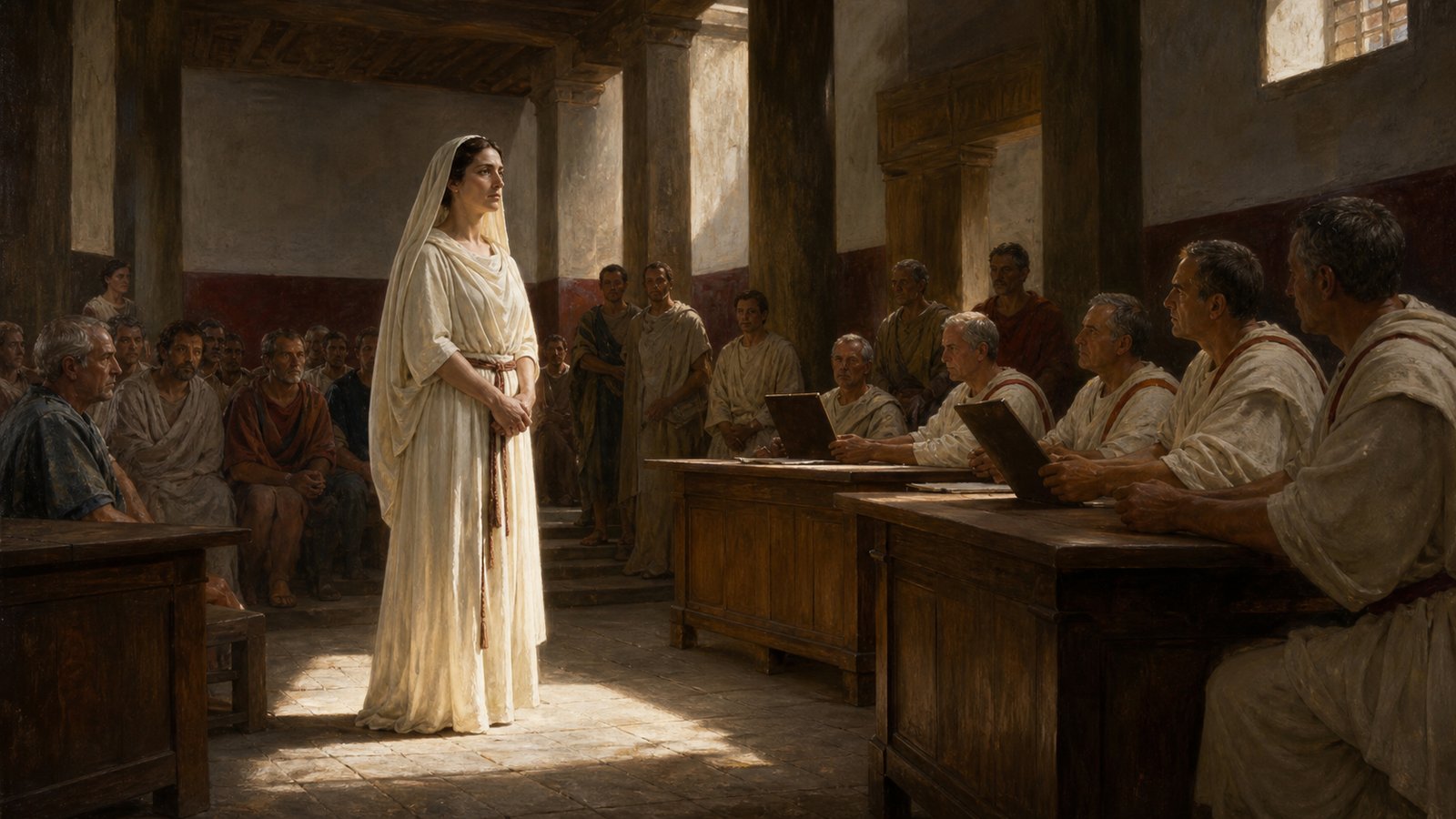
Gellius singles out the right of giving testimony. The Horatian law called Taracia testabilis, capable of bearing witness. He emphasizes the contrast by quoting the opposite term from the Twelve Tables: intestabilis, forbidden to testify.
That vocabulary matters because it turns honour into legal capacity. A wreath could mark distinction in public. A favorable seat could display rank. The right to testify affected whether a person’s formal words could operate inside a civic process.
Gellius adds the sharpest qualification: no other woman in the state received this privilege. His statement belongs to his account of the old law and should be read as his claim, not expanded into a complete survey of every Roman woman in every century. Even with that caution, the remembered exception is remarkable.
Taracia was not being described as generally free from rules. She was granted one specified capacity. Roman privilege often worked that way: it could be personal, bounded and expressed through exact language rather than through a universal change.
The same culture could make witnesses central to family ritual. Ten witnesses watched the spelt-cake marriage ceremony, placing public recognition around a change in status. Taracia’s law shows another side of witness: not merely being present, but possessing the accepted capacity to speak as testimony.

Forty marked a choice rather than an automatic release
The second privilege was tied to age. When Taracia reached forty, she could leave the priesthood if she wished and marry. Every part of that sentence limits the claim. Gellius does not say that she was expelled at forty, that she had to marry or that every Vestal received the same option.
The phrase preserves agency. The law created a route out of the order, but Taracia decided whether to take it. Her sacred identity and a possible married life were not collapsed into one compulsory timetable.
Age supplied a clear threshold. Before it, the option described by Gellius did not apply. After it, the honours attached to her benefaction included the power to choose a different future. A public law thus reached into the intimate architecture of household and marriage.
This makes Taracia’s exception especially revealing beside the strict ritual logic surrounding Vestals. Their service was connected to Rome’s security, purity and continuity. Individual freedom could not be assumed from the prestige of the office. It had to be stated.
The provision also resists a tempting romantic ending. Gellius does not tell us that Taracia left, whom she married, or whether she used the permission at all. The historical fact is the available choice, not an invented wedding scene.
Rome rewarded a person without rewriting the whole order
The Horatian law joined a material gift to civic honour while leaving the broader system intact. Taracia could testify; Gellius still called the capacity unique. Taracia could leave and marry at forty; the passage does not turn that option into a general reform of Vestal service.
This personal structure was useful to Rome. It allowed the community to answer extraordinary generosity without admitting that every rule had changed. The exception celebrated the donor precisely because it was not ordinary.
It also shows how sacred and civic categories overlapped. Taracia’s priesthood established her distinctive place, her land benefaction served the people, and legislation converted the response into enforceable status. Religion, property and legal voice met in one settlement.
Compared with the larger Roman belief that Vestals helped keep the city safe, Taracia’s story is unusually personal. The state did not reward an anonymous office. It named one Vestal and remembered what her kindness had supplied.
Gellius preserves no speech by Taracia. Ironically, what survives is a law about her ability to speak as a witness. Her own words are gone, but the legal fact of their exceptional admissibility remained.
The riverside ground made generosity tangible. The word testabilis made gratitude precise. The age of forty made freedom optional rather than vague. Together they show Rome turning one woman’s benefaction into a carefully bounded civic exception.
Gellius’s method is part of the evidence. He does not claim to have watched Taracia or to know her private intentions. He points to the Horatian law as proof that she was a Vestal, notices the legal term used in it, and sets that term beside language from the Twelve Tables. His argument moves through surviving words. The result is not a full biography but a reconstruction anchored to what an old legal text allowed him to say.
That narrowness protects Taracia from becoming only a symbolic figure. She was remembered through actions and capacities: presenting land, receiving honours, giving testimony and holding an option at forty. None requires a fabricated personality. Rome’s response can be examined through the arrangement itself, in which a public resource supplied by one woman produced an exception that public law could recognize.
Sources
Aulus Gellius, Attic Nights 7.7