
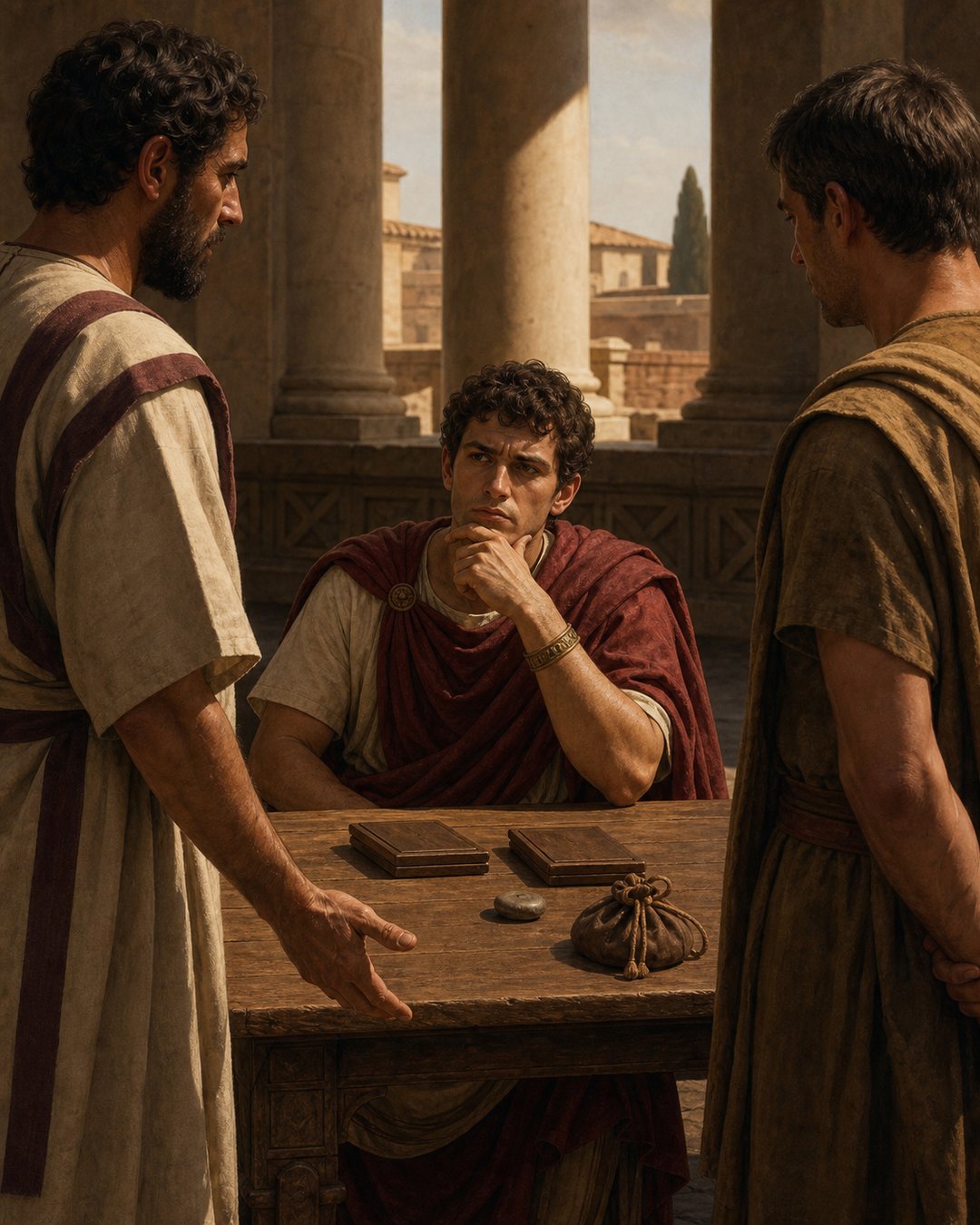
A money claim came before Aulus Gellius with almost everything a cautious judge might distrust. The claimant produced no receipt, no account entry, no signature, no sealed deed, and no witness. Yet Gellius believed him to be a man of tested honesty. The defendant, surrounded by advocates, had a reputation for lies and fraud.
The legal answer looked simple to experienced men in the forum: acquit because the payment had not been proved in a customary form. The moral answer pulled the other way. Gellius could not persuade himself that the worse man should win merely because the better man lacked paperwork.
He postponed the case, consulted the philosopher Favorinus, rejected the advice he received, and finally swore that the matter was not clear to him. The oath released him from giving judgment. His story preserves something rarer than a famous verdict: a procedural ending built for a judge who would not disguise uncertainty as knowledge.
Books Prepared Him for Delay, Not for Doubt
Gellius presents himself at the beginning of judicial service. Praetors had selected him for the cases Romans called private suits. He was young and conscious of the distance between literary education and the work now placed before him. Poets and orators had trained him to read stories and speeches; neither automatically taught him how to decide another person’s money dispute.
He responded by searching books in Greek and Latin. The image is revealing. Roman adjudication did not arrive as a single handbook that answered every possible conflict. Gellius consulted the Julian Law, the commentaries of Masurius Sabinus, and other jurists. These authorities helped with postponements, delays, and certain legal principles.
What they did not resolve was the collision between incomplete proof and unequal credibility. Rules can tell a judge when a hearing may be continued. They do not remove the need to evaluate people whose stories cannot both be true. Gellius calls books mute counsellors: useful, present, and unable to answer a new question in a living voice.
That limitation distinguishes his problem from a badly drafted statute or a missing procedural step. Readers can compare the market lawyers divided by one missing tooth, where classification controlled the dispute. Here the categories were visible. The uncertainty lay in deciding what to believe when the preferred forms of proof were absent.
Five Missing Proofs Strengthened the Wrong Man
The claimant said money had been paid and counted out. He offered slender arguments rather than documentary confirmation. Gellius nevertheless describes him as thoroughly good, tested in integrity, and supported by striking examples of honesty. Character did not prove this transaction, but it made a fabricated demand seem less likely.
The defendant’s character pointed in the opposite direction. Gellius says he was of base life, repeatedly caught in lies, and full of treachery and fraud. His advocates did not need to make him admirable. They made the narrower claim that the plaintiff had failed to prove payment in the accepted ways.
Their list gave the argument physical force: a receipt for payment, a book of accounts, a signature, a sealed deed, or witnesses. Each item could connect the alleged transfer to something outside the claimant’s unsupported speech. None appeared. The empty places in the case began to act like evidence for the defence.
The advocates also tried to keep reputation outside the tribunal. This was a money claim before a private judge, they said, not a moral inquiry conducted by censors. Their distinction protected procedure from becoming a general contest in social standing. A disagreeable defendant could still be right about one debt; an honorable claimant could still remember badly or demand too much.
Gellius’s experienced friends therefore advised acquittal. Forum business pressed everywhere, and they saw no reason to prolong a case that lacked customary proof. Speed, form, and the presumption favoring the person asked to pay all aligned. Only the judge’s view of the two men resisted.
Favorinus Turned One Lawsuit into Four Judicial Problems
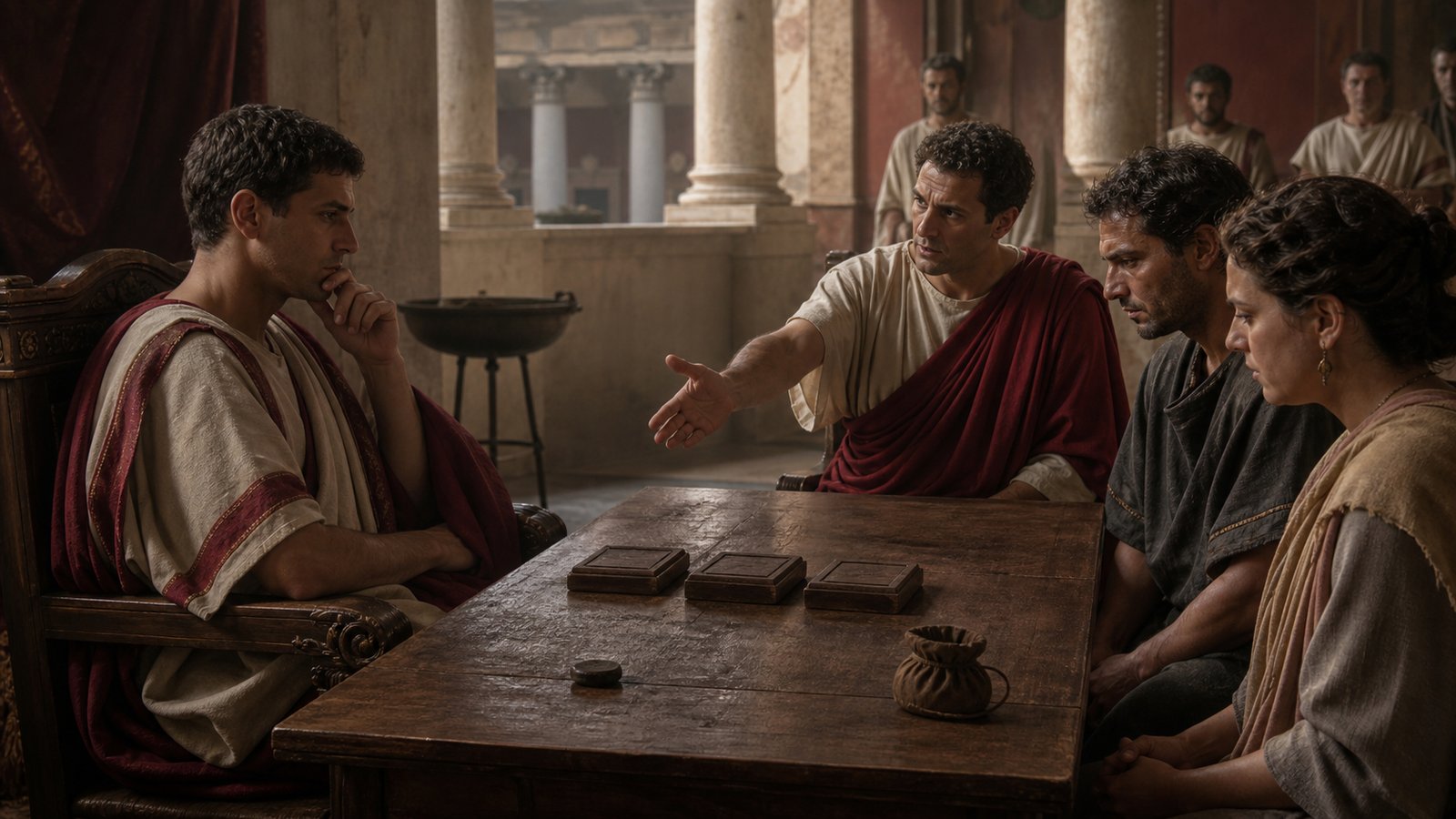
Gellius ordered a postponement and went from the bench to Favorinus, with whom he often associated at Rome. The movement matters. Delay was not avoidance by itself; it created room for consultation before an irreversible decision. Favorinus praised the young judge’s conscientious hesitation rather than treating doubt as weakness.
He then widened the discussion. What if a judge personally knew a fact before trial but the parties failed to prove it in court? Should he decide from private knowledge or the evidence presented? Could a judge pause adjudication to become a peacemaker? Might he ask about a useful point that one side had failed to raise, or would that turn him into an advocate?
Favorinus added a fourth problem. A quick, questioning judge might reveal changing reactions as arguments unfolded. A calmer judge might conceal every provisional opinion until judgment. One method could clarify a confused case; the other could protect dignity and prevent a temporary impression from looking like a settled verdict.
These questions explain why the money claim could not be solved by one slogan. A judge managed boundaries: knowledge inside and outside the record, decision and compromise, clarification and advocacy, active thought and visible partiality. Gellius had encountered one sharp point within a much larger craft.
Cato Made Character a Rule of Last Resort
For the immediate case, Favorinus invoked Marcus Cato. He recalled an ancestral custom for disputes that could be proved by neither documents nor witnesses. The judge should ask which litigant was the better man. If both were equally good or equally bad, the defendant should be believed.
The rule did not discard the ordinary burden of proof. It addressed the moment after ordinary supports had failed. Equal character still protected the defendant, the person from whom something was demanded. Unequal character, however, allowed reputation to break the deadlock.
Applied to Gellius’s case, Favorinus found the answer straightforward. The claimant had the highest character; the defendant had the worst; no witnesses existed. Believe the claimant and condemn the other man. Philosophy, inherited custom, and Gellius’s own description of the litigants seemed to converge.
Yet this solution introduced a different danger. Reputation could become a substitute for evidence about a particular act. A young judge might condemn not because he knew the debt existed, but because one man carried more social credit than another. The method acknowledged uncertainty while still demanding a winner.
Roman legal reasoning often exposed such tensions through concrete accidents and persons. In the case of a stray ball and a barber’s razor, responsibility depended on where blame should fall in a chain of actions. Gellius faced a chain with a missing first link: the alleged payment itself could not be independently shown.
An Oath Ended the Case Without Inventing Certainty
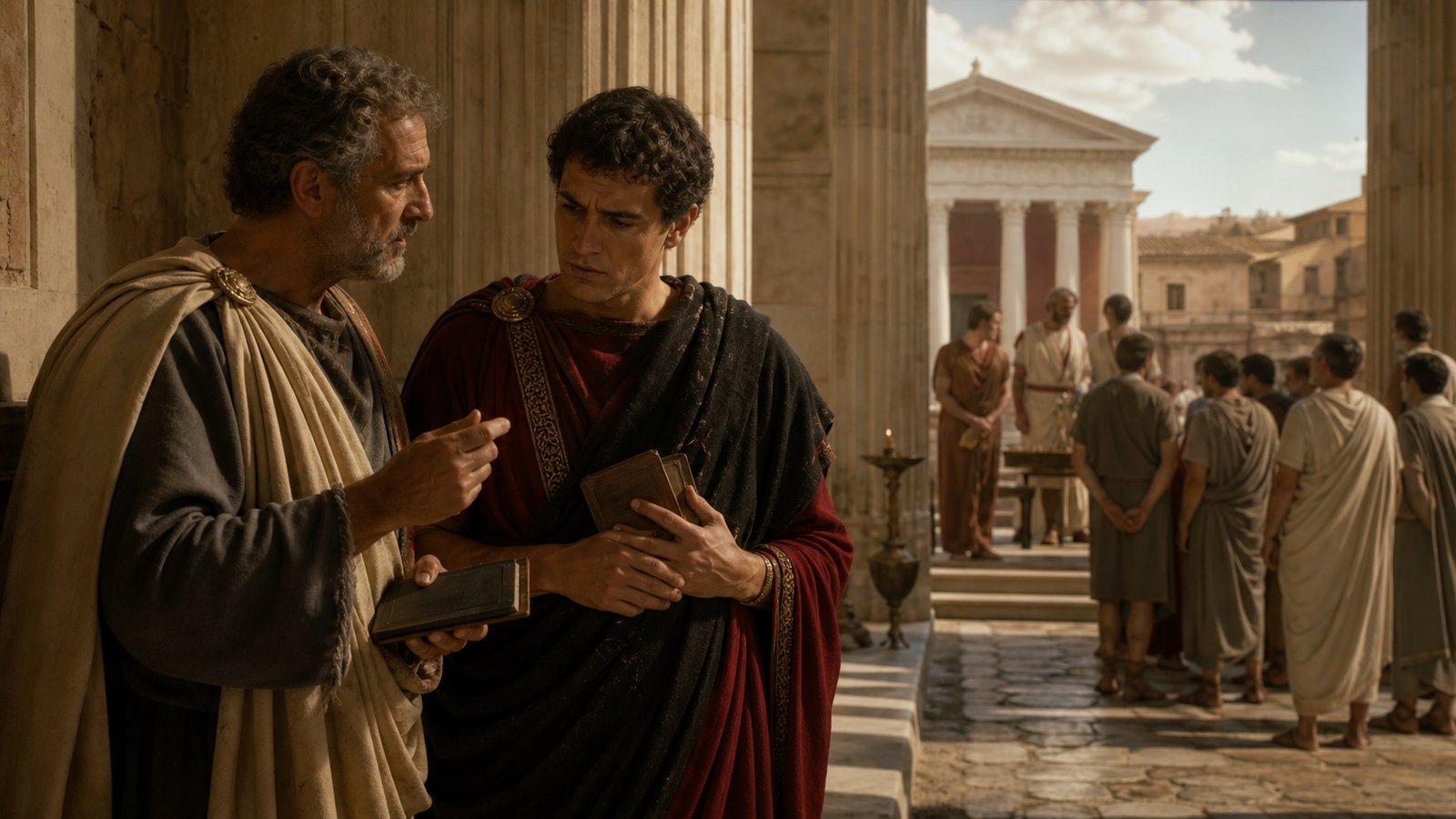
Gellius refused both easy exits. He could not acquit a defendant he considered deeply untrustworthy. He also believed it too presumptuous, given his youth and modest standing, to condemn a man from the comparative character of the parties rather than the evidence in the case.
His answer was an oath that the matter was not clear to him. By swearing to his uncertainty, he was relieved from rendering a decision. The procedure did not prove the claimant right or the defendant innocent. It separated the judge’s inability to know from a declaration about the underlying debt.
The oath imposed a cost on the judge’s hesitation. He did not quietly abandon the file or pretend a technicality had made the facts obvious. He formally attached his own credibility to the statement that he could not decide. Uncertainty became something declared under obligation.
That ending also completes the story’s education. Books taught Gellius how postponement worked. Advocates showed the force of conventional proof. Favorinus supplied broad questions and Cato’s character test. Gellius still had to decide what kind of judicial act he could honestly perform.
His final choice is not a timeless formula for every weak case. It is evidence that Roman procedure recognized a human limit inside adjudication. A judge could be careful, informed, and morally alert yet remain unable to convert suspicion into a verdict. The law’s answer, at least in Gellius’s memory, was not to force confidence. It was to make doubt speak clearly.
Sources
Aulus Gellius, Attic Nights, Book 14, chapter 2.