
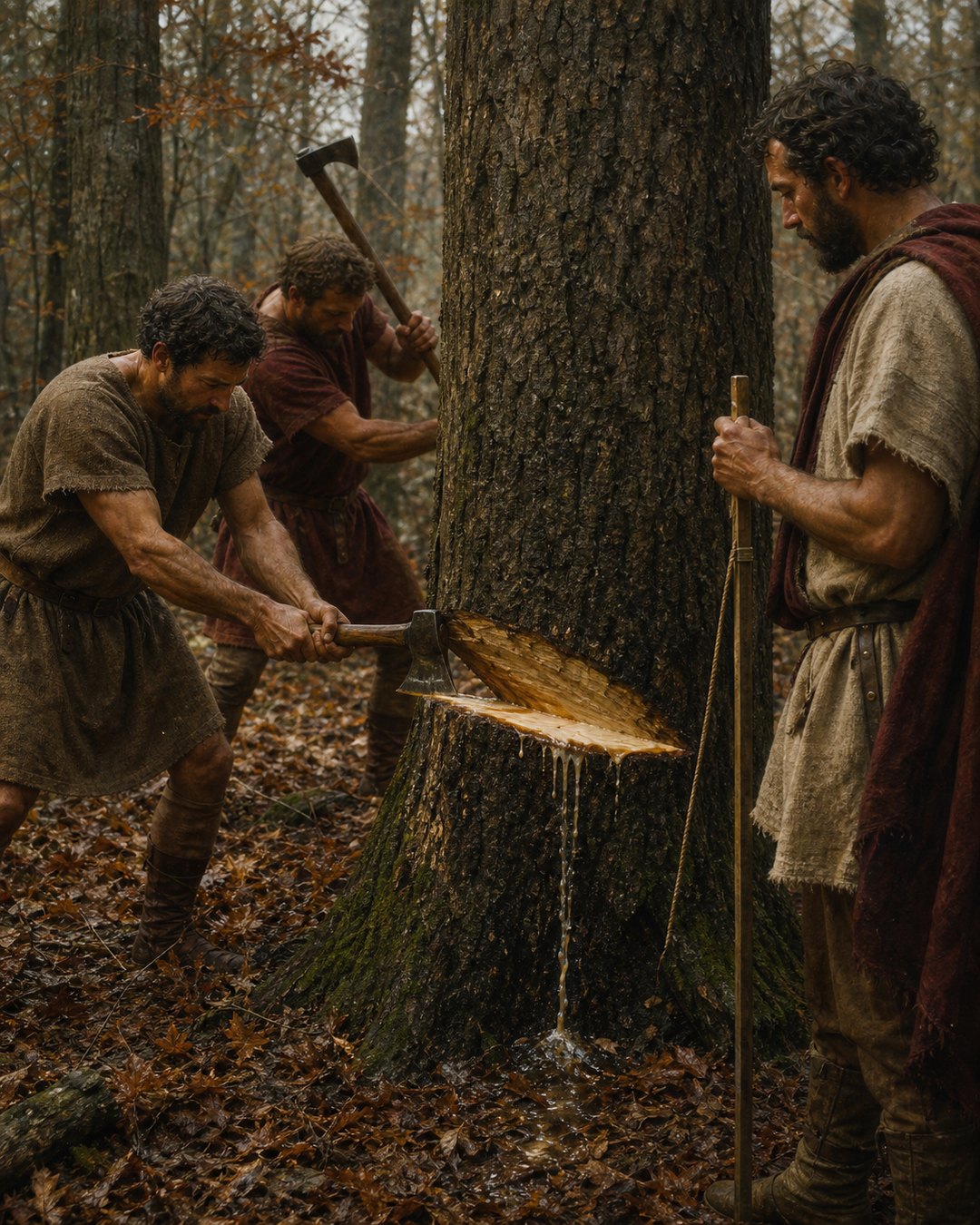
The first deep cut was not supposed to bring the tree down. Vitruvius told builders to open the standing trunk as far as its heart and then stop. The roots remained in the earth, the crown remained in the air, and liquid began to escape through the wounded sapwood drop by drop.
Only when the dripping ended should the workers return to complete the felling. The pause turned a familiar act into a controlled sequence: choose the season, open an outlet, wait while the trunk drained, observe the cut and take the tree only after a visible condition had changed.
Vitruvius explained the process with an ancient theory of seasonal strength and bodily fluids, not modern forestry. Yet the practical concern is unmistakable. Timber entered a building with a history. Moisture, season and preparation affected what happened after the beam was squared, joined and placed under load. The material had to be managed while it was still alive.
The calendar entered the timber before the axe did
Vitruvius begins with a window rather than a tool. Timber, he says, should be felled from early autumn until Favonius, the west wind, begins to blow. Spring was the wrong moment because trees were spending their vigour on new leaves and the fruit that returned each year.
His language is physiological. He describes the spring tree as swollen, open in texture and weakened by growth. The comparison he uses for that condition is uncomfortable to modern readers: a pregnant body whose nourishment is directed toward another life. The analogy belongs to his period, including its reference to enslaved women offered for sale. It should be read as evidence for Vitruvius’s reasoning, not repeated as a sound account of plant biology or human health.
Autumn reversed the movement in his model. Once fruit had ripened and leaves began to wither, he believed the roots restored moisture and strength to the trunk. Winter air then compressed and consolidated it. The right felling season was therefore the period in which the tree had recovered from annual growth but had not yet begun the next spring’s expansion.
The calendar mattered because Vitruvius treated wood as changing matter. A beam did not possess one permanent set of qualities merely because it came from a named species. The moment of harvest could leave it tighter or looser, wetter or better prepared for durable work.
A heart-deep opening made the tree its own drain
The instruction becomes unusually physical in the next step. A worker was to cut into the trunk to the very heart. This was not casual bark scoring. The opening had to cross the outer material and reach the central wood, giving internal moisture a route toward the air.
Then the tree remained upright. Vitruvius does not provide a number of days, a measured volume or a prescribed width for the notch. His control was visual and sequential. Sap would drain drop by drop; while it continued, the job had not reached the condition required for final felling.
That pause distinguished the method from seasoning a log after it was already on the ground. Drainage began through a living structure that was still connected from root to crown. The cut acted as an outlet low on the trunk, and gravity made the change legible at one place where a worker could inspect it.
The scene also reveals coordination. A tree opened deeply enough to weaken it could not simply be forgotten. Workers had to choose it, notch it, leave it safely, return to it and recognize when the signal had changed. The timber yard’s schedule started in the woodland.
Dripping supplied the stop rule
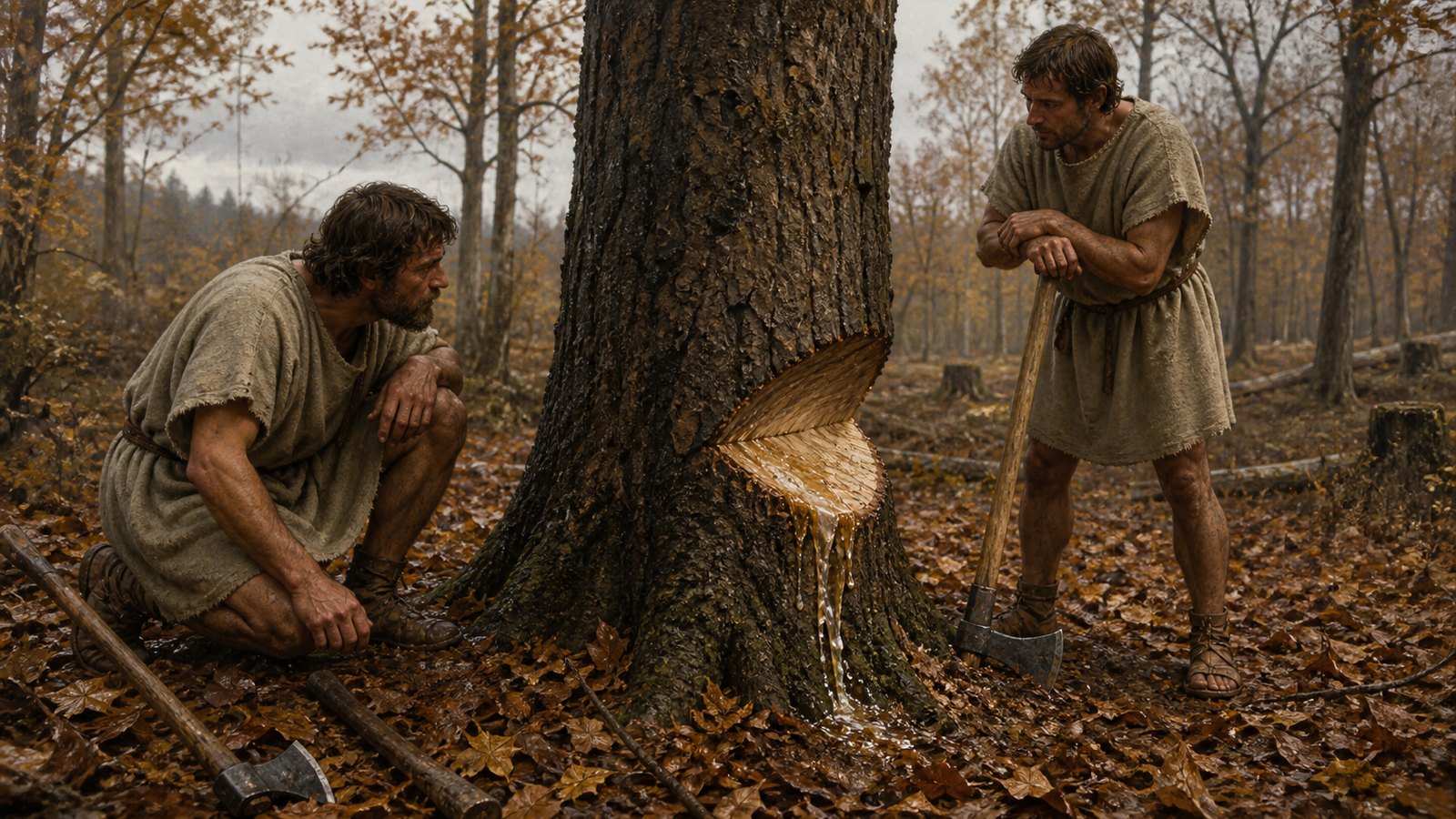
Vitruvius says the unwanted liquid should run out through the sapwood instead of dying inside in a mass of decay. Once the tree was drained dry and sap no longer dripped, it could be felled. He calls that the point at which the wood reached its highest state of usefulness.
The claim is broader than the evidence he supplies, and his explanation should not be mistaken for a universal engineering specification. Different species, trunk sizes, climates and intended uses are compressed into one recommendation. What survives clearly is the operating rule: do not judge completion by the depth of the first cut alone; wait for the observed flow to stop.
That is a form of process control without instruments. There was no moisture meter in the passage and no table converting trunk diameter into waiting time. The material announced the next step. So long as drops emerged, the workers had a reason not to finish the cut.
The same attention to evidence appears elsewhere in Vitruvius even when his explanations differ from modern science. In the larch tower at Larignum, an unexpected survival under fire became an argument about one timber’s qualities. Here the sign was quieter: a wet notch slowly becoming dry.
Fruit trees gave Vitruvius his comparison
To make the drainage principle persuasive, Vitruvius asks readers to look at fruit trees. When they were tapped near the base and pruned at the proper time, he says, excess liquid poured from the heart through the openings. Draining supposedly made them durable.
He then imagines the opposite result. Juices given no means of escape would clot and rot, hollowing the tree and leaving it useless. The language merges observation with theory. A cut trunk can visibly release liquid; the claim that trapped juices explain every later failure is Vitruvius’s interpretation of what that visible event meant.
His comparison matters because it links building practice to cultivated landscapes. The architect did not have to begin with an abstract doctrine. Tapping and pruning offered familiar acts through which a landowner or worker could see fluid emerge from wood. Vitruvius transferred that experience to trees selected for beams and joinery.
The result was a small chain of analogy: fruit trees appeared to benefit from correctly timed openings; structural trees also contained moisture; therefore a deep opening before felling could protect timber from decay. Whether or not every link satisfies modern forestry, the chain shows how Roman technical writing converted repeated sights into instructions.
Species still decided where the dried wood belonged
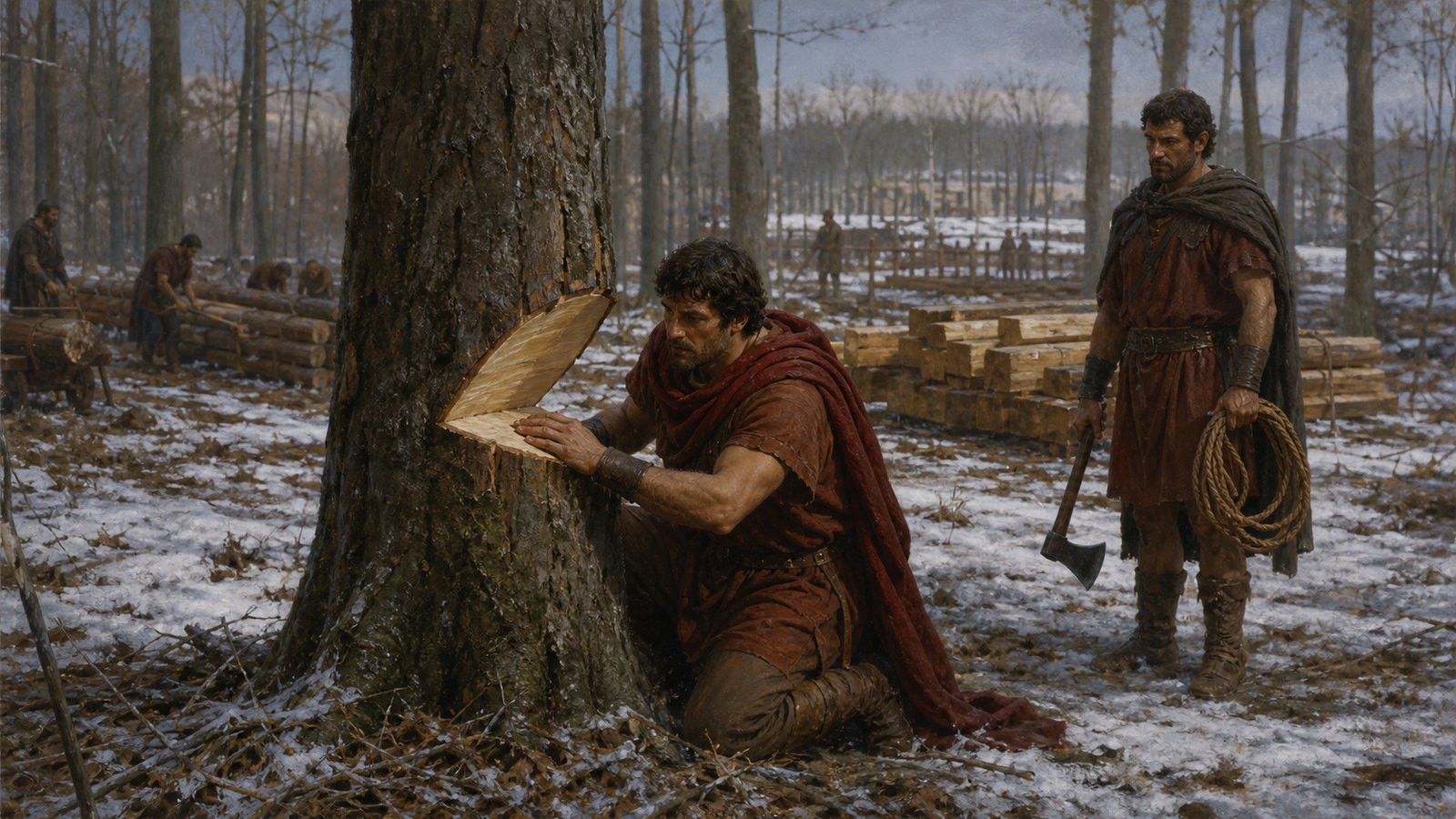
Drainage did not make all timber interchangeable. Immediately afterward, Vitruvius compares species by the qualities he believed came from different balances of earth, water, air and fire. Fir, oak, elm, poplar, alder and larch do not enter the same jobs merely because they have passed through the same felling sequence.
He divides fir itself by position in the tree. The lower portion, close to the roots and relatively free of knots, could be quartered; after rejecting the outer rings, it suited joinery. The upper portion carried more branches and was treated differently. Preparation continued from choosing the season to choosing a section of trunk.
Oak, in his account, endured well underground because wet did not readily penetrate it, but it could twist and split the work around it. Alder looked nearly useless above ground yet excelled as piling in wet foundations. The future article on Ravenna’s alder piles follows that surprising assignment into a marsh landscape.
These distinctions keep the heart-cut method in proportion. It was one stage in a longer material decision, not a charm that erased species, position and environment. A carefully drained log could still be wrong for a particular setting. A seemingly modest wood could still be right when water changed the conditions.
Vitruvius’s forestry passage begins before the tree falls because architecture, in his view, begins before the building site. The useful beam depended on a season chosen months earlier, a cut that deliberately stopped short of completion, a return visit and a dry notch. The final swing of the axe was not the start of preparation. It was the moment the material’s own dripping allowed preparation to move on.
Sources
Vitruvius, On Architecture, 2.9.