
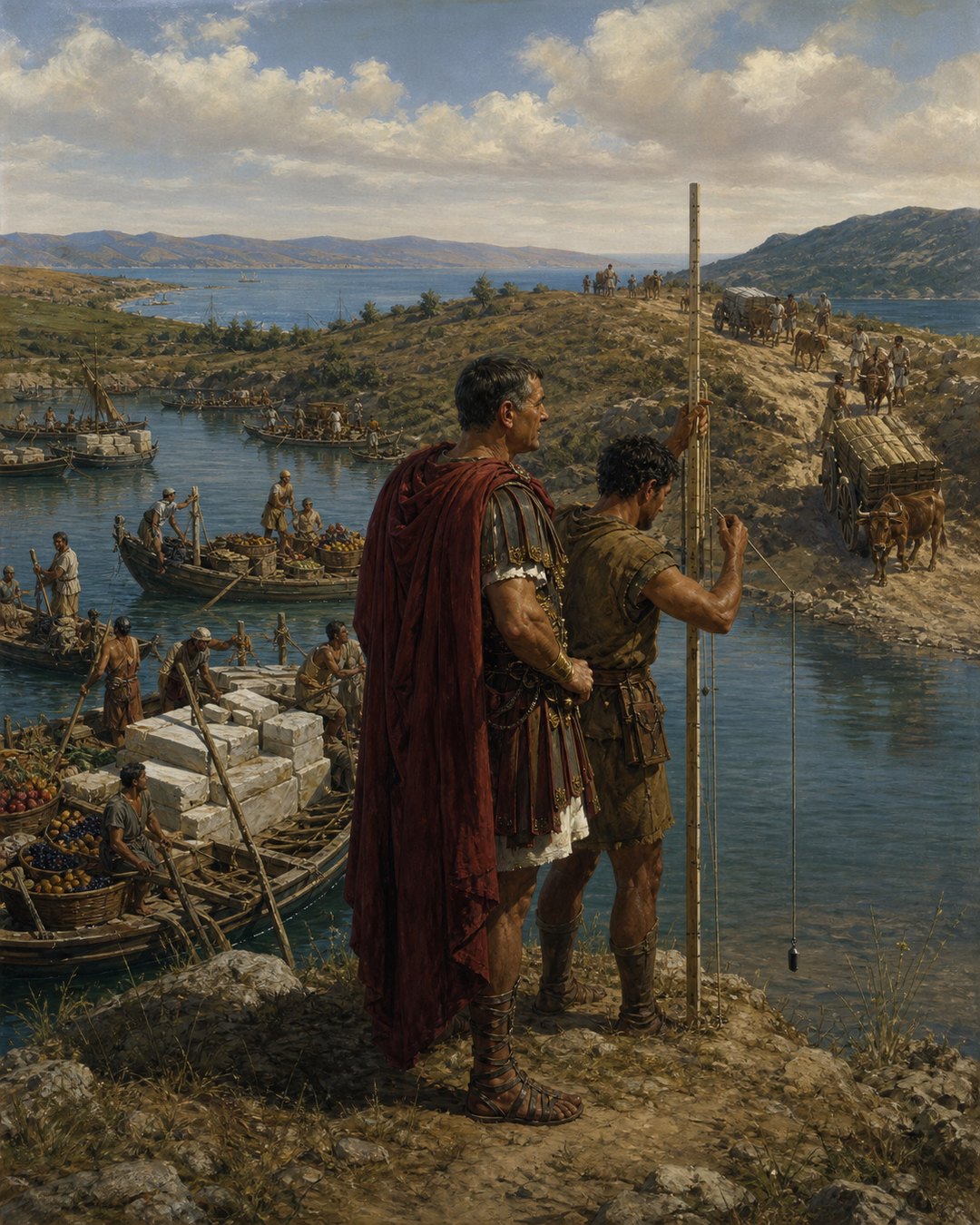
A boat carrying marble reached the edge of a large lake near Nicomedia and stopped where the cheap part of its journey ended. Fruit, timber and other local goods could cross the water with little labour or expense. The sea was still beyond the high road, however, and everything had to be unloaded, placed on vehicles and hauled overland at much greater cost.
Pliny the Younger saw a canal where the cargo changed hands. Writing to Trajan as governor of Bithynia-Pontus, he presented the cut as useful, achievable and worthy of an emperor. Provincial engineers believed the lake stood forty cubits above the sea. An unfinished channel made by an earlier king even seemed to prove that someone had imagined a related work before him.
Trajan did not reject the prospect, but he changed the question. How high was the lake in fact? How much water did it hold, and where did that water come from? A connection valuable enough to transform regional transport might also empty the lake. The surviving letters capture Roman infrastructure at its most consequential moment: not the triumphant opening, but the interval in which cargo, landscape, measurement and risk still argued with one another.
The Freight Problem Began Where the Boats Stopped
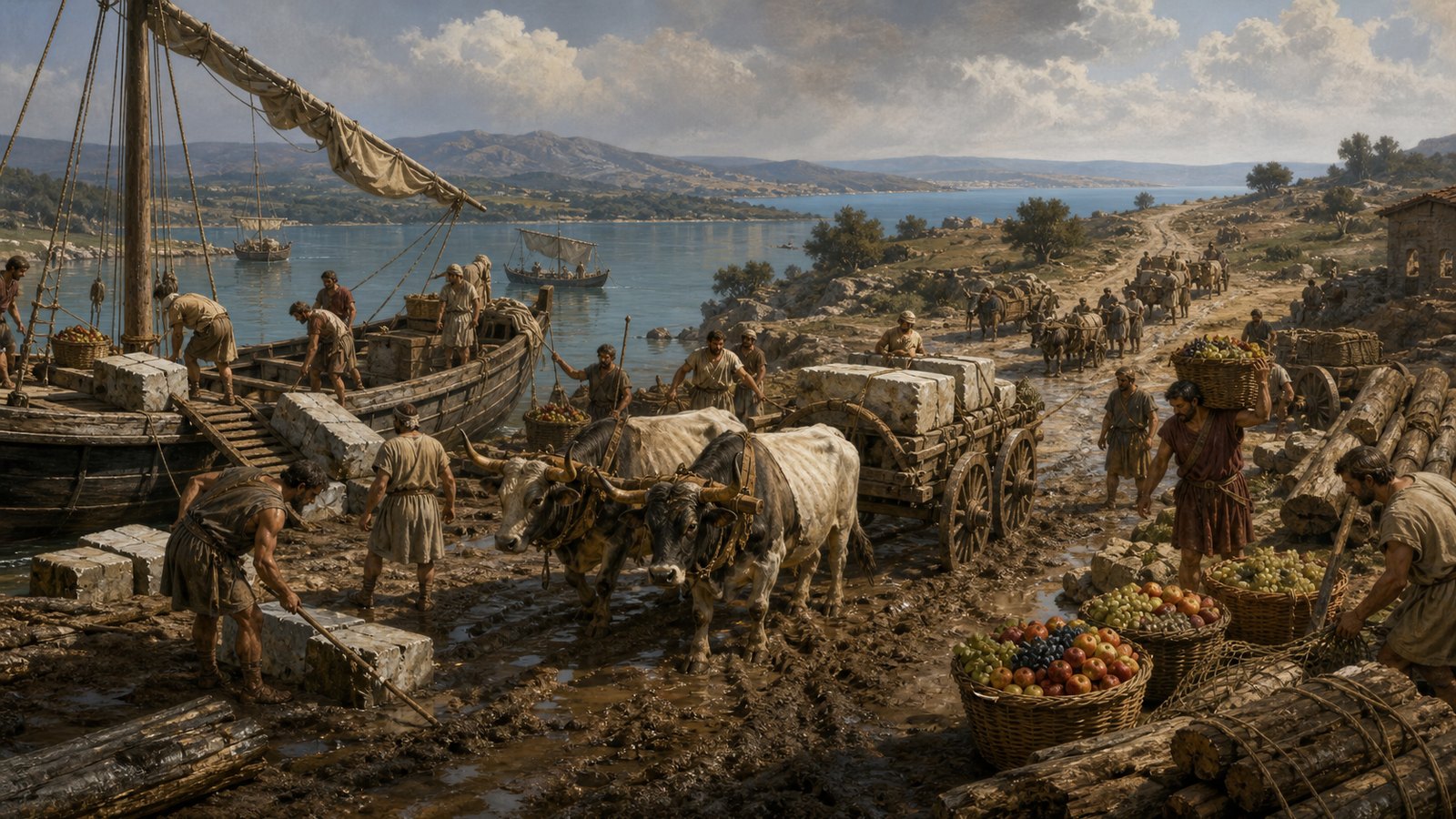
Pliny’s case starts with movement rather than monumentality. He describes an extensive lake beside Nicomedia’s territory. Marble, fruit, timber and other products travelled across it in boats until they reached the high road. Water had already performed the easy stage of transport, carrying bulky or numerous loads with comparatively little effort.
The bottleneck came at the landing. From there the same goods went by vehicle to the coast, and Pliny emphasizes the additional labour and expense. The problem was not that Nicomedia lacked transport altogether. It had two working systems that failed to meet: lake boats on one side and road traffic on the other. Every transfer multiplied handling, animals, carts and time.
This makes the proposal different from an abstract wish to display imperial power in stone. Pliny identifies a recurring friction inside ordinary commerce. A finished water route could reduce the expensive overland segment for every marble block, fruit basket and timber bundle passing through it. The range of cargo matters because it suggests that the gain was not confined to one luxury or one state shipment.
Roman law could distribute an emergency shipping loss among merchants when cargo went overboard to save a vessel. Pliny’s canal problem belongs to another stage of the same material world. Before any maritime peril, someone had to get the cargo from an inland producing landscape to a harbour. Here the decisive expense gathered at a short piece of land between two cheaper bodies of water.
Pliny also argues that labour would be available. The countryside was populous, he says, and Nicomedia especially so; a work offering universal benefit should attract willing hands. That confidence is part of his salesmanship, not a surviving workforce register. The letter names no labour levy, pay scale or construction season. It proves that Pliny expected the human requirement to be large and thought population could answer it.
Forty Cubits Looked Like an Answer Until Trajan Asked for a Survey
The provincial engineers believed the lake lay forty cubits above sea level. That estimate could make a gravity-fed connection sound promising: water would have somewhere to go. It also contained the project’s central danger. If the difference was real and the outlet uncontrolled, the lake might not merely feed a canal. It might pour itself away.
Pliny therefore asked for a surveyor or architect to examine the level. The request keeps the forty cubits in their proper evidentiary place. They were an opinion awaiting measurement, not a completed technical result. The letter does not preserve a contour survey, a gradient table or the length and section of the proposed cut. It preserves the moment when those absences became visible.
Trajan replied by broadening the inquiry. Position alone was insufficient. The lake’s volume and sources also had to be investigated. A water body is not a static tank whose surface height settles every design question. Inflow, outflow and stored quantity determine what a new opening can release and whether the supply can replace it.
Claudius’s attempt to drain the Fucine Lake was a different imperial project in which water, gradient and excavation resisted a huge promise. Nicomedia’s proposal reversed the intended benefit: Pliny wanted connection rather than drainage. Trajan’s warning nevertheless recognized the same physical truth. Once earth is cut and water begins moving, imperial purpose cannot command it back uphill.
For this reason Trajan’s hesitation was productive. He did not confuse a plausible estimate with permission to excavate. He directed Pliny toward Calpurnius Macer for an engineer and promised another specialist. Technical expertise entered the correspondence before irreversible construction, precisely where it could still alter the scheme.
An Unfinished Royal Cutting Added Prestige but Not Certainty
Near the proposed route Pliny found a large old cutting attributed to a king of the region. Its existence offered an irresistible precedent. A ruler had already attempted something on the landscape, and Trajan could gain the glory of completing what kings had only begun. The abandoned earthwork allowed Pliny to turn a provincial transport repair into a contest across time.
Yet the old canal was ambiguous. Pliny could not tell whether it had been dug to drain nearby fields or to link the lake with a river. He also did not know why it stopped. The king may have died, or the builders may have despaired of finishing. Those alternatives lead to opposite readings: interrupted success or discovered impossibility.
Pliny’s honesty about that uncertainty is as valuable as his imperial flattery. The cutting proved that soil had been moved, but it did not prove the purpose, gradient or safety of the new route. Archaeological presence without functional understanding could become a dangerous argument by resemblance. An old trench was not automatically a usable design.
Trajan’s response resists the appeal of inherited ambition. He was tempted by the communication between lake and sea, but his consent remained conditional on investigation. The emperor could receive the honour if the canal worked; the lake and the city would bear the consequence if it did not. Measurement had to mediate between those unequal rewards and risks.
This concern echoes Nicomedia’s record of spending millions of sesterces on two unfinished aqueduct attempts. The projects were not technically identical, and the letters should not be collapsed into one failure. Together they show why a governor’s confidence required scrutiny in a city where useful waterworks could consume money before delivering water.
Four Fallbacks Turned a Canal into a Water-Balance Problem
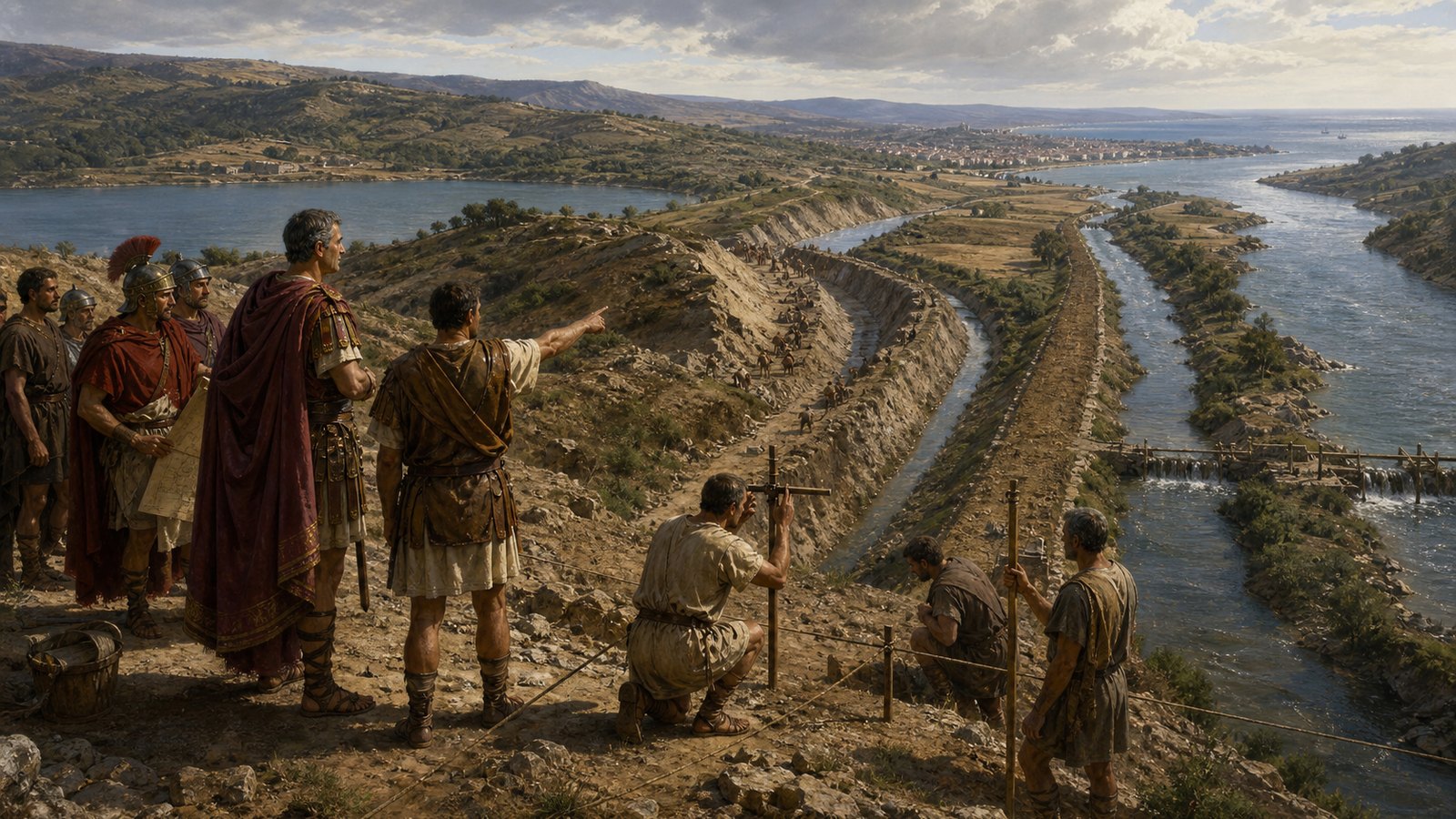
When Pliny returned to the issue, he answered the fear of drainage with alternatives rather than reassurance alone. One scheme would cut a channel toward the river but stop before joining it. A narrow strip of land would remain between canal and river. Goods could cross that small ridge while the lake stayed physically separate from the outlet.
This compromise preserved one transfer, but it shortened the expensive road haul without gambling the entire water body. It is revealing that Pliny was willing to accept an imperfect connection. The aim was not purity of design. It was reducing friction while keeping failure bounded.
He then considered the lake’s balance more directly. Its depth offered some confidence. The existing river flowing from the opposite side might be dammed or redirected to retain water, while nearby brooks could be collected to replace discharge. Alternatively, the new channel could run farther, narrower and directly to the sea, where Pliny imagined the returning tide countering some of the outflow.
Sluices formed the last stated safeguard. They could check the water if the terrain defeated the other schemes. Each option changed a different part of the system: the connection, the outlet, the inflow, the channel or the control point. Pliny had moved from a single glorious cut to a family of conditional designs.
None of these letters proves which proposal was built. They record planning, not completion, and they should not be illustrated as a finished canal lined with known locks. Their historical force lies in the unresolved sequence. Pliny found a commercial bottleneck, turned it into an imperial opportunity, received a hydraulic objection and came back with multiple ways to contain the risk.
Trajan’s final answer approved the care behind the alternatives and left selection to examination on the ground with an engineer. The most important decision therefore remained local and empirical. Forty cubits, an ancient trench and a promise of cheaper transport had opened the argument. Only water levels, supply and terrain could close it.
Sources
Pliny the Younger, Letters, 10.41–42 and 10.61–62.