
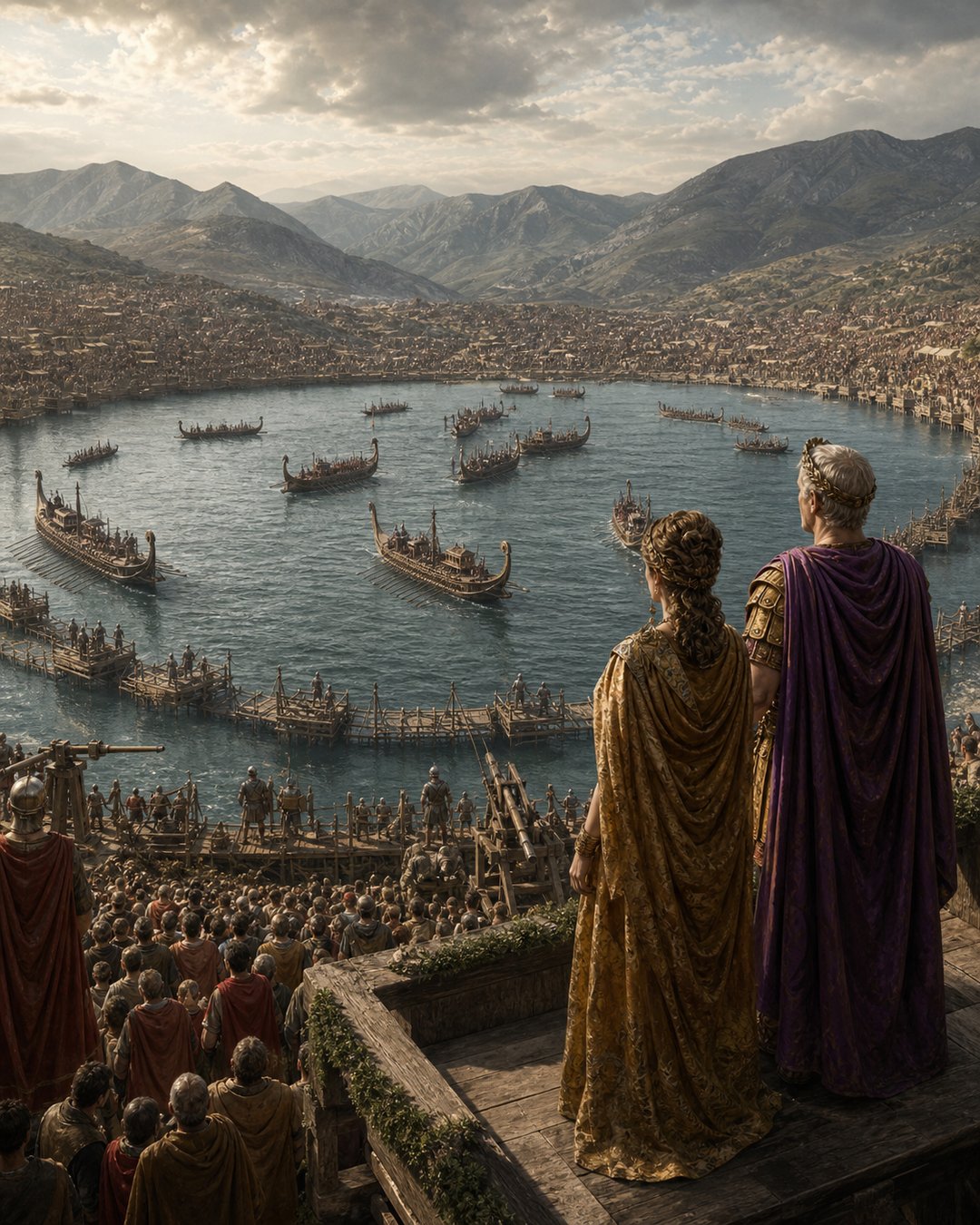
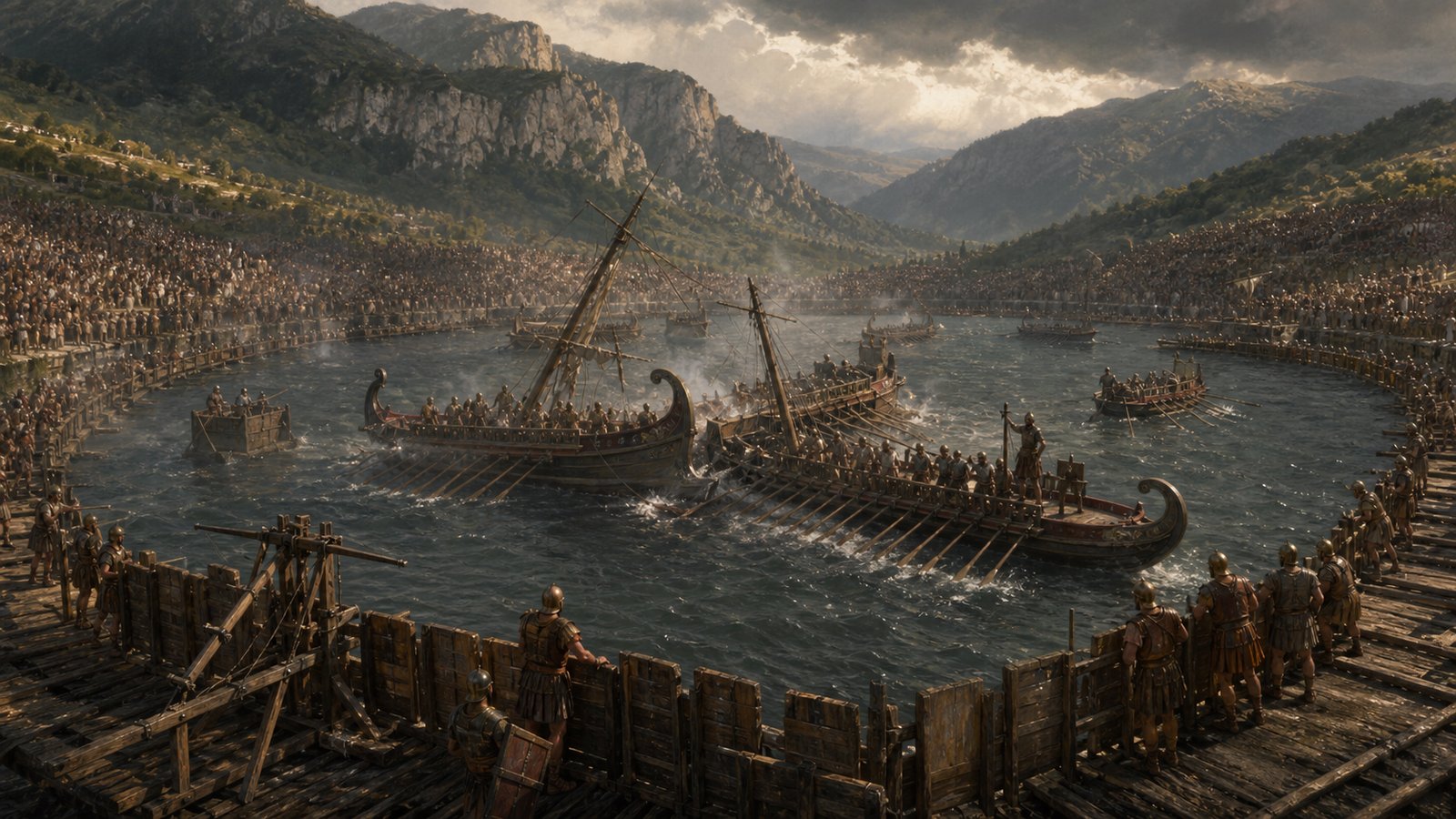
Nineteen thousand condemned men took their places aboard galleys on Lake Fucinus while the mountains filled with spectators. Claudius had chosen the opening of a drainage tunnel for a naval spectacle on a scale that turned a landscape into an arena. Ships with three and four banks of oars moved across the lake. Timber rafts closed the circumference. Praetorian infantry, cavalry, catapults and ballistae stood on the floating boundary.
The design permitted battle but denied departure. Inside the ring there was room for pilots to turn, crews to pull and hulls to strike. Outside it, troops and decked vessels made escape impossible. Tacitus then follows this carefully controlled human system into a different kind of failure. When the outlet opened, the tunnel proved too high. After deeper excavation, released water surged past a banquet, shook the shore and terrified the company.
The two scenes belong together. Claudius could surround men with timber and weapons, organize a mountain audience and make slaughter serve an inauguration. Water did not respond to the same choreography. The naumachia displayed command over bodies; the outlet exposed the limits of command over level, gradient and force.
A Mountain Lake Became an Arena with No Back Door
Tacitus begins with the engineering work. A mountain stood between Lake Fucinus and the river Liris, and a tunnel had been bored through it. The project promised drainage, reclaimed land and an achievement large enough to deserve witnesses. Claudius did not present the opening as a technical inspection. He attached a naval battle to it, borrowing a form of spectacle Augustus had staged on a smaller artificial basin near the Tiber.
Fucinus changed the scale. This was an existing lake under mountain slopes, not a purpose-built pool. Claudius equipped large galleys and supplied nineteen thousand men. The number is Tacitus’s, and it should be read as the historian’s claim rather than a surviving personnel ledger. Even as a reported figure, it communicates the administrative reach required to assemble crews, guards, ships and provisions.
The perimeter made that reach visible. Rafts ran around the lake so there would be no exit at scattered points. They did not compress the centre so tightly that the ships could not operate. Tacitus explicitly preserves space for rowing power, piloting skill, impact and the normal actions of a sea fight. The prison wall was calibrated to produce convincing movement within confinement.
On the rafts stood Praetorian infantry and cavalry behind a breastwork. Catapults and ballistae pointed from the boundary; marines completed the enclosure aboard decked craft. Rome had effectively built a temporary fortified coast around inland water. The military hardware was not decorative scenery. Its position explained to every combatant where the performance ended.
An earlier article on Claudius’s long attempt to drain Fucinus follows the tunnel as infrastructure. The battle reveals what the inauguration added: a second engineering problem in timber, hulls and armed men, built to contain people while celebrating the first project’s supposed completion.
The Audience Occupied the Banks, Hills and Mountain Tops
An immense crowd came from nearby towns and Rome. Some wanted the spectacle; others, Tacitus says, came to show respect to the emperor. The distinction matters because attendance around imperial power was never only leisure. A viewer could be curious, dutiful or both, and the mountain setting made the assembled multitude part of what everyone saw.
The banks, hills and summits resembled a theatre. That comparison did not mean neat stone seating. It meant that topography itself became tiers. The lake formed the stage below, the raft ring marked an edge, and rising ground provided sightlines. The audience could take in not only combat but the entire architecture of containment.
Claudius presided in a splendid military cloak. Agrippina sat near him in cloth of gold. Their clothing translated authority into colour and surface while condemned men handled oars below. The imperial pair did not need to enter the fight to dominate its image. The lake, mountains, fleet and crowd were arranged around their place of viewing.
Tacitus says the battle was fought with the courage of brave men even though the participants were criminals under sentence. His sentence refuses to make status a measure of nerve. After much bloodshed, the survivors were released from the necessity of continuing mutual slaughter. Mercy arrived only after violence had been made sufficient for the occasion.
Another imperial council could turn a giant fish into a test of flattery, as in Domitian’s enormous turbot. Fucinus worked in the opposite direction: thousands of coerced performers made one emperor’s public image. In both cases, an event’s scale forced courtiers, officials and spectators to locate themselves around imperial attention.
The Outlet Failed Where the Spectacle Had Seemed Complete
After the battle, the water outlet was opened. The error appeared quickly: the tunnel had not been bored down to the bottom or even the middle of the lake. A monumental channel through a mountain could exist and still fail at the decisive interface with its water source. Length and labour could not compensate for the wrong level.
The excavation was deepened after an interval. Claudius again paired engineering with entertainment, this time attracting a crowd through gladiators and an infantry engagement fought on floating pontoons. The repetition suggests that spectacle was not merely attached to a successful endpoint. It was used again while the project itself was being corrected.
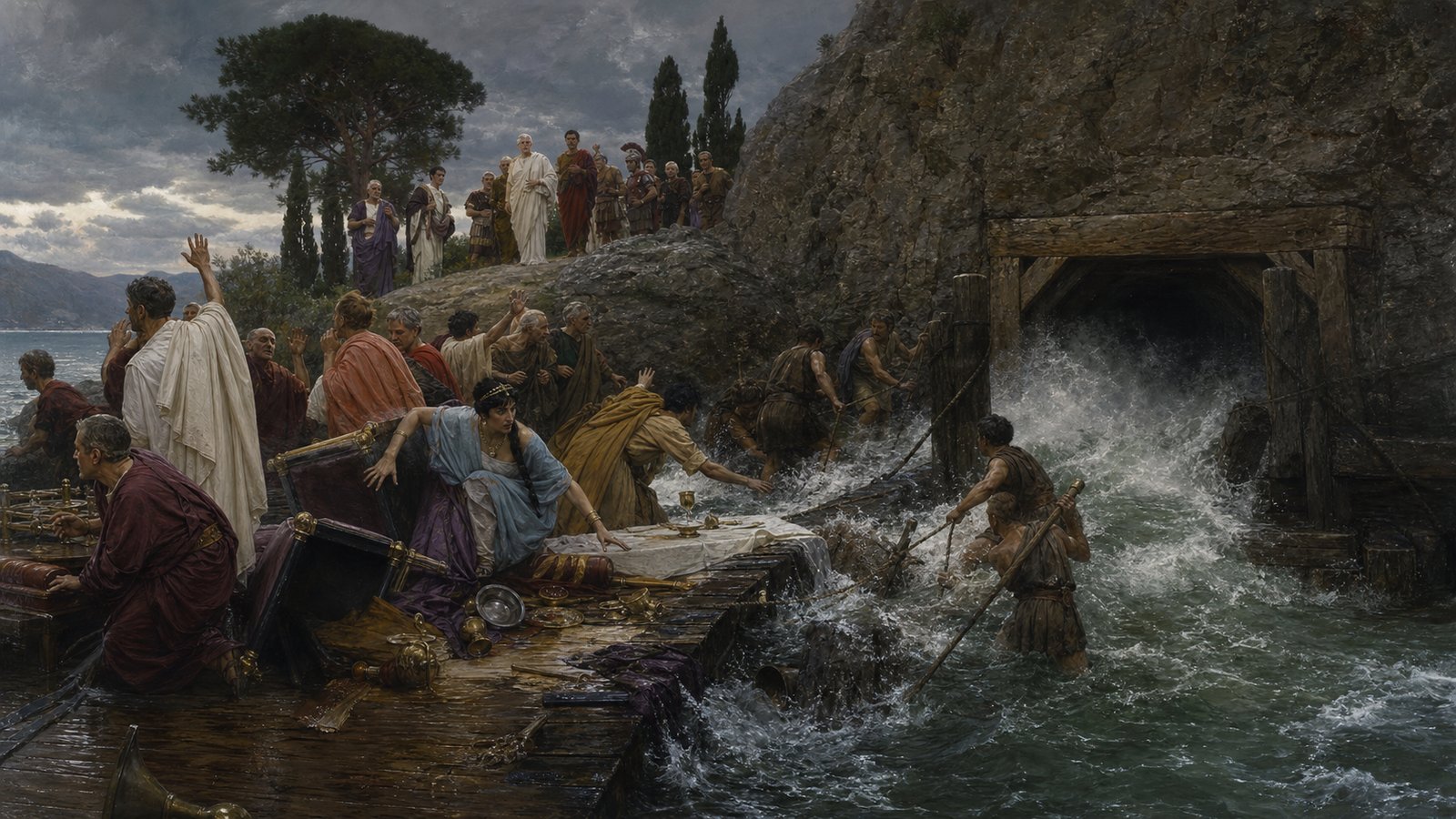
A banquet was laid near the outflow. That choice placed elite consumption beside hydraulic release, as though proximity to the engineered force increased the occasion’s drama. Instead, the outburst swept away nearby structures, shook more distant ground and spread terror with its crash. The guests who had come to watch controlled water found themselves reacting to uncontrolled water.
The scene reverses the naval battle. During the naumachia, the raft wall held and people inside could not leave. At the banquet, the surroundings ceased to feel fixed. Water crossed the expected boundary, movement reached the watchers and the emperor himself was frightened. What had been arranged as another view became a physical threat.
The failure was not proof that Romans lacked hydraulic expertise. It is evidence that a specific work was badly executed at a critical elevation and that correction produced new danger. The same tradition that could devise sluices for mining against a Spanish mountain could also misjudge where a lake met its tunnel.
Agrippina and Narcissus Turned Hydraulic Panic into Political Blame
Tacitus closes with accusation. Agrippina used the emperor’s fear to charge Narcissus, the freedman responsible for the work, with greed and embezzlement. Narcissus answered by attacking her domineering character and ambition. The water had barely settled before engineering failure became court conflict.
The exchange does not prove the financial charge. Tacitus reports a political use of the event, not an audit. Agrippina had an opening because the project’s visible malfunction made responsibility urgent. Narcissus had his own language of defence: he redirected scrutiny from expenditure and execution toward the empress’s power.
This is why the naumachia cannot be reduced to a colourful anecdote about Roman decadence. It joined coerced labour, capital punishment, naval construction, crowd management, hydraulic engineering and palace rivalry in one location. The same inauguration that displayed the emperor at the centre also placed him close enough to the result to be frightened by it.
Claudius’s temporary arena succeeded on its own terms. The ships fought, the guards held the perimeter, the audience watched and survivors received a reprieve. The tunnel did not perform so obediently. Its height first withheld the promised drainage; its deeper release later exceeded the safe frame of the banquet.
Imperial power appears strongest in Tacitus when it arranges people and weakest when it assumes that arrangement is identical to mastery. Nineteen thousand men could be enclosed by order. A lake could be opened only through accurate contact between excavation and water. The distinction turned a demonstration of control into a noise of collapsing ground, frightened guests and immediate blame.
Sources
Tacitus, Annals, 12.56–57.