
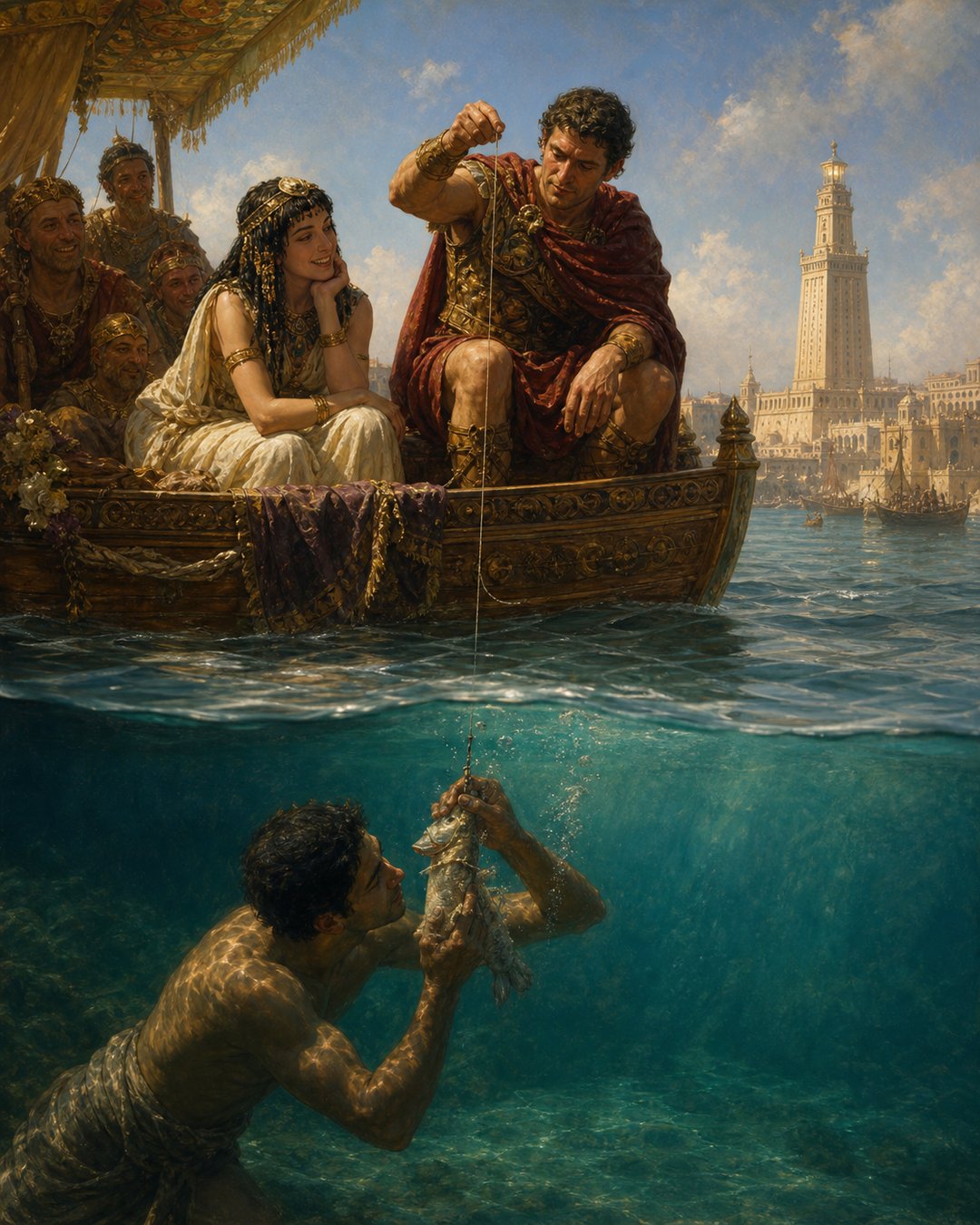
Mark Antony was having no luck with a fishing line, and Cleopatra was there to see it. Irritated by failure in front of her, he ordered fishermen to swim below the boat and fasten fish already caught to his hook. Two or three convenient successes came out of the water. Cleopatra recognized the trick, admired him aloud and said nothing about what she knew.
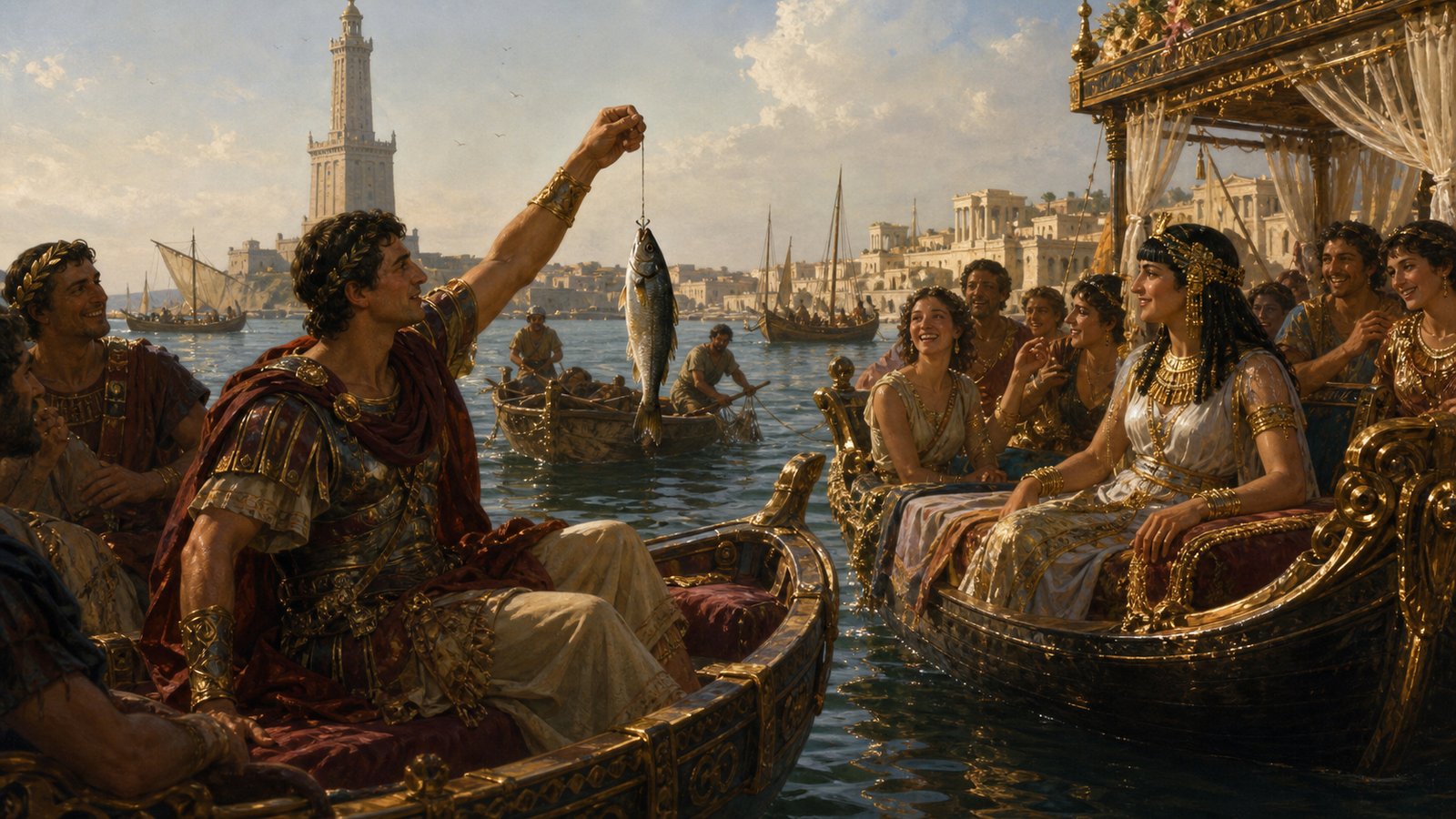
Then she changed the audience. Friends were invited onto fishing boats the next day. When Antony lowered his line, Cleopatra sent her own swimmer ahead of his helpers. The diver attached a salted Pontic herring. Antony hauled up a preserved fish from the sea, and the company laughed.
Her final line made the prank more than exposure. Leave the rod to the fishermen of Pharos and Canopus, she told the Roman commander; his quarry was cities, realms and continents. The joke cut down counterfeit skill while returning Antony to a status large enough to absorb the laughter. Plutarch uses one impossible fish to show how intimacy at court depended on backstage labour, managed witnesses and the ability to rebuke power as play.
A Bad Catch Became a Problem of Rank
Fishing should have been a small pastime. Antony’s annoyance made it a test. Cleopatra’s presence raised the stakes because failure no longer belonged only to the angler and the water. It became visible to the person whose attention he wanted to hold.
His solution relied on unequal roles. Antony remained above the surface with the rod. Working fishermen entered the water, found the hook and attached earlier catches. The apparent skill belonged to the man holding the line; the successful mechanism belonged to bodies hidden beneath him. Plutarch’s anecdote is comic because the deception is disproportionate to the prize.
Nothing in the source says Cleopatra challenged him immediately. She saw through the trick and performed admiration. That delay gave her control over the next act. If she had simply accused Antony, he could deny it or dismiss the complaint. By allowing the false catch to succeed, she learned its timing and preserved his confidence.
The scene belongs to a court where display constantly consumed labour. Plutarch’s previous chapter describes the Inimitable Livers, the dining association in which Antony and Cleopatra entertained each other lavishly. A royal cook reportedly kept several suppers in preparation because Antony might demand food at once, postpone it, drink wine or continue a conversation. Spontaneity at the table was manufactured by abundance behind the door.
That kitchen resembles the fishing trick in structure, not in moral weight. Multiple roasting boars made an apparently effortless perfect meal possible at an uncertain moment. Divers made an apparently effortless catch possible at Antony’s chosen moment. In both cases, invisible preparation protected the ruler from waiting on ordinary conditions.
Cleopatra Added Witnesses Before She Changed the Fish
The next day’s boats carried many spectators. Cleopatra had told friends what happened and invited them to watch. She did not only replace a prop; she expanded the social space in which the replacement would acquire meaning.
Antony let down his line expecting the same system to work. His fishermen knew their task and presumably waited to repeat it. Cleopatra’s attendant had to reach the hook first. The counter-prank therefore depended on the same underwater timing as the original trick. She defeated hidden labour with better coordinated hidden labour.
The object attached to the hook was precisely chosen. A fresh fish could be claimed as another catch. A salted Pontic herring carried its contradiction on its body. It had been preserved and transported; it did not belong alive beneath the Alexandrian boat. No technical argument about currents, bait or fishing luck was needed. The evidence was comic and immediate.
When Antony pulled it up, laughter spread among people already prepared to understand. The audience knew the previous story. They could see the preserved fish and recognize Cleopatra’s control of the reveal. Antony’s rod became a stage device, and the water’s surface became the curtain through which the joke appeared.
The episode contrasts with the high material stakes of Lollia Paulina’s forty-million-sesterce jewellery. Both scenes turn an elite gathering into a demonstration of value. Yet Cleopatra’s fish was valuable because it was cheap and out of place. Its obvious wrongness accomplished what another jewel could not.

Her Rebuke Gave Antony Somewhere to Stand
Public laughter around a commander could be dangerous. Cleopatra managed the ending so that the fish did not reduce Antony to an ordinary failed angler. She told him that fishing belonged to people who actually knew the waters of Pharos and Canopus. His own hunting field was cities, kingdoms and continents.
The phrase rebuked and praised at once. It denied him the small skill he had tried to fake, but it granted him a larger identity. Antony did not need to win every pastime in order to remain Antony. The joke offered a route back to dignity without retracting the exposure.
That route also acknowledged the fishermen. Cleopatra’s line gave the rod to those whose craft had been hidden under Antony’s performance. The men of the Alexandrian coast did not need divers to counterfeit a catch for them. Their competence was local, practical and real.
Plutarch frames Alexandrian life through masks. He says the city enjoyed Antony’s coarse humour and imagined that he wore a tragic mask for Romans and a comic mask among them. The salted herring belongs to that comic register. It could expose pretence without becoming a formal accusation, because everyone accepted the scene as an amusement.
A different ruler’s table forced a council to debate how to cook one enormous turbot. There, absurdity moved downward from emperor to advisers. On Cleopatra’s boats, the comic design moved toward Antony, and his continued participation depended on accepting that someone else could direct the scene.
The Small Joke Preserved a Large Political Shadow
Plutarch does not let Alexandria become innocent leisure. While Antony followed Cleopatra there, Fulvia was fighting in Rome and Parthian forces threatened Syria. The biography places costly time beside political absence. The reader knows that cities, realms and continents were not merely a flattering metaphor; they were responsibilities and ambitions with armies attached.
This makes Cleopatra’s final line sharper. She assigned Antony the quarry his position demanded, but the biography has already shown him spending time on entertainments. Her compliment could therefore sound like a reminder. A man who claimed continents should not need underwater help to win at fishing.
The story is still not a transcript. Plutarch wrote long afterward and selected an anecdote suited to his portrait. Its polished ending and balanced contrast are literary. Historical caution means treating it as Plutarch’s crafted evidence for remembered court behaviour, not as a verbatim recording made in the boat.
Yet the mechanisms are unusually concrete: bad luck, injured pride, divers, earlier catches, delayed response, invited friends and a salted fish. Those details explain why the anecdote endured. It makes hierarchy visible without a decree or battle. The commander holds the rod; workers manipulate the result; the queen sees the workers; the audience sees only when she decides it should.
The herring exposed more than a borrowed catch. It revealed that mastery performed for an intimate audience could be dismantled by another person who understood the backstage system. Cleopatra won because she did not reject the game. She reproduced it with a better prop, a larger audience and an ending that left Antony laughing at the edge of his own power.
Sources
Plutarch, Antony, 28–29.