
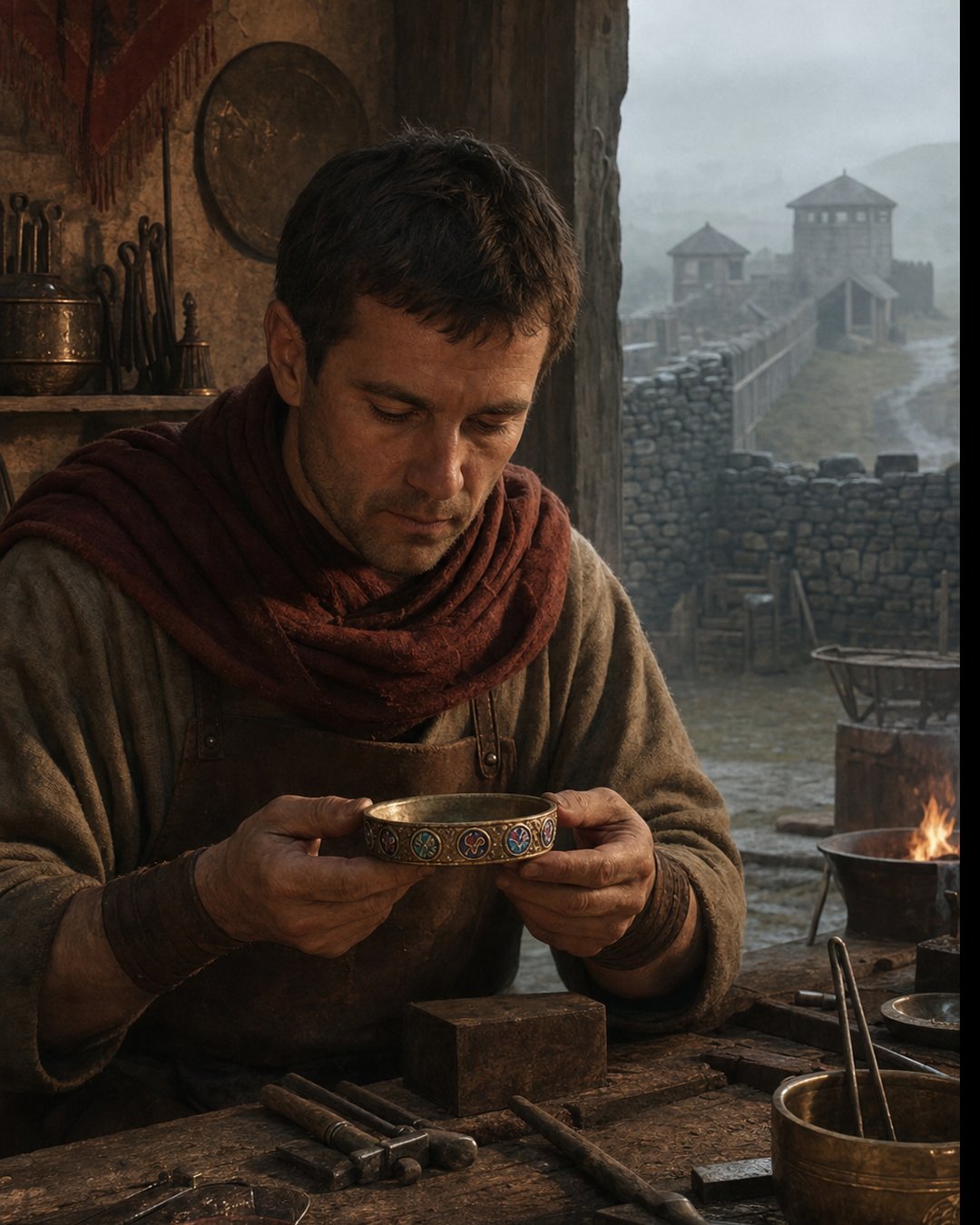
The object is small enough to disappear between two hands. Its rim measures 89.5 millimetres across, its surviving body stands 47 millimetres high, and the whole copper-alloy pan weighs only 132.5 grams. Yet a line cut around that narrow rim holds four forts from the western end of Hadrian’s Wall, a technical phrase for the Wall’s line, and the name Draco.
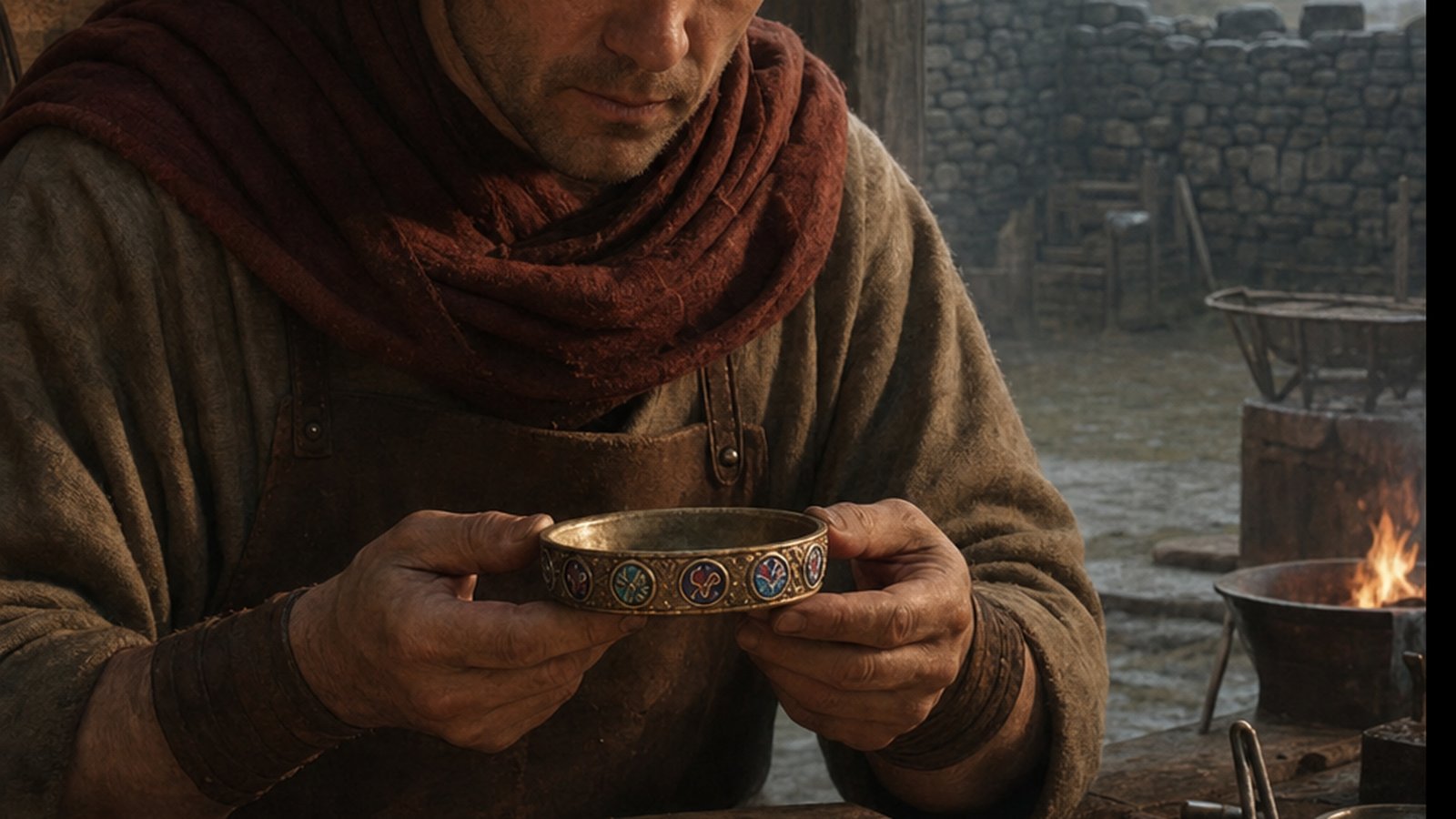
Below the letters, eight roundels once flashed with turquoise, dark blue, purple, red and yellow glass. Each enclosed a swirling dragonesque form. The handle and base disc are gone, the rim is bent, and three small holes interrupt the metal, but the vessel still joins itinerary, decoration and person in a single portable surface.
It is tempting to call it a veteran’s souvenir and stop. That interpretation may be right, but the inscription does not grant such comfort. Draco could have been the purchaser or the maker. AELI could belong to his name or describe an Aelian Wall. Even the point where the text begins is uncertain. The Staffordshire Moorlands Pan matters because a Roman frontier survives here not as one solved message, but as a route compressed around an object whose grammar keeps several lives possible.
Four Forts Became a Route around the Rim
The place-names run west to east: Mais, Coggabata, Uxelodunum and Cammogianna. Roman Inscriptions of Britain identifies them with Bowness-on-Solway, Drumburgh, Stanwix and Castlesteads. They do not describe the entire frontier. They select a connected western sequence and make the curve of the pan carry movement along it.
That sequence distinguishes the vessel from a generic picture of military power. A wall can be imagined as one continuous obstacle, but service and travel occurred through named locations. Forts organized watches, supplies, orders and human memory. The pan reduces those large installations to a list that could move far beyond them.
The object’s findspot proves that portability. A metal detectorist found it near Ilam in Staffordshire in 2003, well south of the named western forts. The find does not tell us who carried it there or when it left the frontier. It does show that the itinerary did not remain fixed to the landscape it described.
The broader function of Hadrian’s Wall as a managed frontier helps explain why four names could evoke more than masonry. A named fort was a station in an operating system of roads, gates, garrisons and movement. On the pan, the west-to-east order preserves the logic of a journey even after the traveler and handle disappeared.
Two related vessels make the choice clearer. The Rudge Cup and Amiens Skillet also name forts along the Wall, but their lists are not identical. The Staffordshire vessel is not a lone eccentricity, nor is it a mass-produced modern map. It belongs to a small family of objects that turned a frontier itinerary into decoration and memory.
Turquoise Letters Shared Space with Eight Swirling Forms
The inscription was incised above the decorative band. Its plain capitals stand only 3.5 to 4 millimetres high, and turquoise inlay filled the cuts. The same object therefore asked the eye to read two systems: named places in a narrow line and coloured forms arranged at regular intervals beneath them.
Eight incised roundels divide the outer wall evenly. Inside each, a dragonesque triskele curls around itself. Surviving inlay ranges from turquoise and dark blue to purple, red and yellow. The palette made the pan more than a neutral carrier for words. Route and colour competed for attention on a surface smaller than many modern drinking cups.
This northern decorative language is important because it refuses a crude split between “Roman” inscription and “local” ornament. Latin fort names, copper-alloy vessel making and swirling enamel design coexist. The frontier did not produce identity by replacing every regional practice with one imperial style. It could bring administrative geography into contact with craft choices that were especially at home in Britain.
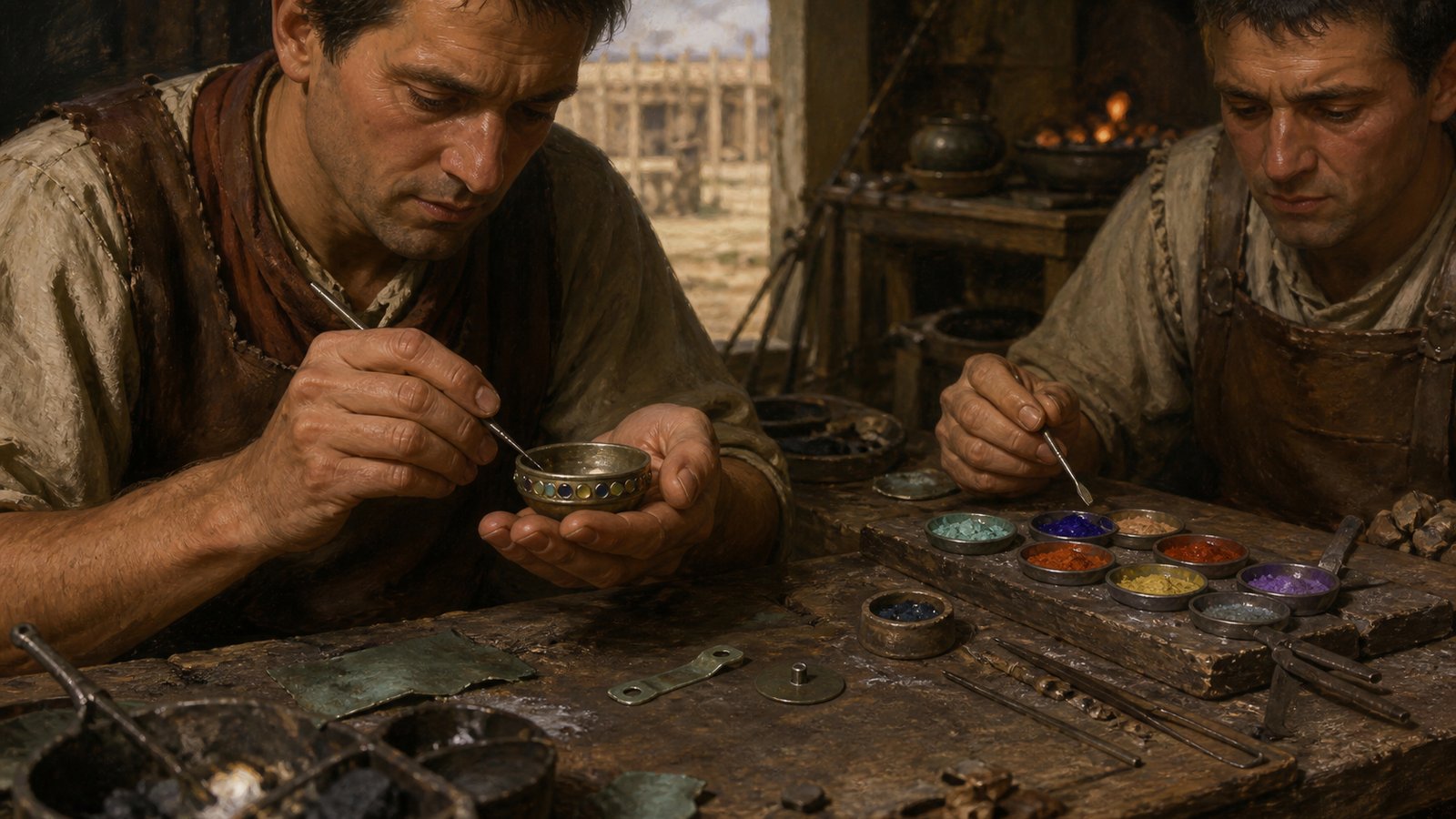
A related material story appears in the curved bronze grinder used to mix colour in Roman Britain. Both objects make colour depend on worked materials and practiced hands, but the pan carries that labor on its finished skin. Glass inlay had to fit tiny recesses without swallowing the legibility of the letters or the rhythm of the roundels.
The missing parts also shape interpretation. The handle and base disc were cast separately. Their loss removes the easiest evidence for how the pan was grasped and displayed. Comparable vessels suggest what a complete trulla could look like, but this one must be read from its damaged body rather than silently restored into an ideal specimen.
The Engraver Left the Planning Visible
Above the decoration, an incised setting-out line located the tops of the letters. That physical guide is a rare invitation to watch preparation. The engraver did not improvise every capital in open space; a line established one edge of the narrow band before the text was cut.
Planning did not produce perfect spacing. The inscription is continuous, with little separation between words and no explicit marker for its beginning. One space appears before MAIS, while the end of CAMMOGIANNA crowds against RIGORE. The final letters of the fort name become lower, as if the cutter realized that room was running out.
Other details preserve adjustment. VALI sits lower because the decorative band encroached from below. A generous gap around one letter in Uxelodunum looks less like punctuation than a miscalculation. These are not failures that make the object worthless. They are evidence that a human being had to fit a long route and name around finite metal.
The spacing has even encouraged a possible reconstruction of sequence. DRACONIS may already have occupied the band when MAIS was cut, while RIGORE may have preceded the crowded ending of CAMMOGIANNA. Such observations cannot recover a workshop diary, but they make one caution unavoidable: the inscription may have accumulated through decisions rather than appearing as one perfectly laid-out sentence.
That possibility changes the object’s intimacy. A personalized name need not have been part of an original decorative programme. A vessel could be made first and customized later; a route could frame a person, or a person’s name could force the route to bend around remaining space. The cramped letters preserve negotiation between design and ownership.
Draco’s Genitive Keeps the Owner Uncertain
The phrase RIGORE VALLI can mean “on the line of the Wall.” Rigor was a technical term used by Roman land surveyors for a straight course between points. Applied here, it turns the four fort names into more than a random cluster. They lie along a defined frontier line.
The next words resist a single translation. AELI may go with VALLI, making the phrase refer to an Aelian Wall named through Hadrian’s family name. It may instead join DRACONIS as Aelius Draco. The absence of modern punctuation is not merely inconvenient; the Latin itself leaves the attachment open.
DRACONIS is a genitive. It can identify something as Draco’s, but that relationship still needs interpretation. He might have been the client for whom the vessel was made. He might have been its craftsman. Roman Inscriptions of Britain notes a possible veteran scenario: an auxiliary leaving frontier service could have wanted a personalized memento. The catalogue presents that as an attractive possibility, not a recovered biography.
This distinction protects the pan from becoming costume drama. We do not know Draco’s unit, birthplace, term of service, retirement journey or feelings about the Wall. The object supplies a name and a relationship expressed through grammar. Everything more must remain conditional unless another source joins him to this vessel.
The most responsible story is therefore also the richer one. Four forts define a route. Coloured roundels locate the vessel in a British decorative world. Tiny corrections expose an engraver managing limited space. Draco’s name adds possession or production without telling us which. The pan can be frontier souvenir, practical vessel, crafted display and personal object at once, while none of those labels fully consumes the others.
In 2005, three museums acquired it jointly with help from a £112,200 Heritage Lottery Fund grant. Modern shared ownership seems fitting for an object already divided among places, institutions and interpretations. What survived near Ilam was never only a pan. It was a western frontier made portable, then carried into another landscape with its route still circling the rim.
Sources
Roman Inscriptions of Britain, Brit. 35.24: Staffordshire Moorlands Pan. BBC News, “Roman souvenir of wall found” and “Roman bronze pan saved for nation.”