

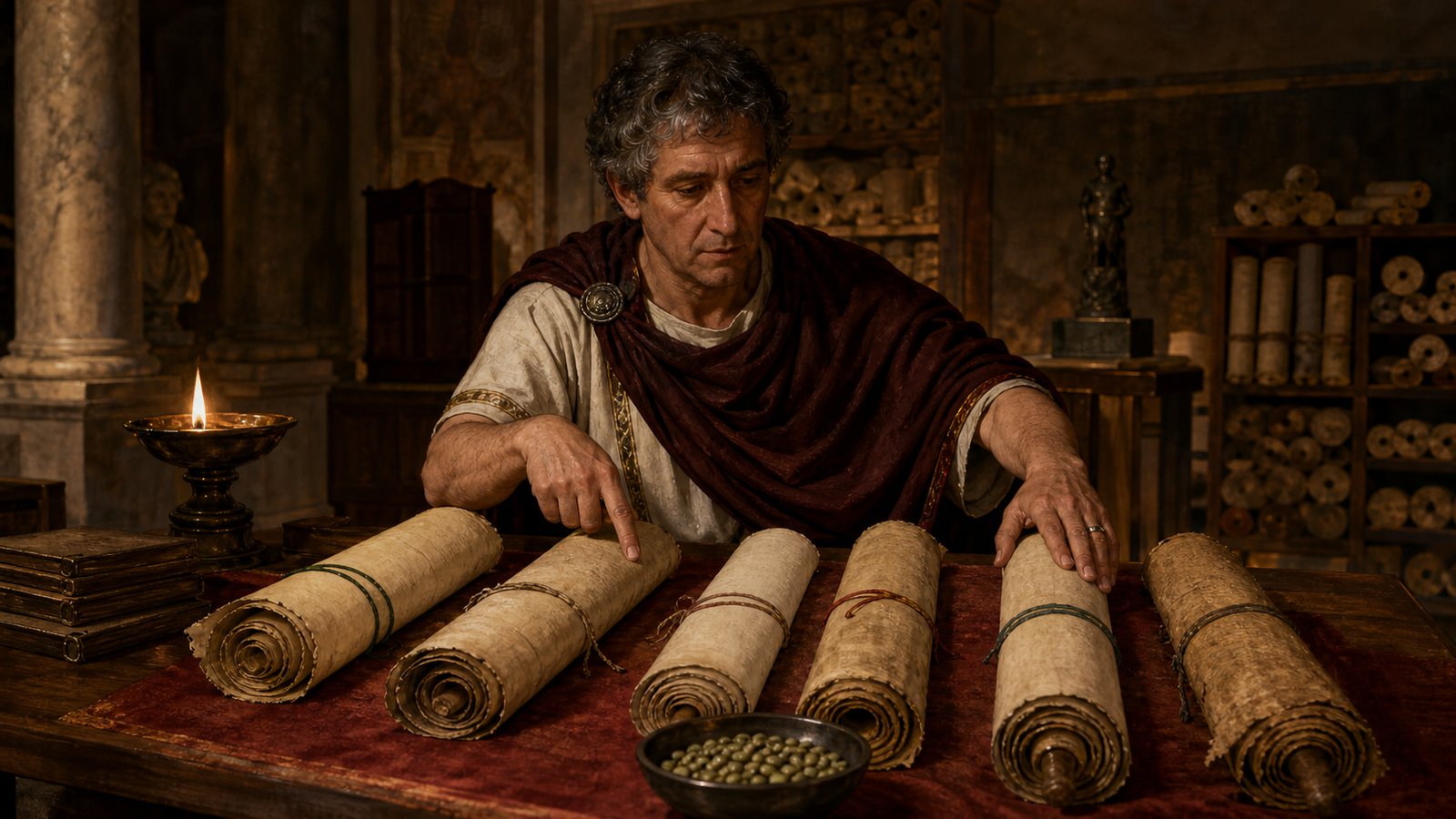
A bowl of beans sits at the center of one of antiquity’s most persistent biographical arguments. By the second century, Aulus Gellius could call it a long-established belief that Pythagoras avoided beans and ate no animals. The picture was memorable: the philosopher’s discipline could be reduced to a forbidden food that anyone understood.
Gellius did not accept the menu. In Attic Nights 4.11, he assembled poets, philosophers, comedy and learned prose against one another. Callimachus and Cicero helped explain why the prohibition endured. Aristoxenus, presented as a pupil of Aristotle with access to older Pythagorean testimony, said nearly the opposite. Plutarch and Aristotle narrowed the claim about meat to particular parts.
The result is not a final shopping list. It is a lesson in how a famous life reaches later readers. Every witness arrived through genre, quotation and a claim to authority. Gellius put beans back on Pythagoras’s table, but his deeper achievement was to show the hands that had removed them.
A Famous Prohibition Arrived Already Explained
Gellius begins with reputation rather than discovery. People commonly believed that Pythagoras abstained from animals and from the bean, called kyamos in Greek. The rule had become sufficiently familiar for later writers to use it without rebuilding the evidence from the beginning.
Callimachus turned it into a poetic warning: keep your hands from beans, as Pythagoras did. Verse made the restriction compact and repeatable. A reader did not need to know which early Pythagorean community observed what practice. The philosopher’s name authenticated the command.
Cicero supplied physiological logic. Discussing the state suitable for undisturbed sleep and thought, he said Pythagoreans were believed to avoid beans because flatulence troubled those seeking mental calm. The explanation made the rule feel practical. Food affected the body; the body affected the mind; philosophy therefore governed supper.
That chain is persuasive because each link seems to support the next. A famous poet repeats the ban. A Roman intellectual explains it. Common belief fills the distance between them and Pythagoras. Gellius interrupted the chain not by mocking dietary discipline, but by asking whether another witness stood closer to the people being described.
This differs from Roman dinner laws that counted spending and special occasions. Those rules can be approached through statutes and named restrictions. The Pythagorean menu reached Gellius as biography, where authority depended on who had heard what, from whom, and how a phrase had been understood.
Aristoxenus Reversed the Bean Rule
Gellius introduced Aristoxenus with credentials. He was a musician, a pupil of Aristotle and a man thoroughly versed in early literature. More important, he had written a work On Pythagoras. The description prepared readers to treat his contradiction as informed testimony rather than casual dissent.
Aristoxenus said that Pythagoras used beans more often than any other vegetable. He even supplied a bodily reason. Beans were digestible, gently loosened the bowels and brought relief. The detail directly reverses Cicero’s account: the food that supposedly disturbed calm becomes useful because of what it did inside the body.
The opposition reveals how easily explanatory neatness can conceal a source problem. Both versions connect diet and physical effect. One says beans caused disruptive wind; the other says they aided digestion. Neither survives here as an observation made by Pythagoras in front of Gellius. They are rival reports embedded in later texts.
Aristoxenus also said Pythagoras ate very young pigs and tender kids. That statement attacks the larger image of total abstinence from animal food. Gellius strengthened it by naming the apparent route of information: Xenophilus the Pythagorean, an intimate friend of Aristoxenus, and other older men who lived not long after Pythagoras.
“Not long after” is still not eyewitness testimony. Xenophilus himself belongs to a later generation, and Gellius writes centuries after all of them. Yet the named chain mattered. It gave the report a social path rather than leaving it as an anonymous correction. Gellius wanted readers to compare distances between authorities, not merely count how many repeated the famous version.
Comedy and Philosophy Complicated the Meatless Table
Gellius did not rely on Aristoxenus alone. He added Alexis, a comic poet whose work The Pythagorean Bluestocking also referred to animal food. Comedy is not a dietary register, but it can preserve what an audience recognized, exaggerated or found contradictory about a group’s public image.
The comic evidence must therefore be handled carefully. A joke about Pythagoreans eating meat does not prove what Pythagoras personally ate each day. It does show that the simple vegetarian stereotype was not the only version circulating. The tradition contained friction before Gellius organized it into a chapter.
Plutarch supplied another route through Aristotle. According to the quotation, Pythagoreans abstained from some parts—the womb, heart, sea-nettle and other items—but used other animal food. Elsewhere, Gellius says, Plutarch added mullets to the restrictions. The pattern is selective rather than absolute.
Selective rules are harder to remember than one clean ban. A list of exceptions requires explanation: which community, which period, which symbolic reason and whether a rule described Pythagoras or later followers. “No meat” travels more easily. The compressed statement removes the distinctions that a source critic must restore.
Gellius’s method resembles the reversal tested in Carneades arguing both sides of justice at Rome. The subjects differ, but both episodes deny readers the comfort of one unchallenged performance. An inherited claim becomes visible only when another argument is placed tightly against it.
One Greek Word Redirected the Tradition
For the beans themselves, Gellius proposed a linguistic source of error. Empedocles had written a line warning miserable people to keep their hands from kyamoi. Most readers took the word in its ordinary sense: beans. The verse then looked like early confirmation of a Pythagorean food ban.
Gellius reported a different interpretation from readers who claimed greater care and knowledge. In their account, kyamoi covertly meant testicles because of an association with conception and generation. Empedocles was warning against excess in sexual activity, not against eating a vegetable.
The alternative is itself an ancient interpretation, not a modern verdict that automatically settles the word. Gellius’s phrasing preserves the contest. “Most men” understood beans; supposedly more learned readers found symbolism. The dispute shows how philology could rewrite biography. Change the referent of one noun, and a famous diet loses one of its oldest supports.
This mechanism explains durability without requiring deception. A common meaning was easier to recognize. Once later writers connected it with Pythagoras, repetition made the association stronger. Cicero could then offer a plausible bodily rationale, and the rationale made the rule seem independently sensible.
Gellius closes by mentioning other claims about Pythagoras’s earlier lives, including identities beyond the well-known Euphorbus. Diet was part of a larger biographical field in which marvel, memory and learned testimony competed. The philosopher had become an object assembled from traditions as much as a person recovered from evidence.
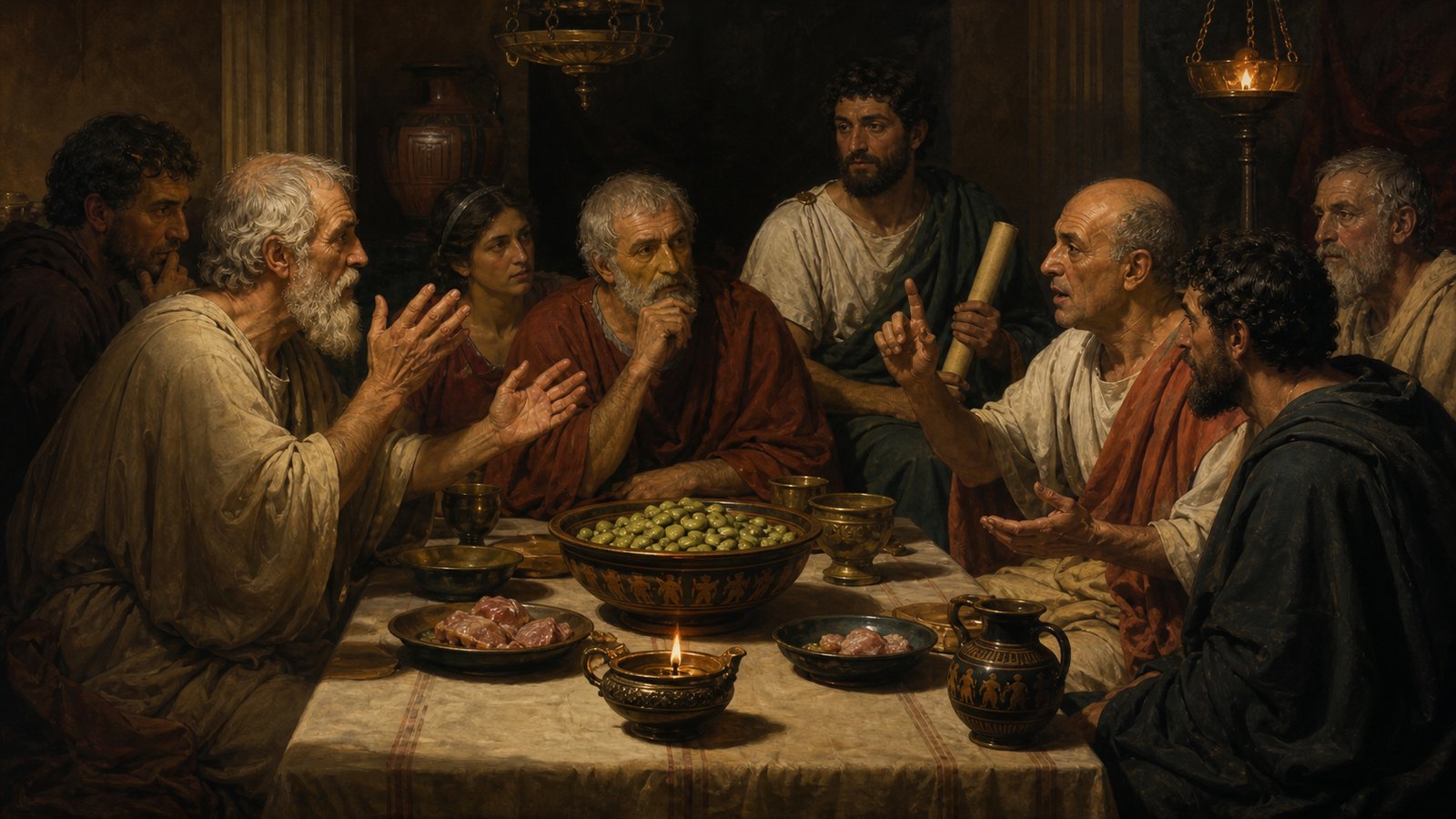
That is why the beans matter. Gellius did not merely swap vegetarian Pythagoras for a meat-eating one. He ranked witnesses, exposed interpretive forks and left rival details in view. The reader sees a reputation being made: poetry gives it a line, prose gives it a reason, source proximity gives a contradiction weight, and one ambiguous word keeps the argument alive.
Sources
Aulus Gellius, Attic Nights, 4.11.