
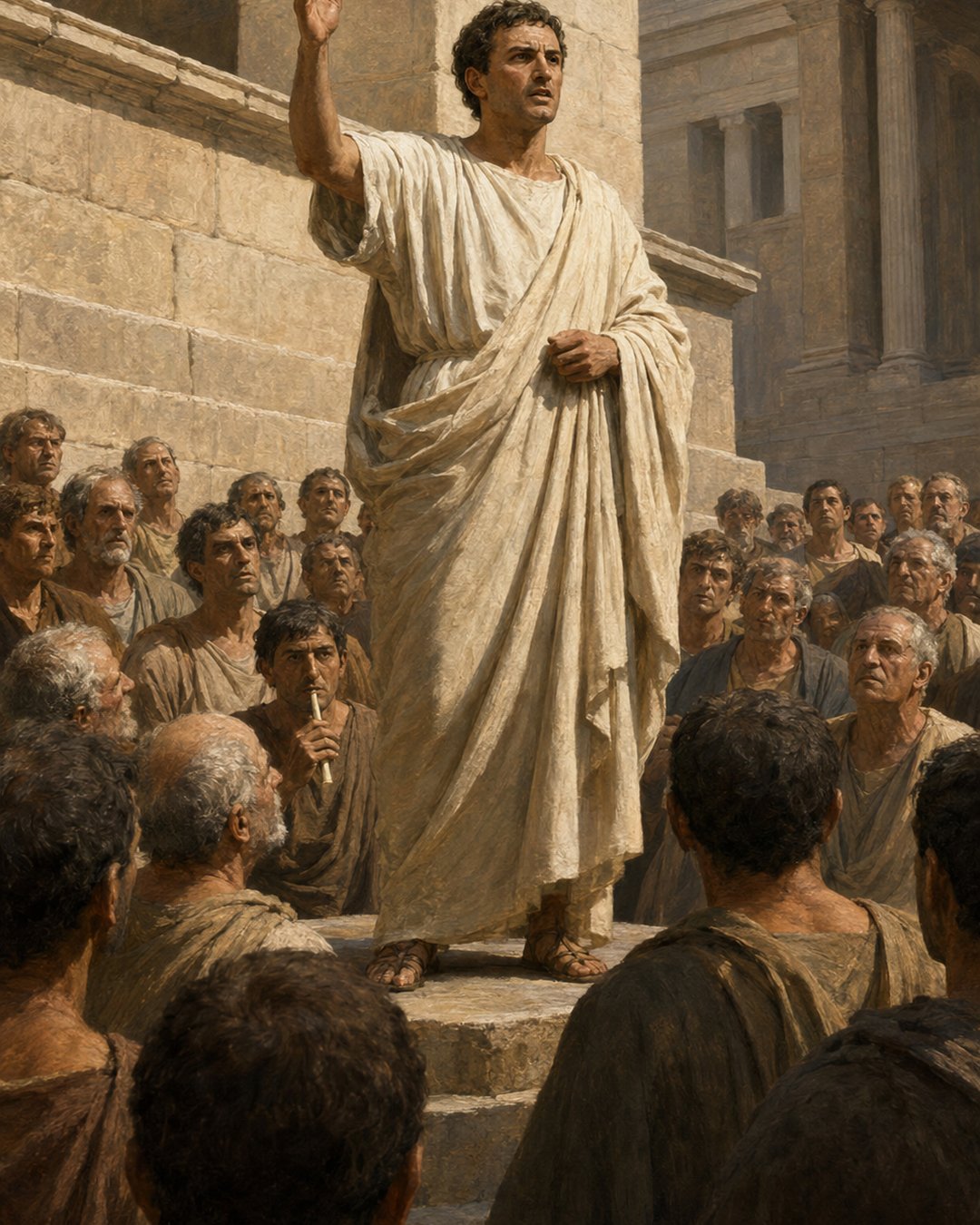
Gaius Gracchus was speaking before a Roman assembly when a note came from somewhere near the crowd. It was not applause, interruption or a signal to the listeners. The sound was meant for the orator. A concealed musician had judged that his delivery needed correction.
Aulus Gellius preserves the story in Attic Nights 1.11, but he does not simply repeat it. He separates a theatrical popular version from the account he considers more credible, then quotes Cicero for a third angle. The instrument shifts position, the notes change function, and the identity of the witness becomes part of the argument.
Beneath that disagreement lies a concrete political technique. Gracchus’s voice was not treated as an invisible expression of thought. It had pitch, force and dangerous momentum. A short pipe could provide an external reference when the speaker’s own excitement made self-measurement difficult.
The scene therefore joins politics to trained performance without reducing an assembly to theatre. One sound, heard at the right instant, could help keep vehemence from breaking the shape of an argument.
The Famous Version Sounded Too Much Like a Stage Show
Gellius reaches Gracchus by way of military music. He has just discussed the Spartan practice of advancing to pipes so that soldiers moved calmly and kept formation instead of rushing ahead in disorder. Music, in that example, does not inflame courage. It checks impetuosity and gives many bodies a shared measure.
That comparison reminds him of what he calls the oratorical pipe. The familiar claim was that a musician stood behind Gaius Gracchus while he spoke, continuously changing pitch to restrain or animate both feeling and delivery. It is vivid enough to survive as an anecdote because it makes the speaker look almost conducted.
Gellius refuses it. A public address accompanied by a sequence of changing melodies would, in his judgment, resemble the performance of a dancing entertainer. His objection is not that Romans lacked music in civic or ceremonial settings. It is that constant accompaniment would turn correction into spectacle and distract from the mechanics the story was supposed to explain.
This skepticism is an important part of the evidence. Ancient authors could recognize that a good story had acquired an implausible flourish. Gellius does not discard the pipe itself. He reduces the claim until the musician’s action fits the problem: not a score beneath every sentence, but an occasional signal when the voice crossed a limit.
A Low Note Reached the Speaker from Inside the Audience
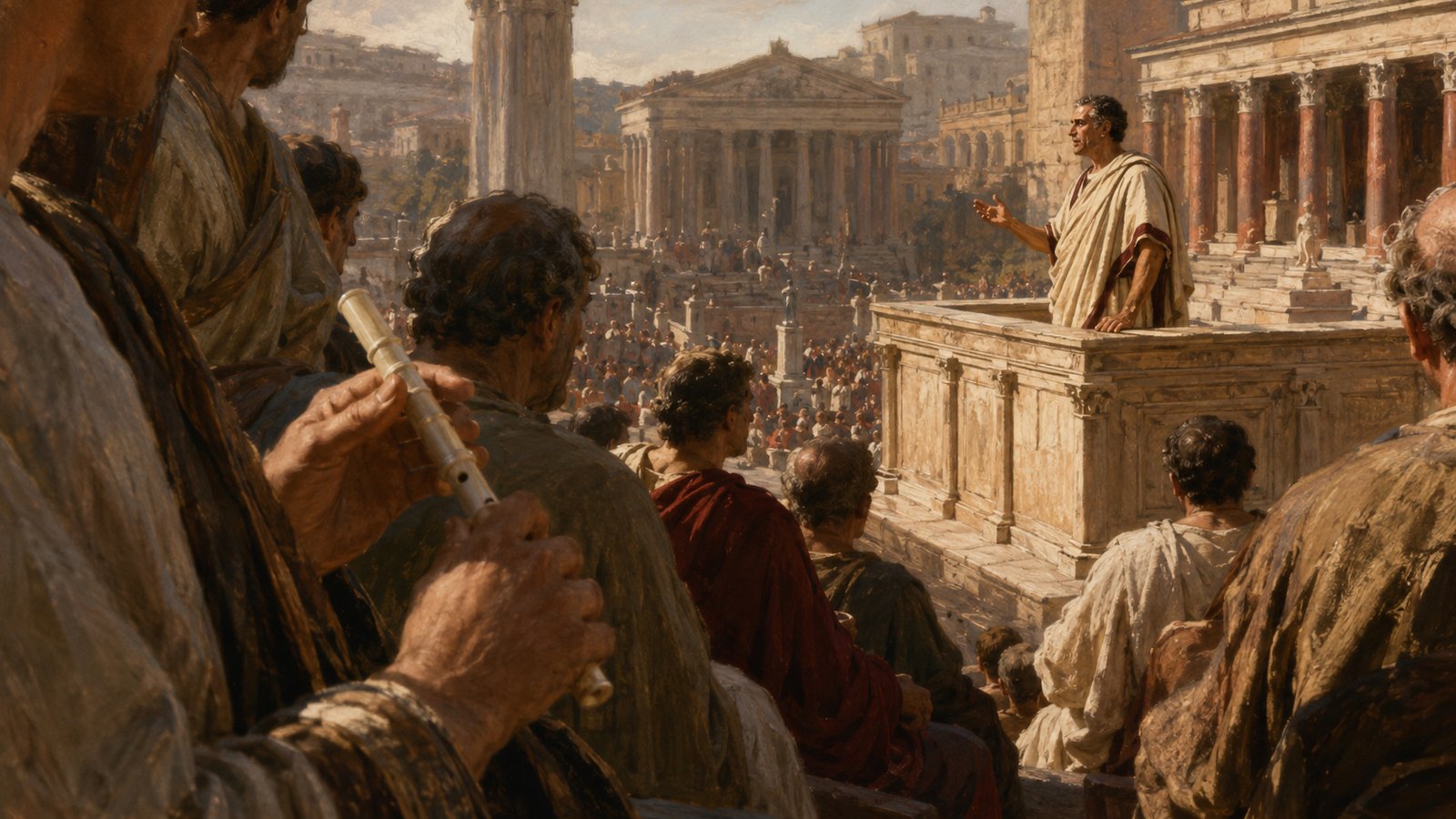
The version Gellius prefers places the musician unobserved among the listeners. At intervals, the player sounded a deeper note on a short pipe. Its purpose was to restrain and calm the abundant energy of Gracchus’s delivery.
Position changed the mechanism. A musician openly at the speaker’s back would become part of the performance, visible to everyone who watched the rostra. A player concealed within the audience could supply a reference without claiming attention. The intervention remained audible, but its source did not need to dominate the scene.
Timing mattered just as much. “At intervals” makes the note corrective rather than continuous. The musician had to listen, decide that the pitch or force had drifted, and enter quickly enough for Gracchus to respond. The speaker then had to recognize the cue without losing his sentence or advertising the adjustment.
Gellius thinks only restraint was necessary. Gracchus was famous for natural vehemence, so an outside stimulus to greater excitement seemed unnecessary. The lower note acted like a boundary marker. It did not supply conviction; it recalled a powerful voice from the point where power could become excess.
A Lost Eagles article on Cicero training a harsh voice for the Forum follows long-term preparation through exercise and practice. Gracchus’s pipe belongs to a different moment. Preparation had ended, the crowd was present, and correction had to happen inside the live delivery.
Cicero Let the Ivory Pipe Correct the Voice Both Ways
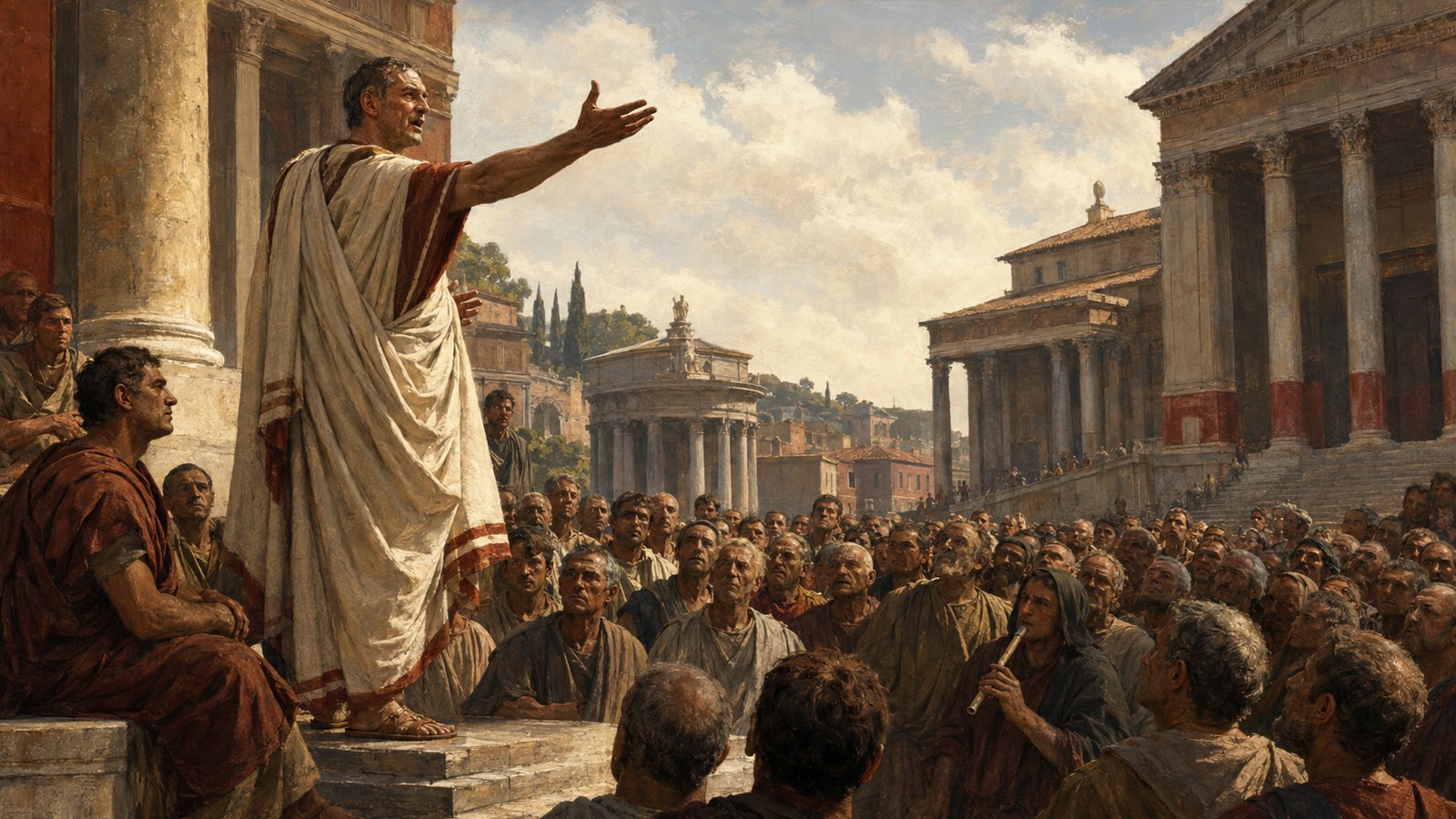
Gellius then quotes Cicero, whose account refuses the one-direction rule. Cicero says a skilled musician stood in concealment behind Gracchus with an ivory pipe. The player could quickly sound a note if the orator became languid or if he moved into undue vehemence.
In that telling, soft and shrill notes formed a two-sided instrument. One could animate delivery that had weakened; another could check speech that had grown too violent and passionate. The exact acoustic vocabulary is less secure in translation than the basic logic: the orator could drift below or above the desired range, and the musician supplied a reference in either direction.
Cicero also attaches the story to Licinius, whom he describes as an educated man who had once been Gracchus’s slave and amanuensis. That detail gives the anecdote a human chain of transmission. The claim did not float into the dialogue without an attributed connection to the household and working life of the speaker.
It does not settle every discrepancy. Gellius places his preferred musician among the audience and restricts the cue to calming. Cicero places the player behind Gracchus and gives the pipe both an accelerating and restraining role. Rather than merging those versions into a false certainty, the disagreement should remain visible.
The ivory matters as a physical detail, not proof that a surviving object can be identified. It distinguishes Cicero’s account from an abstract metaphor about “finding the right tone.” Someone held an instrument, waited in concealment and produced an audible pitch that the speaker was expected to understand.
Political Authority Still Depended on a Vulnerable Body
Roman oratory is easy to imagine as preserved words. Speeches survive in literary quotation, summaries and later judgments, so argument can seem separable from breath. The hidden pipe restores the body. Gracchus had to project across an open public space, manage pace and emotion, and keep his voice useful while confronting a responsive audience.
The correction also reveals cooperation behind individual fame. The public saw one renowned speaker, yet delivery could depend on another person’s ear. The musician listened for deviation; Gracchus trusted the sound enough to change course. Political charisma, in this scene, was supported by a small technical partnership.
That partnership was not neutral. A cue that steadied delivery helped an argument retain authority. Too little force could make the speaker seem weak, while too much could blur words, strain the voice or let passion overwhelm control. The desired range was persuasive as well as acoustic.
The mechanism offers a counterpoint to the shorthand strokes that captured Cato’s Senate speech. Shorthand tried to preserve words after they left the mouth. The pipe acted one stage earlier, intervening while sound was still being formed.
Gellius’s handling of the anecdote deserves the final word. He keeps the memorable object but challenges the easiest picture of it. There was no need to imagine Gracchus speaking over a continuous melody. A concealed player, a brief low note and an orator capable of recognizing it were enough. The smallest sound in the Forum could help govern one of its largest voices.
Sources
Aulus Gellius, Attic Nights 1.11; Cicero, On the Orator, as quoted by Gellius.