
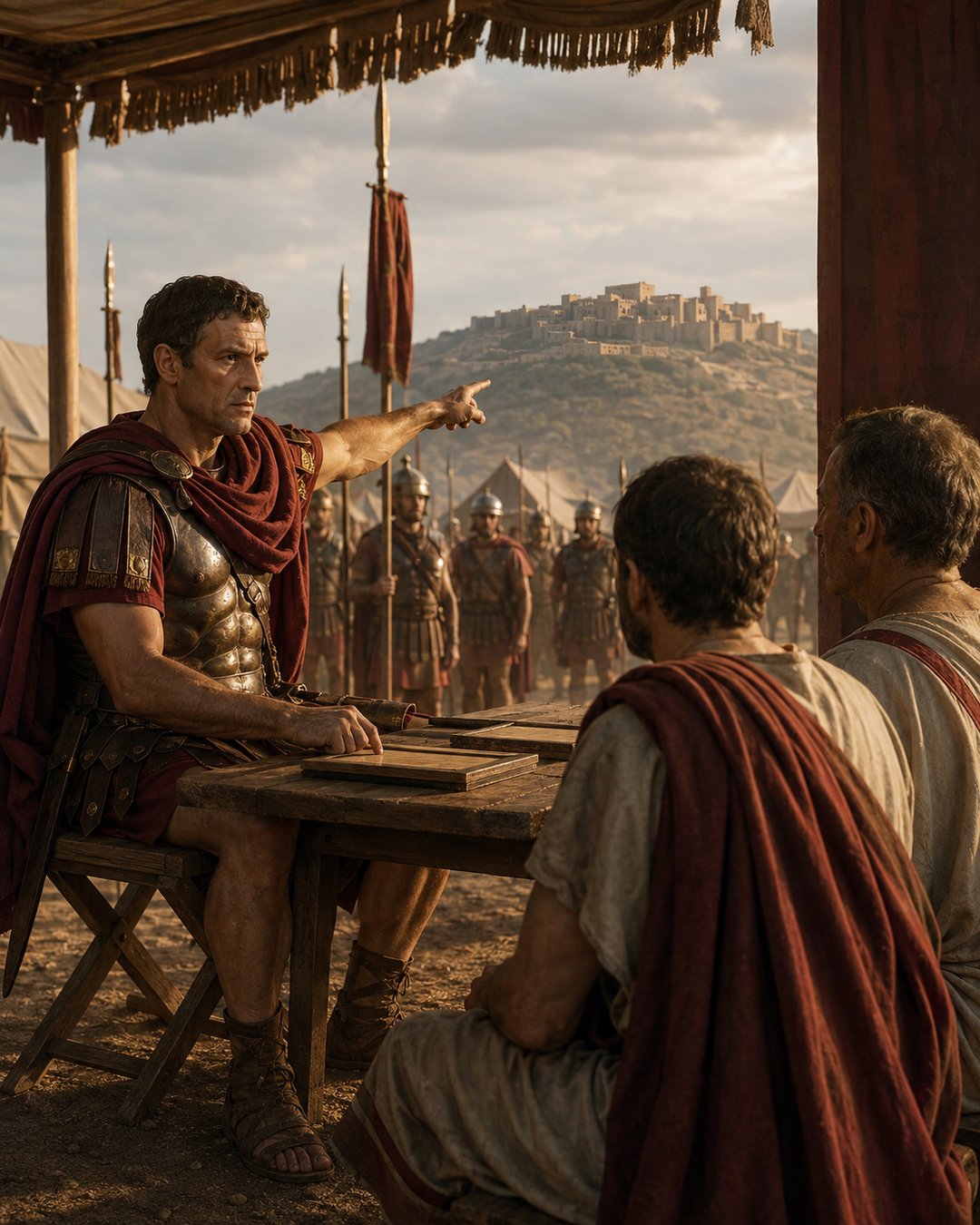
The town was fortified, well supplied and protected by its position. From the Roman camp, its citadel remained visibly beyond Scipio’s control. Yet the commander was not standing before his troops to promise a dramatic assault. He was sitting in judgment.
One of the soldiers on trial asked the ordinary procedural question: on what day, and in what place, should the defendants give bail to appear again? Scipio extended his hand toward the enemy citadel. They were to appear there the day after tomorrow.
Aulus Gellius says the town fell on the third day and Scipio held court in the citadel exactly as ordered. The anecdote is only a few lines long, but its construction is precise. A military prediction becomes more striking because it is expressed as an administrative appointment. The commander treats possession of the stronghold as settled enough to enter into the court calendar.
Gellius places this scene after traditions about Scipio’s unusual birth and private visits to Jupiter’s shrine. The capture therefore does more than display confidence. It becomes one of the deeds through which admirers explained a reputation that hovered between exceptional judgment and divine intimacy.
A Commander’s Reputation Arrived Before the Siege Story
Gellius introduces the elder Publius Scipio Africanus through stories drawn from writers on his life and deeds. He names Gaius Oppius and Julius Hyginus among those authorities. Their material does not begin with the Spanish town. It begins before Scipio’s birth, with a tradition shaped to make his later career look extraordinary from the start.
Scipio’s mother, the story said, had long been considered unable to bear children, while his father had abandoned hope of offspring. During the husband’s absence, observers supposedly saw a huge serpent lying beside her as she slept. When frightened witnesses cried out, it slipped away and could not be found.
Scipio’s father consulted soothsayers. After sacrifice, they predicted that children would follow, and the woman soon experienced signs of conception. In the tenth month she gave birth to the man later credited with defeating Hannibal and Carthage in Africa during the Second Punic War.
Gellius does not leave the prodigy unqualified. He says Scipio was believed to possess godlike excellence far more because of his achievements than because of the serpent story. That sentence establishes the chapter’s method. Marvels may surround the hero, but deeds give those marvels their persuasive afterlife.
The distinction matters for the siege anecdote. Gellius is not supplying a neutral campaign report with named town, troop numbers and engineering detail. He is showing the kind of action that could make earlier and later rumors of divine favor appear credible. The capture becomes evidence inside a biography of reputation.
Silent Dogs Guarded the Path to Jupiter’s Shrine
A second tradition brought Scipio to the Capitol late at night, before daybreak. He supposedly ordered the shrine of Jupiter opened and remained there alone for a long time, as if consulting the god about public affairs.
The physical detail that gives the story force is not a voice from the statue or a written oracle. It is the behavior of the temple dogs. According to the account, they rushed at other people who entered, but they neither barked at Scipio nor troubled him. The guardians noticed the exception.
Silence did the narrative work. A private meeting inside the shrine could not be witnessed directly, and Gellius carefully uses the appearance of consultation rather than claiming to record a divine conversation. The dogs provided an observable edge around the inaccessible encounter. They behaved as though this nighttime visitor belonged there.
Scipio’s solitary visits also linked statecraft to sacred counsel. He was not represented as entering merely to make a public display before a crowd. The hour was late, the shrine had to be opened, and he stayed inside alone. Those conditions encouraged later readers to imagine a relationship unavailable to ordinary magistrates.
A separate Lost Eagles account of the geese that raised an alarm on the Capitol turns animal noise into a warning that human guards missed. Here, the memorable sign is reversed. Dogs known for attacking intruders remain quiet, and their restraint marks Scipio as exceptional.
A Bail Question Turned Confidence into Procedure
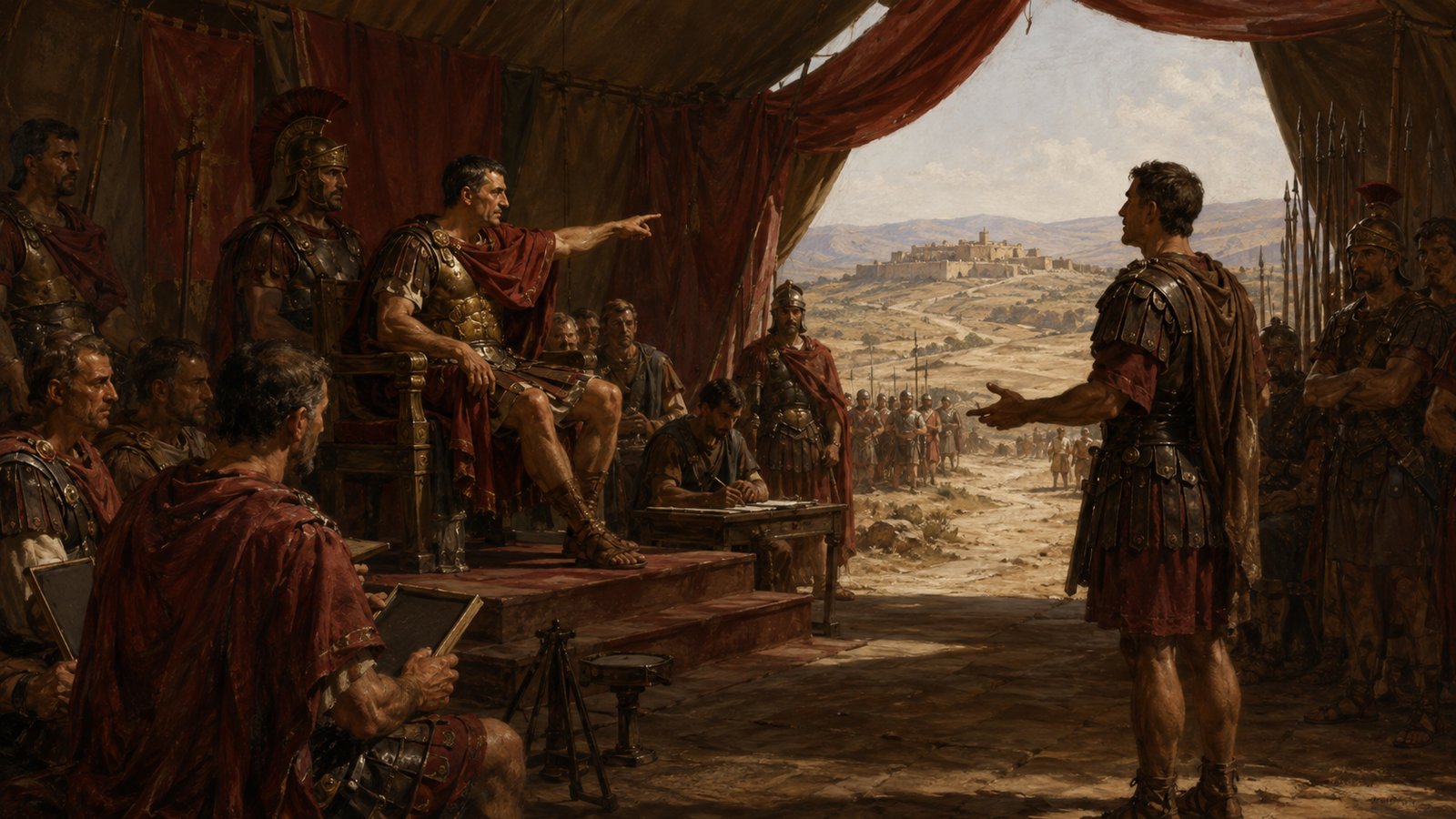
Gellius then says popular beliefs about Scipio appeared to receive support from remarkable actions and sayings. He selects the Spanish siege as one example. The town’s defenses were formidable, its position strong and its supplies adequate. From the Roman perspective described in the chapter, there was no visible prospect of taking it.
Scipio nevertheless continued the ordinary work of command. He sat holding court in camp at a place from which the town could be seen at a distance. The placement is essential. When the defendant asked where to reappear, Scipio did not need to summon an imaginary location. The occupied citadel stood in front of everyone.
The soldier’s question concerned bail for another appearance. That gives the answer a deadline and a venue. Scipio could not hide behind a vague promise that the town would fall eventually. “The day after tomorrow” was close enough to test, and “yonder place” was specific enough for those present to see.
By pointing rather than delivering an extended speech, the commander collapsed future conquest into current administration. The citadel entered his court schedule before it entered Roman possession. A statement that might sound boastful in a battlefield address sounded almost routine when phrased as the next location for legal business.
The scene offers a revealing contrast with Scipio’s repeated camp-building exercises. Practice made difficult operations familiar through labor and repetition. At the tribunal, language performs a related transformation: a difficult capture is treated as the settled condition under which tomorrow’s ordinary duties will continue.
The Third Day Converted a Risk into Evidence
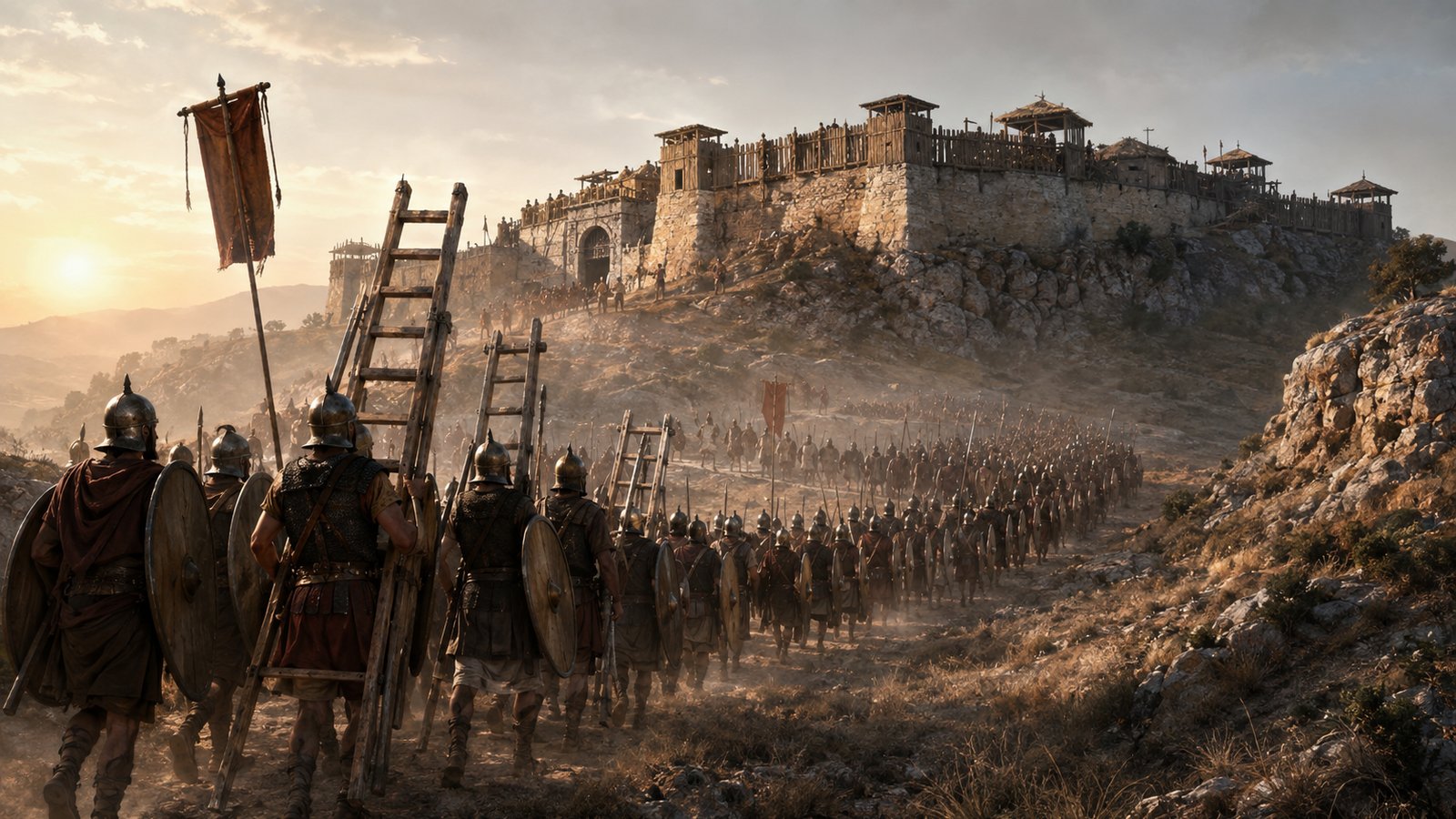
Gellius gives the outcome without tactical explanation. On the third day the town was captured, and on that same day Scipio held court in its citadel. The appointment was kept.
Because the chapter omits the mechanics of the assault, it cannot tell us whether Scipio possessed intelligence unknown to the defendant, had already prepared an operation he expected to succeed, or simply made a dangerous public commitment. Those possibilities belong to interpretation, not to the surviving claim. What Gellius preserves is the prediction, the short interval and the matched result.
The absence of tactical detail is part of the anecdote’s power. Siege ramps, mining, negotiations or a betrayed gate would locate success in a mechanism. Gellius instead places attention on Scipio’s certainty. The reader sees the citadel first as unreachable, then as the place the commander confidently names, and finally as his actual courtroom.
Success changes how the earlier gesture can be remembered. Had the attack failed, the pointed finger would have looked reckless. Because the town fell, the same motion could be retold as proof of foresight. Reputation selects the successful prediction and binds it to the stories already circulating around the commander.
The court session supplied especially strong closure. Capturing a wall did not merely permit a victory claim. Scipio occupied the citadel long enough to resume the procedural business interrupted in camp. The defendant’s question and the commander’s answer were verified by institutional routine.
Administration Made the Marvel More Believable
Scipio’s statement is memorable because it does not separate war from government. A Roman commander abroad could judge soldiers as well as direct operations. The camp tribunal and the siege belonged to the same command. Gellius exploits that overlap by letting one function predict the success of the other.
The story also shows how mundane details can make an extraordinary reputation persuasive. The question concerns bail, not an omen. The answer supplies a date and venue, not a mystical formula. The final proof is another court session. Each procedural element gives the marvel a hard edge.
That does not require us to decide that Scipio knew the future. Gellius himself balances prodigy against achievement when discussing the commander’s birth. The chapter records what admirers said, what temple guardians reportedly observed and what one military anecdote was thought to demonstrate. It allows action to support belief without explaining the action as supernatural.
The strongest reading therefore keeps both levels visible. A commander under pressure publicly acts as though a fortified town is already his. His forces capture it within the declared interval. Later biography sets that success beside a serpent at his mother’s bed and dogs silent before Jupiter’s visitor.
In that sequence, Scipio’s hand pointing toward the citadel becomes more than bravado. It joins timetable, place and authority in one gesture. The town is still hostile, but the next sitting of his court has already been entered there. Victory arrives not as the end of the anecdote’s world, but as the condition required for Roman administration to keep its appointment.
Sources
Aulus Gellius, Attic Nights 6.1; Gaius Oppius and Julius Hyginus, writings on Scipio’s life and deeds, as cited by Gellius.