
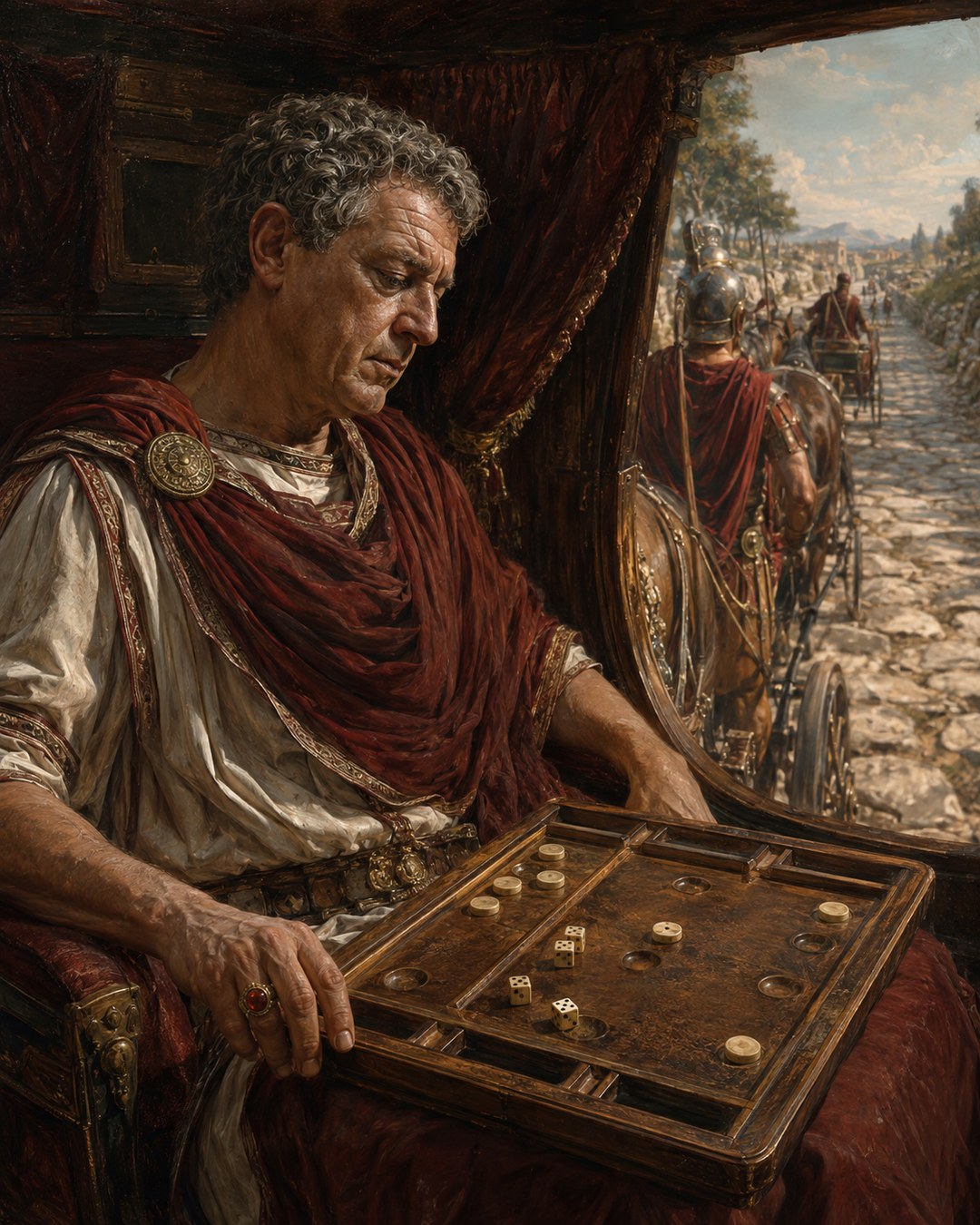
A carriage wheel struck a rut, the cabin shifted, and the game continued. Suetonius says the emperor Claudius had his gaming board fitted to the vehicle so that movement would not disturb play.
The sentence is brief, but the object it describes is unusually revealing. Dice and counters are small. A road is rough. A board balanced loosely on knees or cushions would answer every jolt. Claudius’s solution was not to wait until arrival. He changed the carriage.
Suetonius adds another measure of the emperor’s commitment: Claudius published a book on gaming. One detail turns play into a subject worthy of explanation; the other turns a moving vehicle into a protected playing space.
Together they show habit becoming infrastructure. The fitted board did not move an army or drain a lake, yet it solved a specific mechanical problem for the most powerful traveller in the Roman world: how to keep a turn intact while the road moved underneath him.
A Road Made Every Loose Counter Vulnerable
Ancient wheeled travel did not provide a smooth cabin. The point need not be exaggerated into a reconstruction of springs or suspension that Suetonius never describes. His own wording supplies the essential difficulty. Motion threatened to disturb the game, and the board was fitted to prevent it.
A gaming position depends on memory made visible. Counters occupy places; dice land and must be read; a move changes what can happen next. If the surface tilts or jumps, chance outside the rules invades chance inside them. A thrown die should decide an outcome. A wheel striking stone should not.
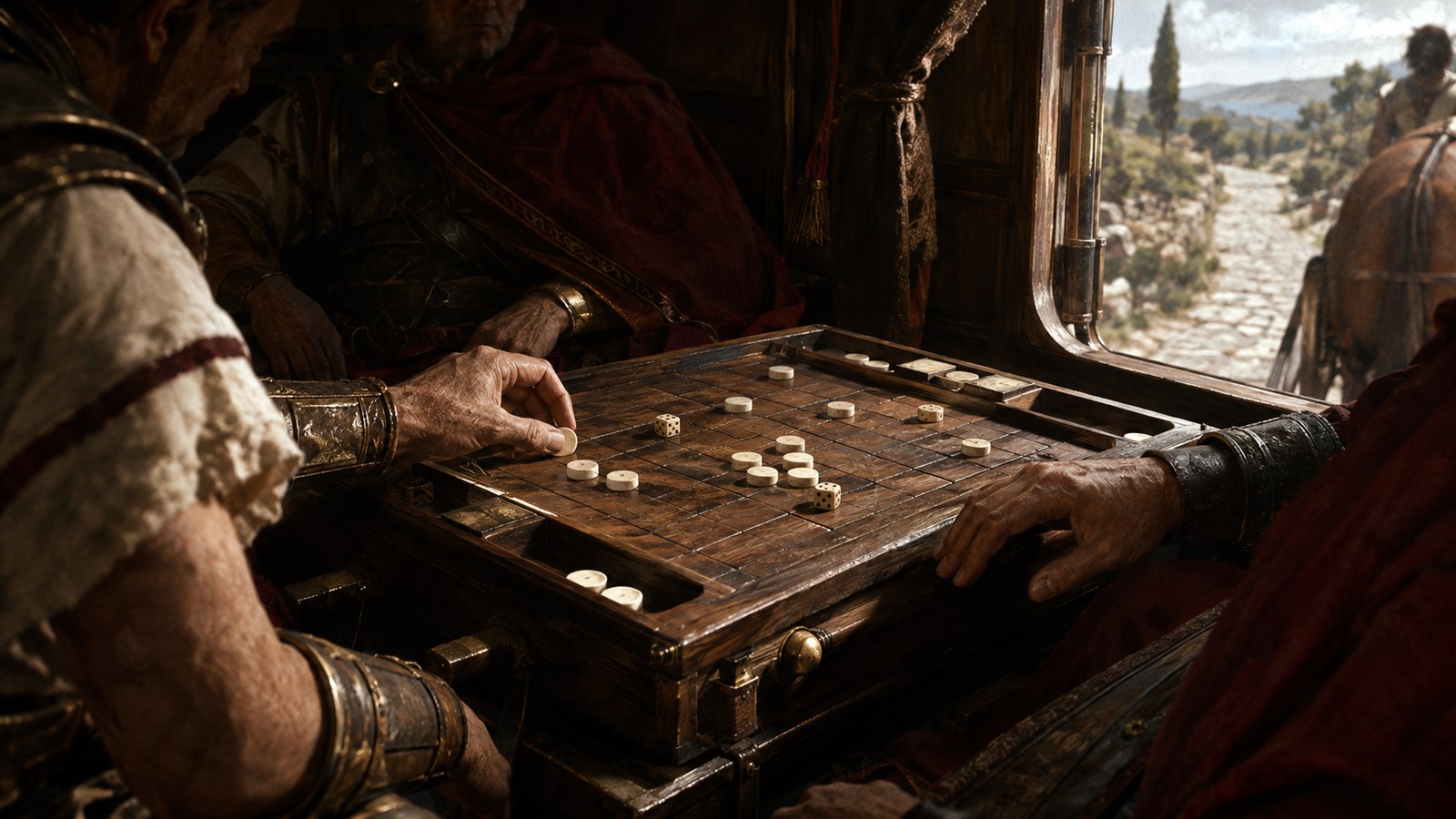
The fitted board therefore created a boundary between two kinds of movement. Beyond it, horses, wheels and road carried the carriage forward. Upon it, pieces were expected to remain where the players put them. The object made the cabin’s travelling motion irrelevant to the little world of the game.
Suetonius does not provide dimensions, joinery or a diagram. Raised edges, recesses and supports are plausible possibilities, but they remain possibilities rather than reported facts. What survives securely is function: the board belonged to the carriage and resisted disruption.
That narrow certainty is enough to make the scene physical. An imperial preference reached the hands of a craft worker. Someone had to measure the available space, place a stable surface and make it useful to seated players. Claudius’s leisure became a design requirement.
The Emperor Treated Gaming as Knowledge Worth Writing Down
The carriage board is only half of Suetonius’s evidence. Claudius also published a book on the art of gaming. The work has not survived, so its rules, arguments and voice cannot be recovered from the biographer’s sentence.
Its existence still changes the scale of the interest. Claudius did not merely accept an occasional invitation to play. He treated gaming as a practice that could be organized in prose. A book implies distinctions worth recording: procedure, skill, perhaps precedent or strategy, though Suetonius does not tell us which.
This literary habit fits a wider portrait. Suetonius says Claudius wrote histories in Latin and Greek. He also reports that the emperor introduced three letters into the alphabet and used them during his reign. The gaming manual belonged to a man repeatedly attracted to systems, records and learned intervention.
That does not make every Claudian project equally serious. It does show why the dice book should not be dismissed as a stray joke. The emperor’s scholarship could reach public language, historical narrative and private recreation.
Readers can compare that urge to redesign written practice with Claudius’s attempt to add three letters to the Roman alphabet. The alphabet left official traces during his reign; the gaming book disappeared. Suetonius’s line is now almost all that remains of the latter.
The Fitted Board Turned Travel Time into Claudius’s Time
Playing in transit altered the daily boundary between journey and destination. Without the adaptation, gaming would begin after the carriage stopped. With it, the interval on the road became available for the emperor’s chosen activity.
That conversion is the board’s real luxury. Precious wood or decoration would be secondary, and Suetonius mentions neither. The privilege lay in reorganizing time. Claudius did not need to accept the interruption imposed by movement because labour and material could be used to remove it.
An emperor travelled with attendants, documents, obligations and security. The fitted game occupied space among those demands. Every surviving turn declared that this preference deserved protection from the same road everyone else endured.
The device also condensed hierarchy. Claudius wanted continuity; another person made continuity possible. A craft decision stabilized the board, attendants accommodated the play, and the imperial schedule allowed a journey to contain a game.
This is different from the vast staged control visible in Claudius’s captive lake battle involving nineteen thousand men. Yet both episodes show environments rearranged for an emperor’s attention. One transformed a lake into spectacle. The other transformed a shaking cabin into a game room.
Suetonius Used Small Habits to Build a Large Character
The placement of the anecdote matters. Suetonius groups it with bodily routine and appetite. He describes Claudius’s sleep, his tendency to doze while holding court, his sexual conduct and his devotion to gaming before turning toward darker accusations.
This is biography built from accumulation. A reader does not receive a neutral inventory of palace equipment. The gaming book and carriage board become evidence in an argument about excess: Claudius cared so much that he wrote, travelled and engineered around play.
That framing deserves caution. Suetonius selected details for literary effect, and his language about devotion guides the reader before the carriage appears. The fitted board can be accepted as the reported object without accepting every moral judgement attached to it.
Indeed, stripped of ridicule, the adaptation is intelligent. It identifies a predictable failure and changes the environment rather than demanding impossible steadiness from the players. The same fact can support two readings at once: practical ingenuity and consuming appetite.
The tension makes the anecdote durable. Claudius appears scholarly and unserious, methodical and indulgent. His lost treatise elevates the game; his modified carriage makes the elevation comic because the road itself must yield.
A Minor Object Preserved the Shape of an Imperial Appetite
Claudius is often remembered through works on a monumental scale. Suetonius credits him with completing aqueduct construction and the outlet from the Fucine lake. The archive also preserves the immense labour and disappointment surrounding that drainage project.
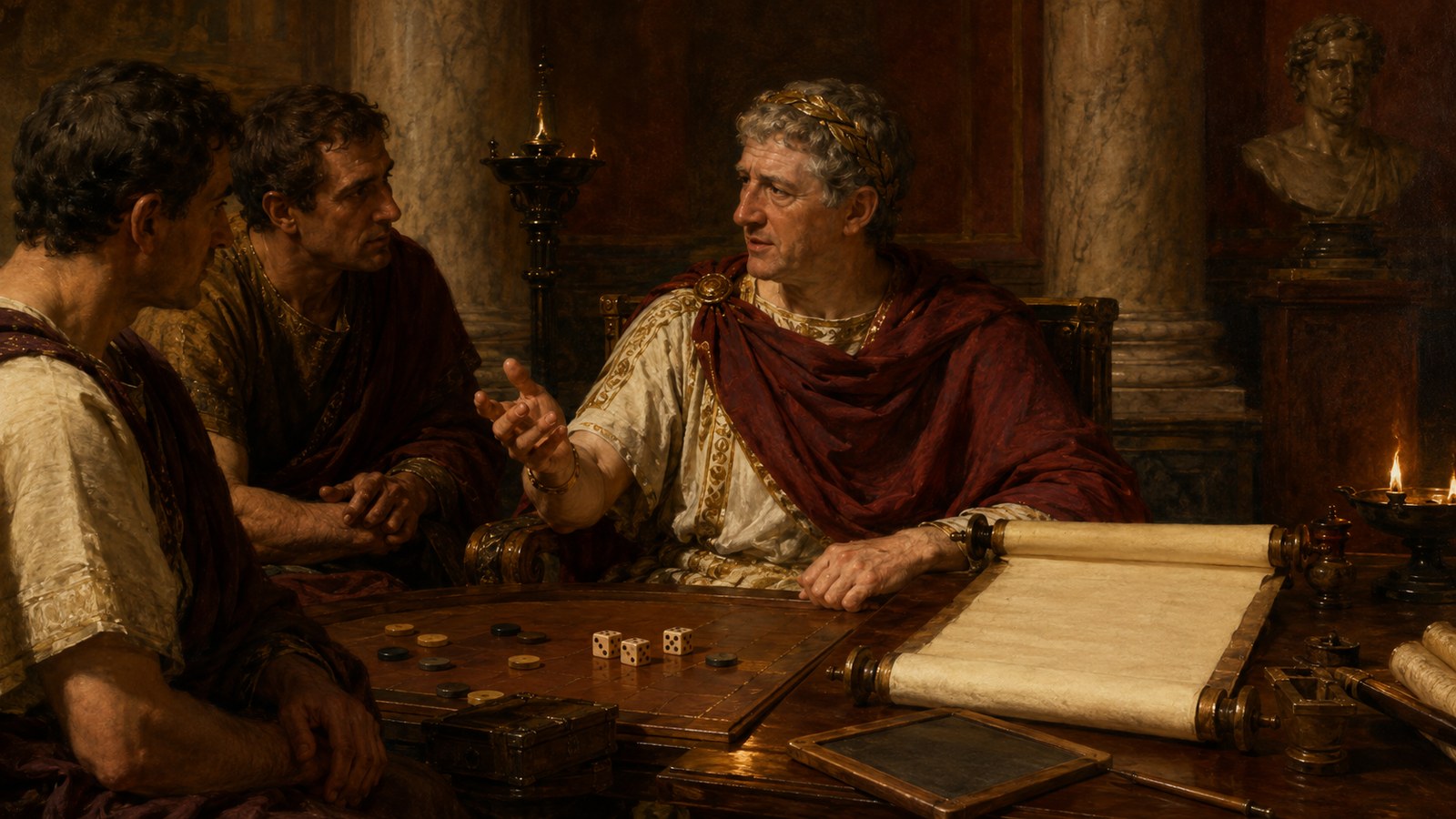
The gaming board belongs at the opposite end of material history. It needed no army of workers and left no surviving ruin. Its importance lies in proportion. A very small problem received a purpose-built answer because it was the emperor’s problem.
No rule of the lost book can now be quoted. No counter can confidently be assigned to this particular board. Even the construction must remain undescribed beyond Suetonius’s functional statement. Yet the relationship among object, vehicle and desire is clear.
The carriage moved. Claudius wanted to play. The board was fitted so one fact would not interfere with the other. In that compact chain, Roman biography preserves something monumental architecture rarely can: the exact point where a ruler’s private impatience became somebody else’s practical work.
Sources
Suetonius, Claudius 20, 33–34, 41–42.