
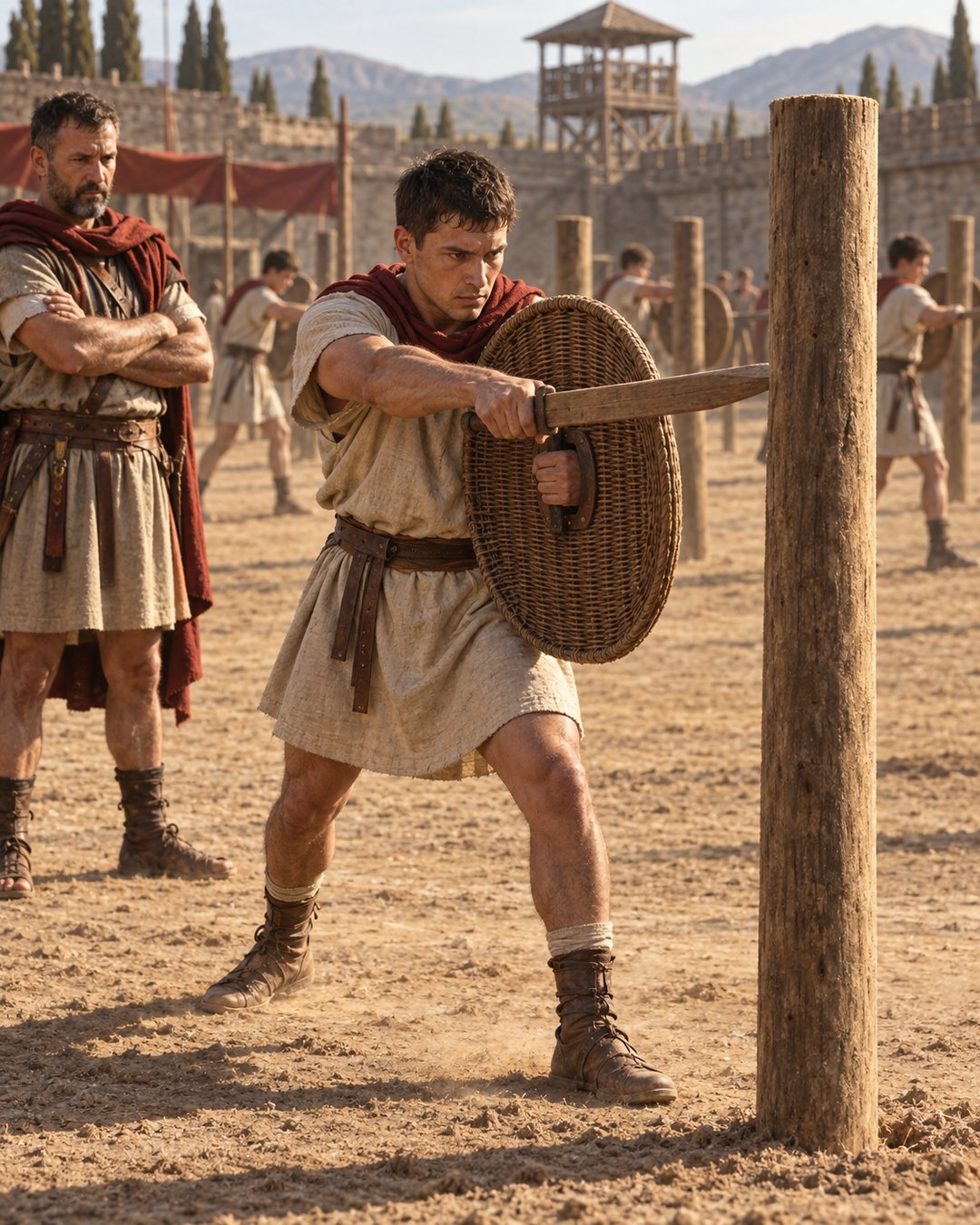
The enemy in a Roman training yard did not move. He stood about six feet high, was sunk firmly into the earth and had no face beyond the one a recruit imagined for him. Against this wooden post, Vegetius says, the beginner learned to attack the head, sides and legs, to advance, retreat, spring forward and drop behind his shield.
The post was simple. The equipment was not easy. A round shield woven from willow weighed twice as much as an ordinary shield, while the wooden practice sword was twice the weight of the common weapon. Morning and afternoon, extra resistance followed every movement. A shield that sagged and an arm that wandered announced themselves before an actual opponent could exploit them.
This was more than hard work for its own sake. Vegetius’s drill joined weight, repetition and an unmoving target into a lesson about remaining protected while delivering force. The recruit did not merely learn where to hit. He learned how not to uncover his own body on the way there.
A Six-Foot Post Became the First Opponent
Vegetius begins with an individual station. Every recruit fixed a post into the ground so securely that it could absorb repeated blows. Its height gave the beginner something like the vertical range of a standing adversary, but without the confusion of a partner who struck back or changed distance.
That stillness narrowed the lesson. The recruit could direct blows toward an imagined head and face, then lower them toward the sides and legs. Each angle asked the feet, shoulders, shield and weapon hand to cooperate differently. Missing the post carried no battlefield consequence, but the post made an uncontrolled line obvious.
The exercise was not performed from a planted pose. Vegetius includes advance and retreat, a spring into attack and a movement down behind the shield. Distance therefore became part of the target. A recruit had to close enough to strike, recover enough to remain organized and change height without losing the screen in front of him.
Morning and afternoon practice mattered because none of those actions was a fact to memorize once. They were movements to repeat until an instructor no longer had to rebuild the sequence after every attempt. The fixed post gave every beginner the same patient opponent and gave the army a station that could be used again without consuming valuable weapons or injuring a training partner.
That individual work complements the longer transformation of civilians into career soldiers. Formation discipline depended on bodies that already knew how to control shield, feet and point. The post isolated those parts before the line added neighbors, commands and fear.
Willow and Wood Made Every Error Heavier
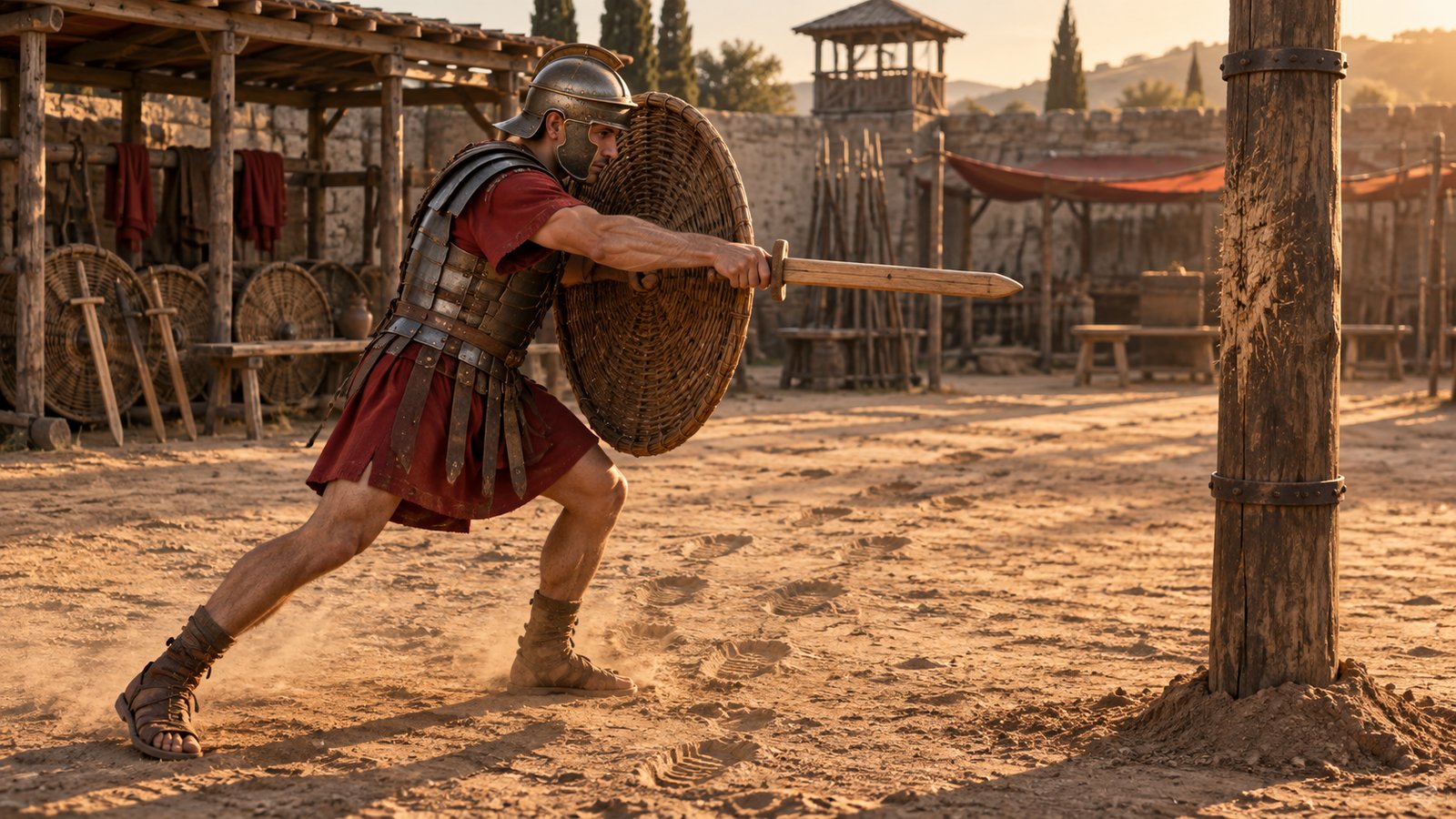
The practice shield was round and woven from willow. Wicker made sense for repeated training, but Vegetius emphasizes a less comfortable property: it weighed twice as much as the ordinary shield. The wooden sword imposed the same two-to-one burden compared with a common sword.
Extra weight changes a movement long before exhaustion becomes dramatic. The forward arm notices when the shield drifts away from the body. The shoulder notices when the weapon is held too far from its useful line. A wide flourish costs more to stop and recover than a short controlled action. Vegetius does not give a modern theory of resistance training, but his equipment created that practical feedback.
The point was not to make war gear feel unrealistically light in isolation. Shield and sword were worked together against a target. A blow that pulled the right side open had to be recovered while the other arm carried its heavier screen. The recruit learned under a burden that magnified the cost of separation between attack and defense.
The willow shield also reminds us that training material occupied a category of its own. It was not a damaged battlefield shield pressed into service, and the sword was not simply left blunt. Both were built to make the exercise harder. The army invested labor in objects whose value lay in repetition rather than display.
Roman drill often turned construction into habit. wooden horses trained recruits to mount from either side by keeping the platform constant while bodies repeated the approach. The post did the same for sword lines, but added deliberate weight so poor mechanics became tiring quickly.
The Point Kept the Striker Behind His Shield
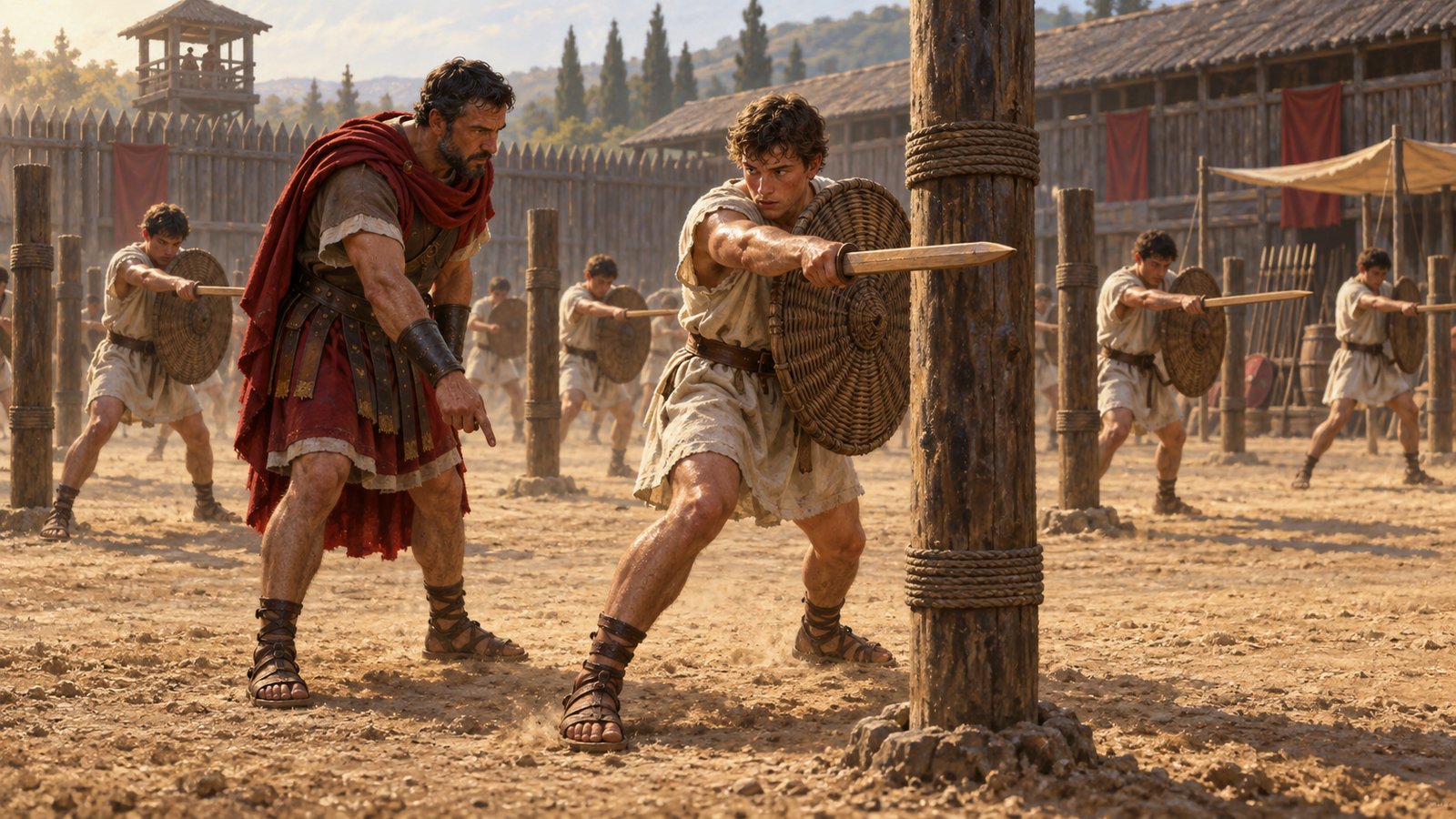
Vegetius uses the next chapter to distinguish a cut from a thrust. His preference for the point is not presented only as a claim about what happened to the enemy. It is also about what the attacker exposed. A cutting stroke, he says, leaves the right arm and side open.
A point-first attack can travel on a narrower line. The shield stays between bodies while the weapon reaches past its edge. Vegetius says even a short penetration may be deadly, whereas an edge stroke is less reliable. His language is severe because this is a military manual, but the training principle is precise: effectiveness and cover should arrive in the same motion.
The post made that distinction repeatable without requiring a victim. A recruit could see whether the wooden point arrived while his chest remained screened. He could practice recovering directly behind the wicker circle instead of finishing with the weapon arm flung wide. The target did not punish an opening, so the instructor and the weight had to expose it.
Vegetius even records mockery aimed at soldiers who used the edge rather than the point. Whatever distance separates his late Roman prescription from every earlier legion, the passage shows the ideal he wanted readers to restore. Skill meant controlled geometry, not merely enthusiasm with a sword.
This also explains why the drill ranges over height and footwork. A thrust against a high target, a lower line toward the body and a retreat behind cover ask for different balance. The shield cannot be treated as scenery held in the left hand. It is the surface around which the entire attack is organized.
Heavy Javelins Extended the Same Lesson
Vegetius carries the overload principle from sword work to throwing. Practice javelins were made twice as heavy as ordinary ones and hurled at the same post. The target that had received close blows now measured alignment, release and force at distance.
The heavier missile did not imitate the service weapon exactly. It made the training demand greater than the later task. Shoulders, grip and stance had to manage the added mass, while the fixed post gave the throw a clear destination. Once ordinary arms replaced the practice set, the recruit was not meeting weight for the first time.
Together, the passages describe a compact training system rather than a collection of quaint wooden objects. The post standardized the opponent. Twice-daily repetition standardized exposure to the task. Double-weight shield, sword and javelin raised the physical cost. The instructor could then judge whether a recruit still advanced, struck and recovered in order.
Real combat would destroy that order with noise, motion and fear. Vegetius does not pretend the post could reproduce those conditions. Its advantage was the opposite: it removed them. By holding one problem still, the army could insist on a protected thrust, a controlled retreat and a shield that remained useful even when every practice movement was heavier than the one expected in war.
Sources
Vegetius, Epitome of Military Science, Book 1, chapters 11–12.