
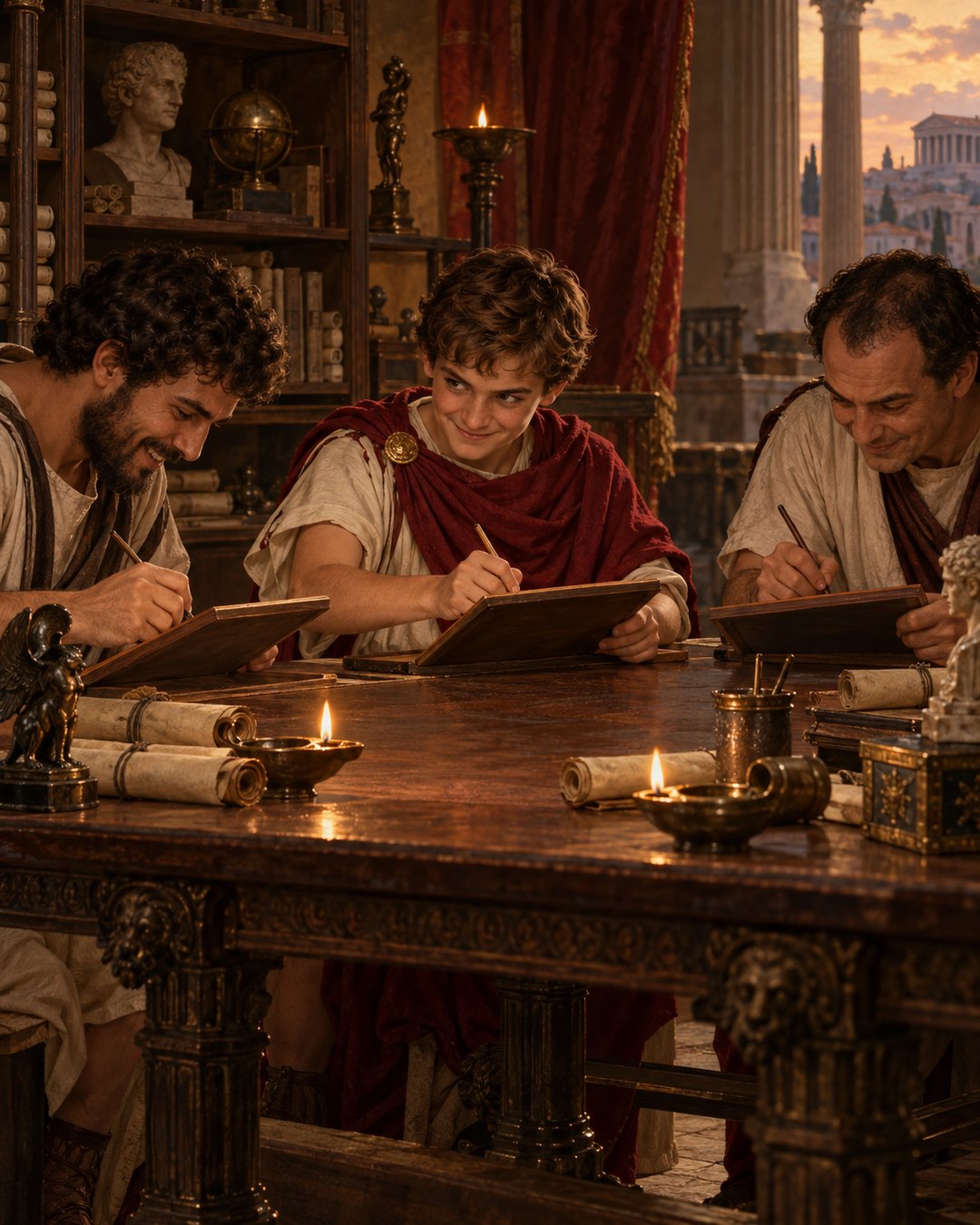
Titus sits among secretaries with a wax tablet and stylus. Suetonius says the future emperor could write shorthand with remarkable speed, and that he turned the skill into a game: show him a hand, and he would imitate it. The competition ended with a joke. Titus often said he was admirably equipped to become a forger.
The remark survives inside a chapter of praise. Titus has an excellent memory, speaks Latin and Greek, improvises prose and verse, rides, uses weapons, sings and plays the harp. Copying handwriting is one more proof that his mind and hands answer quickly. Yet forgery gives the talent a shadow. A copied hand can make somebody else appear to have written.
Suetonius does not accuse Titus of forging a document. He reports a recurring joke, attributed to many informants, about what Titus could have done. That distinction is the key to the anecdote. The skill was real enough to be admired; its possible misuse was obvious enough that Titus could name it himself.
Suetonius Built the Portrait from Speed and Range
The biographer begins with a broad claim. Titus displayed notable gifts of body and mind as a boy, and they became more conspicuous with age. His appearance supposedly joined majesty to grace. He was strong, though not tall, and Suetonius calls him somewhat corpulent.
Then the catalogue accelerates. Titus possessed an excellent memory and capacity for peaceful and military arts. He handled weapons and rode well. Latin and Greek were both available to him, not merely for ordinary speech but for prose and poetry. He could harangue and compose verse without preparation.
Music belonged to the same portrait. Titus could sing and play the harp, which Suetonius presents as cultivated skill rather than an accidental amusement. The result is not a sequence of offices or campaigns. It is an inventory of a person able to cross quickly from one demanding performance to another.
This matters because the handwriting episode is easy to detach and sensationalize. Inside the biography, it is the final item in a chain about memory, verbal facility, physical training and practiced hands. The forgery joke works because Suetonius has already made quick mastery the organizing feature of Titus’s abilities.
Shorthand Put the Future Emperor Beside Secretaries
Suetonius says he learned from many people that Titus wrote shorthand remarkably quickly. The appeal to multiple informants marks a change in evidence. The earlier qualities are delivered in the biographer’s own flowing description; the secretarial contest arrives as remembered behavior reported by others.
Shorthand turned speech into marks at speed. The source does not preserve Titus’s signs, a sample tablet or the rules he used, so the anecdote cannot support a reconstruction of his exact system. What it establishes is competitive quickness. Titus could measure himself against professional secretaries in the act of writing.
The scene narrows an imperial life to a desk. Weapons, riding and extempore speeches could be publicly impressive. Rapid notation was the quieter craft that let spoken material be caught before it vanished. Suetonius’s placement suggests that dexterity could travel between the ceremonial, military and administrative parts of Titus’s education.
A Lost Eagles article on how Caesar moved each letter four places to hide a message follows a rule applied to characters. Titus’s contest required a different precision. He was not changing a text by formula; he was reproducing the visible habits through which another writer formed it.
Imitating a Hand Reproduced More Than Words
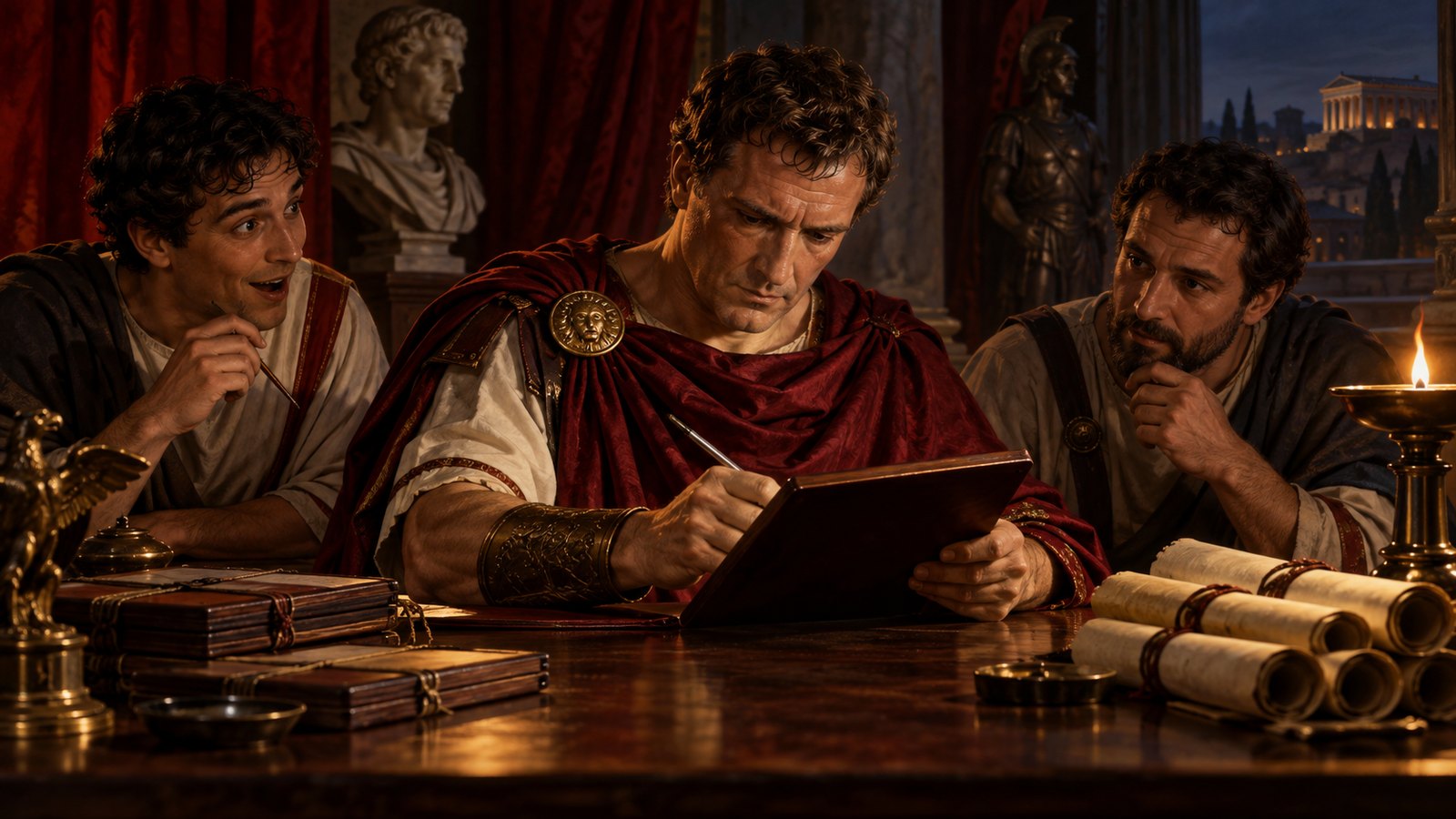
Suetonius’s wording makes the breadth of the claim striking: Titus would imitate any handwriting he saw. The text does not tell us how long a sample he required, how exact the result was or whether the contest involved signatures. Those missing details matter. “Any hand” is a biographer’s compact praise, not a laboratory measurement.
Even with that caution, handwriting adds something the language skills did not. Two people can write the same sentence while leaving visibly different forms. To imitate the hand is to imitate repeated choices of movement, spacing and shape. Titus’s game therefore moved from remembering content to reproducing another person’s manner of inscription.
The activity was playful. He engaged with his secretaries in merriment, not in the hidden preparation of a false order. That setting protected the demonstration. Everyone present knew who had written the imitation and why. Resemblance could be admired precisely because its real author remained visible beside the copied example.
Remove that context, and the meaning changes. The same marks could be presented to someone who had not watched Titus make them. The technical action would remain copying, but the social action could become deception. His joke identifies the moment when impressive resemblance threatens the trust attached to a recognizable hand.
The Forgery Line Was a Boundary, Not a Confession
“Qualified for forgery” is memorable because it interrupts praise without cancelling it. Titus does not claim to have produced a fraudulent text. Suetonius gives no victim, false order, disputed signature or gain. Treating the line as evidence of an actual crime would add a story the source never tells.
Instead, the joke shows Titus recognizing the double use of dexterity. Fast shorthand could serve recording. Hand imitation could entertain a room and test control of the stylus. Both abilities could also make marks travel farther than the honest circumstances of their production.
Another Lost Eagles story follows three seal rings used by Augustus. A seal impression and a familiar hand are different forms of evidence, but both ask a recipient to connect a visible mark with a person’s authority. Titus’s imitation game exposes why appearance alone could never tell the whole story of authorship.
The humor also depends on status. A future emperor joking about forgery is not an ordinary clerk imagining mischief. Suetonius’s audience knew that Titus’s genuine decisions would carry enormous weight. The anecdote gains tension from the distance between his legitimate authority and his admitted ability to reproduce someone else’s hand.
One Talent Collected the Rest of the Portrait
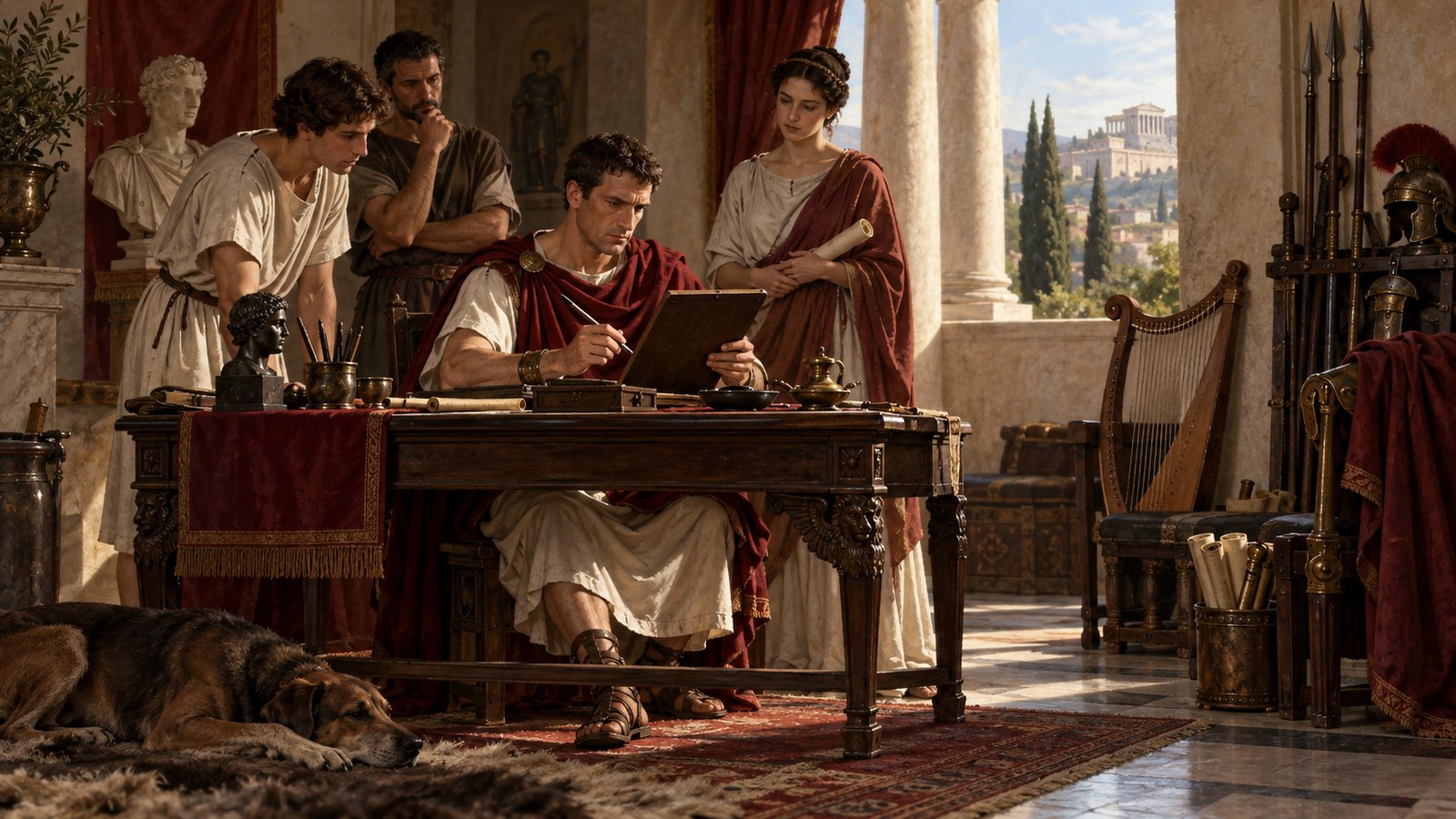
The chapter’s skills are not identical, but the final anecdote gathers many of them. Excellent memory helps retain a model. Facility in two languages makes varied content manageable. Improvised prose and verse demand speed. Music trains controlled performance, while weapons and riding belong to practiced physical response. Handwriting imitation joins perception, memory and movement in a small space.
Suetonius may be shaping these details to create a coherent admired figure. His list is biography, not a neutral skills examination. The claim that Titus could imitate any hand should therefore be read as part of that literary portrait, with its taste for compressed virtues and telling personal habits.
Still, the forgery joke resists perfect polish. It is too pointed to be a bland compliment. Titus’s own reported line concedes that mastery can make legitimacy harder to see. The better the copy, the more knowledge a viewer needs about where, when and by whom it was produced.
The tablet in the secretaries’ room remained a game because witnesses saw Titus make it. Outside that room, resemblance could impersonate authority. Suetonius preserves no forged document, only the future emperor’s awareness of the possibility. The surviving evidence is therefore not a crime but a boundary drawn in laughter.
Titus could speak without a prepared text, catch speech rapidly and reproduce another person’s hand. Each gift shortened the distance between perception and performance. His joke supplied the necessary pause. A hand could be copied in moments; trust in whose hand it was required something beyond technique.
Sources
Suetonius, Life of Titus, section 3.