
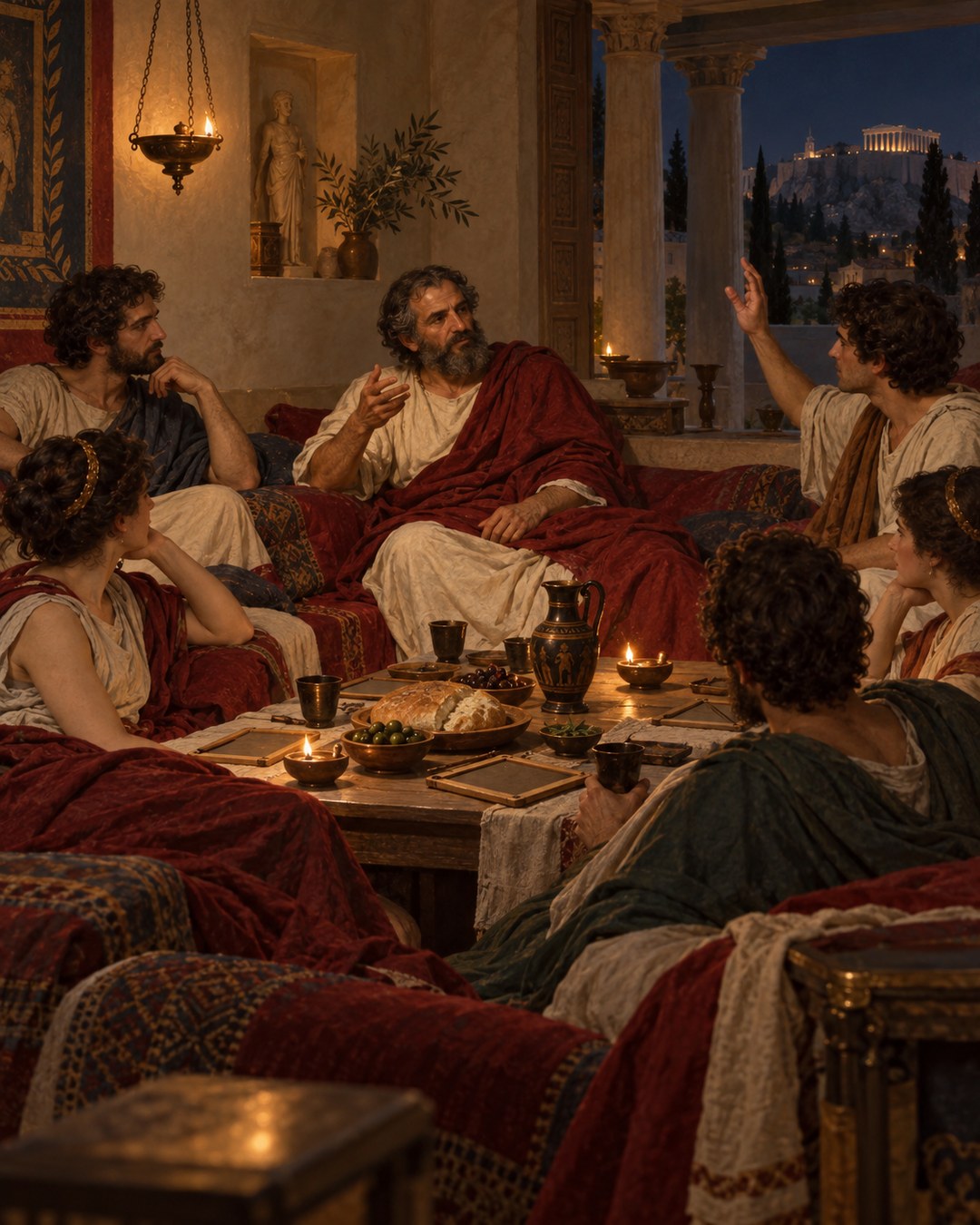
No guest arrived at Taurus’s house empty-handed, although the expected contribution could not be eaten. The philosopher served a simple meal in Athens. His students supplied the luxury: each person had to think up one ingenious question before coming to dinner.
Food came first. Only after eating ended did the questions begin. They were not meant to sound like formal lectures. Aulus Gellius describes small, teasing problems suited to a mind enlivened by wine: when exactly does a dying person die, when does someone rising become upright, and at what instant does a learner become an artist?
The arrangement turned hospitality into a compact educational machine. Taurus gave the room, table and meal. Every guest prepared something worth sharing. Laughter opened the discussion, but it did not close it. When someone dismissed the riddles as idle tricks, Taurus traced one of them to Plato and the difficult problem of transition between opposite states.
A Simple Meal Set the Price of Admission
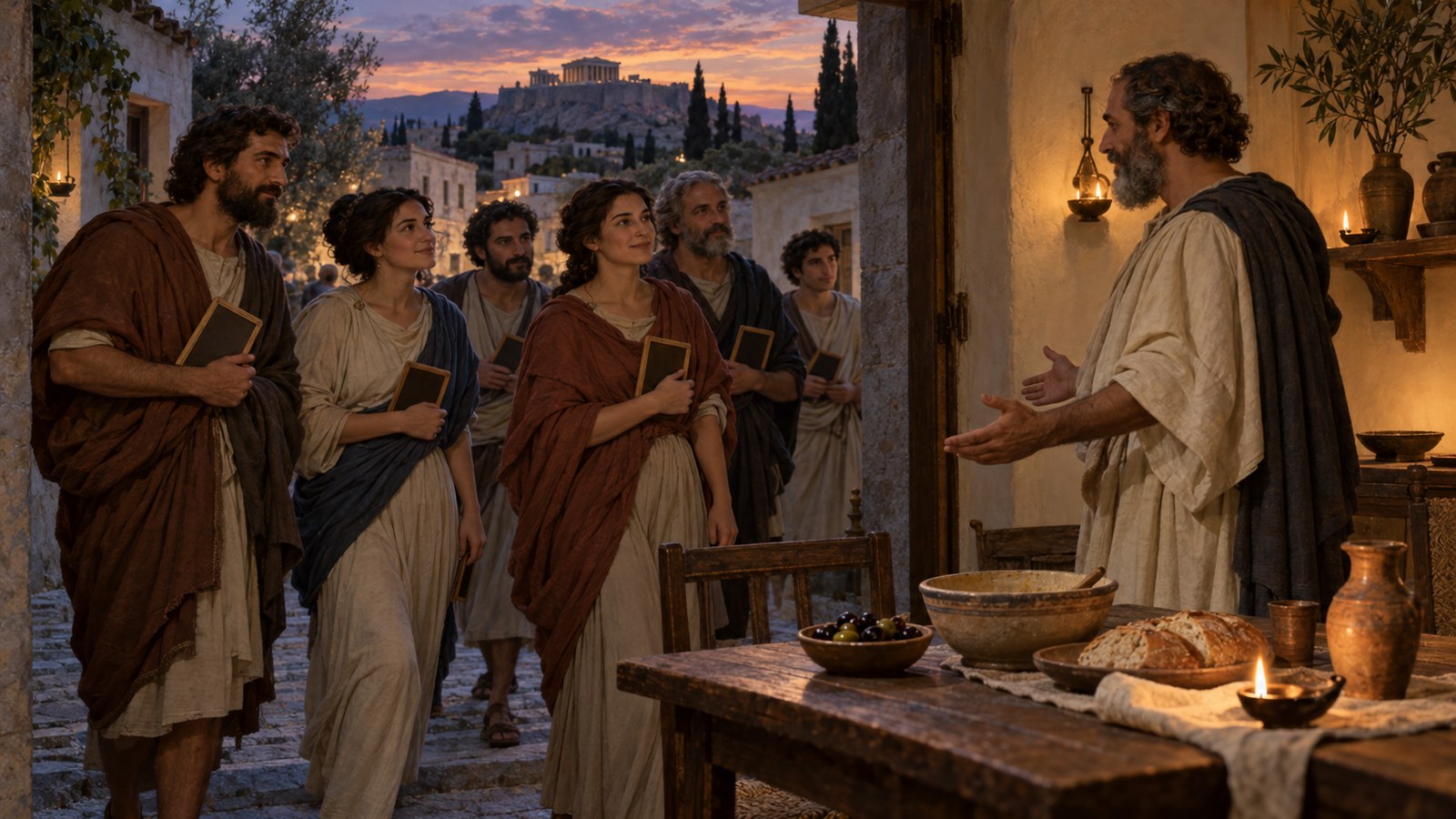
Gellius places the custom among people close to Calvenus Taurus, the Platonist teacher he knew while studying at Athens in the second century. This was not a public banquet or an anonymous lecture crowd. Taurus invited members of his circle into his home, where familiarity carried an obligation.
Gellius jokes that the guests were not allowed to come wholly tax-free. The phrase makes the dinner sound like an assessment, but Taurus did not demand expensive provisions. The meal was explicitly simple, and the contribution was not a delicacy. Guests brought subjects for thought instead.
That distinction protected the character of the gathering. A wealthy student could not dominate by arriving with rarer food or better wine. The useful offering depended on preparation. Each person had to notice a problem, shape it so others could grasp it and remember it long enough to place it before the group.
The custom reveals a different side of the teacher who used Euclides’s dangerous night journeys to shame sleepy pupils. In that lesson, Taurus contrasted heroic effort with rich young men who kept philosophers waiting at their doors. At dinner he built diligence into the invitation itself. Anyone could enjoy the meal, but no one was meant to consume the evening passively.
The social balance mattered. Taurus remained host and teacher, yet the raw material did not come from him alone. The students’ prepared questions gave the gathering its sequence. Authority operated by receiving contributions, choosing how seriously to treat them and showing where a small puzzle might lead.
Eating Ended Before the Arguments Began
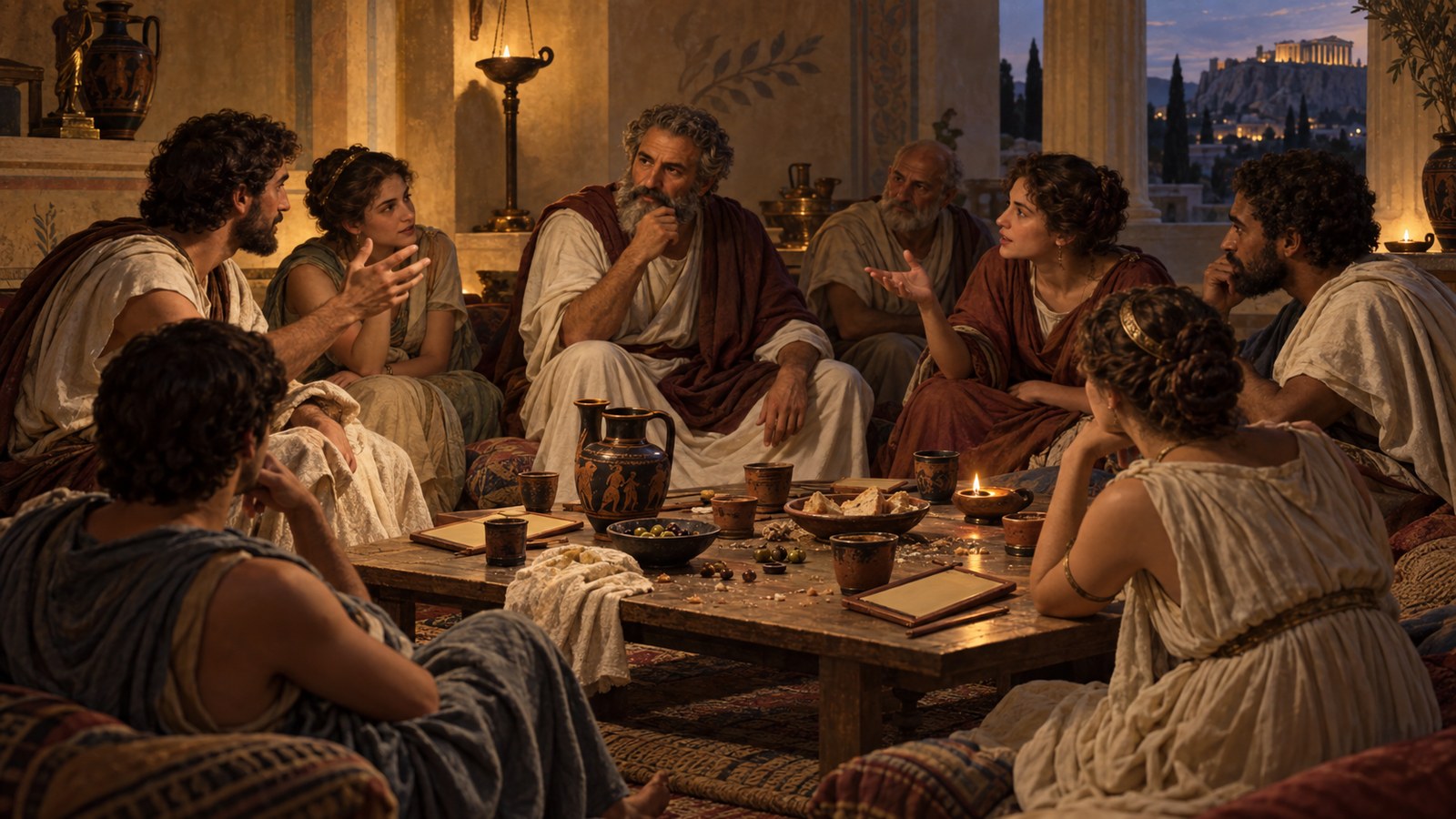
Gellius is precise about timing: when the eating ended, conversation started. That order kept the meal from becoming an interrupted seminar. Bread, side dishes and cups could establish ease first; focused exchange followed when hands and attention were freer.
Nothing in the passage gives a menu, a guest count or the strength of the wine. Those details should not be invented. What survives is enough to recover the rhythm: arrival with a question already prepared, a modest shared meal, then a change in activity as the circle turned toward its intellectual contributions.
Wine was part of the atmosphere, but Gellius does not describe uncontrolled drunkenness. He says the problems could pique a mind enlivened by wine. The point is stimulation rather than collapse. The questions had to be light enough for the table and sharp enough to hold a group’s attention after eating.
This makes Taurus’s supper very different from Trimalchio’s theatrical feast of deceptive dishes. Petronius fills that fictional banquet with wealth, surprise and status display. Gellius’s teacher strips the food back and lets the surprise come from an argument. One host makes guests stare at what is served; the other expects them to serve something from their own minds.
The separation of courses and conversation also gave the teacher a clean threshold. A prepared question did not vanish into casual chatter while cups were passed. It received a distinct hearing. In a culture where much advanced education depended on voice and presence, the order of an evening could function like the order of a text.
Three Tiny Questions Broke Time into Instants
Gellius preserves a family of puzzles about change. Does a dying person die while life remains, or after death has already taken hold? Does someone rise while still seated, or only once standing? Does a student become an artist during learning, or after already becoming one?
Every easy answer appears to borrow the condition it is trying to explain. If the person is alive, death has not yet arrived; if dead, the act of dying seems complete. If seated, the person has not risen; if standing, the rising is over. The same trap catches the learner and the finished practitioner.
These were good dinner questions because no equipment was required. A speaker could state one in a sentence, and everyone could test it against an ordinary action. Rising from a couch made the puzzle physically present. The difficulty did not come from obscure vocabulary but from trying to put an exact boundary around continuous change.
Gellius admits the comic effect. Whichever side a guest chose could sound absurd, while choosing both or neither seemed worse. The group was not embarrassed by laughter. Play exposed how confidently ordinary verbs hide unresolved sequences.
The questions therefore rewarded preparation without rewarding mere display. A guest did not need a long speech. The best contribution was portable, clear and resistant to the first answer. It could pass around the room like a cup and return altered by everyone who handled it.
Taurus Refused to Leave the Riddle as a Joke
Some participants apparently called the puzzles pointless sophisms. Taurus answered by changing the scale of the evening. Serious philosophers, he said, had debated precisely when the term “die” properly applied. Some left a residue of life in the moment of dying; others assigned the whole interval to death.
The teacher did not deny that the question was playful. Instead, he rejected the assumption that play and seriousness were opposites. A compact verbal trap could uncover a genuine philosophical difficulty if someone knew how to connect it to a larger argument.
Taurus attributed a distinctive solution to Plato. Opposing states such as life and death could not occupy the same moment without contradiction. Plato therefore named an intermediate instant, a sudden boundary that belonged wholly to neither side. Taurus told the circle that the term could be found in the Parmenides.
Gellius does not reproduce the entire Platonic discussion, and the dinner should not be expanded into a complete exposition of that dialogue. What matters for the scene is the turn. A question prepared as table amusement becomes a doorway into a text and a longstanding dispute.
That turn shows the work of the teacher. The students generated examples; Taurus supplied depth, genealogy and a route for further reading. He did not replace their contributions with a set speech. He demonstrated how to recognize when a small question had touched a much larger one.
The Dessert Was a Habit of Attention
At the end, Gellius returns to the language of food. The questions were the guests’ contributions and, in Taurus’s own playful description, the sweetmeats of dessert. The metaphor completed the exchange: modest food nourished the body, while prepared problems prolonged the evening’s appetite.
The custom also made memory practical. Gellius later carried at least one dinner’s questions into the Attic Nights. What began as speech in a private room survived because a participant recognized the form as worth recording. The meal vanished; the designed habit of contribution remained reproducible.
We should not turn the gathering into a modern classroom in disguise. It belonged to an adult philosophical circle shaped by ancient hospitality, status and oral argument. Nor does Gellius say every dinner followed an identical script. He reports a custom observed among Taurus’s intimates and gives one set of examples.
Within those limits, the passage catches education at unusually human scale. Students arrived before the teaching material was complete. A shared table created trust, wine loosened attention, prepared riddles distributed responsibility, and the host decided when amusement deserved a more exact answer.
Taurus’s real charge was not one brilliant solution. It was one question brought in good faith. That rule made curiosity visible and prevented the dinner from becoming another service delivered by a philosopher to comfortable clients. Every person had to help build the conversation before tasting its intellectual dessert.
Sources
Aulus Gellius, Attic Nights, 7.13.