
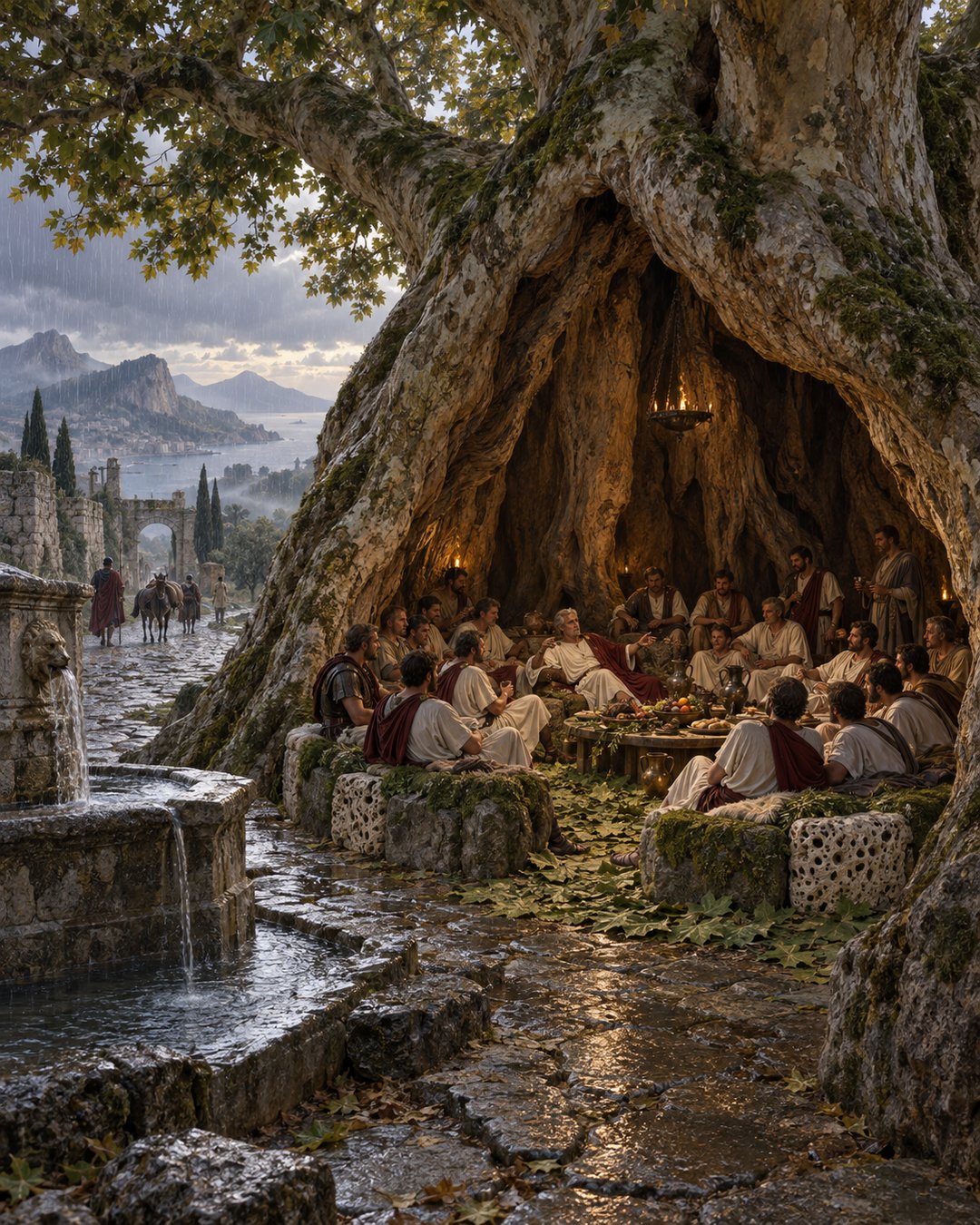
Rain crossed the Lycian fields, but Licinius Mucianus could not hear it striking the leaves above him. He was eating inside a plane tree with eighteen members of his retinue. The hollow enclosed stone seats, pale pumice and moss; loose leaves supplied more than enough material for their couches. Wind did not reach the table.
Mucianus had been consul three times and had recently governed the province as its legatus. He chose to preserve this meal for posterity, according to Pliny the Elder, because the setting defeated the usual vocabulary of magnificence. Marble, paintings and a ceiling bright with gold offered less pleasure than a living chamber beside the road.
The anecdote sits in Pliny’s survey of remarkable plane trees. It is not a botanical measurement alone and not simply a celebrity dinner. Mucianus makes the tree legible by entering it, furnishing it with bodies and comparing its shelter with rooms built to advertise wealth. The banquet turns natural scale into witnessed experience.
A Fountain and a Road Framed the Colossal Trunk
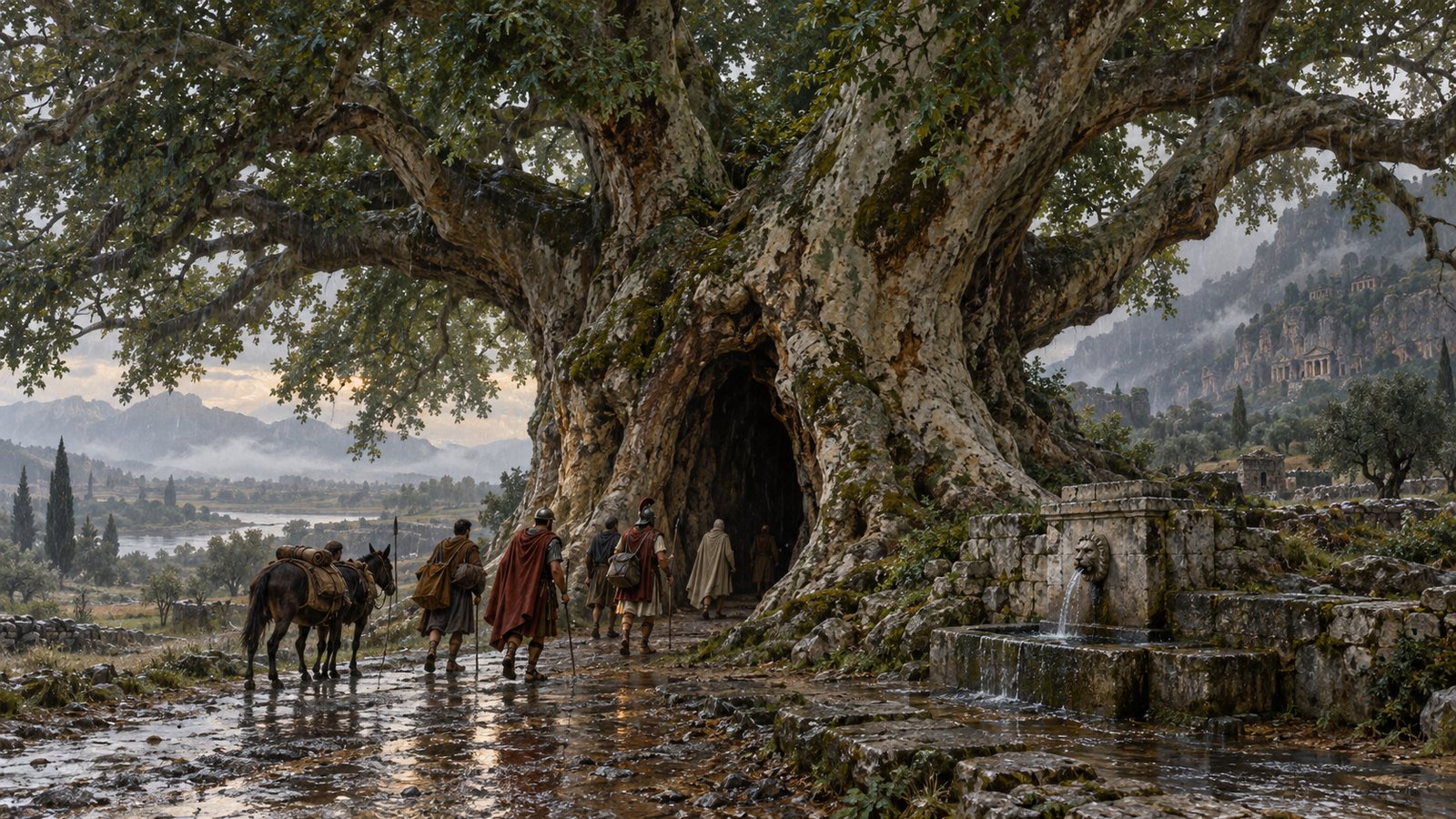
Pliny locates the tree in Lycia near a fountain of exceptional coolness and beside a road. Those details keep the marvel attached to travel rather than floating in an unnamed wonderland. A passerby could approach from a route, feel the water and encounter the opening in the trunk.
The cavity formed what Pliny calls a kind of house. His stated width is eighty-one feet, a figure so large that it demands caution from a modern reader; the point here is what the ancient text claims, not a fresh measurement of a surviving specimen. Pliny supports the impression with parts that can be pictured separately. The crown looked like a grove. Huge branches, each compared with an ordinary tree, carried shade far across the fields.
The scale worked outward and inward at once. From outside, one tree multiplied into the appearance of many. From inside, wood enclosed a room. That reversal distinguishes the scene from the careful transport of young trees with their native soil, where Roman expertise moved manageable plants into designed ground. The Lycian plane could not be reduced to a decorative unit. Visitors had to enter the structure it had made.
Pliny begins the same chapter with admired plane trees along the walks of the Academy at Athens. One reportedly sent roots thirty-three cubits outward, beyond the reach of its branches. Root span and hollow width are different measures, but both make hidden growth visible through numbers. The chapter teaches readers to imagine trees not as flat crowns in a landscape, but as systems extending under soil, over fields and around human bodies.
Mossy Seats Made the Hollow Look Like a Grotto
The interior was not empty timber. A circle of stone seats stood within it, mixed with pumice overgrown by moss. Pliny says this completed the likeness to a grotto. The description blurs any clean division between natural cavity and arranged room.
Someone had placed or shaped the seating, yet weather and growth continued the work. Stone provided the circle, porous pumice altered its texture, and moss softened the surfaces. The result was furnished without becoming an ordinary dining chamber. It carried traces of deliberate use while remaining visibly alive and damp.
A Roman formal dining room usually organized reclining bodies, service and rank through architecture and furniture. The placement of the principal dining couch could make precedence part of the room. Inside the Lycian tree, Pliny does not map who occupied which place or describe elaborate tableware. His attention stays on what the trunk and its modest fittings did: enclose a circle, block weather and hold a group.
That omission is revealing without proving that rank disappeared. Mucianus still arrived with a retinue, and his account centers his enjoyment. The tree did not erase hierarchy. It briefly replaced the surfaces through which hierarchy usually displayed itself. Moss stood where polish might have shone; bark and living wood occupied the place of decorated walls.
Nineteen Diners Turned Size into Testimony
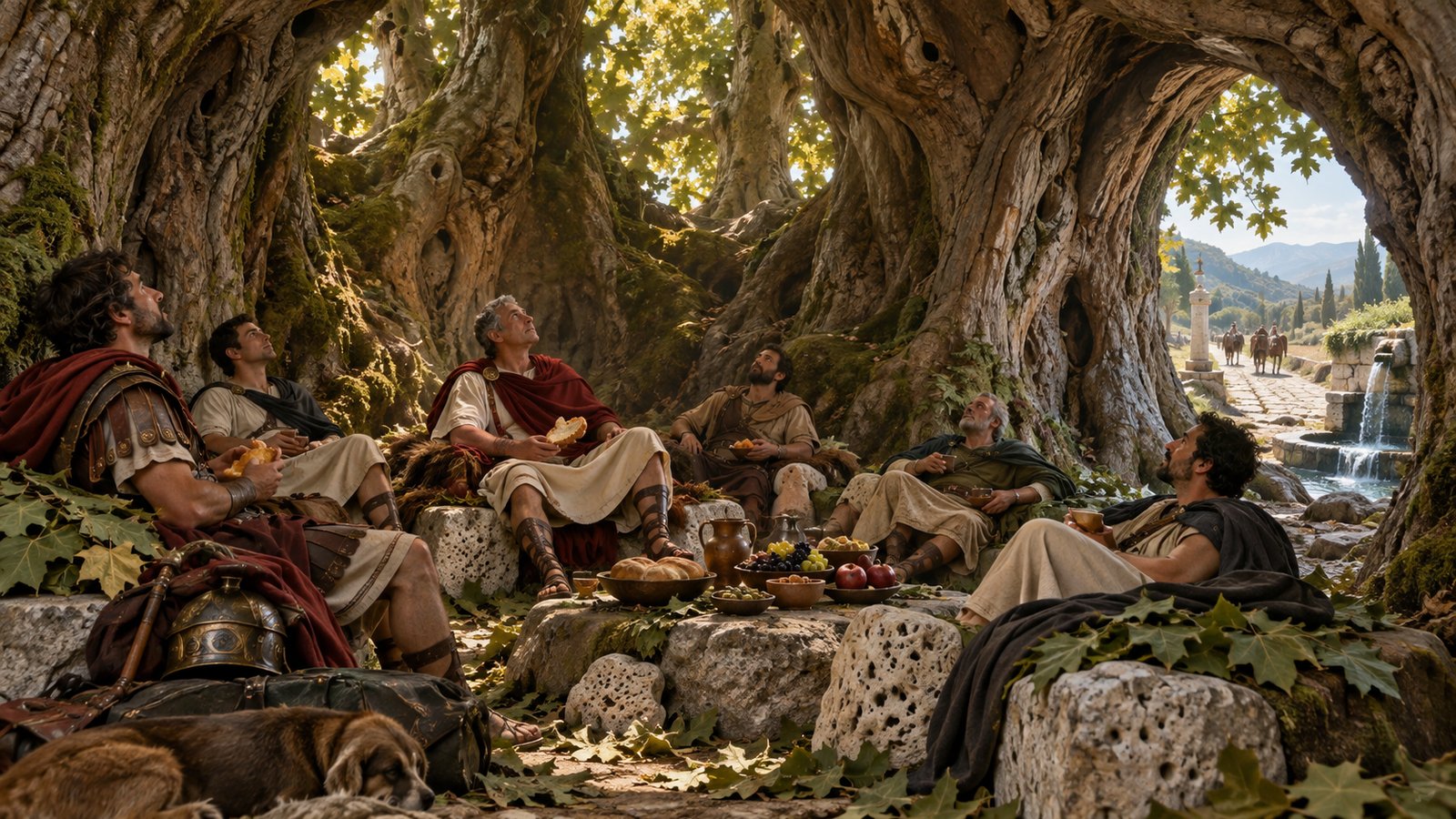
Mucianus did more than say the plane was enormous. He reported that he and eighteen companions sat down to eat inside it. The human count provides scale through occupation. A chamber that could receive nineteen diners, their couches and a meal became easier to imagine than a bare number of feet.
The retinue also served as a body of witnesses. Pliny presents Mucianus as a senior public figure—three times consul and recently provincial legate—whose office and travel gave weight to a report from Lycia. Status did not make every marvel true, but within the narrative it supplied a named route by which the observation reached Rome and later readers.
Mucianus’s testimony is sensory. Leaves were abundant enough to serve as couch material. The hollow stopped every gust. Most strikingly, he tried to hear rain pattering on the foliage and failed. Silence converted the canopy into evidence. Instead of merely declaring the shelter thick, he described a sound that should have arrived and did not.
The detail creates a miniature scene of attention: a statesman pauses over a meal and listens upward. Around him are companions, food, rough stone, moss and gathered leaves. Beyond the opening, rain reaches the landscape. The marvel lies not in a supernatural event but in the mismatch between expected weather and the protected interior.
The Tree Defeated a Palace in Mucianus’s Comparison
Mucianus claimed that he enjoyed the meal more than one set amid gleaming marble, numerous paintings and a ceiling radiant with gold. These were not random expensive materials. Together they formed a compressed image of elite interior display: imported surface, collected art and light reflected from precious decoration.
The plane tree answered each element without imitating it. Stone appeared, but as mossy seating rather than smooth revetment. The trunk offered images through irregular grain and shadow rather than painted panels. Leaves filtered light overhead without a gilded ceiling. The comparison allowed an experienced elite diner to praise simplicity while the scale of his retinue and the fame of his report remained unmistakably elite.
That tension matters. The banquet was modest in setting, not socially ordinary. Mucianus could turn access to a distant provincial wonder into cultural capital precisely because he possessed office, mobility and listeners. His rejection of palace splendor was itself a polished story, one designed to be remembered.
Yet Pliny preserves a genuine reversal in the objects of attention. A temporary Roman spectacle could raise marble, glass and gilded wood for a single month, making expense and engineered impermanence part of the achievement. The Lycian chamber required no named patron and no dismantling crew. Human additions were slight beside the organism that held them.
Two More Plane Trees Changed the Kind of Wonder
Pliny follows the Lycian account with a second arboreal dining room. During the reign of Emperor Caius, a plane tree near Velitrae carried broad benches from branch to branch like floors in a multi-storey house. Caius hosted fifteen guests there, with attendants, and called the triclinium his “nest.”
The pairing sharpens the difference. Mucianus entered a cavity and emphasized shelter from wind and rain. Caius occupied constructed levels among branches and added materially to the shade. One scene admired an interior discovered in the trunk; the other made a platformed room aloft. Both used a meal to prove that a tree could become architecture, but they staged power differently.
A third plane at Gortyna moved the chapter from occupation to memory. Pliny says it never shed its leaves and carried an old legend that Jupiter lay with Europa beneath it. Slips were planted elsewhere in Crete because people loved novelty, and they reproduced the parent tree’s unusual character. Here wonder traveled through propagation and story rather than a governor’s dinner.
Pliny’s sequence therefore tests three ways a tree could outgrow ordinary botany: one became a hollow house, another a layered imperial nest, and another a living anchor for myth. The Lycian plane remains the most tactile. It has a road, cold water, moss under the hand, leaves beneath the diners and rain that cannot be heard.
Mucianus’s banquet survives because he made those details compete with luxury. The tree did not need to resemble a palace to beat one. Its claim on memory came from doing the basic work of architecture—holding people together and keeping weather outside—through wood, age and growth. Nineteen diners supplied the scale; a failed attempt to hear rain supplied the proof.
Sources
Pliny the Elder, Natural History, 12.5.