
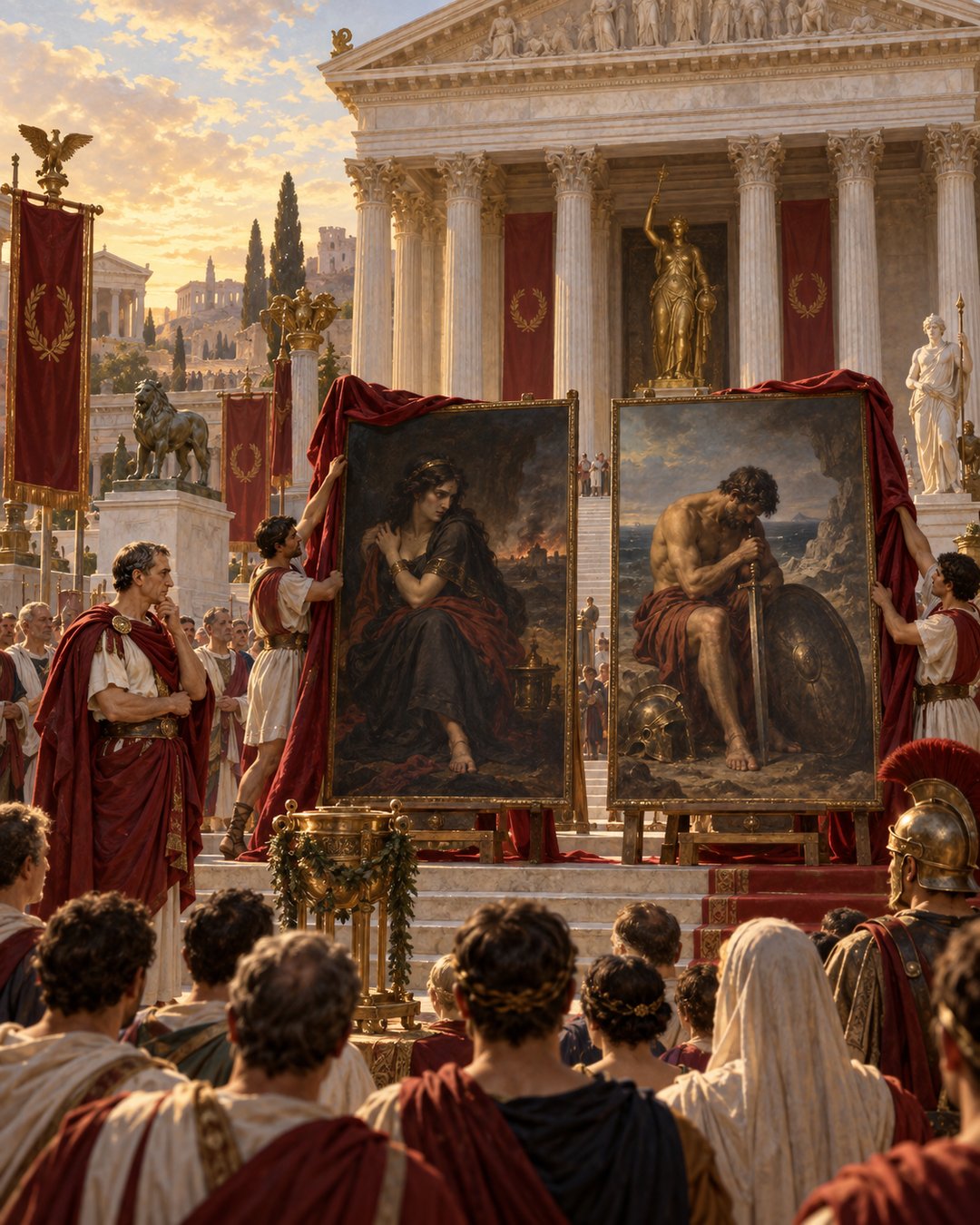
Eighty talents changed hands for two painted panels: Medea caught inside her terrible decision and Ajax destroyed by his own shame. Julius Caesar bought both from the Greek painter Timomachus, then carried them into the public architecture of his new forum.
Pliny preserves the price in one book of the Natural History. In another, he explains why the purchase mattered. Caesar placed the paintings before the Temple of Venus Genetrix, the divine ancestress claimed by his family, and thereby gave pictures what Pliny calls outstanding public importance.
The transaction was therefore only the first movement. Money removed Medea and Ajax from one owner; location made them part of Roman civic experience. Their path from an artist’s panels to a dynastic temple shows how collecting, ancestry and public access could be fused into one political image.
The Price Entered a Catalogue of Astonishment
Pliny lists Caesar’s purchase among acts designed to establish the extraordinary value of art. King Attalus, he says, bid one hundred talents for a single work by Aristides of Thebes. King Candaules paid the weight of a sizeable painting in gold. Demetrius the Besieger even spared part of Rhodes because setting it alight might destroy a picture by Protogenes.
Caesar’s eighty talents belong to this register of rulers using wealth or force around objects whose value could not be reduced to timber and pigment. The number is precise enough to sound like an account entry, yet Pliny’s sequence turns it into a measure of desire. Powerful men altered purchases, sieges and cityscapes because painted surfaces had become difficult to replace.
The piece on Cicero’s half-million-sesterce citrus table follows another luxury price into elite competition. A table remained usable furniture even while rare grain made it a fortune. Timomachus’s pair worked differently: their value depended on singular images and the reputation of the hand that made them.
Pliny names the subjects rather than describing their dimensions. Medea and Ajax were both figures suspended near catastrophe. He does not tell us which moment Timomachus chose, what the panels looked like in Caesar’s day or how viewers interpreted them. The record supports cost, subject, maker and destination; it does not license a reconstruction of every gesture.
The figure of eighty talents does not by itself reveal how seller and buyer reached a valuation. Pliny supplies no negotiation, rival bidder or inventory of pigments. What he does provide is a comparison class: a hundred-talent bid, a picture exchanged for its weight in gold, and a siege decision altered by fear for a painting. Caesar’s purchase sits among stories in which rulers made exceptional value legible through exceptional conduct.
Reading Pliny’s two notices together also prevents the number from swallowing the story. Book 7 counts the purchase among astonishing prices; Book 35 returns to the same panels while tracing the dignity of painting at Rome. The repeated pair can therefore answer two different questions: how much did famous art command, and what could a Roman patron make that art do after he obtained it?
A Temple Forecourt Converted Ownership into Audience
The Temple of Venus Genetrix was not a neutral gallery. Its very title named Venus as ancestress or mother. Setting Timomachus’s tragedies before that sanctuary placed Greek prestige beside a Roman patron’s charged religious architecture.
Pliny’s wording makes placement the decisive act. Pictures had already stood in Rome’s forum. He remembers an unbecoming Gaul sticking out his tongue and an Old Shepherd with his Staff that prompted a rude assessment from a visiting Teuton. Caesar did not invent public viewing. He intensified its status by attaching celebrated, costly works to a new monumental center.
A purchaser can hide an expensive object and still possess it. Caesar did the opposite. Senators, petitioners, clients, veterans, traders and passers-by moving through the forum could encounter Medea and Ajax at the threshold of a temple bearing the title Venus Genetrix. Access did not make the ownership politically innocent; it made the ownership visible.
This distinction helps explain why the eighty talents are not merely evidence of extravagance. The outlay acquired cultural authority, while the dedication distributed an experience under Caesar’s name. Viewers received the pictures, but they also received a reminder of the man who had paid for and positioned them.
Agrippa Argued That Great Art Should Not Vanish into Villas
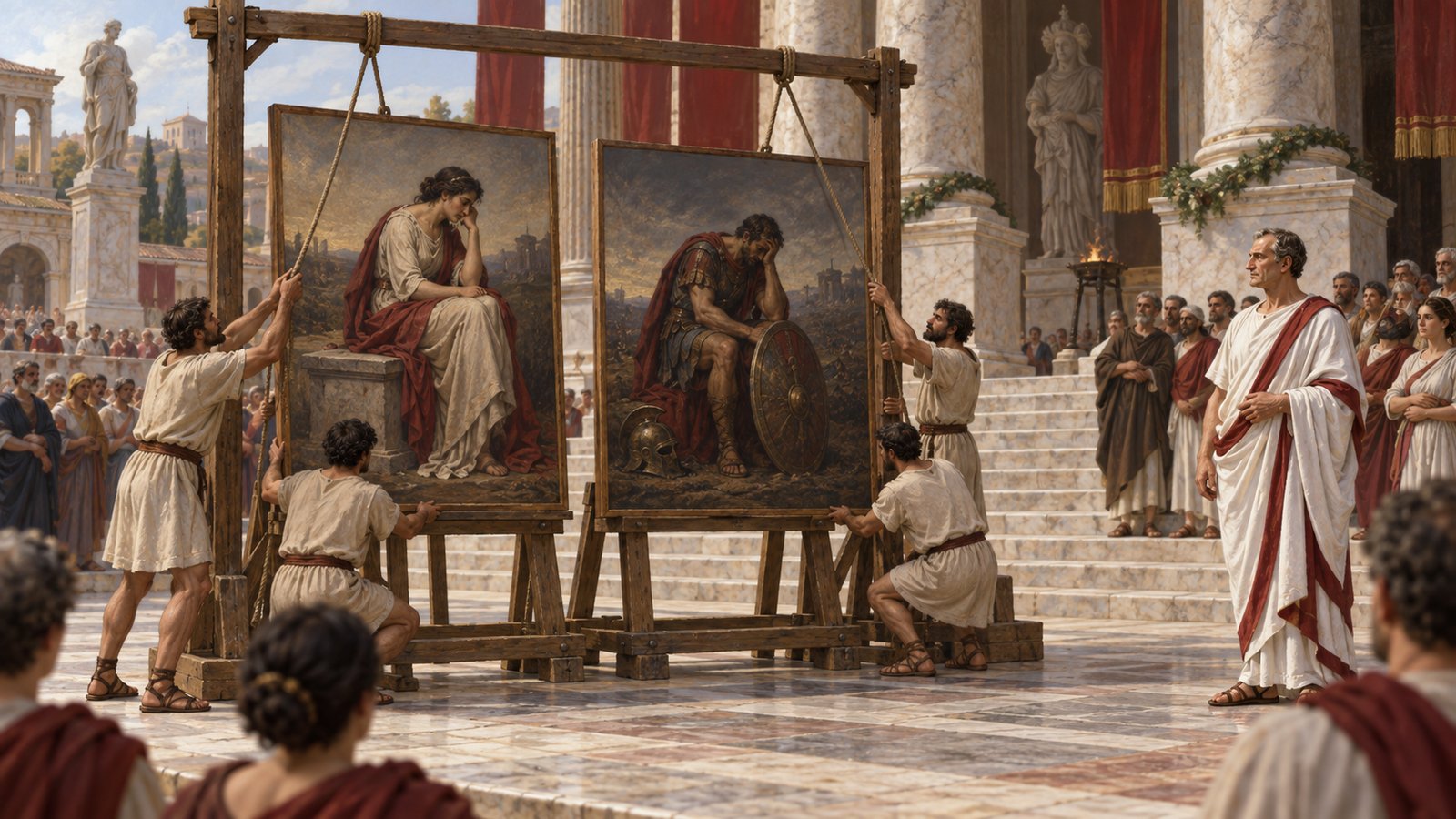
Pliny follows Caesar with Marcus Agrippa and preserves a striking argument. Agrippa delivered a speech favoring the treatment of pictures and statues as public property. Pliny approves the principle, saying it would have been better than banishing art to country houses.
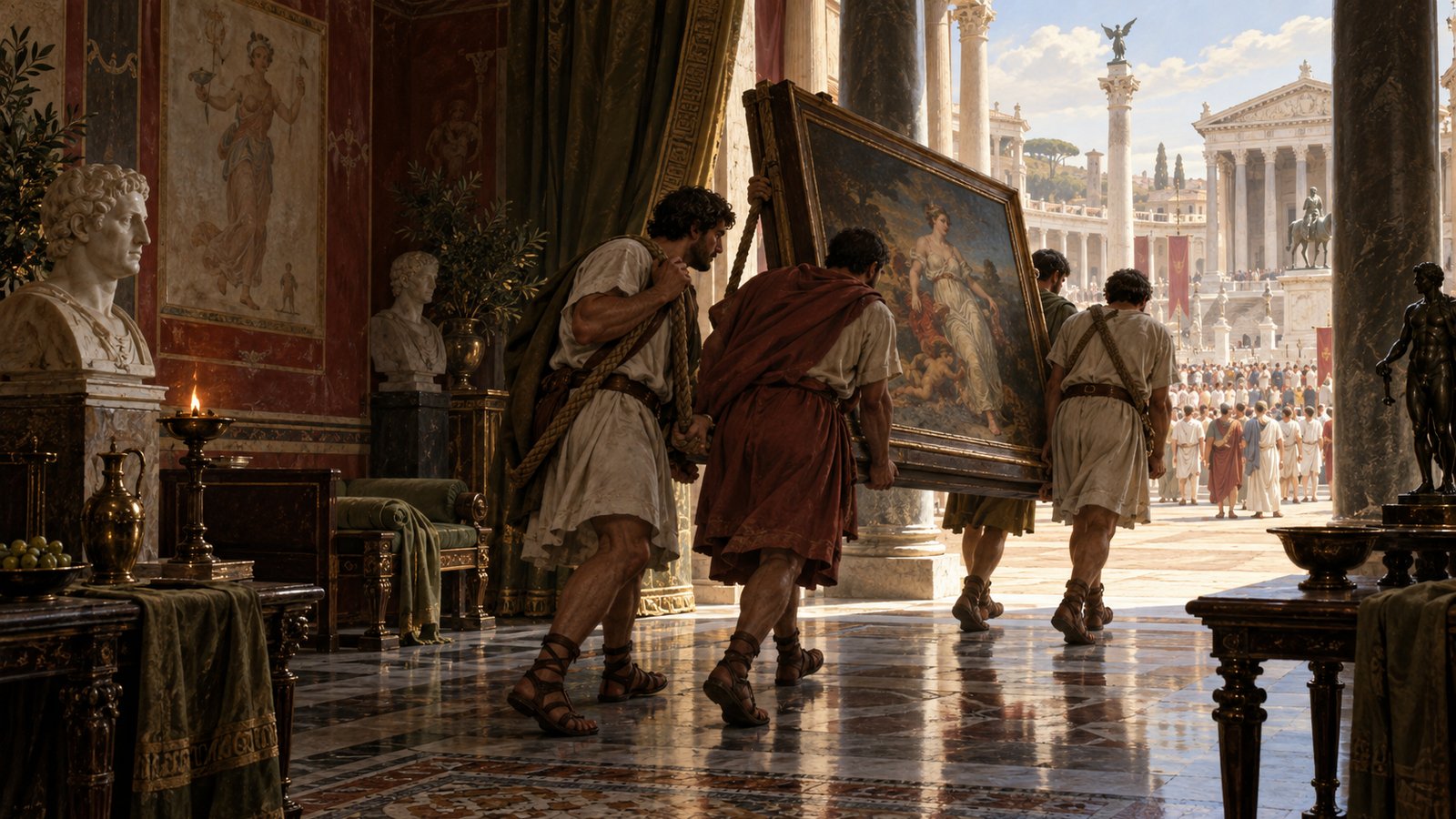
The phrase reveals the rival destination. Roman wealth could pull remarkable objects away from shared urban spaces and into estates where access depended on the owner. Agrippa’s proposal treated visibility as a civic question: who should be allowed to stand before works whose fame exceeded one household?
Agrippa was not outside the market he criticized. Pliny immediately notes that he paid Cyzicus 1,200,000 sesterces for two pictures, an Ajax and an Aphrodite. The second Ajax creates an accidental echo of Caesar’s pair. A tragic subject could be purchased again, transported again and made to serve another Roman patron.
Nor did Agrippa keep every picture at the level of formal principle. Small paintings were set into the marble in the hottest part of his baths. Pliny says they were removed during later repairs. The detail is wonderfully physical: heat, marble, moisture and maintenance surrounded objects whose civic status could sound abstract in a speech.
The movement between private purchase and public display resembles the tension inside the story of Protogenes finding painted foam with a thrown sponge. There the image survives through accident at the artist’s surface. In Pliny’s account of patrons, survival depends on decisions about war, walls, baths, temples and access.
Augustus Made the Forum a Sequence of Painted Claims
Augustus pushed the practice further. In the busiest part of his forum he placed two pictures: one joining War with Triumph, another joining the Castors with Victory. These were not labels for a quiet collection. They were themes chosen for an urban route where repeated passage could turn imagery into political atmosphere.
He also embedded paintings in institutional walls. Pliny describes a work by Nicias set into the senate house in the Comitium and another by Philochares showing an elderly father and his son, with an eagle carrying a snake above them. The second picture leads Pliny to a sharp conclusion about memory.
Glaucio and his son Aristippus would otherwise have remained obscure, he says, yet the painting kept them before the senate centuries later. Public art did not only magnify famous patrons. It could preserve people whose names survived because an image occupied a durable seat of government.
The study of Zeuxis and Parrhasius testing illusion against birds and a fellow painter explores how viewers judged skill. Caesar’s purchase raises another kind of judgment: who chose the audience, who controlled the wall and what political setting told viewers to notice.
Medea and Ajax crossed that threshold when Caesar’s money met the forecourt of Venus Genetrix. The paintings remained Greek works with tragic subjects, but their Roman placement gave them an additional biography. They became proof that a conqueror could turn acquisition into public magnificence without surrendering credit for the gift.
Pliny’s chain of examples refuses a simple choice between generosity and possession. Caesar paid and displayed. Agrippa argued against private exile while spending heavily himself. Augustus filled civic interiors with images that carried victory, divinity and memory. Public access expanded, but each act also strengthened the patron who arranged it.
The eighty talents are memorable because they supply scale. The temple forecourt supplies meaning. Caesar did not merely own Timomachus’s Medea and Ajax; he made Rome see them in a place built to make Rome think about Caesar.
Sources
Pliny the Elder, Natural History 7.126 and 35.25–29.