
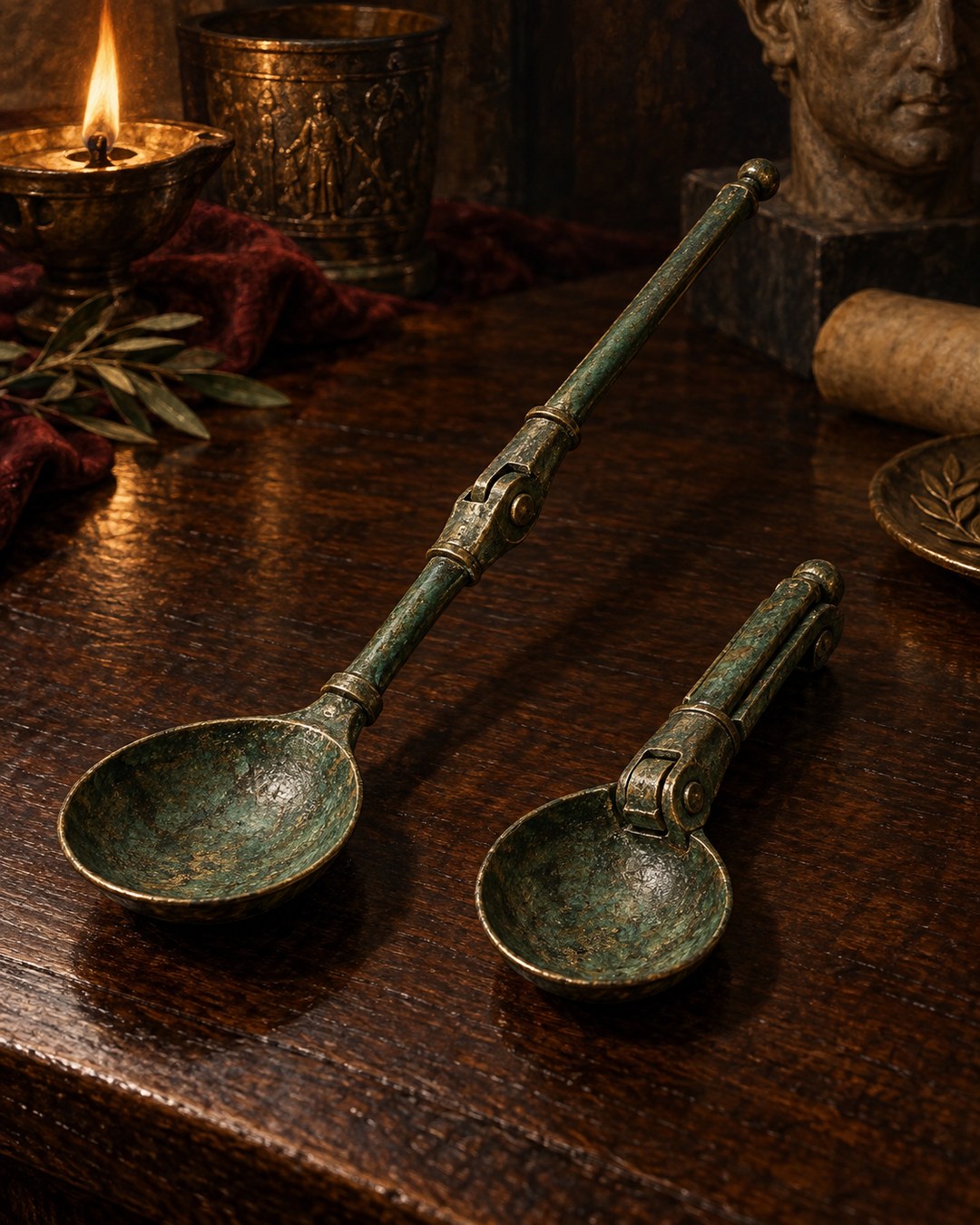
The museum record gives the object two lengths. Extended, the Roman bronze ladle measures 46.8 centimetres. Folded, it measures 26.1. Between those positions, 20.7 centimetres of awkward reach disappear.
Nothing supernatural happens to the metal. The bowl remains a bowl, and the handle still supplies the distance needed to dip and pour. A joint simply lets one section turn back against another when the implement is not working.
That paired measurement makes this small survivor unusually eloquent. Ritual utensils are often discussed as symbols. Here, the catalogue preserves evidence of a practical problem as well: how to contain a long ceremonial tool between the moments when its full reach was required.
The Catalogue Records Two Versions of One Object
The Metropolitan Museum of Art identifies the piece as a bronze simpulum, or ladle, and also uses the object name kyathos. It assigns the implement to Roman culture, the Mid Imperial period and the second century CE. Those labels establish what the object is and where the museum places it; they do not require an invented owner or find scene.
The dimensions provide the article’s firmest physical evidence. The unfolded length is 18 7/16 inches, rendered by the museum as 46.8 centimetres. The folded measurement is 10 1/4 inches, or 26.1 centimetres. Subtracting one catalogue value from the other gives a reduction of 20.7 centimetres.
Another comparison makes the change easier to picture. Folded, the ladle occupies about 56 percent of its working length. Almost half the long profile can therefore be taken out of the storage problem without detaching a loose component.
The record classifies the object among bronzes. It also notes that the Rogers Fund brought it into the museum in 1988. Those modern collection facts matter because they define the evidence available to us: a catalogued artefact with material, date and paired dimensions, not a literary description that happens to mention a convenient hinge.
The two positions should not be mistaken for two different tools. They are alternate arrangements of the same implement. Extended length answers use; folded length answers what happens afterward. The catalogue holds both conditions together.
This is a different kind of mechanical story from the chain of bronze buckets that lifted water above a wheel’s height. That machine multiplied repeated movement. The folding ladle solves a quieter problem by changing its own outline.
A Long Handle Was Useful Until the Work Ended
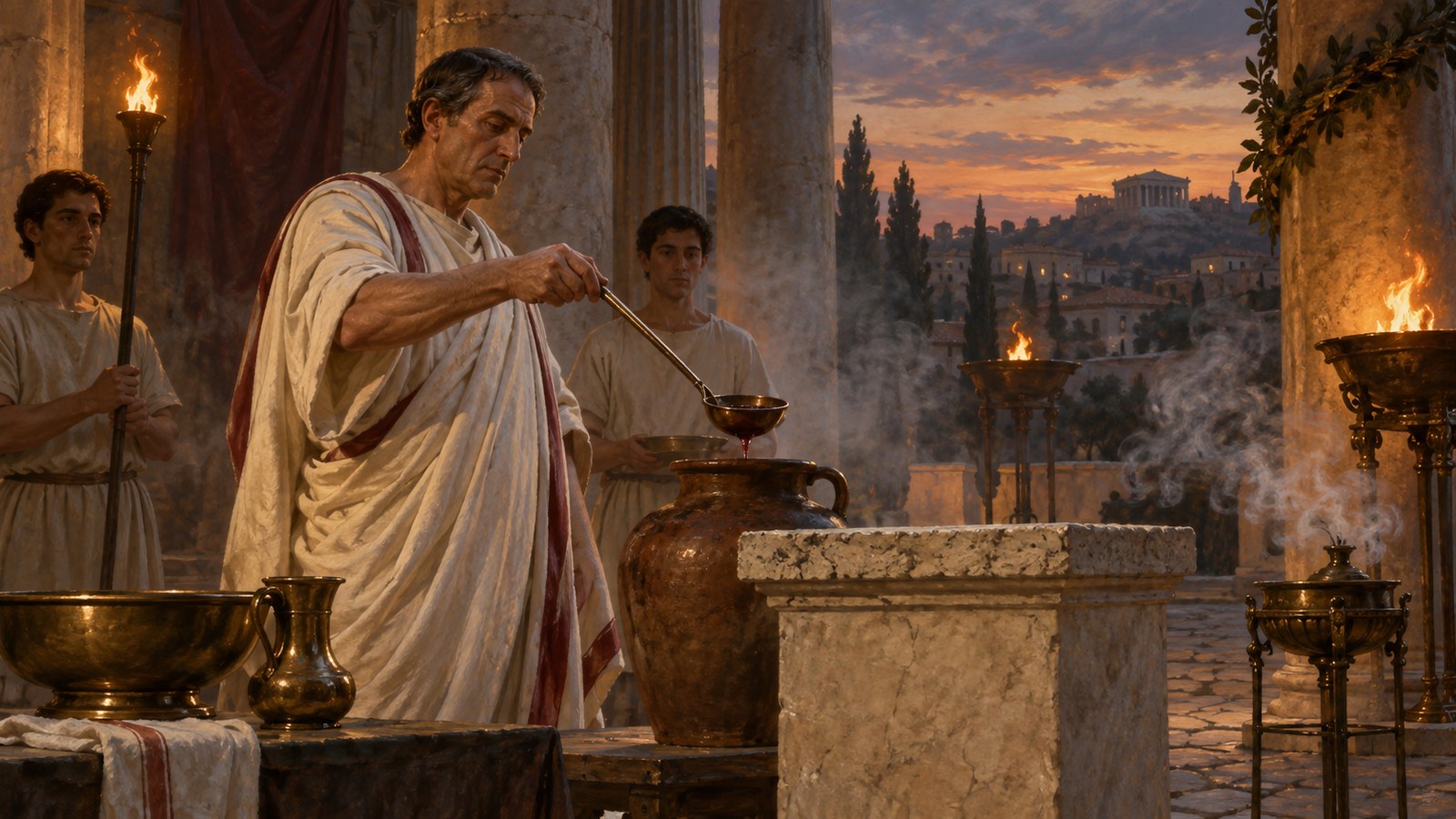
A simpulum belonged to the world of dipping, tasting and pouring. The traditional description presents it as a small vessel or long-handled ladle used in sacrifice, including libations and the tasting of wine or other liquid associated with the rite. Its identity lay in the combination of a receiving bowl and the reach supplied by the handle.
Reach matters whenever a hand must enter a vessel without following the tool all the way down. A long shaft allows the bowl to descend while fingers remain clear of the liquid and rim. It also allows a controlled portion to be raised and directed. The exact vessel used with this particular museum object is not recorded, so its shape and depth should not be invented. The functional relationship is still visible in the ladle form.
The same length becomes inconvenient after use. A 46.8-centimetre bronze object demands a long drawer, chest or wall space. Its bowl creates width at one end, while the handle extends a vulnerable lever from it. If left projecting, the shaft can catch against another object or receive force far from the bowl.
Folding changes that relationship. At 26.1 centimetres, the implement becomes easier to place within a bounded container and less likely to project beyond nearby equipment. The museum does not tell us which ancient container received it, so we cannot claim a particular box or travel kit. We can say that the recorded shorter state is a storage state made possible by articulation.
The mechanism therefore protects two opposed virtues. During use, the ladle can be long enough to reach. Between uses, it can become compact without surrendering the same bronze sections. The owner does not choose permanently between a short utensil and a long one.
That practical rhythm resembles the material discipline behind Cato’s cycle of issuing, returning and repairing estate clothing, though the objects and settings differ. Both cases make the interval after use part of the item’s design or management rather than treating it as dead time.
The Joint Turned Reach into Stored Length
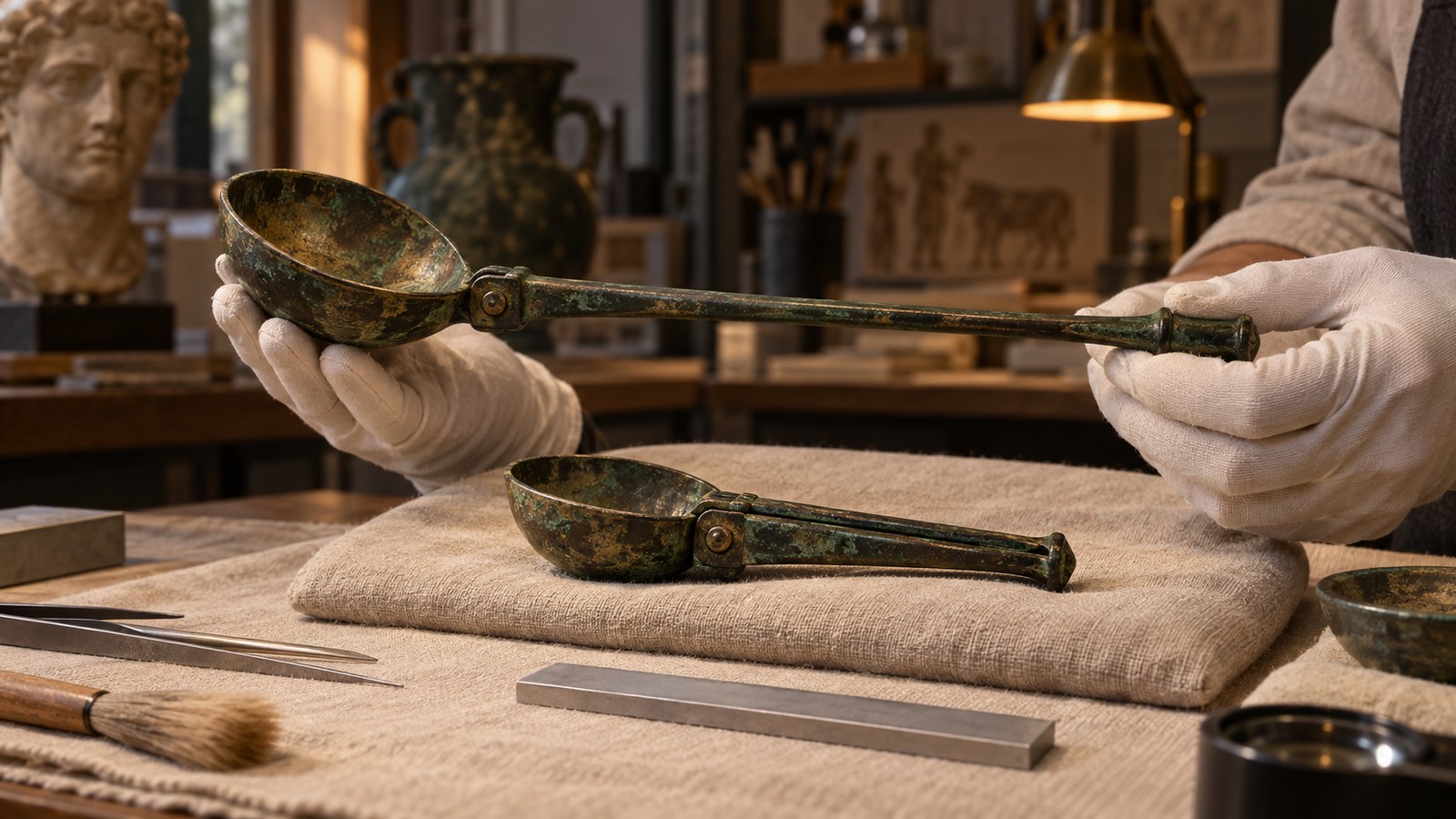
A folding implement requires an intentional break in what could have been a continuous handle. That break is not merely weakness. Properly made, it controls movement around a fixed point and allows the two sections to occupy different alignments.
The museum dimensions tell us the outcome even where a catalogue summary does not narrate the workshop sequence. When open, the sections cooperate to produce the full 46.8-centimetre span. When turned back, their lengths overlap in plan, leaving a 26.1-centimetre package. The reduction is the work performed by the joint.
This is easy to overlook because the ladle’s bowl carries the recognizable function. A viewer sees the part that holds liquid and identifies the utensil. Yet the less conspicuous articulation governs where the whole object can go when empty.
Any reconstruction must keep that engineering modest. The hinge needs a plausible axis and enough metal around it to resist ordinary handling. It should not resemble a modern locking gadget or an impossible chain of floating parts. The surviving object’s lesson is compelling precisely because one controlled movement is enough.
Bronze was not selected in the museum record as an abstract category; it is the material of this object. Its surface now belongs to the artefact’s long history, but the design still communicates through geometry. Bowl, shaft, interruption and second shaft can be read as parts of one sequence.
The paired measurements also discipline interpretation. “Portable” can become a vague compliment applied to anything that can be carried. Here it has numbers. The object does not merely look compact. Its catalogue states how far its length changes, allowing the claim to be tested against an explicit before and after.
Ritual Meaning Did Not Remove Practical Handling
The simpulum could act as a sign of priesthood and as an insignia associated with the College of Pontiffs. Images of the implement also appeared with sacrificial and augural instruments on Roman coins. In those settings, the outline helped viewers recognize religious authority.
An emblem, however, still came from an object people understood as a tool. The bowl and long handle were legible because they belonged to ritual action. The Met’s folding specimen adds a dimension that a small coin image may suppress: a real implement had weight, length and an afterlife between ceremonies.
Roman ritual could demand close control over words, roles and sequence. The division of speaking tasks explored in the four specialists who guarded a public prayer shows how correctness could be distributed among several participants. A ladle belongs to the material side of that same concern. Liquid had to be received, raised and directed by an object suited to the action.
Yet we should not use the folding joint to invent a lost rule. The catalogue does not say that pontiffs were commanded to fold this ladle, that every simpulum articulated or that the piece travelled with one named priest. The evidence supports a narrower conclusion: at least this second-century bronze example combined ritual form with a measurably compact alternative position.
That restraint makes the practical insight stronger. The object does not need a dramatic biography. Its design already records two recurring moments. First comes extension, when reach matters. Then comes folding, when reach becomes excess length.
The surviving ladle therefore bridges symbol and handling. On a coin, the simpulum could proclaim priestly office. In the hand, it moved liquid. At rest, this example turned back on itself. Ceremony did not suspend the ordinary demands of storing, protecting and moving things; it gave those demands a particularly meaningful object to organize.
A 20.7-centimetre reduction is a small achievement beside an aqueduct or siege engine. It is also exact, repeatable and fitted to one task. A single joint let the ritual tool be long when length served the rite and short when the rite was over.
Sources
Metropolitan Museum of Art, collection record for the bronze simpulum, object 255892. A Dictionary of Roman Coins, “Simpulum,” as summarized in the reference overview.