
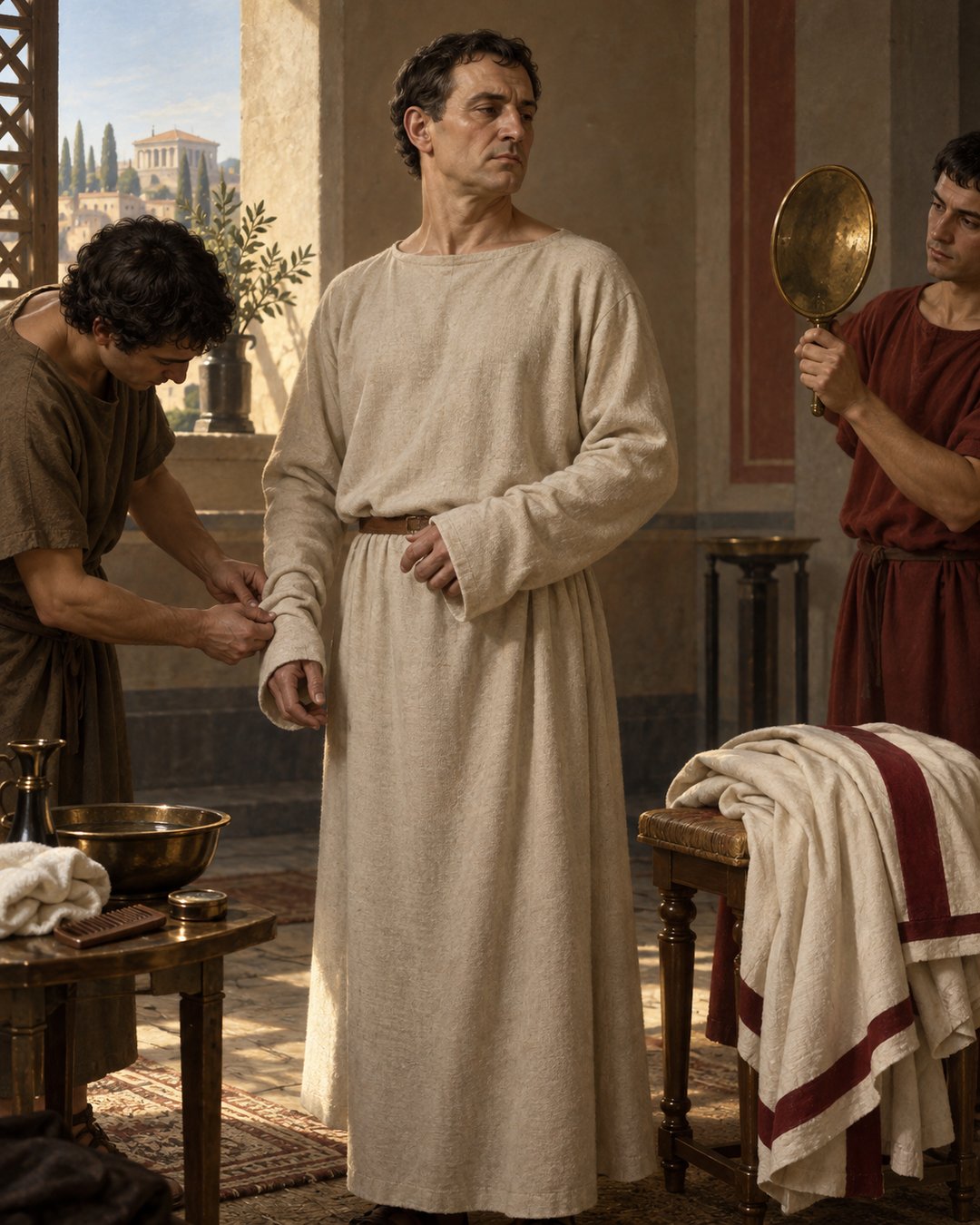
A Roman man’s sleeve could end below the shoulder, at the wrist or almost at the fingertips. In Attic Nights 6.12, those few inches become evidence. Aulus Gellius says that tunics reaching down the arms were considered unbecoming for men in Rome and Latium. He calls them chiridotae, a Greek-derived name for long-sleeved garments.
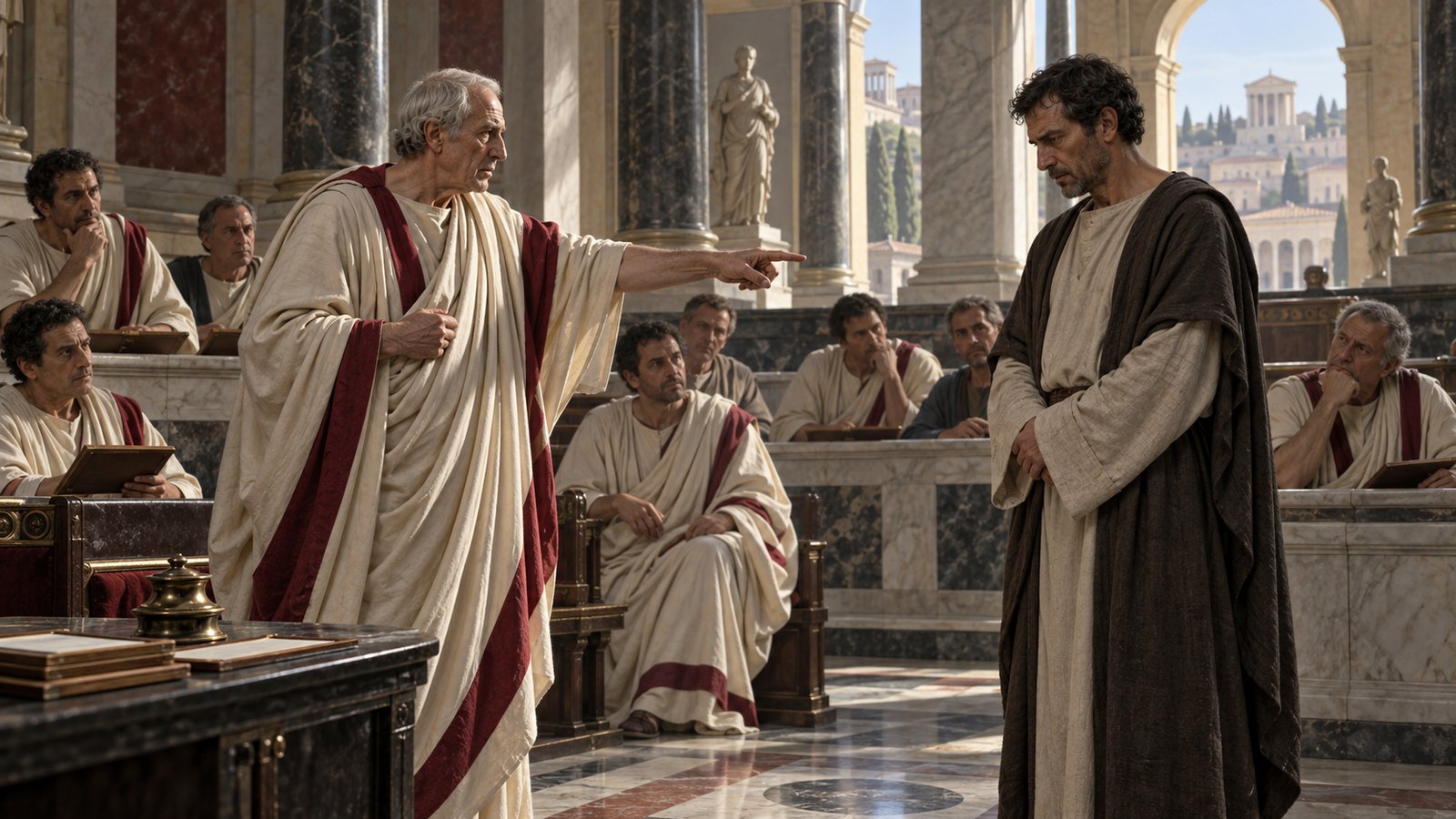
Then the cloth enters an attack. Scipio Aemilianus reproached Publius Sulpicius Gallus for wearing tunics that covered his whole hands. Yet the quotation Gellius preserves does not stop at tailoring. It piles up perfume, a mirror, trimmed eyebrows, removed hair, a banquet couch, wine and sexual allegations. The sleeve is made to look like the visible edge of a whole character.
That distinction matters. The passage offers valuable evidence about garment vocabulary and remembered male dress. It also preserves hostile rhetoric, not a neutral inspection report. Scipio’s target is described through an accusatory catalogue built from the gender and sexual prejudices of its world. Repeating the verdict as a simple Roman dress code would make the attack sound more objective than it was.
Gellius adds Virgil and Ennius to the chapter. Their lines make long tunics and covered arms seem like an inherited literary sign rather than one speaker’s invention. Clothing, quotation and reputation reinforce one another. A reader can therefore learn most by asking not only what Romans wore, but how a visible garment was recruited to claim knowledge about the person inside it.
The Chiridota Reached Toward the Hand
Gellius begins with dimensions. A tunic came down below the arms, reached the wrists and could extend almost to the fingers. That concrete description is more useful than a vague label such as “luxurious.” It lets us see what drew attention: the male wearer’s forearm and hand were covered far beyond the short cut Gellius presents as customary.
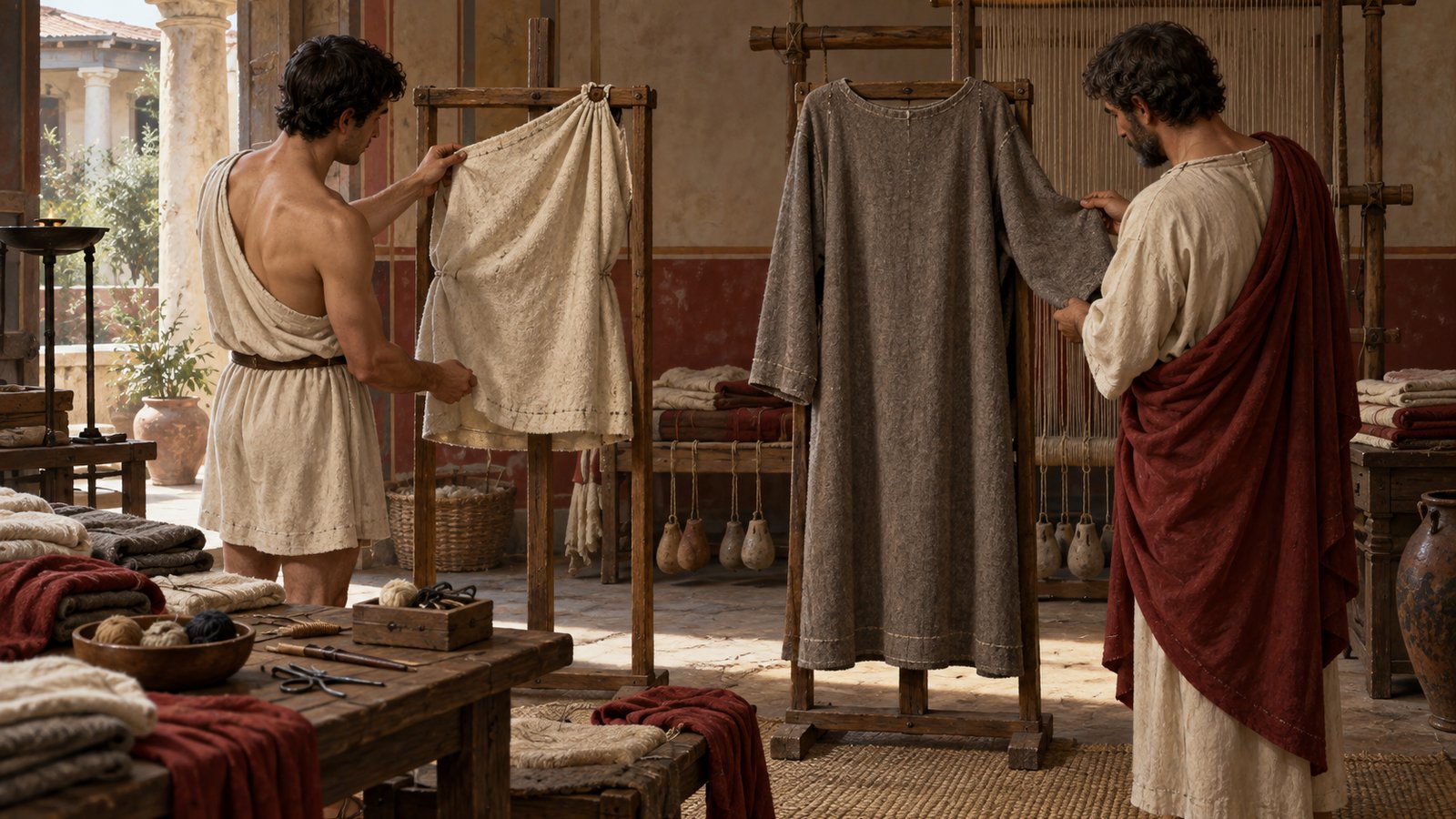
The Latin chapter uses chiridotae, a name borrowed from Greek. The word identifies sleeves rather than fabric, colour or price. Nothing in the chapter says that the garment had to be silk, embroidered, imported or expensive. The social charge rests on silhouette and coverage.
Gellius contrasts that form with clothing he assigns to women. Long, full-flowing garments, he says, were considered appropriate for concealing women’s arms and legs. His explanation exposes the gendered logic behind the criticism. The same length that decorously covered one body could be used to shame another.
This was not a universal truth about cloth. It was a social reading reported for Rome and Latium. Garments changed meaning with wearer, place and speaker. Even within Gellius’s compressed history, male dress had already changed over time. Sleeves could therefore carry convention, but convention required a story about what counted as the older norm.
That visible norm sits beside the broader account of the toga as Rome’s public garment. The toga announced civic setting and status; the chiridota passage focuses more narrowly on how the tunic beneath or apart from it could be read against expectations of masculine presentation.
An Older Short Tunic Made the Contrast Work
Gellius supplies a compact sequence. Roman men, he says, first wore the toga without tunics. Later they adopted close, short tunics ending below the shoulders, garments he compares with the Greek exomis. Only against that remembered progression does the long sleeve appear as a striking departure.
The chapter is not a complete history of Roman clothing. It gives no dates for either stage, no account of season or labour, and no survey of regional practice beyond its opening claim about Rome and Latium. Its sequence should be read as the tradition Gellius uses to frame the rebuke, not as a wardrobe ledger covering every Roman man.
Still, the contrast is physical. The short tunic leaves the upper arm freer. The chiridota runs past the wrist. One cut emphasizes exposure and movement; the other supplies flowing coverage. An audience did not need a technical lecture in weaving to see the difference.
Memory of older dress also gave moral criticism a convenient direction. The shorter form could stand for ancestral simplicity; the longer form could be made to look like deviation. This did not happen because cloth carried morality by itself. The speaker activated the contrast by placing a named person against the older model.
The stronger comparison is with the occasion when footwear exposed senators to a teacher’s rebuke. In both scenes, dress becomes legible through an observer who publicly assigns it meaning. The objects do not speak without the confrontation.
Scipio Built a Catalogue Around the Sleeves
Gellius identifies the critic as Publius Africanus, son of Paulus: Scipio Aemilianus. He praises Scipio’s accomplishments and virtue before naming Publius Sulpicius Gallus as the target. That introduction gives the accuser authority before the preserved words begin.
The long sleeves are only one reproach among many. In the quotation, Gallus perfumes himself every day and dresses before a mirror. His eyebrows are trimmed. His beard hair is plucked and his thighs are smoothed. At a banquet, though a young man, he reclines in the long-sleeved tunic on the inner side of the couch with a lover.
The list then adds wine and desire for men before ending in a sweeping insinuation. Its force comes from accumulation. Mirror, grooming, cloth, dining position and intimacy are made to confirm one another. The audience is invited to treat a series of selected details as if it reveals a stable private identity.
For historians, the catalogue is double evidence. It shows practices an audience could recognize—perfuming, mirrors, hair removal, reclining positions and sleeve cuts. At the same time, it shows how those practices could be weaponized. The words come from an adversarial performance designed to damage a named man.
We cannot safely turn every accusation into biography. The passage proves that Scipio’s quoted attack said these things; it does not independently verify each habit. Gellius’s admiration for the speaker further reminds us that the transmission is not neutral. Clothing history survives here inside a judgment.
The Dining Couch Turned Dress into a Scene
A sleeve described in isolation might remain a matter of cut. Scipio’s catalogue places it at a banquet. Gallus is made visible reclining in the garment, positioned on the inner side of a couch with a lover. The accusation becomes a miniature scene rather than a list of abstract faults.
The physical details do rhetorical work. A mirror suggests self-scrutiny. Perfume supplies scent. Smoothed skin invites the audience to imagine touch. The flowing sleeves occupy the eye. The dining couch fixes all of them in a setting associated with leisure, wine and social observation.
That density is precisely why modern readers should separate description from endorsement. The speech depends on ancient contempt for gender nonconformity and same-sex desire. Those prejudices shaped what counted as a damaging detail. They tell us about the accuser’s available weapons, not an objective measure of worth.
The scene also demonstrates how reputation could be assembled from public and private fragments. A garment was visible. Grooming might be inferred from a face or body. A banquet could produce witnesses and gossip. Oratory joined those fragments into one narrative whose coherence made it persuasive.
Once bundled, the signs could circulate beyond the original conflict. Gellius wrote centuries after Scipio Aemilianus. Whatever the speech’s first setting, the catalogue survived because collectors and readers found it quotable. The sleeve kept carrying the accusation long after the wearer was gone.
Virgil and Ennius Made the Judgment Look Traditional
Gellius closes by moving from invective to poetry. He cites Virgil attacking tunics with sleeves alongside turbans and ribbons. He then recalls Ennius apparently using “tunic-clad men” of the Carthaginians with scorn. Neither quotation gives a tailoring manual. Both widen the field of association.
Virgil’s line connects sleeves with easternizing accessories in a hostile poetic frame. Ennius turns covered bodies into an ethnic insult against an enemy people. In each case, dress marks an outsider from the speaker’s preferred Roman masculinity. Gellius places those verses after Scipio so that literature appears to echo the social verdict.
Quotation can make prejudice feel ancient, shared and authoritative. A reader encounters not one critic but a chorus: the admired statesman, the canonical poet and the old national epic. Their agreement is constructed by selection. Gellius chooses the passages and puts them in sequence.
That sequence is the chapter’s mechanism. First define the garment. Next establish an older short-tunic norm. Then present the long sleeve inside a cumulative character attack. Finally call poets as supporting witnesses. By the end, a measurement from wrist to finger has acquired moral, sexual and ethnic associations.
The safest conclusion is therefore narrower and more revealing than “Roman men never wore sleeves.” Gellius shows that one kind of long sleeve could be stigmatized and that prominent texts helped reproduce the stigma. He also shows exactly how material culture entered rhetoric: a cut of cloth was noticed, narrated and surrounded with allegations until it seemed to disclose a life.
Sources
Aulus Gellius, Attic Nights 6.12.