

The beard reached almost to the petitioner’s waist. Herodes Atticus still asked who he was.
The man pointed, in effect, to the answer he was wearing: long hair, a philosopher’s cloak and the cultivated appearance of someone who had renounced ordinary concerns. He grew angry that an ex-consul celebrated for Greek eloquence could fail to recognize the type.
Herodes recognized the type perfectly. He did not recognize the achievement.
“I see a beard and a cloak,” he replied in Gellius’s account. The philosopher remained to be shown.
A Costume Made the Claim Before the Man Spoke
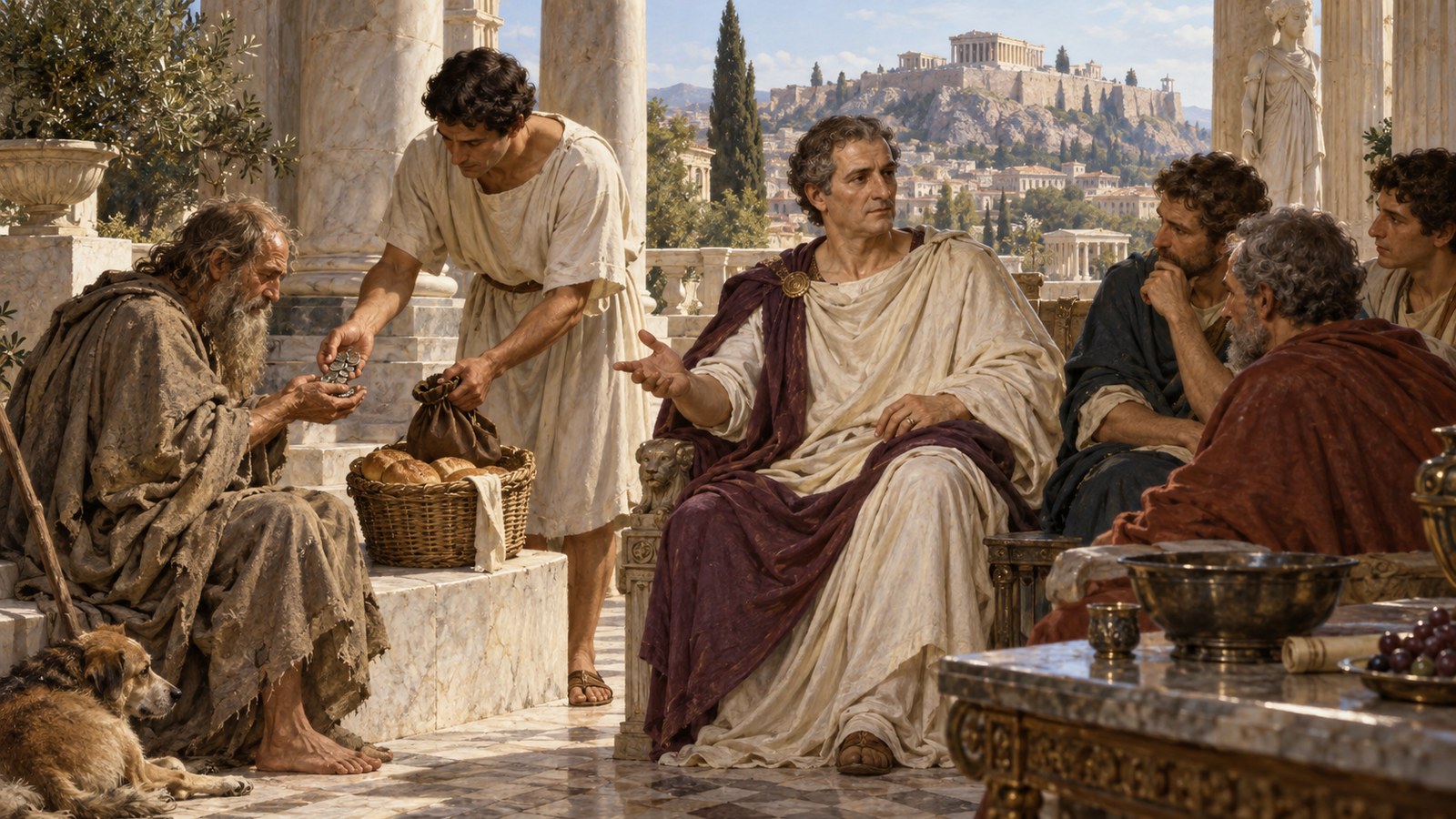
Aulus Gellius places himself among the people present when the stranger approached. That eyewitness frame gives the exchange its social pressure. The petitioner was not making a private request at a closed door. He entered a company around Herodes and demanded money for bread while dressed in visible signs of intellectual authority.
Herodes Atticus had occupied the consulship and belonged to the immensely wealthy Greek elite of the second century. Gellius praises both his charm and his command of Greek speech. The petitioner therefore chose an audience who understood exactly what the cloak and beard were intended to communicate.
Philosophical appearance could represent simplicity, discipline and distance from fashionable grooming. It could also become an efficient uniform. A stranger did not need letters of introduction if bystanders accepted hair and cloth as a complete biography.
Herodes’s first question broke that shortcut. When the man answered that he was a philosopher and complained that the fact was obvious, Herodes listed what sight actually established. He could see material signs. He could not see the habits, reasoning or conduct that would make the name true.
His demand was precise: by what evidence should the company recognize the claimant as a philosopher? The burden shifted from costume to life.
The Companions Supplied an Unflattering Biography
People around Herodes believed they knew the petitioner. They described him as a wandering man of bad character who frequented disreputable drinking places and became abusive when demands were refused.
That report might have ended the encounter. It offered Herodes a socially acceptable reason to send the man away: the costume was false, the behavior was worse, and giving could reward intimidation.
Instead, Herodes preserved a difference between exposing a claim and denying food. The man’s alleged habits answered the question of whether beard and cloak proved philosophy. They did not answer every question about what the household should do next.
This distinction resembles the tension in the Stoic whose face changed during a storm. An outward sign can be real without defining a whole moral character. There, involuntary pallor did not disprove trained judgment. Here, deliberate costume did not prove it.
Gellius’s scene makes spectators important. The companions offered reputation; the petitioner performed identity; Herodes had to decide what his response would teach everyone watching.

Thirty Days of Bread Defined the Giver
Herodes ordered money sufficient to buy bread for thirty days. The period made the gift substantial without turning it into a permanent pension. It met the stated need on a scale that no one could dismiss as a token coin.
His explanation redirected moral attention. They should give, he said, whatever the man’s character might be—not because the recipient was a worthy man, but because the givers were human.
That formula did not certify the petitioner’s story. It kept Herodes’s standard from becoming dependent on the stranger’s performance. If generosity occurred only after a recipient proved philosophical virtue, the gift would function as a prize for status rather than aid for hunger.
Herodes supported the choice with a story about Musonius. That philosopher was said to have ordered one thousand sesterces for another impostor. When warned that the man was a rogue who deserved nothing good, Musonius joked that such a person therefore deserved money.
The joke is edged rather than sentimental. Money appears as the lower good appropriate to someone who has not demonstrated the higher good he claims. Herodes’s bread allowance follows the same division: material relief can be granted while moral recognition is withheld.
A Sacred Name Could Be Stolen without Taking Property
What angered Herodes was not merely aggressive begging. He resented the use of “philosopher” by people whose conduct emptied the word. The name was sacred because generations had attached demanding ways of life to it.
He illustrated that idea through civic naming rules. Athenians, he said, had once forbidden enslaved people to receive the names Harmodius and Aristogeiton, remembered as men who tried to kill the tyrant Hippias. The decree sought to protect names linked to sacrifice for liberty from a status that the citizen community treated as dishonor.
Herodes then reversed the direction with a Roman comparison. Early Romans were said to have forbidden patrician clans from reusing the forenames of members condemned to death for crimes against the state. In one city, honored names were kept away from degradation. In the other, disgraced names were symbolically killed with their bearers.
The assumptions behind the Athenian example belong to a slave society and should not be adopted as moral truth. Its value here is historical: Herodes imagined names as property guarded by collective memory. A title could be misused even when no object changed hands.
Roman reputation often worked through such visible classifications. Hadrian’s argument with a grammarian also shows social power pressing against learned identity. Herodes’s answer insists that authority over a title still depends on evidence, not volume or costume.
Recognition and Mercy Followed Different Tests
The exchange ends without transforming the petitioner. Gellius records no repentance, lesson learned or revelation that the companions were mistaken. Herodes did not investigate the man until a perfect biography emerged.
He made two decisions with the information available. The stranger had not shown the character needed for recognition as a philosopher. The household would nevertheless fund his bread because its own conduct should not imitate his alleged baseness.
That combination is what gives the anecdote durability. A simpler moralist could have stripped off the false identity and celebrated exposure. A simpler benefactor could have given money and politely accepted the title. Herodes did neither.
The beard and cloak remained visible, but visibility lost its power to conclude the argument. The gift also remained visible, but it did not become applause. Bread answered hunger. Scrutiny answered the claim.
For the company around him, Herodes made character operate in both directions. The petitioner could not borrow virtue from clothes. The givers could not borrow an excuse from the petitioner’s faults.
He refused to see a philosopher where he saw only a costume. Then he chose to behave as the kind of human being he wished others to see.
Gellius’s arrangement makes the saying memorable without reducing the stranger to a visual joke. The spectacular beard draws attention, but every important decision concerns something invisible: intention, reputation, need, dignity and the standard by which a giver judges himself. Herodes does listen to the companions’ report, so the account does not ask its audience to become credulous. He simply refuses to let reliable suspicion perform work it cannot do. It can block the grant of an honored title. It cannot prove that hunger should be ignored. Thirty days of bread gives that distinction a material duration. For a month, the false claim and the real food could coexist, neither cancelling the other. The scene’s discipline lies in keeping those judgments separate when anger invited Herodes to collapse them.
The petitioner asked for one kind of recognition and received another: not the intellectual standing advertised by his clothes, but acknowledgment of a basic need. Herodes kept authority over the first judgment and accepted responsibility for the second.
Sources
Aulus Gellius, Attic Nights 9.2.