
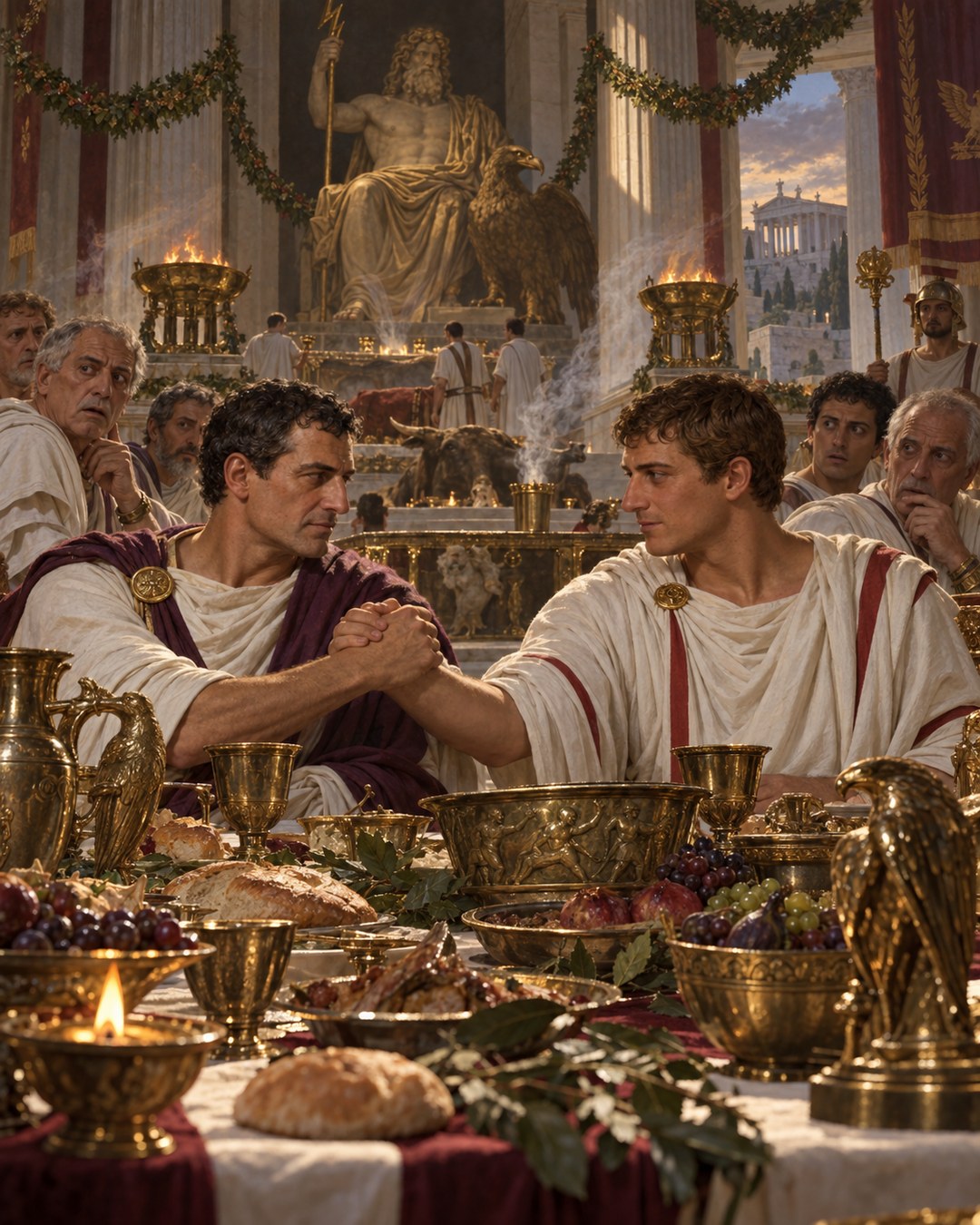
Scipio Africanus sat down beside a man he had opposed for years. Before the feast ended, that enemy had become his future son-in-law.
Aulus Gellius tells the reconciliation as a sudden turn at Jupiter’s banquet on the Capitol. The Senate’s seating arrangement placed Publius Scipio beside Tiberius Gracchus after repeated disagreement over public affairs.
The table did what argument had not. Conversation became friendship, and friendship became a marriage alliance on the spot.
Gellius then paired the scene with two rival aristocrats elected to share the censorship. Rome’s institutions did not eliminate enmity. They created moments when enemies had to perform a choice before witnesses.
Public Disagreement Had Become Personal Distance
Gellius introduces Scipio and Gracchus with balanced praise. Both had achieved distinction, held high office and earned reputations for upright lives. Their conflict was not explained as a clash between virtue and vice.
They often disagreed on public questions. Gellius allows that these disputes, or perhaps another cause, made them unfriendly. The uncertainty matters. By his time, the existence of the hostility was memorable even if its complete origin was not.
Political life repeatedly placed Roman aristocrats in competition for commands, policies, honors and authority. Such disputes moved through the Senate and assemblies, but they also entered houses and family networks. Refusing friendship could shape introductions, marriages and future coalitions.
Scipio’s public confidence appears vividly in the day he turned a prosecution into the anniversary of Zama. Gellius’s banquet story shows another kind of control: the capacity to revise a private judgment when a formal occasion removed the usual distance.
Their enmity had lasted long enough to make reconciliation noteworthy. It needed a setting in which neither man had arranged a private surrender.
Jupiter’s Feast Assigned the Dangerous Seat
On the appointed day, a feast was offered to Jupiter Optimus Maximus and the Senate dined on the Capitol. Gellius says Scipio and Gracchus happened to be placed beside each other at the same table.
Roman dining order could advertise status and relationship. A neighboring place created repeated contact: shared dishes, overheard remarks, the need to acknowledge another body at close range. At a ritual feast, simply leaving or launching a public quarrel would have carried its own cost.
Gellius gives divine color to the coincidence, imagining the gods as arbiters who joined the men’s hands. The language does not tell us the content of their conversation. It tells us how contemporaries could interpret an institutional accident after seeing its result.
The setting redistributed responsibility. Neither rival had invited the other to a private meeting. Neither needed to arrive as a petitioner. The seating plan created equality of exposure under Jupiter’s ritual authority.
This was not the loose company of an ordinary dinner. In Varro’s rule for a conversational banquet, the host controlled scale so voices could circulate. Here, the civic feast controlled proximity so two particular voices could no longer avoid one another.
A Marriage Made the New Judgment Expensive
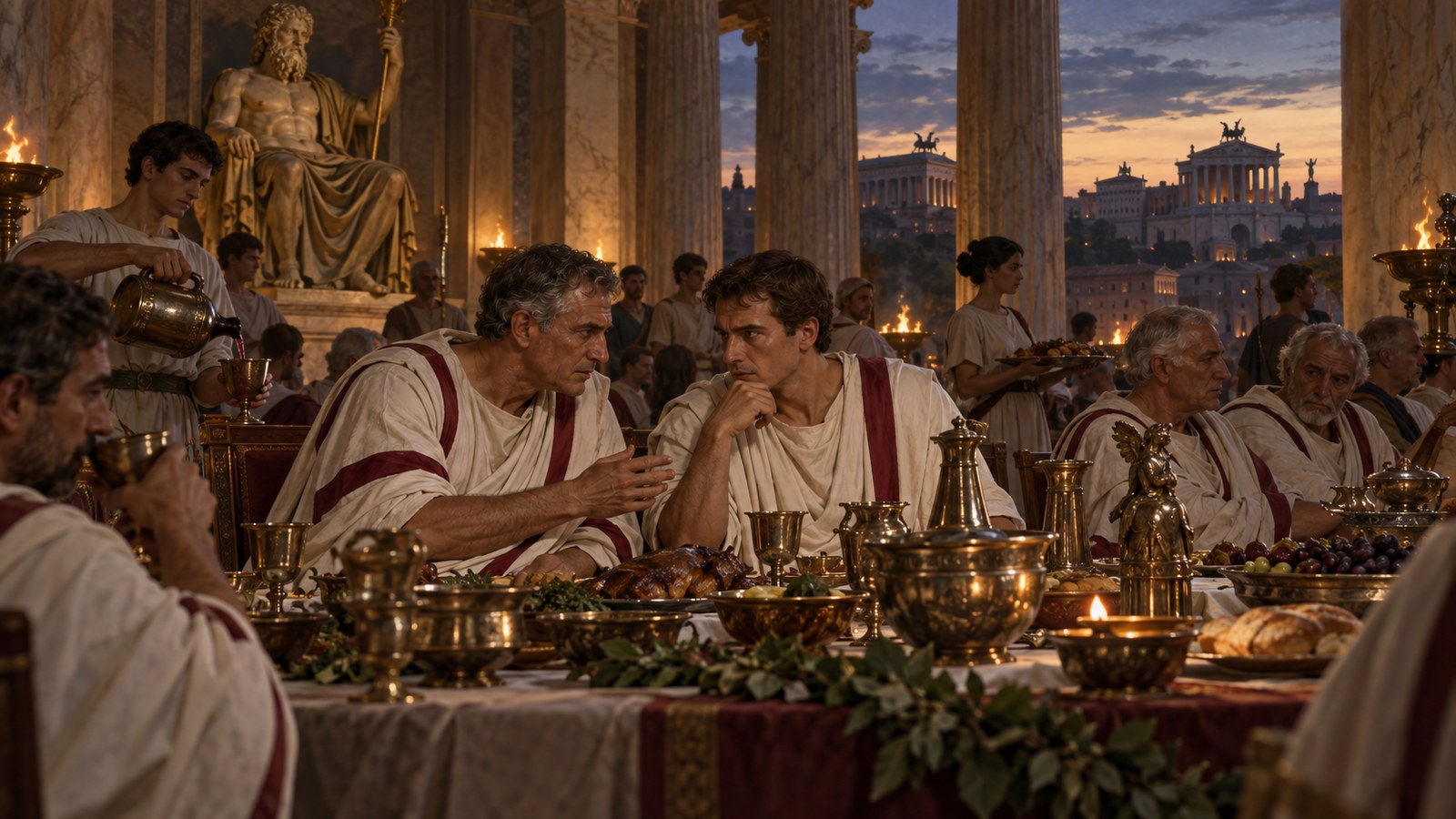
Gellius says friendship arose immediately. He then offers evidence stronger than polite words: the families were joined through a marriage arrangement at the same time.
Scipio had an unmarried daughter of marriageable age. At the feast he betrothed her to Tiberius Gracchus. The agreement converted a change of feeling into a durable link between households.
Marriage among Rome’s elite organized inheritance, prestige and political association. Choosing a son-in-law was therefore not a casual compliment offered to improve a dinner’s mood. It entrusted family continuity to the man sitting beside him.
Gellius sharpens the point by saying Scipio selected and approved Gracchus while judging him under the strictest condition: as a personal enemy. Praise from a friend might be softened by affection. Approval extracted from hostility appeared harder to counterfeit.
The story should not be treated as a transcript with every motive visible. We have Gellius’s compressed moral anecdote, not a marriage contract or the two men’s private reflections. Its historical force lies in what the tradition considered convincing proof of reconciliation.
A handshake could be strategic. A daughter’s betrothal made reversal costly.
The Censorship Forced Another Pair into One Office
Gellius’s second example begins with Aemilius Lepidus and Fulvius Flaccus, aristocrats of high birth and high office who had maintained a bitter enmity for a long time.
The Roman people elected them censors together. The censorship was unusually difficult to divide into private spheres. Its holders conducted the census, reviewed civic standing and acted through a magistracy whose moral authority depended on the seriousness of both colleagues.
As soon as the herald proclaimed the election in the Campus Martius, before the assembly had dispersed, the two men approached each other. Gellius says they voluntarily joined hands and embraced with equal joy.
The speed turned reconciliation into a public interpretation of the vote. Citizens had created a joint office. The new censors answered by showing that personal hostility would not disable it.
Gellius adds that their harmony continued through the censorship and afterward. That detail protects the embrace from looking like a temporary performance. Public gesture began the settlement, but sustained cooperation verified it.

Institutions Could Stage a Way Back
The two stories share a mechanism without sharing an outcome. Scipio and Gracchus moved from neighboring seats to family alliance. Lepidus and Flaccus moved from simultaneous election to collegial friendship.
Neither pair reconciled through a legal command to feel differently. A ritual and an election instead rearranged bodies in public. The feast made avoidance awkward. The censorship made continued hostility irresponsible. Witnesses raised the reputational cost of refusing the opening.
Roman politics remained fully capable of feuds that ended in exile, violence or inherited faction. Gellius selected these cases because they were notable, not routine. Their rarity explains why the exact locations—the Capitoline table and the Campus Martius assembly—belonged in the memory.
They also show that compromise did not always begin with agreement about the original dispute. Gellius never says Scipio changed his policy or Gracchus conceded a public question. Lepidus and Flaccus did not erase the years behind them. Each pair chose a relationship capable of carrying future disagreement.
The feast and election supplied face-saving thresholds. No man had to announce that fear or defeat brought him forward. Jupiter, chance, voters and office could absorb part of the explanation.
At the first scene, the dangerous neighbor became family. At the second, the rival became a colleague before the herald’s audience could leave. Roman institutions had created both conflicts, but for one visible moment they also gave enemies somewhere to put them down.
Gellius’s compact examples also explain why reconciliation needed proof beyond a pleasant sentence. Roman aristocrats were trained to speak ceremonially, and a public exchange of courtesy could disguise calculation. These settlements produced observable commitments. Scipio exposed his household to the consequences of his changed judgment. The co-censors exposed a major magistracy to theirs. Subsequent conduct could test both decisions: the marriage would connect descendants, while the censorship demanded shared work after the crowd departed. This did not make either friendship pure or politics free from interest. It made reversal expensive enough to be credible. In a competitive order with no modern party organization to discipline allies, family and collegial office supplied durable structures. The handshake mattered because the structure waiting behind it would remember.
Both scenes also left room for dignity. Reconciliation came through participation in a shared civic form, not a forced confession before a victor. Each man could step forward as a senator, father, elected magistrate or colleague. The new bond did not require anyone to deny that the old disagreement had been serious. It required them to show, through a consequential act, that hostility would no longer govern what came next.
Sources
Aulus Gellius, Attic Nights 12.8.