
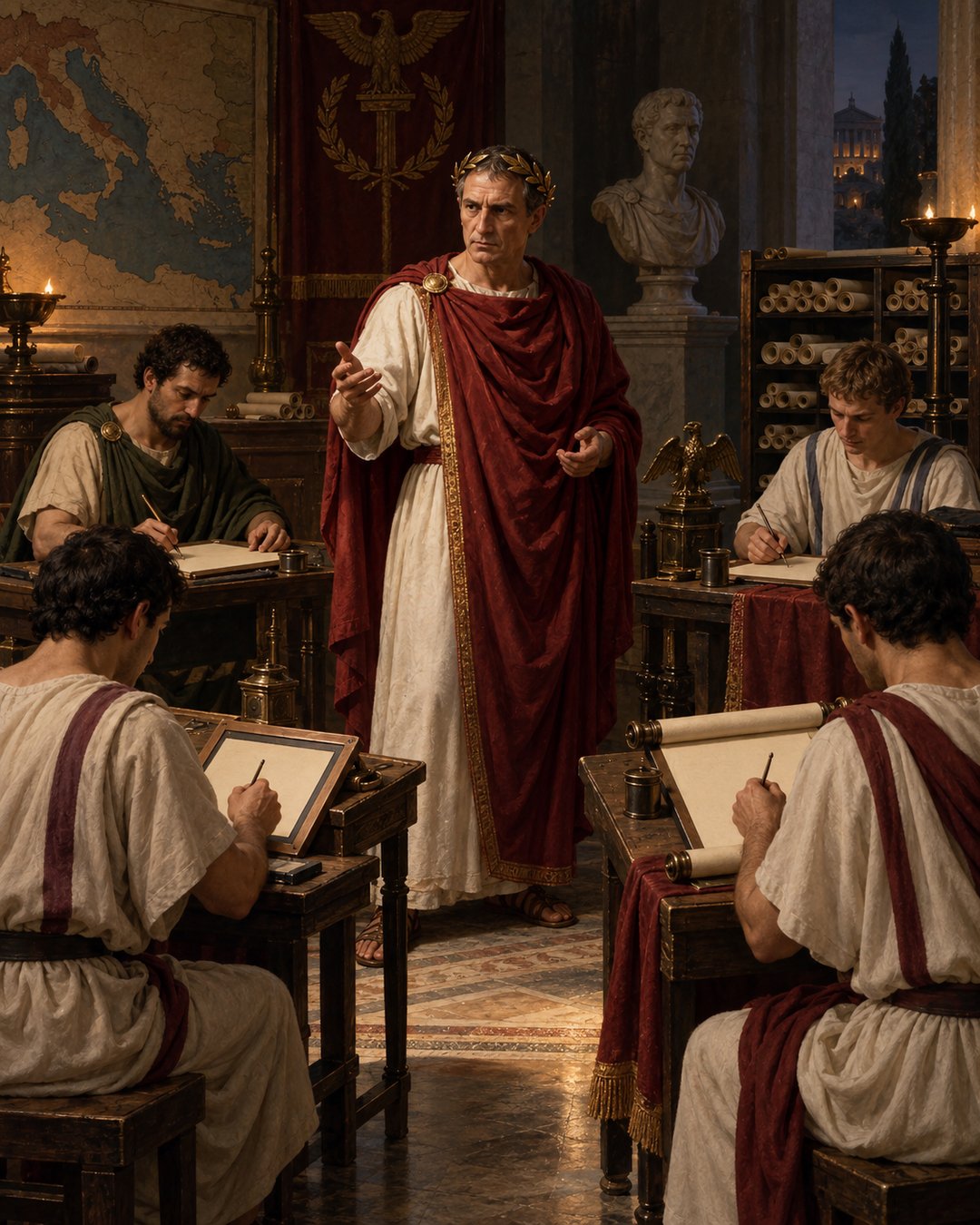
Four secretaries listened for four different letters. One man supplied every stream.
Pliny the Elder offered that scene as a measure of Julius Caesar’s mental speed. He then raised the count to seven when no other business competed for Caesar’s attention.
The boast is memorable because it converts command into throughput: one voice, several hands, many decisions leaving the room at once.
Pliny Counted Attention in Separate Letters
Pliny introduces Caesar as his outstanding example of innate mental vigor. He deliberately sets courage and resolution aside. The quality under examination is quickness, described with the extravagant image of something winged by fire.
The proof is not a speech, a battle plan or a remembered quotation. It is simultaneous work. Caesar, Pliny says, could write or read while dictating or listening at the same time.
Then the passage becomes numerical. On important affairs, Caesar supposedly dictated four letters at once to his secretaries. If otherwise unoccupied, he could manage seven.
Ancient biography often makes exceptional character visible by counting. A number gives the reader a sharp edge to remember. Four channels already exceed ordinary conversation; seven pushes the portrait toward marvel.
The conditional phrase matters. Pliny does not present the larger number as Caesar’s constant working condition. Seven belongs to the rare moment when nothing else demanded a share of attention. The smaller feat is attached specifically to important affairs.
Neither statement is a stenographic record of one named meeting. Pliny gives no date, no identities for the secretaries and no text from the letters. His subject is capacity. The administrative room is implied by the act rather than documented as a scene we can reconstruct line by line.
That limit does not make the report useless. It tells us which ability Pliny thought could embody command: not merely remembering facts, but keeping several verbal sequences distinct long enough for other people to capture them.
Four Hands Turned One Voice into Parallel Work
Dictation is never a solitary achievement. The count requires secretaries who can hear, record and keep their assigned document separate from the others.
Each letter needed an addressee, a purpose and enough continuity to remain intelligible when Caesar returned to it. Even if he alternated in short bursts rather than speaking four sentences literally over one another, the performance depended on reliable division.
The secretaries are anonymous in Pliny’s sentence, yet they are the mechanism that makes the sentence possible. Without trained hands and disciplined listening, quick thought would vanish as sound. Their records gave it duration.
This is the administrative meaning of the anecdote. Caesar’s attention could be divided because the work around him was also divided. One scribe did not have to hold every thread. Separate writing surfaces made separate channels visible and recoverable.
The arrangement resembles neither a private author composing in silence nor a modern office. Roman correspondence moved through readers, copyists, messengers, seals and recipients. A dictated decision entered a chain of labor before it could act at a distance.
That chain helps explain why speed mattered politically. Orders delayed in the room could not travel. Reports left unanswered could not shape the next decision. Multiple secretaries allowed the center of command to release more than one piece of business before circumstances changed.
Pliny praises Caesar’s mind, but the image accidentally preserves collective skill. The ruler receives the superlative. The unnamed workers provide the hands that let the superlative appear.
Suetonius Shows the Documents Around the Performance
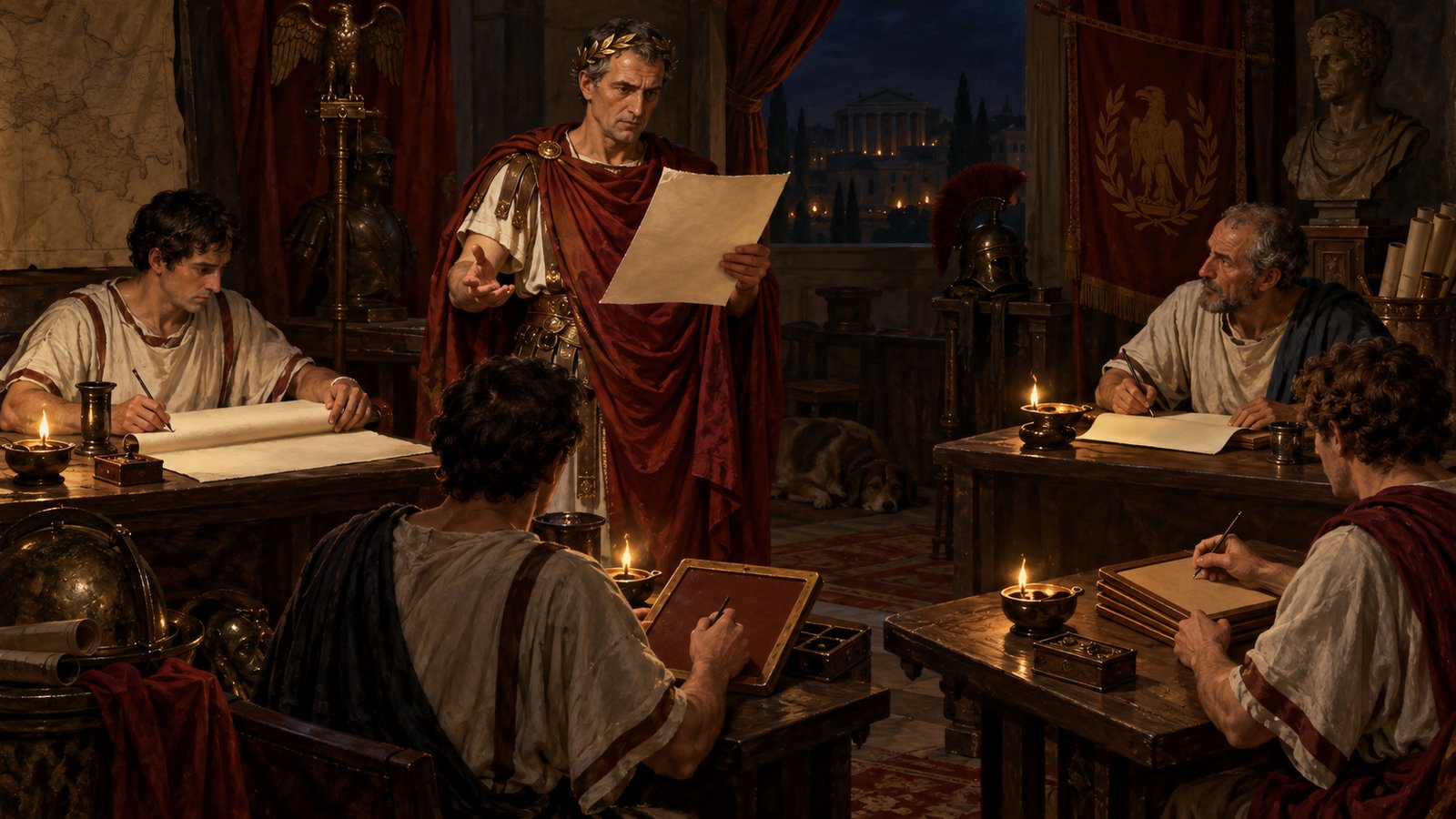
Suetonius supplies a different view of Caesar’s writing life. He lists literary works, journeys of composition and surviving correspondence rather than repeating Pliny’s count.
Caesar’s On Analogy, Suetonius says, filled two books. He composed it while crossing the Alps and returning to his army from Hither Gaul after holding assizes. The work therefore travelled beside legal and military obligations.
Another poem, The Journey, belonged to a twenty-four-day trip from Rome to Farther Spain. The detail does not prove Pliny’s fourfold dictation claim, but it presents the same habit from another direction: movement did not suspend writing.
Suetonius also knew of letters to the senate, to Cicero and to private intimates. Those groups imply different audiences and different stakes. A public report to a governing body was not the same document as a confidential message to a trusted associate.
The archive already shows one protective device in Caesar’s alphabet-shifting cipher. Suetonius explains it with a practical instruction: substitute D for A and continue through the alphabet. Security was applied to a channel whose contents required concealment.
Pliny’s secretaries make more sense within this range. Parallel dictation was not simply a party trick with interchangeable texts. Caesar had multiple kinds of writing to move, and each belonged to a relationship that could demand its own form, pace and protection.
A Notebook Format Made Dispatches Easier to Handle
Suetonius credits Caesar with changing the physical format of letters sent to the senate. Earlier consuls and generals, he says, wrote reports across the sheet. Caesar reduced them to pages in the form of a notebook.
The wording points from mental speed toward material organization. A thought does not become governable merely because it has been spoken. It must be arranged on a surface that can be handled, read and retained.
Pages break a document into ordered units. A notebook form gives the reader a sequence and creates a compact object rather than one broad sheet covered across its width. Suetonius treats the difference as notable enough to attach to Caesar personally.
We should not turn that notice into a complete history of Roman office procedure. The source does not describe a universal reform, standard dimensions or the exact hands that copied each report. It preserves a contrast in format.
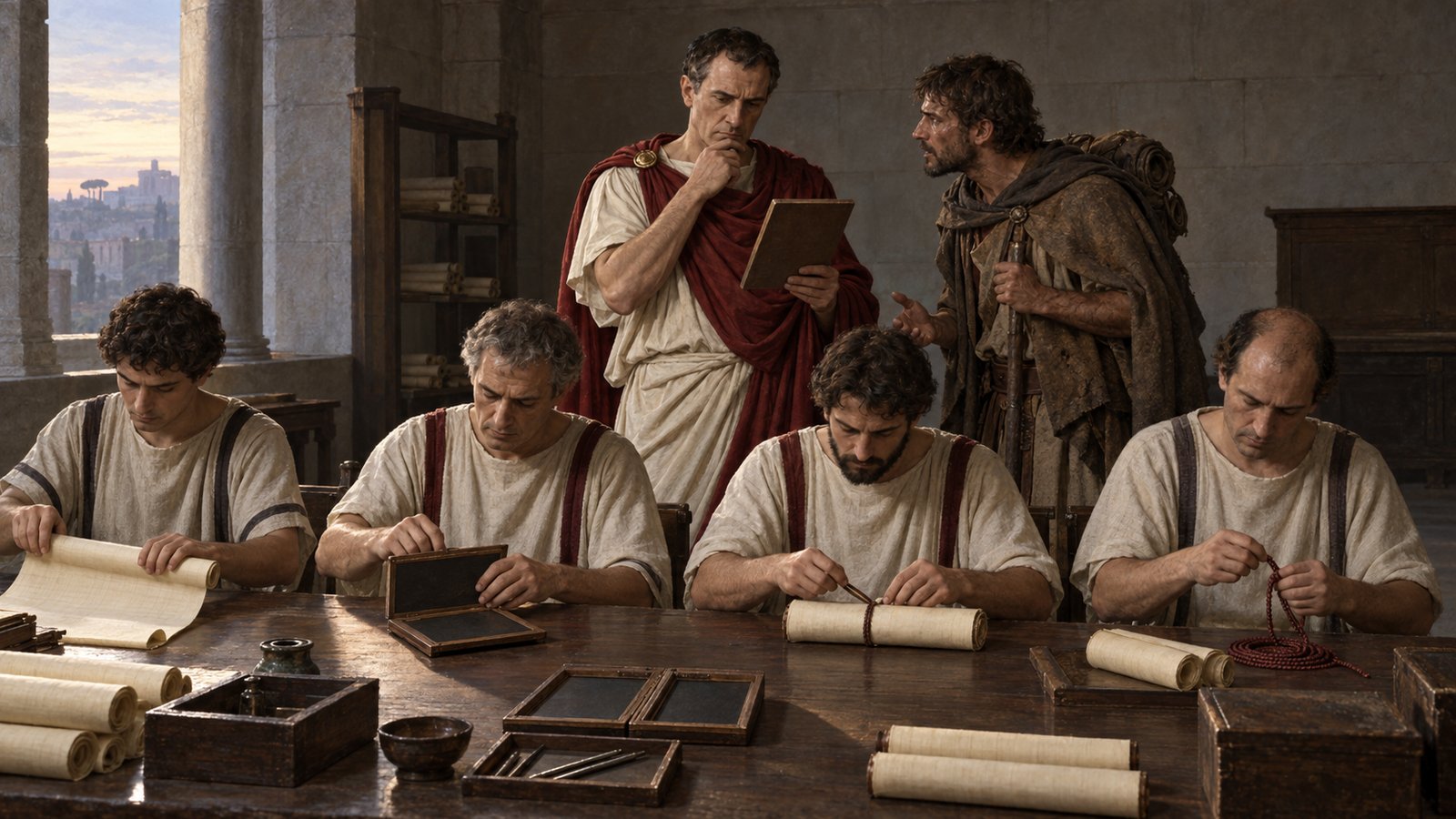
That contrast nevertheless belongs beside Pliny’s count. Four secretaries can produce confusion as easily as speed unless outputs remain distinct. Separate documents, ordered surfaces and identifiable channels transform divided attention into usable correspondence.
Caesar’s publication of daily public records used writing for a different audience. The senate report, confidential letter and posted record each carried authority outward, but they did not travel to the same people or invite the same kind of reading.
The physical page was therefore part of power’s plumbing. It did not create a decision, yet it gave the decision a body that could leave the speaker behind.
The Seven-Letter Claim Reveals How Command Was Admired
It is tempting to read Pliny’s largest number as a productivity target. That misses the literary purpose. Seven letters make Caesar exceptional; they are not instructions for an efficient Roman chancery.
The passage asks its audience to admire a mind that did not lose one thread when another entered. The image condenses a wider political reality: military movement, legal hearings, senate business, private alliances and literary composition all pressed toward the same person.
Suetonius’s evidence gives that pressure physical forms. Two-book scholarship accompanied a return from Hither Gaul. A travel poem occupied the road to Spain. Senate pages, letters to Cicero and ciphered private messages each demanded a different documentary route.
Pliny compresses all of that into simultaneous voices and hands. His claim may magnify, but it magnifies something structurally true about concentrated rule. The more decisions attached to Caesar, the more valuable rapid switching appeared.
The secretaries prevent the portrait from becoming a myth of a completely self-sufficient genius. Caesar could be the junction because other people captured, separated and carried what passed through it. Their anonymity is part of the politics of the anecdote: labor disappears while capacity gathers around the famous name.
Four letters on important affairs and seven in an empty interval mark the boundary between administration and marvel. On one side lies a credible system of dictation, pages and couriers. On the other lies the biographer’s desire to make speed countable.
Read together, Pliny and Suetonius leave a sharper picture than either number alone. Caesar’s attention mattered because a documentary machine could convert it into movement. The room did not merely witness a brilliant mind. It manufactured dispatches.
Sources
Pliny the Elder, Natural History, book seven, chapter twenty-five. Suetonius, Julius Caesar, section fifty-six.