
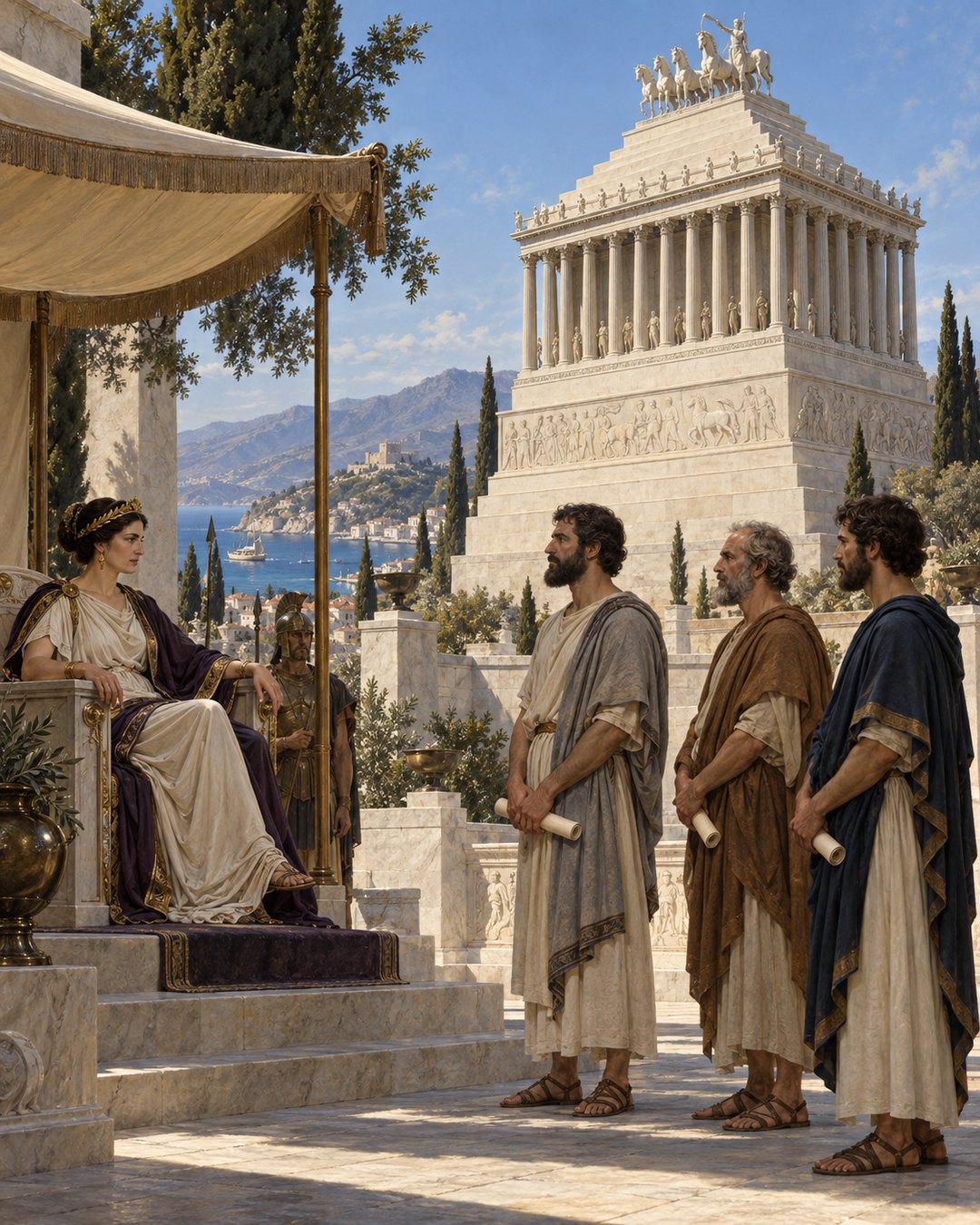
The marble tomb was not enough. At its dedication, Artemisia offered rich prizes and asked celebrated writers to compete in praising her dead husband Mausolus.
Theopompus, Theodectes and Naucrates entered. One ancient tradition even added Isocrates to the field.
A monument made memory visible. The contest tried to make it speak.
Artemisia Built More Than a Burial Place
Aulus Gellius introduces Mausolus as ruler of Caria, while noting that some Greek historians called him a satrap. He then frames Artemisia’s memorial through a tradition of grief intense enough to cross into legend.
In his account, Mausolus died amid his wife’s lamentations and in her arms. Artemisia later mixed his powdered bones and ashes with spices and drank them in water. The story should be reported as Gellius reports it, not as an independently verified medical or archaeological fact.
Its purpose in the narrative is clear. It establishes a widow whose commemoration could not remain private or ordinary. Artemisia then erected the tomb that later gave the word “mausoleum” its enduring association with monumental burial.
Gellius counts the structure among the seven wonders. Pliny the Elder supplies a different kind of admiration, describing dimensions, columns, assigned sculptors, a stepped pyramid and a marble chariot at the summit.
The building turned grief into a skyline. Like the imagined city that Dinocrates proposed carving into Mount Athos, it joined a ruler’s memory to an engineered landscape. Unlike that rejected mountain scheme, the tomb at Halicarnassus was built and kept gathering makers around it.
Pliny’s description helps explain why no single view exhausted the structure. A visitor encountered a surrounding colonnade, carved sides and a roof climbing toward the chariot. Movement around the monument produced changing surfaces. The project could hold several artistic signatures without ceasing to look like one tomb.
Architecture fixed the place of remembrance. Artemisia’s next decision added competition, performance and judgment.
Three Writers Entered a Contest of Praise
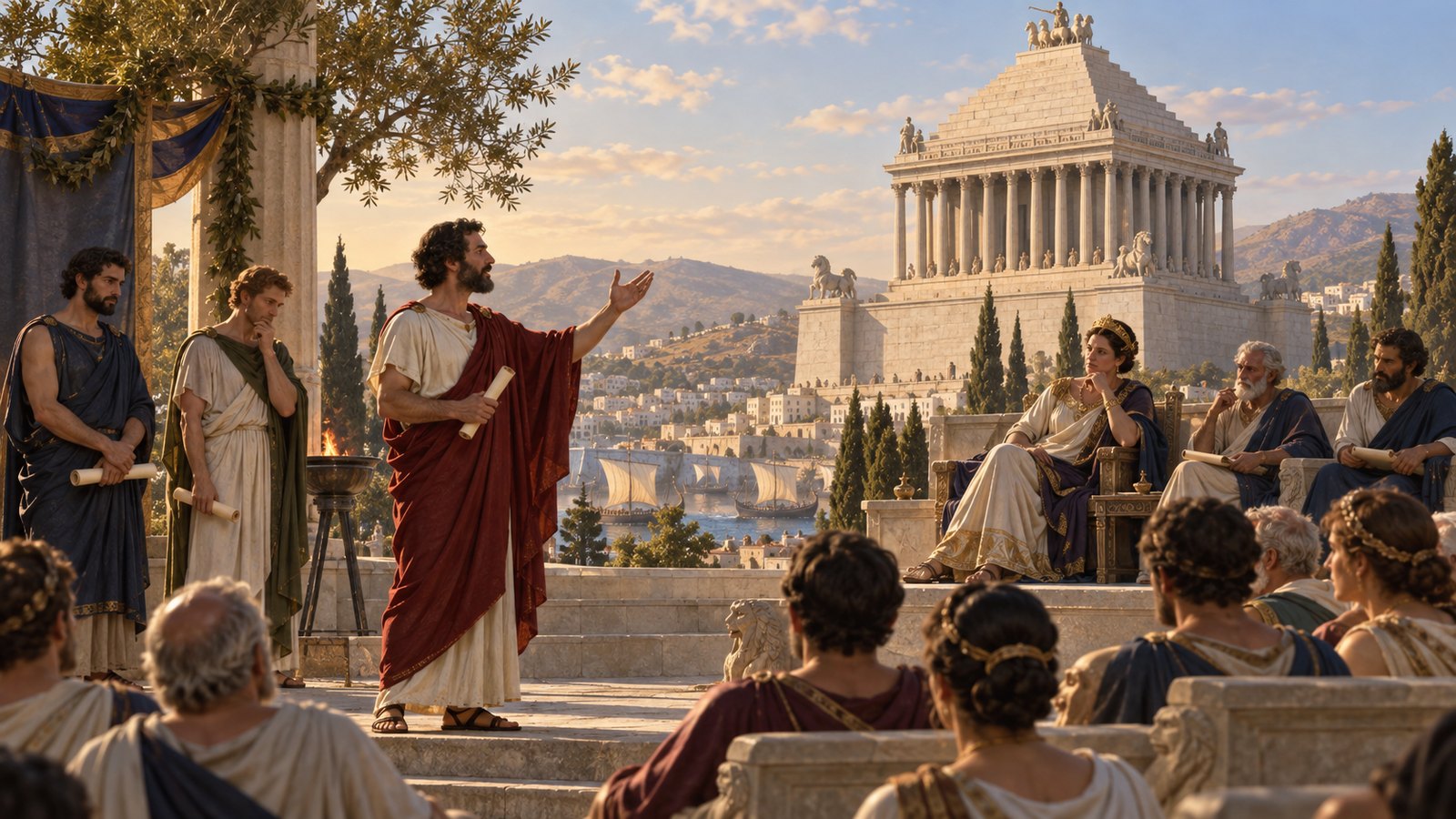
Gellius says Artemisia established an agon when she dedicated the monument: a formal contest devoted to celebrating Mausolus. She offered magnificent prizes in money and other valuables.
The contestants were not nameless hired mourners. Gellius identifies Theopompus, Theodectes and Naucrates as men distinguished for talent and eloquence. Some writers, he adds cautiously, even claimed that Isocrates took part.
That last detail exposes the way prestige gathered around the event. A famous teacher’s possible presence could enlarge the story, but Gellius marks it as something “some have written.” The uncertainty belongs in the retelling rather than being flattened into a firm roster.
The three secure names already show the scale of Artemisia’s ambition. The contest asked accomplished prose writers to shape a public version of a ruler’s life at the moment his tomb was consecrated.
A eulogy was not an inscription carved once into stone. It unfolded in time before judges and listeners. Each competitor selected episodes, arranged virtues and found a voice capable of matching the building behind him.
The prize sharpened those choices. The speakers were not simply repeating an agreed funeral formula in unison; they were trying to produce the most persuasive commemoration. One performance would be declared superior, which meant Mausolus’s public image became the subject of craft, comparison and reward.
Nothing in Gellius allows us to reconstruct the lost arguments. We do not know whether a contestant praised campaigns, government, family loyalty or the city he left behind. The silence is important. What survives securely is the competitive mechanism, not the content of the winning portrait.
The monument gave those speeches weight. The speeches, in turn, supplied the tomb with argument. Marble could announce that Mausolus mattered; a practiced writer could tell an audience why.
Theopompus Won, but Several Reputations Survived
Gellius gives the victory to Theopompus, a pupil of Isocrates. He does not preserve the winning prose or explain the judges’ criteria. The surviving result is a name attached to first place.
Theodectes did not vanish with defeat. Gellius says a tragedy titled Mausolus was still extant in his own day, and reports Hyginus’s opinion that Theodectes was more pleasing in that work than in his prose.
This makes the memorial’s literary afterlife less tidy than a podium. Theopompus retained the honour of victory; Theodectes remained connected through a work readers could encounter later; Naucrates remained part of the distinguished field; Isocrates hovered in a disputed tradition.
Ancient authorship often survives through such uneven traces. The archive of Plautine comedy once faced the opposite problem, when one hundred and thirty plays circulated under Plautus’s name. At Halicarnassus, several known writers converged on one subject and competed to distinguish their treatment.
Their speeches also competed with the monument itself. A weak performance could disappear beneath the building’s scale. A successful one could attach its author to a wonder of the world.
Victory therefore served two commemorations at once. Artemisia sought praise for Mausolus. The writer sought a durable place in the story of praising him.
Four Sculptors Divided the Monument’s Sides
Pliny describes a parallel competition in stone. He names Scopas, Bryaxis, Timotheus and Leochares as contemporary rivals who worked together on the Mausoleum’s carvings.
The assignment preserved individual credit within a collective structure. Scopas carved the east side, Bryaxis the north, Timotheus the south and Leochares the west. A visitor could walk around one tomb while passing through four reputations.
Pliny says the artists were chiefly responsible for making the structure one of the wonders of the world. His account treats architecture as a frame for sculpture, and sculpture as a field in which rivals could still be compared.
Dividing the sides also solved a practical problem of attribution. Large monuments absorb labour from many hands, and collective work can blur individual credit. Here the compass preserved a map of authorship. To name a facade was to name its sculptor, even while every facade remained structurally dependent on the rest.
Artemisia died before the work was finished. The teams did not abandon it. Pliny says they completed the monument because they already regarded it as a memorial to their own glory and to their profession.
That motive complicates any picture of craftsmen merely obeying a patron. The patron’s death removed the original human centre of command, yet the project had acquired a second engine. Finishing the tomb would preserve the makers as well as Mausolus.
Pliny says their works were still considered rivals in skill. The building held competition permanently: no judge needed to crown one facade, because later viewers could continue comparing them.
A Chariot Completed the Stack of Memory
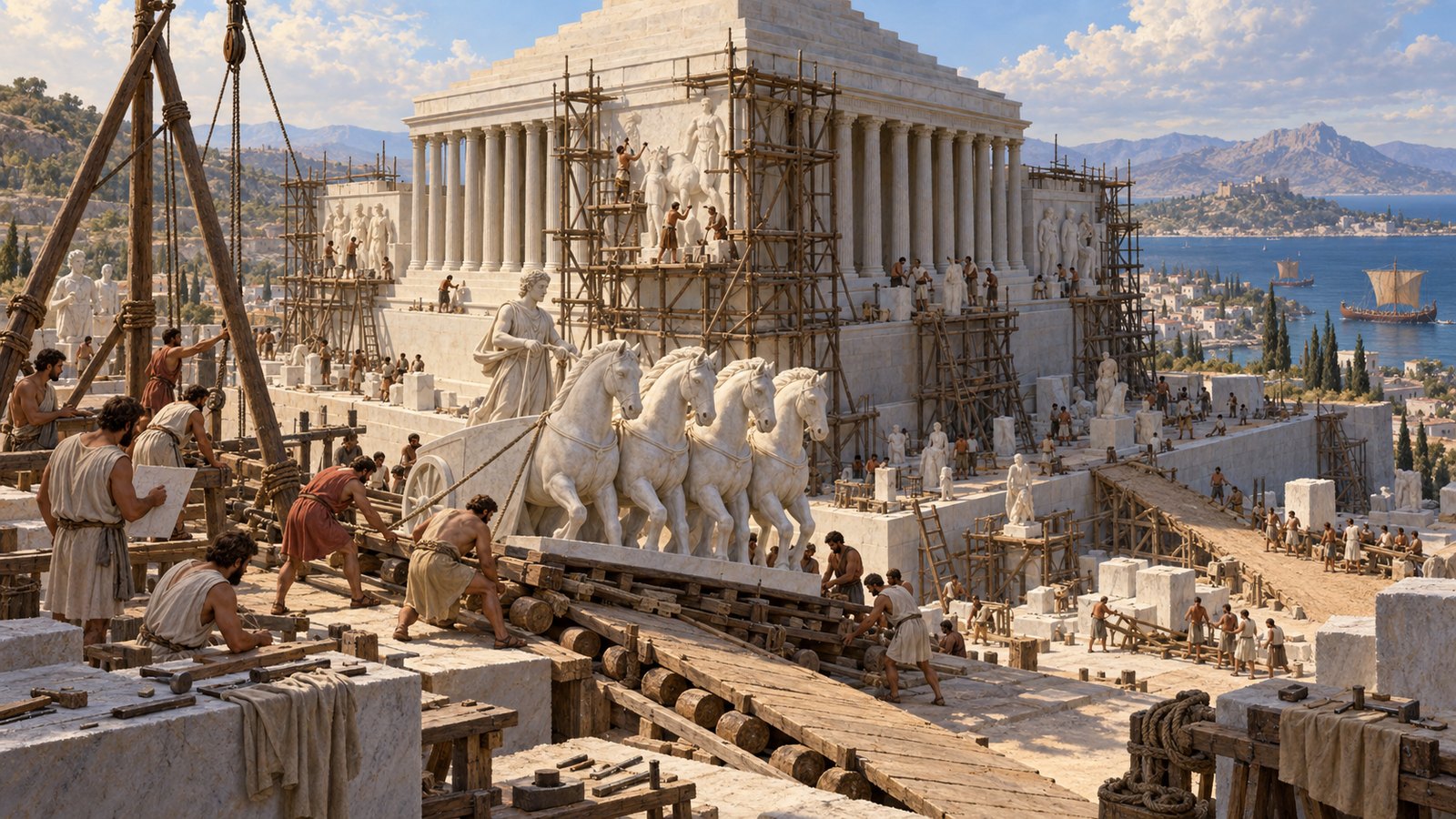
Above the colonnade, Pliny describes a pyramid tapering through twenty-four stages. At its summit stood a four-horse marble chariot made by Pythis.
The composition rose in layers: base, surrounding columns, carved facades, stepped roof and chariot. Each level moved the memorial farther from an ordinary grave and closer to a civic landmark visible across Halicarnassus.
Pythis added a fifth named artistic reputation to the four facade sculptors. His chariot did not compete in the same plane; it completed the silhouette. Pliny credits that addition with bringing the whole work to its final height.
Gellius’s writers occupied another layer, made not of stone but occasion. Their speeches occurred at dedication, when the monument shifted from construction project to public memorial.
The accounts do not tell us exactly where each speaker stood or how the audience was arranged. Images of the event must therefore remain interpretive. What is secure is the conjunction: valuable prizes, named competitors, a judged victory and a celebrated tomb.
That conjunction explains why the story matters. Monumental memory was not passive storage. It was produced by patrons, architects, sculptors, performers, judges and later authors, each selecting what deserved to endure.
Gellius and Pliny preserve different competitions because they ask different questions. Gellius follows the people who made praise audible and records a winner. Pliny follows those who made marble visible and leaves their rivalry open to later viewers. Read together, they show commemoration continuing after dedication rather than ending when the stone was set.
Mausolus supplied the name, Artemisia the commission and contest, Theopompus the winning praise, four rivals the carved sides, and Pythis the summit.
Sources
Aulus Gellius, Attic Nights, book ten, chapter eighteen. Pliny the Elder, Natural History, book thirty-six, chapters thirty to thirty-one.