
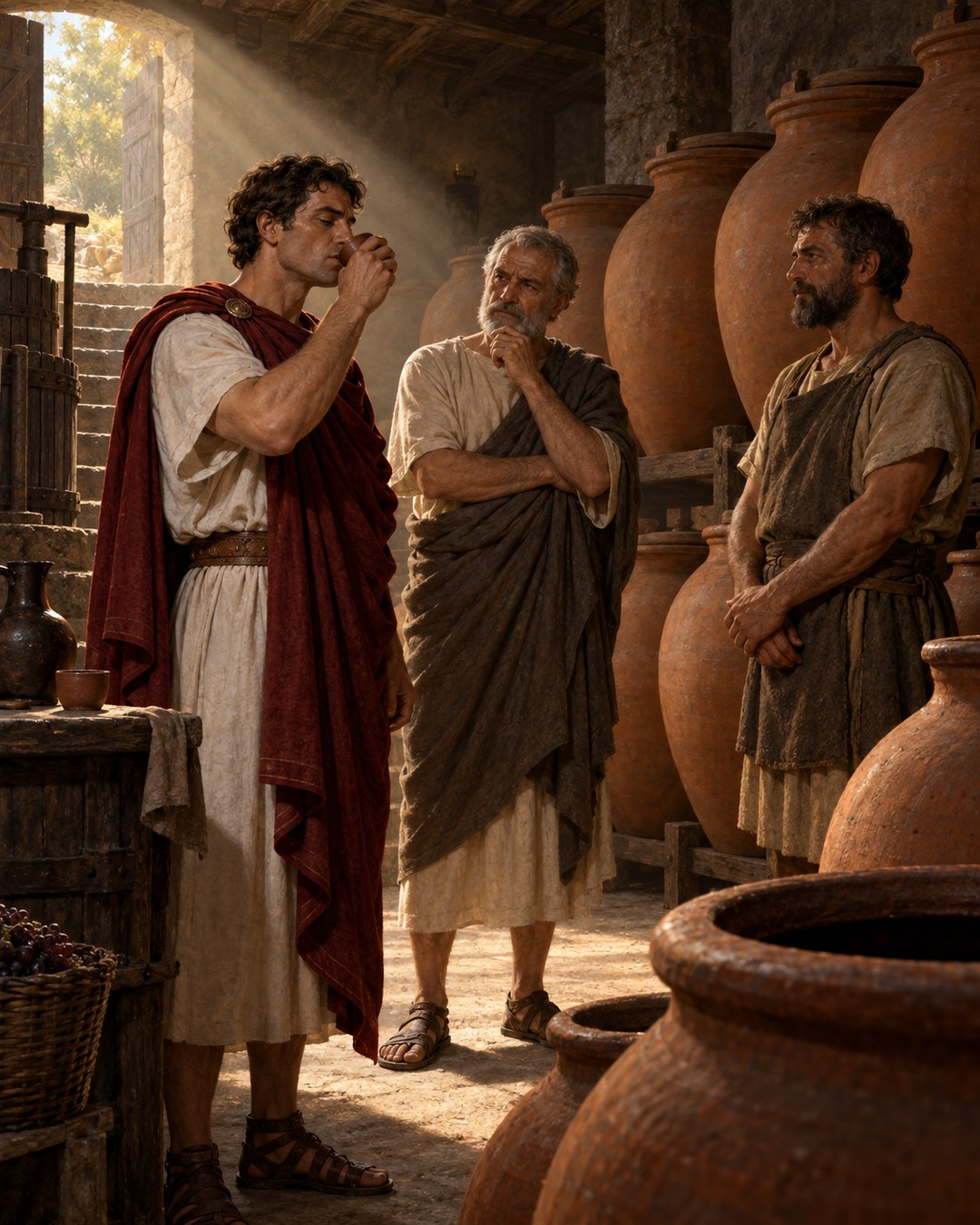
A Roman wine buyer could lose an objection by waiting three days.
Cato’s model terms allowed the purchaser to test wine held in jars and reject stock that was sour or musty. Yet the same clauses prevented inspection from becoming endless: if the buyer did not arrange the tasting in time, the wine counted as tasted.
Quality, quantity and storage each had their own clock. The sale worked by deciding when uncertainty had to end.
The Wine Had to Pass a Defined Test
The clauses survive in Cato’s De Agricultura, among compact instructions for running and contracting work on a farm. They are not a narrative of one named dispute. They read as terms that could be inserted into a sale when wine was already standing in storage jars.
Cato begins with delivery volume: forty-one urns were to make up the culleus used in the transaction. He then states the minimum condition of the stock. The seller was to provide wine that was neither sour nor musty.
Those defects mattered because bulk wine could not be judged from the promise alone. A buyer needed access to the liquid itself, while the owner needed a point after which the bargain could no longer be reopened merely because time had passed.
The answer was a tasting within three days. Cato does not specify a banquet, a panel of connoisseurs or a long list of desirable flavours. The test was narrower: did the wine avoid the disqualifying conditions named in the terms?
An “honest man” could decide the result. This neutral figure appears elsewhere in Cato’s contracts when damage or deductions need judgment. Here he anchored sensory evidence. Sourness or mustiness might be experienced through taste and smell, but the sale did not leave the final consequence to an unsupported accusation from either party.
The procedure joined a physical sample to a social guarantee. A cup made the condition observable. The third party made the observation usable when buyer and seller disagreed.
Three Days Put a Price on Silence
The buyer’s opportunity came with a consequence. If he failed to have the wine tasted during the three-day window, Cato says it would be considered tasted.
That rule did not prove that anyone had actually lifted a cup. It converted inaction into a legal and commercial result. Once the buyer had been given a defined chance to inspect, silence could no longer hold the owner’s stock in suspense.
Cato also assigned responsibility for delay. If the owner caused the tasting to be postponed, the buyer received the same number of extra days. A blocked inspection therefore did not consume the purchaser’s protection.
The two clauses balanced each other. The buyer could not preserve an objection indefinitely by doing nothing. The seller could not defeat the objection period by making the wine unavailable until the clock expired.
This is the core mechanism of the sale. Time was not merely a date written beside an agreement. It was distributed according to conduct. One party’s delay closed a right; the other party’s obstruction extended it.
Cato’s farm was already a place where stored wine could be counted before sale. his production estimate followed the vintage from grape skins through the quantity expected by Saturnalia. The sales clauses start at a different point. The wine exists, but its commercial identity still has to be fixed through condition, volume and acceptance.
January Ended Acceptance; October Ended Storage
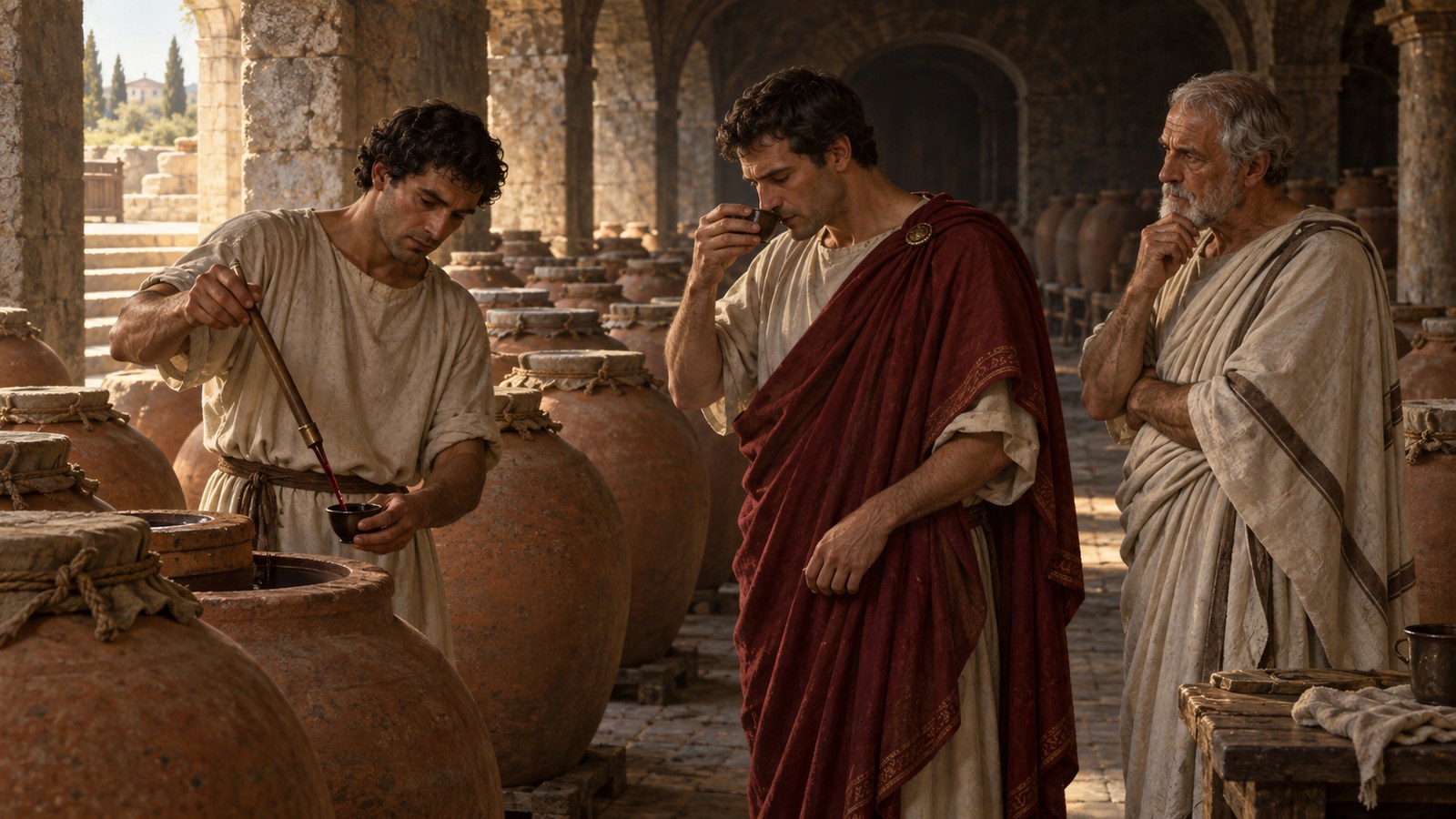
Tasting did not complete every part of the bargain. Cato set another deadline for acceptance: it was to occur before the following first of January.
If the purchaser failed to accept by then, the owner could measure the wine. Settlement would be made on the basis of that measurement. The buyer’s failure to appear did not leave quantity permanently undecided.
The purchaser still had a safeguard. He could require the owner to swear that the measurement had been made correctly. The oath did not replace the vessel or the act of measuring. It attached personal accountability to the quantity recorded in the buyer’s absence.
Storage had a much longer limit. Wine could remain on the property until the following first of October. After that date, if it had not been removed, the owner could do what he wished with it.
A neighbouring clause for grapes sold on the vine uses the same October boundary for the resulting wine. It also requires the purchaser to leave unwashed lees and dregs, then refers other terms back to the olive-sale model. Cato’s contract world was modular: one product’s clauses could borrow enforcement machinery from another transaction.
The October rule separated ownership from indefinite occupation. A buyer might have acquired wine, yet the farm’s jars and cellar space could not remain tied up without end. Removal was part of performance.
That distinction matters in a storage economy. large Roman dolia could turn wine into wealth held in place for months, but the same capacity created a practical question when the liquid was sold: who controlled the space while the buyer delayed collection?
Cato answered with a final date and a severe transfer of control after it. The cellar was not obliged to become a permanent warehouse for someone else’s purchase.
A Four-Handled Cask Made Quantity Repeatable
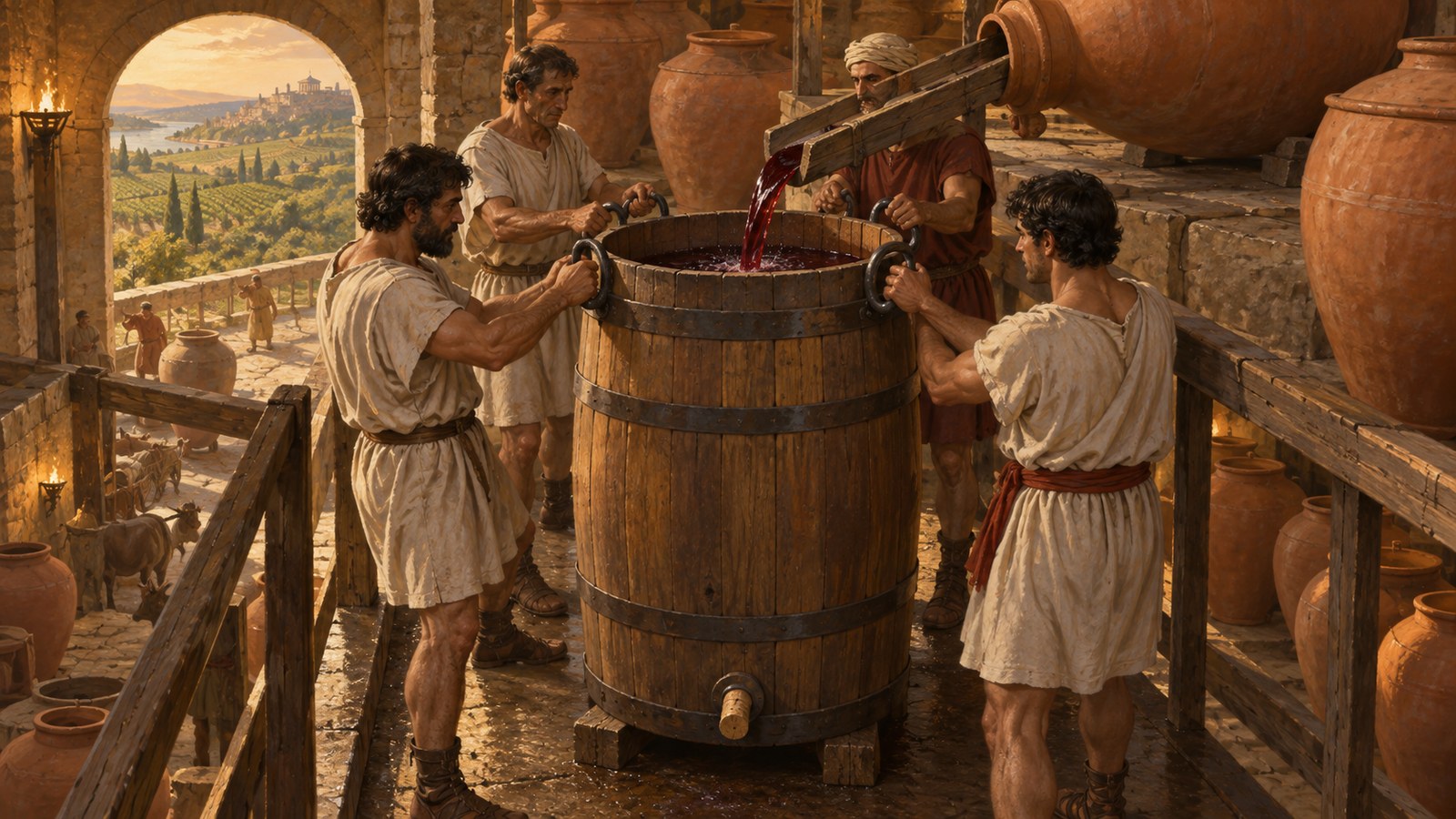
Several chapters later, Cato describes a convenient way to measure wine for purchasers. The device was a cask built to the size of a culleus.
It had four handles at the top. Their purpose was explicitly practical: easier handling. A large measuring vessel had to be moved and steadied by people, not treated as an abstract unit in an account.
At the bottom was an opening fitted with a pipe that could be stopped tightly. Near the top, another opening marked the level at which the cask held exactly one culleus.
The cask stood on the raised walkway among the storage jars. Wine could run from a jar into the measure. When the vessel was filled, it was closed.
This arrangement made volume visible through construction. The upper point defined fullness. The lower pipe controlled release. The handles allowed the heavy container to be managed. Positioning it among the jars let gravity move the wine into a standard space.
Cato does not say in chapter 148 that this exact cask had to be used in every sale governed by the earlier terms. Chapter 154 presents it as a convenient measuring method for buyers. Read beside the contract, it shows what the promised measurement could look like in practice.
The oath and the cask solved different problems. The vessel provided a repeatable capacity. The oath answered the buyer’s concern when he had not watched the owner use it. Material standard and personal guarantee supported the same settlement.
The Contract Turned Wine into a Sequence
The sale did not rely on one decisive moment. It moved through a series of gates.
First came condition: wine could not be sour or musty. Then came inspection: three days to taste, with a neutral judgment available. Next came acceptance before January. If the buyer did not act, owner-led measurement prevented paralysis. Finally came removal before October, after which the farm regained control over what remained.
Each gate addressed a different source of conflict. Taste handled hidden quality. The calibrated cask handled quantity. The oath handled absent observation. The dates handled delay. The storage clause handled occupied space.
The result was not a modern consumer guarantee, and Cato’s brief wording leaves much unstated. It does not identify prices, transport routes or the people who performed every task. Nor does it tell us how often disputes reached the “honest man.”
What survives is still unusually concrete. Forty-one urns defined the delivery unit. Three days defined the challenge period. January forced acceptance or measurement. October ended free storage. Four handles, two openings and a raised walkway turned capacity into a working apparatus.
The clauses reveal commerce as choreography. Buyer, owner, arbiter and workers had different opportunities to act, and the meaning of the wine changed as each deadline passed.
Before tasting, its quality remained open. After silence, it counted as tested. Before acceptance, quantity awaited agreement. After default, the owner’s measurement governed settlement. Before October, the cellar held the buyer’s wine. After October, the owner recovered discretion.
Cato’s strongest protection was not a single penalty. It was the refusal to let any question remain open forever.
A cup tested the wine. A cask counted it. The calendar completed the sale.
Sources
Cato, De Agricultura, sections 147–148 and 154.