
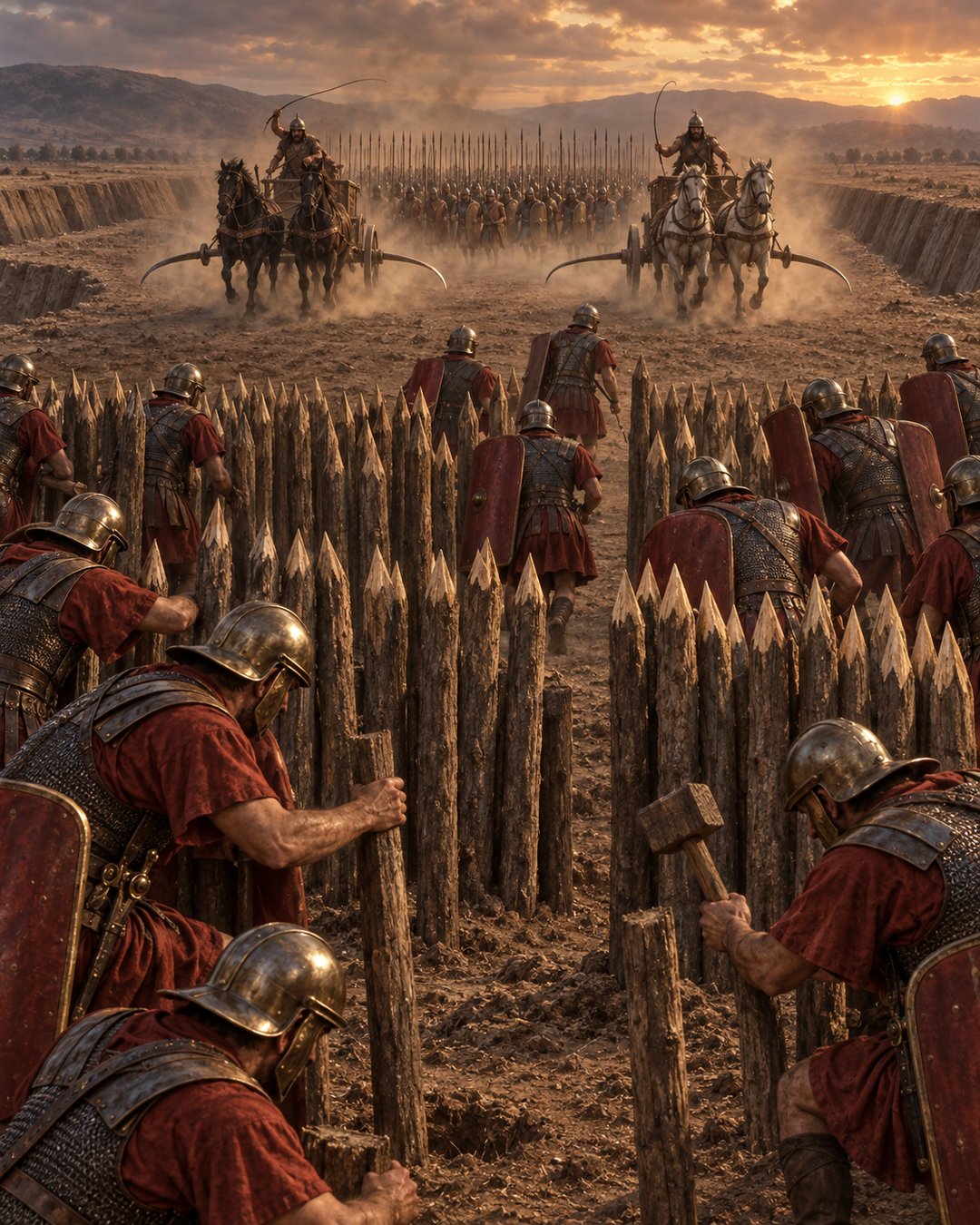
Archelaus put his scythed chariots at the front of a layered battle line. Their task was to break Roman order before the Macedonian phalanx arrived.
Sulla did not meet that threat with a thicker wall of men. He built broad trenches on the wings, left working intervals through his infantry, planted stakes close together and pulled his front rank back at the moment of contact.
Frontinus’s account turns a spectacular weapon into a problem of traffic: which force could move, through which opening, and at whose chosen time?
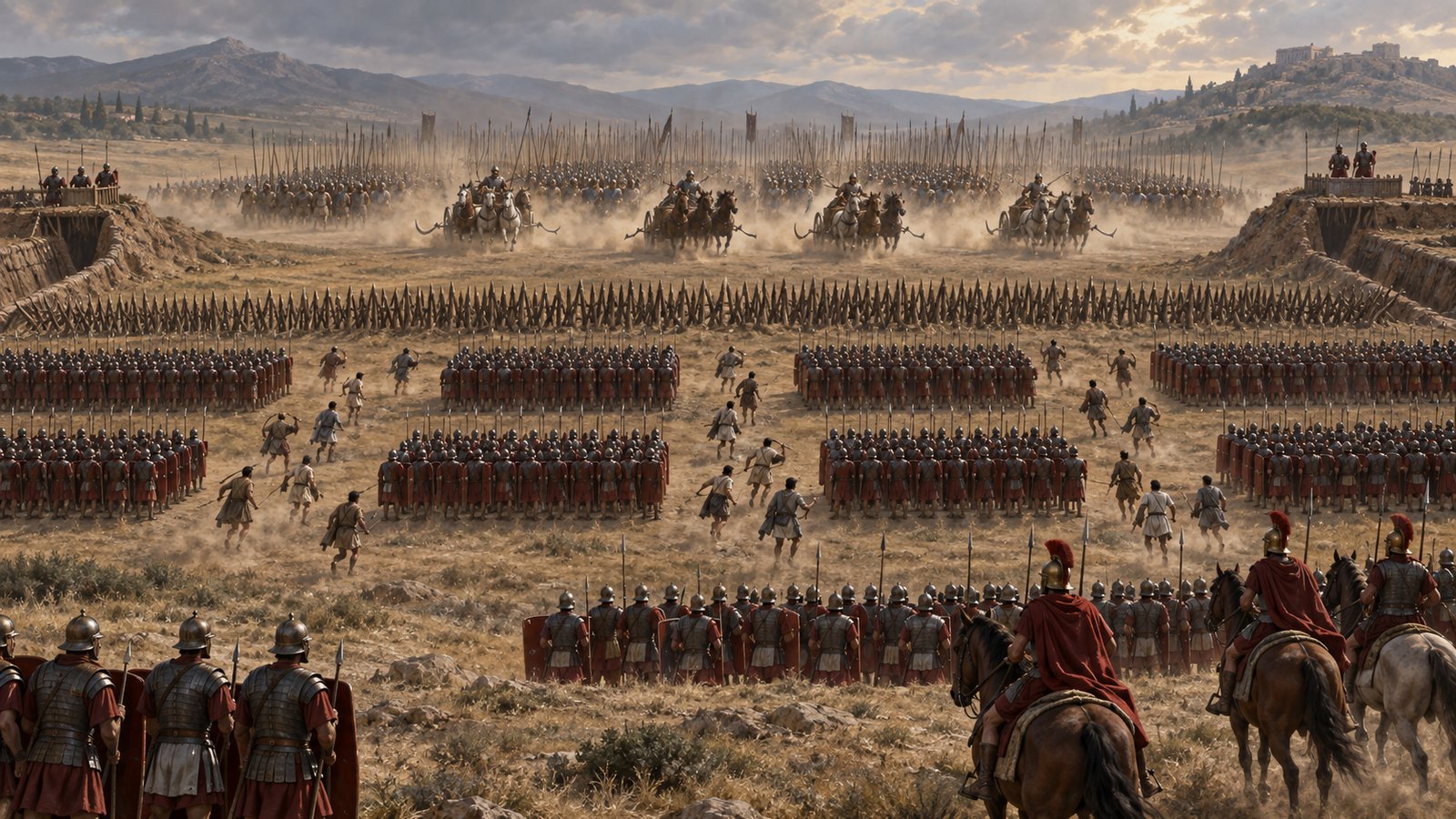
Archelaus Built His Attack in Four Different Depths
Frontinus begins with the enemy arrangement. Scythe-bearing chariots stood first because Archelaus wanted them to throw Sulla’s troops into confusion. The vehicles were not expected to win the battle alone. They were the disruptive edge of a formation built to exploit any gap they created.
Behind them came the Macedonian phalanx. Its long pikes and close order offered a very different kind of pressure. A Roman line shaken by horses, wheels and projecting blades would then have to receive a compact body whose effectiveness depended on maintaining alignment and forward momentum.
The third layer consisted of auxiliaries equipped in the Roman manner. Archelaus mixed Italian runaway slaves among them, men in whose determination Frontinus says he placed particular confidence. That detail made the deployment more complicated than a simple opposition between Roman legion and Macedonian phalanx. Roman methods and Italian fighters appeared on the other side as well.
Light-armed troops occupied the last line. Cavalry spread across both wings, numerous enough that Archelaus intended to wrap them around Sulla’s flanks. The whole design applied different pressures in sequence: shock in front, a dense pike formation behind, adaptable infantry deeper still and mounted envelopment at the edges.
The account does not preserve every distance, unit strength or movement. Frontinus selected the parts that demonstrated arrangement. His subject was the relationship among the layers and Sulla’s answer to each one.
Another Lost Eagles account shows a commander exploiting the physical setting rather than treating battle as a flat contest of courage: Sertorius waited for a north wind to drive dust into the Characitani’s cave positions. Sulla’s materials were different, but the principle was similarly concrete. Ground, obstacles and timing changed what opposing weapons could do.
Trenches Refused the Cavalry Its Wide Road
Sulla first dealt with the threat on the wings. He ordered broad trenches dug on both flanks and placed strong redoubts at their ends. Frontinus explicitly connects those works to the danger of envelopment.
Archelaus had more infantry and an especially large advantage in cavalry. On open ground, that mounted force could seek the outer edges of the Roman line, pass them and turn inward. A flank attacked from the side or rear would be forced to divide its attention while the chariots and phalanx pressed from the front.
The trenches altered that geometry. They did not need to destroy the cavalry. They needed to deny easy lateral passage and make the edge of the Roman formation harder to turn. The redoubts strengthened the ends, where a ditch by itself might otherwise create a vulnerable point.
This was the first closure in Sulla’s system. Archelaus had assigned cavalry to a large sweeping movement; the fieldworks reduced the space available for it. Men and horses could still fight, but the approach they were meant to use no longer remained freely open.
Field obstacles are sometimes described as passive defenses. Here they shaped the coming counterattack. By reducing pressure on the wings, Sulla could hold cavalry behind his own line rather than spending it immediately in a desperate attempt to match superior enemy numbers.
The trenches also made the center more important. If Archelaus could not easily flow around the sides, the chariots and phalanx had to produce the disruption expected of them at the front. Sulla could therefore prepare that frontage for a more exact sequence.
Intervals Let Roman Troops Move without Dissolving the Line
Sulla arranged his infantry in three lines. Frontinus emphasizes that he left intervals through which light troops and cavalry, stationed to the rear, could be sent whenever they were needed.
An interval was not simply empty ground. It was a controlled passage inside the formation. The Roman army could admit its own mobile elements through it and then recover order. The enemy, by contrast, would meet barriers and missiles when attempting to force a path.
This distinction helps explain why a formation with gaps was not necessarily weak. A continuous front can look secure while trapping reserves behind it. Sulla’s line preserved routes from rear to front. The structure allowed skirmishers to engage and withdraw, while mounted troops remained available for a later stage.
Frontinus describes those options in practical terms rather than as a fixed diagram. Light troops and cavalry could be sent through according to need. The design therefore held decisions open. Sulla did not have to commit every kind of fighter before he knew how Archelaus’s first attack behaved.
The arrangement recalls a different defensive problem at Alesia, where concealed obstacles were distributed in depth rather than trusted to one barrier. eight rows of hidden “lilies” made the ground itself interrupt an assault. Frontinus’s Sulla also made obstacles part of a larger formation, but his visible close-set stakes worked with planned infantry movement instead of a concealed field.
That difference matters. The men behind Sulla’s stakes had to know when the front line would move, where the passages were and how the light troops would use them. Timber alone could not coordinate that withdrawal.
The Front Rank Withdrew Inside the Stakes at the Chariots’ Approach
Sulla assigned the postsignani in the second line to drive large numbers of stakes firmly into the earth and set them close together. Frontinus then names the crucial timing: as the chariots drew near, the antesignani at the front withdrew within the barrier.
The maneuver changed what the chariot drivers saw and what route remained. Roman infantry had occupied the space ahead. Their retreat could invite continued speed, yet it did not uncover an open line. It revealed—or brought into immediate importance—a dense obstacle that horses and wheels could not use like ordinary ground.
Close spacing was essential. A few isolated posts might be avoided. A concentrated row forced a driver to slow, turn or risk collision. The scythes attached to a vehicle increased its threatening width, but width became a liability when the clear lanes disappeared.
The Roman front rank also had to pass safely through or around the prepared arrangement. Frontinus’s terse language does not explain every file and opening, so a modern reconstruction should not pretend to know the exact layout. What the source does establish is the order: stakes were driven by the second line, the front line came within them, and only then did the missile troops make their attack.
That sequence protected the soldiers who had been most exposed. It also placed the obstacle between Roman bodies and the incoming vehicles. Sulla did not ask a rank to absorb the chariot charge merely to prove steadiness.
The stakes converted retreat into preparation. Moving backward did not surrender the field. It brought the front rank into a position from which the next arm of the formation could work.
Noise and Javelins Turned Shock Back toward the Phalanx
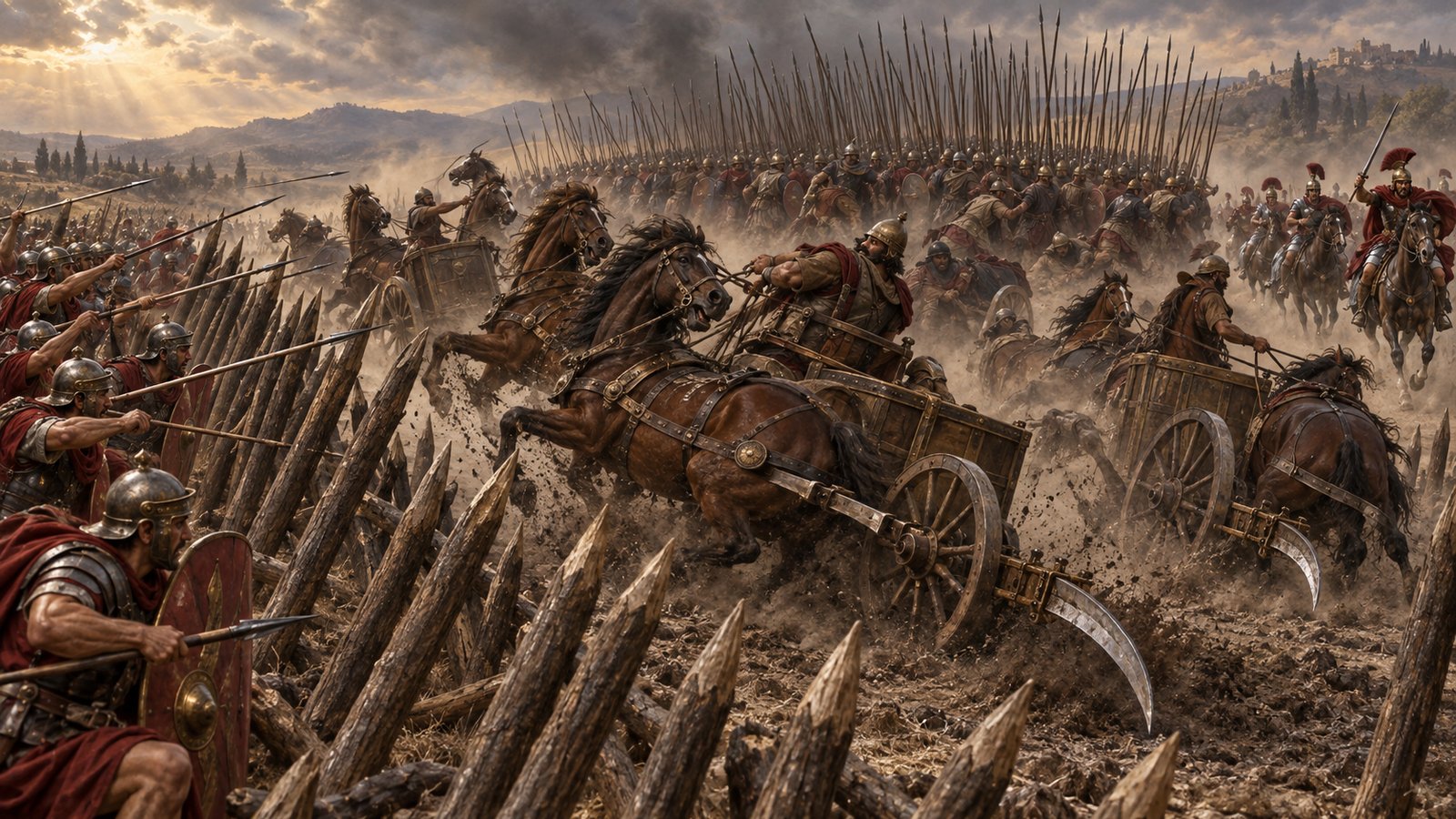
Once the chariots reached the prepared zone, Sulla ordered skirmishers and light-armed troops to raise a general battle cry and discharge their spears. The physical barrier and the human assault arrived together.
Frontinus offers two outcomes. Some vehicles became caught among the stakes. Other drivers panicked at the din and were pressed by javelins into turning back. Either reaction defeated the purpose of the first line. The chariots no longer carried disorder into the Romans.
They carried it toward their own men. Frontinus says the vehicles were driven back upon Archelaus’s force and threw the Macedonian formation into confusion. The phalanx that had been positioned to exploit broken Roman ranks now had to cope with horses, wheels and frightened drivers returning across its approach.
The effect followed from the depth of Archelaus’s own deployment. Placing the phalanx directly behind the chariots created support while the attack moved forward. When the direction reversed, the same closeness transmitted disruption backward.
Sulla pressed forward as the Macedonians gave way. Archelaus then committed cavalry, but Roman horsemen suddenly emerged, drove it back and completed the victory in Frontinus’s telling. The reserves had survived the first crisis because trenches protected the flanks and intervals kept routes through the infantry available.
No single device explains the result. Stakes without the withdrawal might have left Roman troops in front of their own obstacle. Stakes without skirmishers might have slowed vehicles without forcing them away. Skirmishers without protected ground would have faced the charge in the open. Cavalry committed too early might not have been ready for Archelaus’s final response.
Frontinus preserved the episode because the pieces answered one another. Enemy cavalry found narrowed wings. Roman reserves found usable passages. The front rank found safety behind prepared timber. Chariots found no clean road and the phalanx found its own weapon returning.
The lesson is not that ancient commanders defeated machinery with a clever object. It is that an object became decisive only when formation, terrain and timing gave it a precise job.
Sources
Frontinus, Strategemata, book two, section 3.17.