
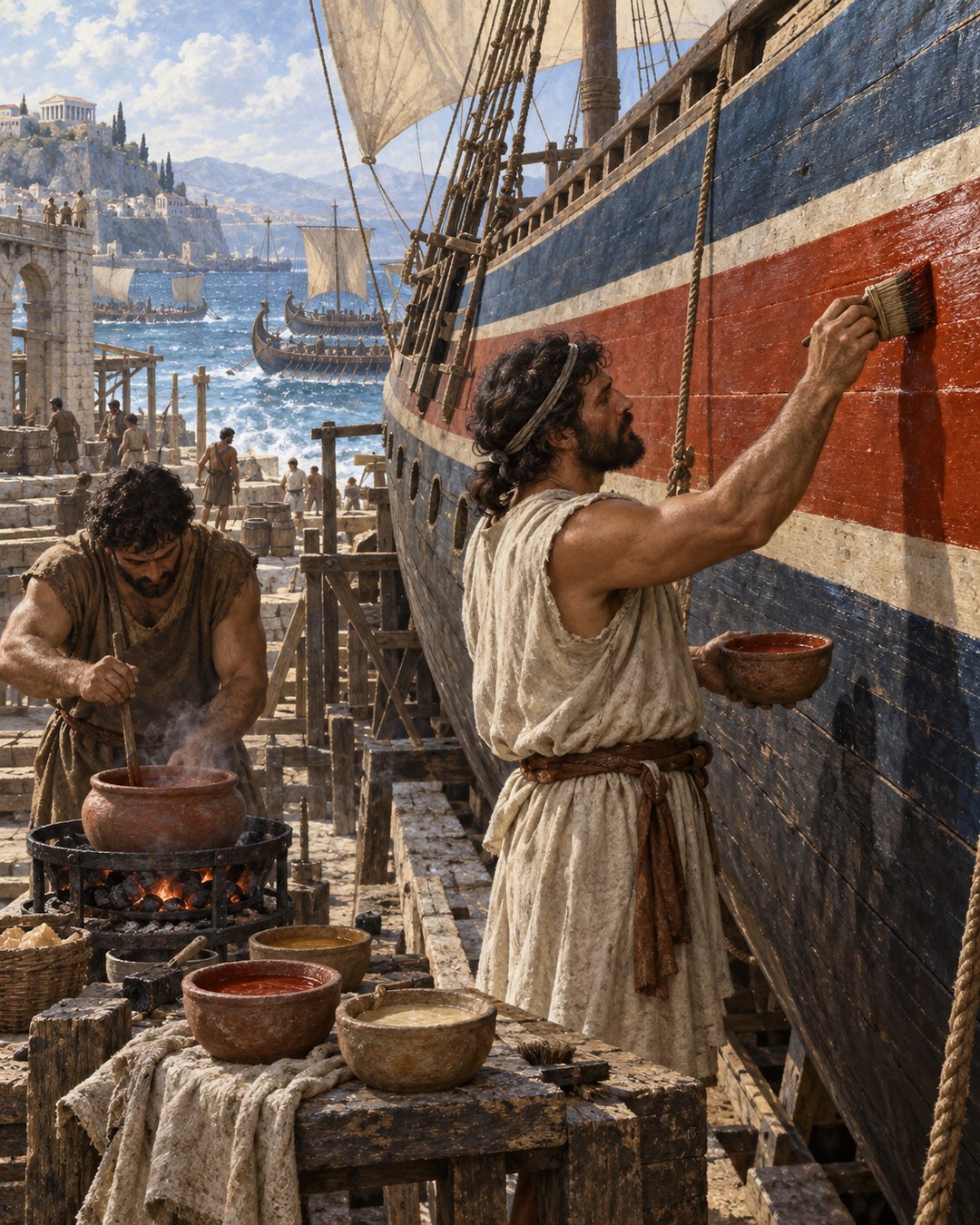
A painter warmed wax over fire until a brush could carry it. Beyond the workshop waited a battleship: timber, salt spray, hard sun and rigging pulled by wind.
Pliny the Elder treated this as a distinct technical step. Early encaustic painting had two forms, he said. Decorating ships added a third, and the new combination of heat, wax and brush produced a surface that weather did not easily spoil.
The passage is only a few lines long, but it shifts encaustic from gallery vocabulary to maritime work.
Pliny Inherited an Argument about Who Burned Wax First
Pliny begins with uncertainty. Ancient authorities did not agree about who invented painting in wax or the process Romans described as encaustic. Some credited Aristides with discovery and Praxiteles with perfecting it, yet Pliny immediately points toward works he believed were earlier.
He names Polygnotus, Nicanor and Mnasilaus of Paros. Their attributed pictures mattered because they disturbed a neat story in which one famous master invented a technique and another completed it. Artistic practices could exist before surviving writers assigned them an origin.
Elasippus of Aegina supplied Pliny with another clue. A picture carried a word meaning that it had been “burned in.” The inscription does not give a workshop recipe, but Pliny treats it as evidence that encaustic practice was already intelligible when the artist chose to advertise it.
The disagreement is valuable because it exposes the limits of the archive. Pliny had names, objects and claims of priority, not an uninterrupted line of dated demonstrations. He could compare traditions without proving the first moment when wax met pigment and controlled heat.
That restraint matters for reconstructing the craft. “Encaustic” should not be treated as one timeless formula. Pliny’s own account separates methods by surface and tool, then introduces ship decoration as a later development. The history lies in changing procedures rather than in a single inventor’s revelation.
The language of burning also needs care. It does not imply setting a picture alight. Heat was part of managing wax: softening, melting or fixing a medium whose behavior changed with temperature. The working problem was controlled warmth, not spectacle.
Panels, Ivory, and a Pointed Tool Came before the Ship Brush
When Pliny finally summarizes early practice, he gives two kinds. One involved wax painting. The other worked on ivory with a cestrum, a small pointed graver. The distinction preserves different relationships between material and hand.
A pointed tool meets a hard surface through pressure and incision. A brush lays down a fluid or softened substance. Even if both could be called encaustic, the physical acts were not interchangeable.
Iaia of Cyzicus makes that range especially visible. Pliny says she painted with a brush at Rome and also drew on ivory with the cestrum. She chiefly produced portraits of women, made a large picture of an old woman at Neapolis and painted herself with the aid of a mirror.
Her example warns against imagining encaustic as a closed male lineage. It also shows why tool names matter. Brush and graver could belong to one artist’s practice while serving different surfaces and effects.
Pliny’s catalogue is concerned with reputation, speed and price as much as chemistry. Iaia’s hand was celebrated as exceptionally quick, and her work earned more than that of prominent male portraitists named beside her. Workshop technique existed inside a market where pace and finish affected fame.
Ivory also imposed a scale unlike a ship’s hull. A cestrum working across a small pale surface demanded controlled marks close to the hand. Maritime decoration would require material to cross broad planks, follow curvature and survive movement outdoors.
Calling both operations “encaustic” therefore identifies a family of heat-and-wax practices, not a promise that every object was made in exactly the same way. Pliny’s third method becomes significant because it changes both application and environment.
A Teacher, a Ceiling Painter, and a Wreath Maker Expanded the Craft
Between the inventor debate and the ship recipe, Pliny follows a social chain. Pamphilus, remembered as the teacher of Apelles, painted in encaustic and taught Pausias of Sicyon. Pausias had begun under his father Bryetes and became famous in the medium.
Pausias’s career moved across surfaces. Pliny associates him with decorated ceilings, small pictures and a famous answer to rivals who mocked encaustic as slow. He completed a boy’s portrait in one day, and the work became known as the “One-day Boy.”
Speed here was a public claim about mastery. Wax could demand preparation and temperature control, so finishing convincingly within a day made process itself part of the picture’s reputation.
Pausias also learned through looking outside a formal studio hierarchy. Glycera, a woman from his town, made flower wreaths. Pliny says his effort to imitate and rival her arrangements advanced his ability to represent many kinds of flowers in encaustic.
The archive already follows Pausias solving a black ox through tonal contrast and foreshortening. The wreath episode reveals another engine: close observation of work performed by someone whose own expertise lay in arranging real flowers.
That exchange makes a useful bridge to naval painting. Techniques spread because artists taught pupils, answered rivals, borrowed from neighboring crafts and met new commissions. A method could move from portrait, ceiling or floral picture toward an entirely different scale without losing its identity all at once.
Pliny does not say that Pausias invented ship encaustic. He places multiple traditions near one another, then closes with a concise taxonomy. The careful reader can trace expansion without forcing all innovation into one biography.
Fire Turned Wax into Paint for a Working Hull
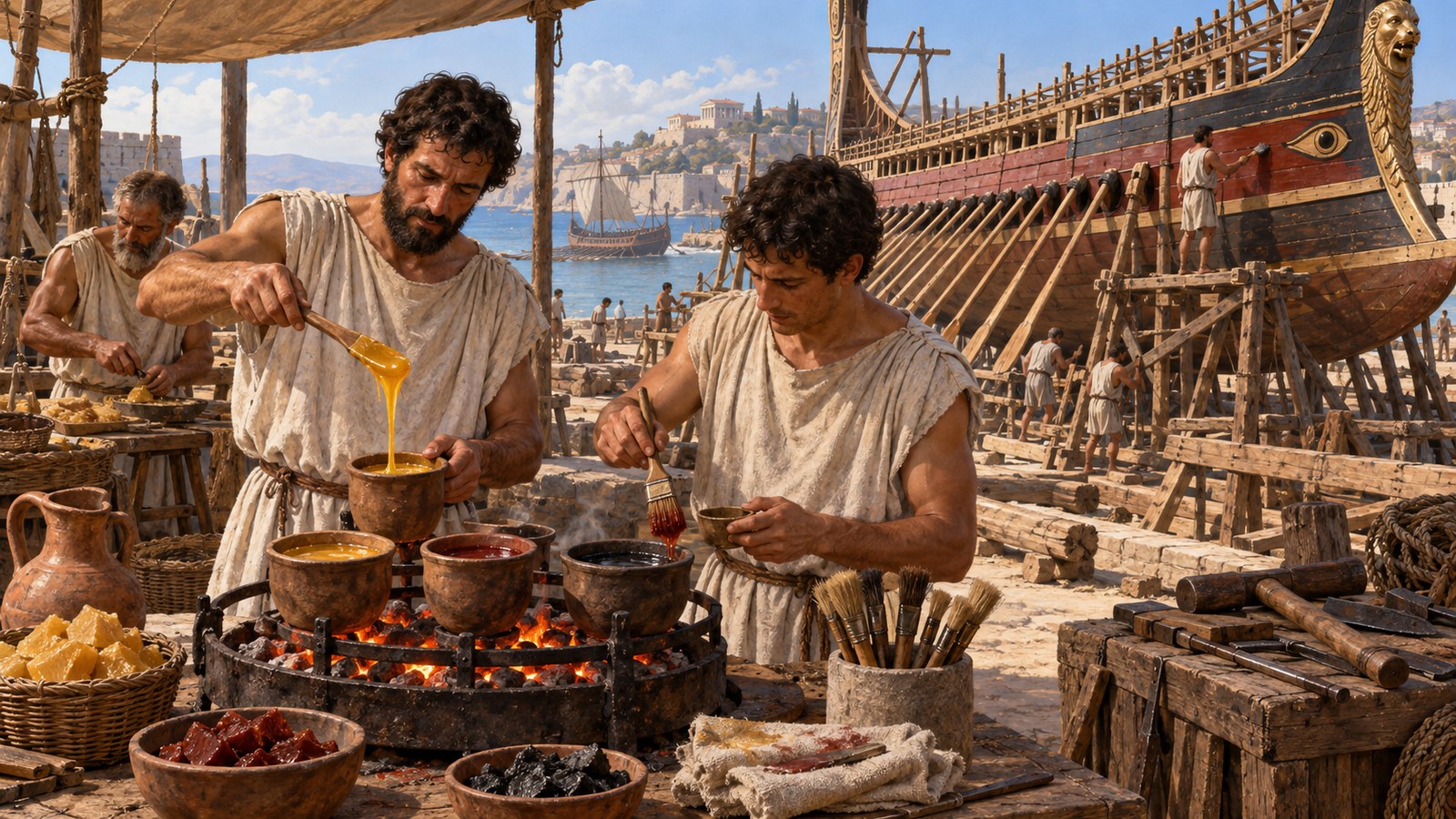
The third method begins with battleships. Pliny says that the practice of decorating them was added later and employed a brush after wax had been melted by fire.
Each element solves part of a workshop problem. Wax that is too cool resists a broad brush. Controlled heat changes its consistency. A brush spreads the softened, pigmented material over timber faster and more continuously than a small graver could work.
The sentence does not identify a precise wax recipe, pigment ratio, brazier shape or number of coats. Supplying those details as certainty would turn a compressed ancient statement into a modern technical manual. What the source securely gives is the sequence: fire, melted wax, brush and ship.
Scale transforms the scene. A panel can sit in front of one painter. A hull requires movement along planks, access around curves and coordination with the people building or maintaining the vessel. The painted surface belongs to an object intended to leave the yard.
Pliny calls the vessels battleships, not decorative models. Their paint would encounter launch, spray and repeated weather. That practical setting distinguishes the method more sharply than a modern label such as “wax painting” can.
The process also joins two forms of control. Fire must remain useful rather than destructive near wood and rigging. Wax must stay workable long enough to spread while still becoming a stable surface after application. The craft sits between heat management and the painter’s eye.
Another Lost Eagles story shows Protogenes throwing a sponge when painted foam refused to look natural. That episode is about chance correcting illusion on a celebrated picture. Ship encaustic has a different narrative engine: material behavior is tested not by a dog’s painted mouth but by the sea.
Sun, Salt Water, and Wind Became the Durability Test
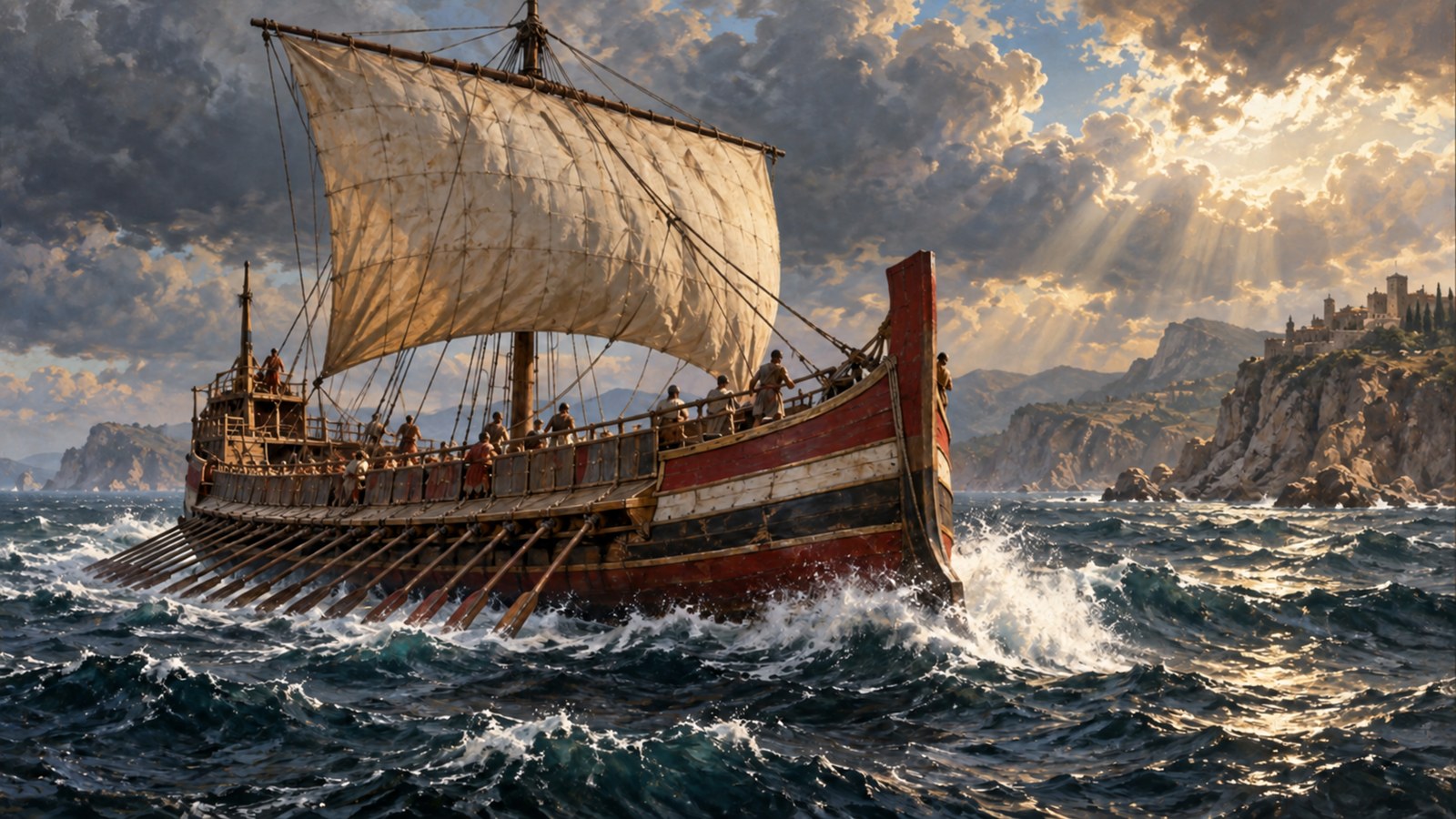
Pliny ends with the property that justified the process. Painting applied in this way, he says, was not spoiled by sun, salt water or winds.
The three exposures describe more than generic “weatherproofing.” Sun heats and brightens a hull. Salt water wets, dries and leaves residue. Wind drives spray and works across a moving surface. Together they define the ordinary hostility of maritime service.
Pliny does not provide a timed experiment or compare treated and untreated boards. His claim is observational and categorical. It tells us what people valued in the method, not how a modern materials laboratory would quantify its lifespan.
Durability also changes the meaning of decoration. Color on a battleship was not useful if it failed as soon as the vessel worked offshore. A visual finish had to coexist with maintenance, movement and exposure.
The painted hull carried workshop decisions into public space. Labor performed beside a brazier remained visible at a harbor, along a coast and perhaps in formation with other ships. Surviving color represented repeated control over wax, temperature and application before it represented any specific motif.
That is why Pliny’s compact sequence deserves attention. The sentence does not merely report that Romans liked painted ships. It identifies an adaptation: an older family of wax practices acquired a brush-based form suited to broad timber and aggressive conditions.
The story begins amid disputed names and prestigious artists, yet it ends with anonymous craft under physical pressure. Whoever first experimented with the method matters less to the surviving mechanism than the fact that heat made wax mobile, the brush made it scalable and the sea proved whether the surface held.
Sources
Pliny the Elder, Natural History, book 35, sections 122–125 and 147–150.