
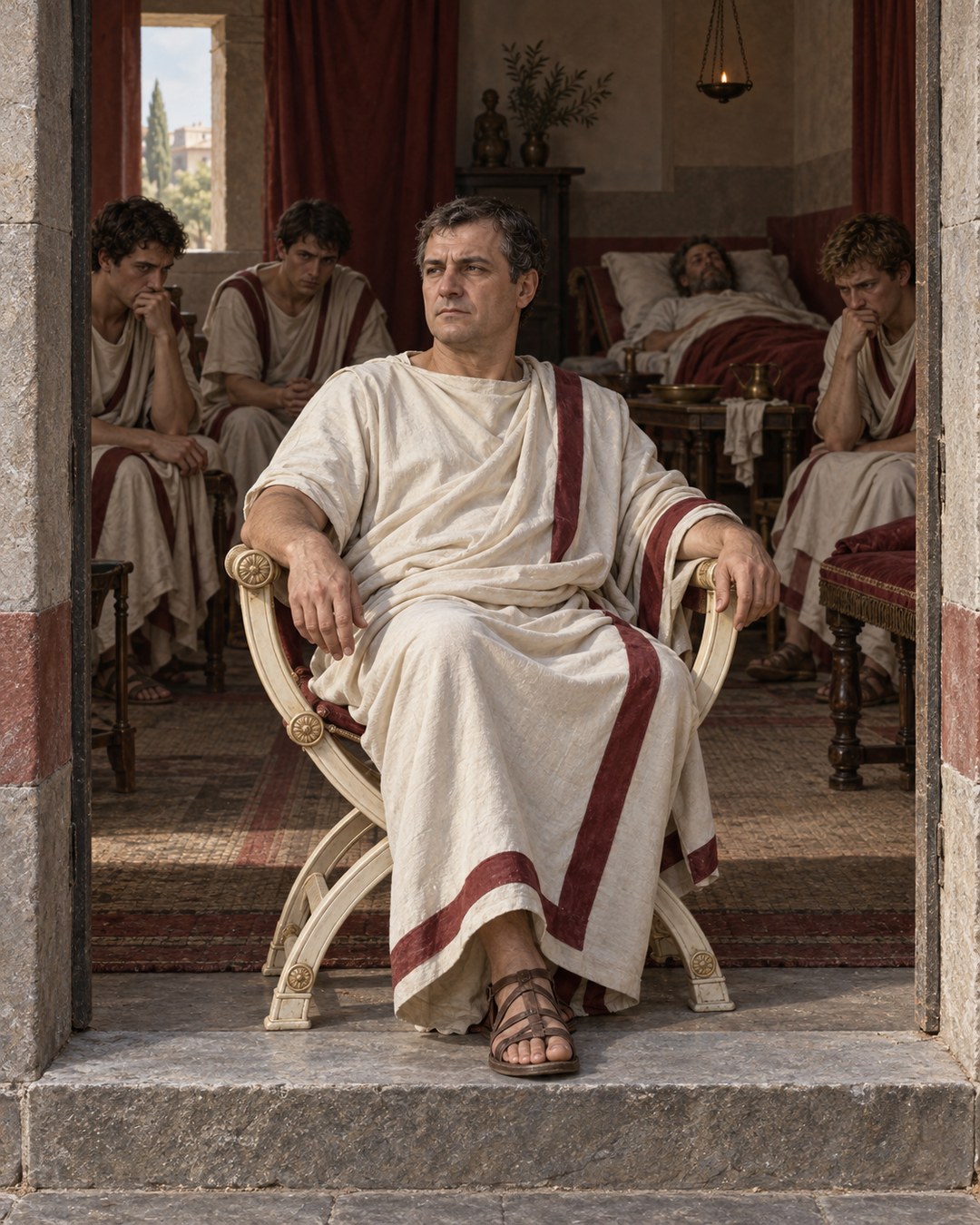
The young nobles did not rise when Gnaeus Flavius entered the sickroom. They remained seated, making a small domestic courtesy carry a public insult.
Flavius did not demand applause or begin a speech about his ancestry. He laughed, called for his curule chair, and had it set across the threshold.
The men who would not acknowledge the magistrate now could not leave without looking at him in the chair of state.
Election Turned a Scribe’s Tablets into a Disqualification
Aulus Gellius introduces the story through the historian Lucius Calpurnius Piso. He admired both the action and Piso’s “pure and charming” style, so he copied the passage from the third book of the Annals.
Piso identified Gnaeus Flavius with unusual insistence as the son of Annius. He also described him as the son of a freedman and a scribe by profession. Those details establish the social pressure inside both anecdotes. Flavius approached high office without the ancestry that young nobles treated as their natural possession.
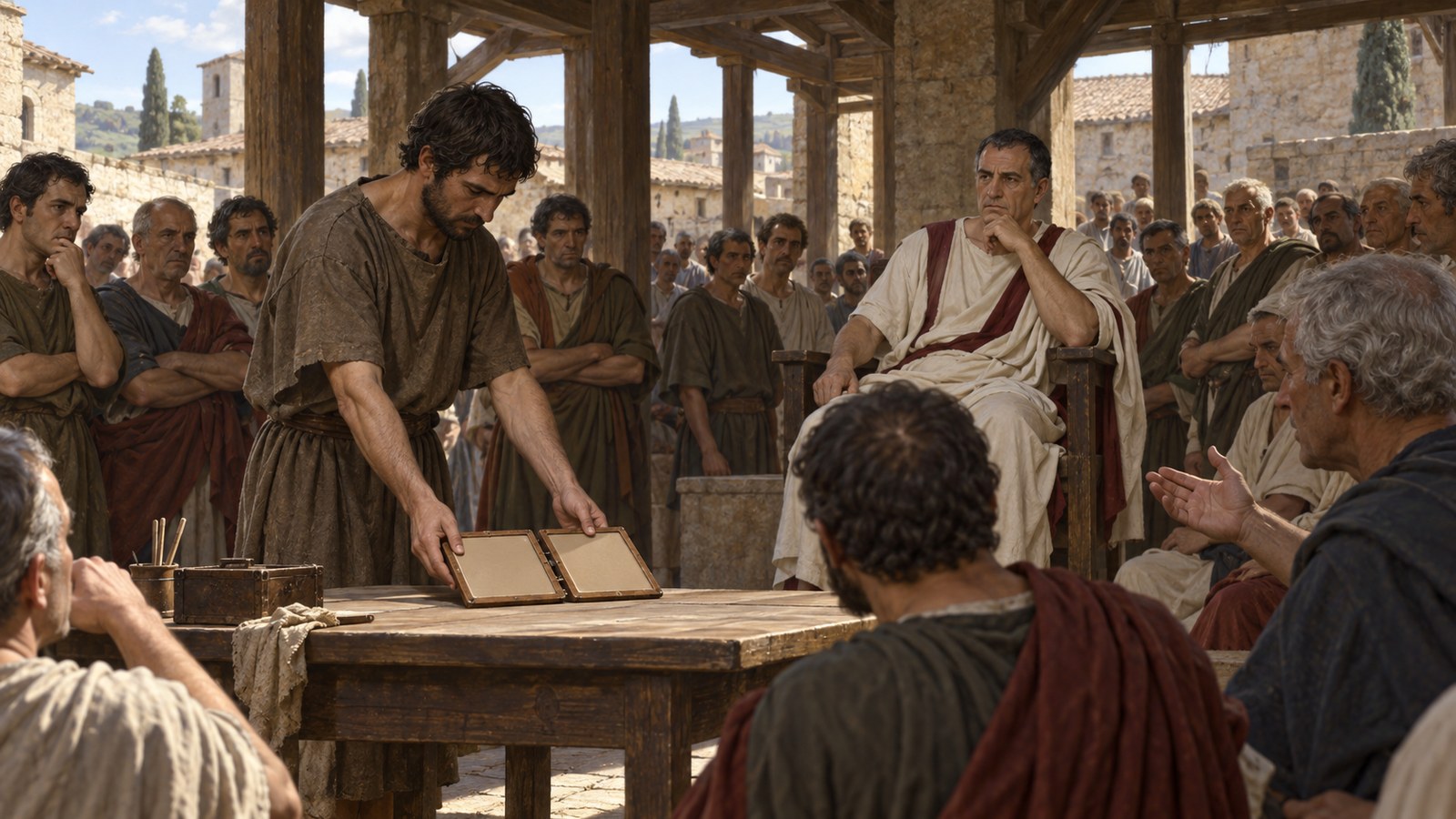
At the time of the election he was serving a curule aedile. The assembly of the tribes selected him as one of the succeeding curule aediles, but the magistrate presiding over the vote refused to accept him.
The stated objection was occupational. The presiding officer did not think that a man who followed the profession of scribe should become an aedile. Piso’s brief account does not tell us whether ancestry, dependency or a formal incompatibility lay behind that judgment. It gives us the public reason and Flavius’s answer.
He laid aside his tablets and resigned his clerkship. Only then was he made curule aedile.
The sequence is sharper than a story in which popularity simply defeats prejudice. The tribal assembly had already named its choice, yet the election officer still controlled whether that choice would be received. Flavius responded by removing the exact condition the officer had announced.
The blank tablets mattered because they were not merely writing equipment. In Piso’s scene they stood for a profession, a place in another magistrate’s service and the status barrier raised against promotion. Setting them down made a visible procedural change.
Resignation Forced the Objection to Stay Narrow
Flavius did not win by persuading the presiding magistrate that scribal work deserved more honor. Nor does the passage record a law declaring every occupation compatible with every magistracy. He resigned.
That choice can look like submission, but it also trapped the objection within its own terms. If being a scribe prevented acceptance, then ceasing to be a scribe removed the declared obstacle. The officer could no longer shift easily from profession to ancestry without exposing a different reason.
Piso compresses this exchange into objects and actions. Tablets go down. A clerkship ends. The elected man becomes aedile. Nothing in the surviving passage needs an invented campaign speech.
The method resembles the discriminating restraint in the veto that stopped Lucius Scipio at the prison door. There too, the response did not erase every preceding dispute. It isolated the next condition and acted precisely upon it.
Flavius’s answer also altered his dependence. A scribe serving an aedile worked inside another officeholder’s administrative orbit. A curule aedile occupied the chair that announced jurisdiction and rank in his own right.
The promotion therefore involved more than a title. It rearranged who waited upon whom, who could summon attendants and whose presence reorganized a room.
Piso’s second anecdote tests whether elite behavior would recognize that rearrangement after the election machinery had done so.
A Sickroom Became a Theatre of Refused Recognition
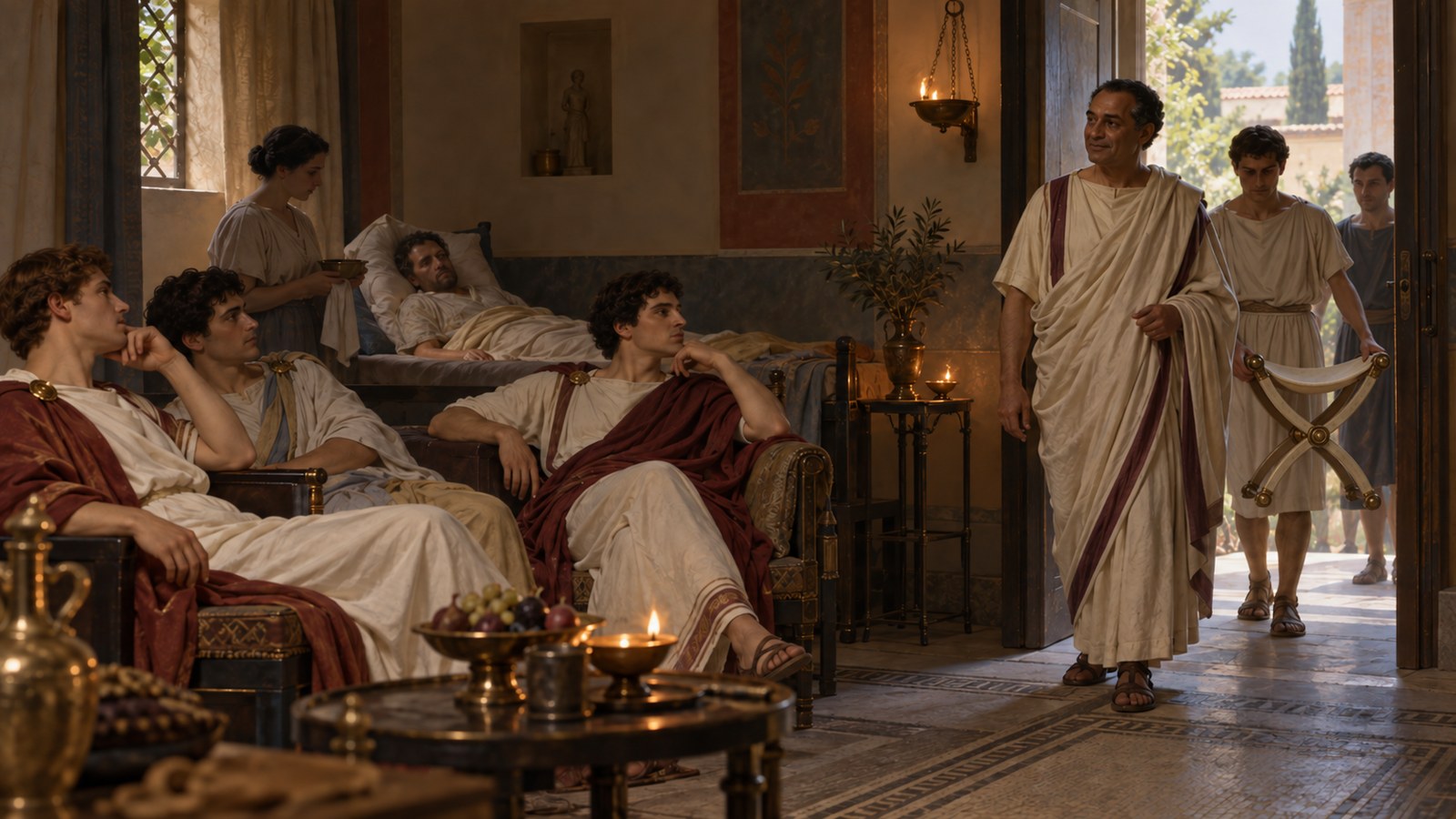
Flavius later came to call on a sick colleague. The setting was not an assembly or a courtroom. Several young nobles were already sitting in the room when he entered.
Roman greeting customs made bodily movement legible. Rising for someone could mark respect for age, dignity or office. Remaining seated could turn stillness into contempt, especially when everyone in the room understood who had arrived.
Piso removes ambiguity by saying that the nobles treated Flavius with contempt and that none was willing to rise. Their posture was deliberate.
The sick colleague adds another layer. A visit to an ill man should have centered care and social obligation. Instead, the room became an audience for a struggle over whether Flavius’s office could overcome his origin.
The nobles controlled the first gesture because they controlled their own bodies. They could withhold the small act that etiquette expected. Flavius could not make their knees straighten without turning courtesy into force.
He chose a different field. Rather than compel the greeting, he changed the route by which the gathering could end.
The senators who followed Cato toward prison used collective movement to transform the meaning of detention. Here, a refusal to move gave Flavius the raw material for a smaller but equally physical political reply.
The Curule Chair Converted Contempt into Captive Attention
Flavius laughed at the rudeness. The laugh is important because it denies the nobles the emotional result they may have wanted. Piso does not show him wounded, pleading or raging.
He ordered his curule chair brought into the house and placed on the threshold. The curule chair was portable and foldable, but it was not neutral furniture. It marked a magistrate entitled to sit in it.
Position did the rest. A chair against a wall would have displayed office. A chair on the threshold controlled passage. The same object became both emblem and obstacle because Flavius chose the narrow point every departing guest had to cross.
Piso states the mechanism plainly: none of the nobles could go out, and all were forced to see Flavius sitting in his chair of state. The punishment was not imprisonment in a legal sense. It was prolonged exposure to the recognition they had tried to deny.
The response matched the insult without reproducing it. They had used sitting to say he was beneath acknowledgment. He used official sitting to make himself the unavoidable center of their sightline.
There is comedy in the inversion. Men confident enough to remain seated now found their exit stopped by a better seat. The room’s social geometry changed while almost everyone stayed exactly where he was.
The anecdote works because the chair’s authority was already understood. Flavius did not need an inscription, a guard or a threat. Furniture, office and doorway completed the argument together.
Piso Made Status Depend on Acts That Others Had to Witness
The two scenes form a deliberate pair. In the election, Flavius set down the tablets associated with subordinate work. In the sickroom, he sat down in the chair associated with magistracy.
One object was relinquished so the assembly’s choice could take effect. The other was deployed so aristocratic contempt could not pretend that choice had changed nothing.
Neither scene abolishes hierarchy. Flavius succeeds by entering the hierarchy of curule office and using its recognized signs. Piso’s point is not that symbols of rank ceased to matter. It is that inherited nobles did not possess exclusive control over who could wield them.
The anecdotes also show procedure and performance reinforcing each other. Election supplied lawful office. The chair made that office visible in a room whose occupants wished to ignore it. Without election, the chair would be pretence; without the chair, the social refusal might pass unanswered.
Gellius valued the story enough to preserve Piso’s prose, not merely summarize a constitutional rule. The concrete details carry what abstraction would lose: blank tablets leaving a scribe’s hands, seated youths refusing a greeting, attendants maneuvering a folding chair into a doorway.
Flavius did not force the nobles to like him. He made their dislike operate inside a space shaped by the office they despised.
The threshold was the perfect boundary. On one side, they could continue sitting. To cross it, they had to face the elected son of a freedman already seated as curule aedile.
Sources
Aulus Gellius, Attic Nights, book 7, chapter 9, preserving Lucius Calpurnius Piso Frugi, Annals, book 3.