
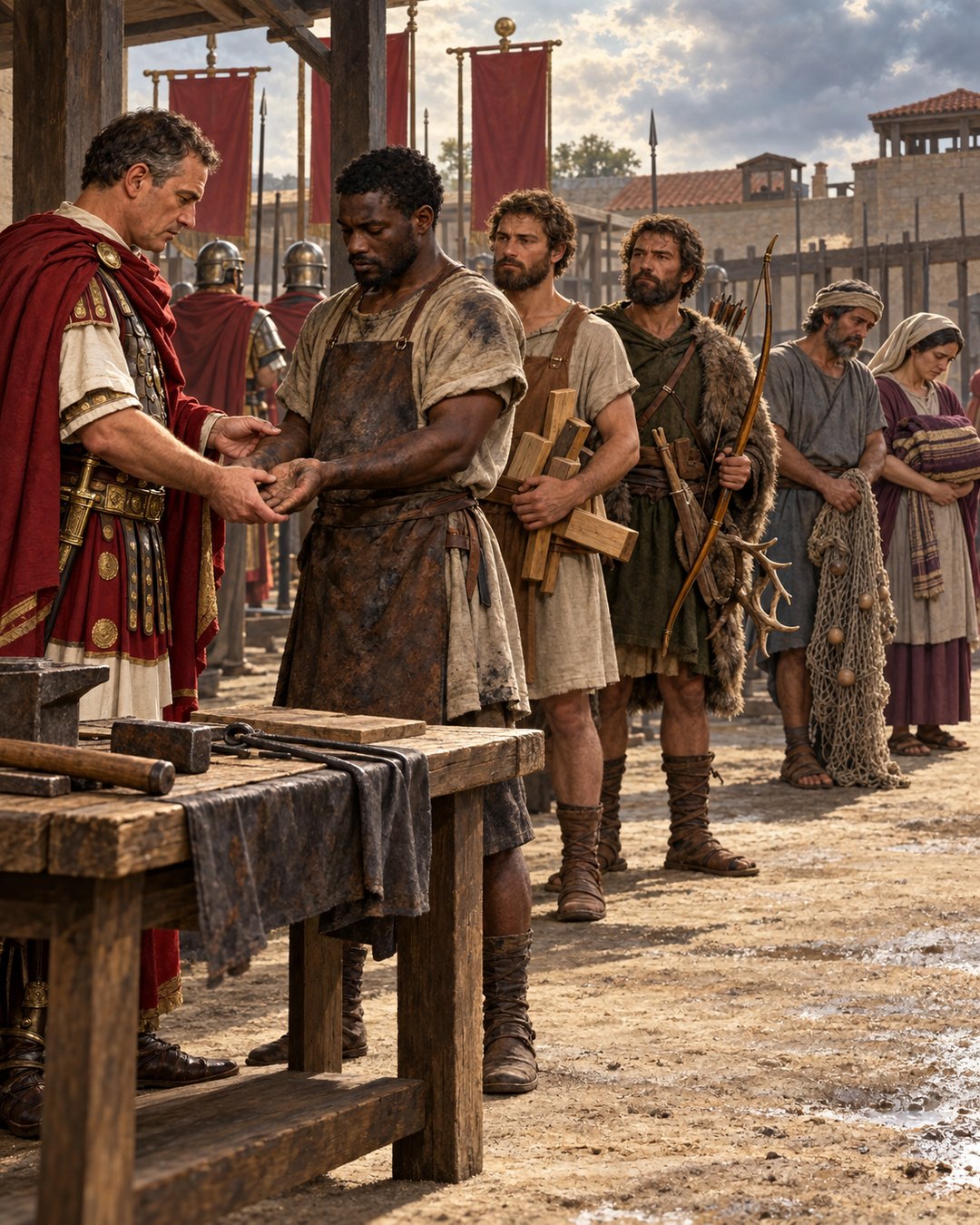
A fisherman, a weaver, a smith, and a carpenter approached the same recruiting ground.
Vegetius would not have read their trades as neutral lines on a register.
Before drill began, civilian work had already become evidence.
The Levy Began Long Before a Weapon Was Issued
Vegetius wrote about Roman military institutions from the troubled later empire, looking backward to practices he believed had made earlier armies effective. His first book does not open with a battle. It opens with selection.
That order is the argument. Training could shape a recruit, but only after officials had chosen material they considered capable of being shaped.
His first preference was geographical and social rather than anatomical. Country labourers, he thought, had grown up under sun, rain, cold, and physical work. They were accustomed to little, less attached to baths and urban comforts, and familiar with digging or carrying burdens.
Vegetius did not claim that a city resident was permanently useless. He described a corrective programme: accustom the urban recruit to labour, dust, heat, limited food, the open air, and life under tents before expecting him to master weapons.
The distinction therefore rested on habits. A rural childhood seemed to supply conditions that an urban body would have to learn deliberately.
This was recruitment as prediction. Where a man came from and what his days had demanded were used to estimate how he might endure a march, camp, ration, or entrenchment.
Age entered the calculation too. Vegetius preferred enlistment around the beginning of puberty, when running and jumping could be learned before older limbs became less adaptable.
The army he imagined did not wait for a fully formed civilian and then add a sword. It tried to seize the moment when movement, obedience, and endurance were still teachable.
That makes his occupational list easier to understand. It was another attempt to infer future behaviour from a life already lived.
Height Was a Standard, Not the Final Verdict
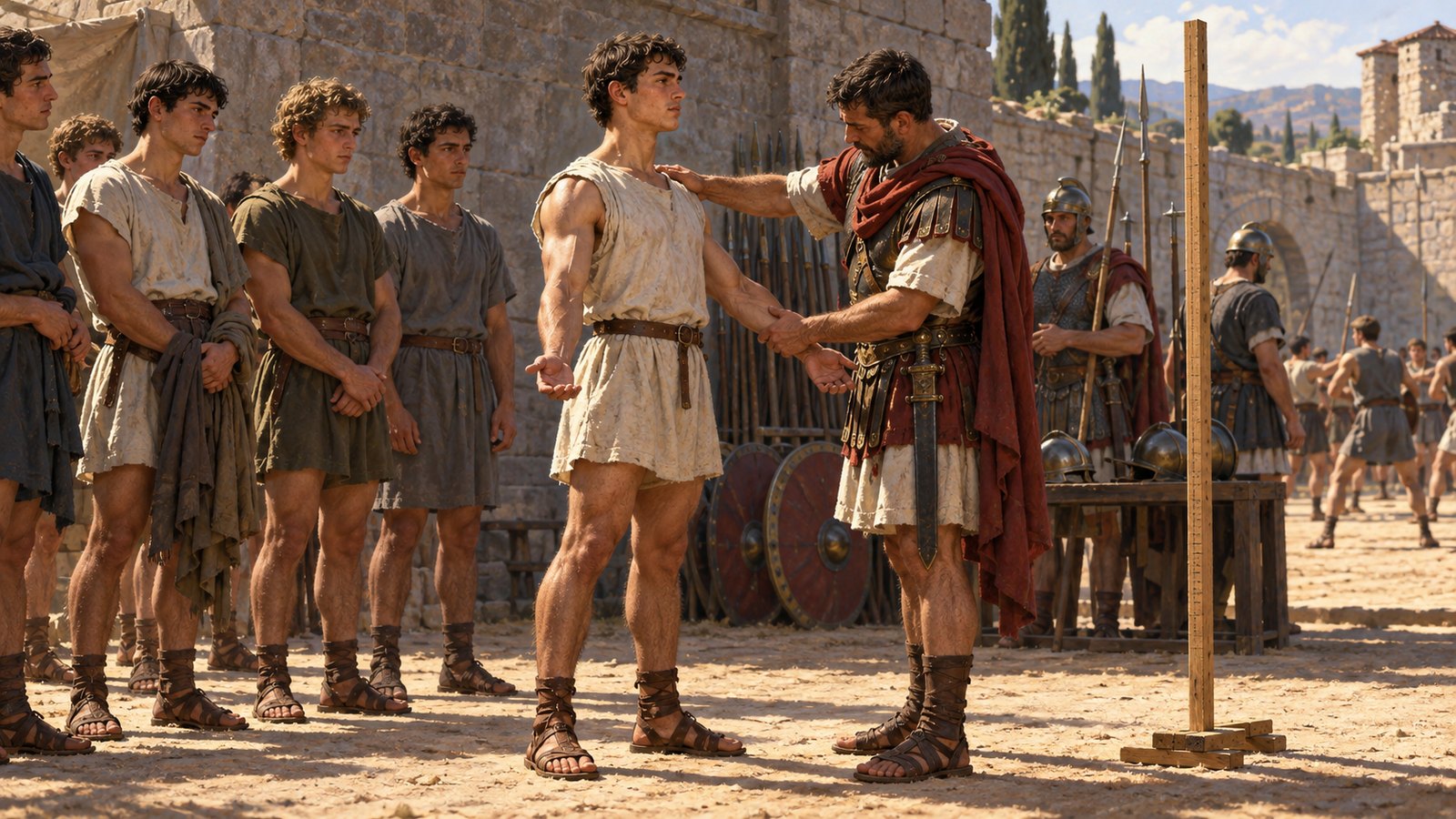
Vegetius reports an imposing measurement for selected formations. Cavalry of the wings and infantry in the first legionary cohorts had once been expected to reach six Roman feet, or at least five feet ten inches.
He immediately weakens any simple idea that Roman recruiting was a height contest. Earlier generations, he says, could maintain such standards because more young men sought military service. Under necessity, a shorter man with strength and courage could be preferable.
The measuring staff mattered, but it did not answer the whole question.
Recruiters were also told to examine the face and body. Vegetius wanted a lively eye, an erect head, a broad chest, strong shoulders, long arms, powerful fingers, a compact waist, sound legs, and feet proportioned to the rest.
The list mixes observation with ancient assumptions about character. Eyes and bearing were treated as signs of spirit in the same inspection that checked shoulders and limbs.
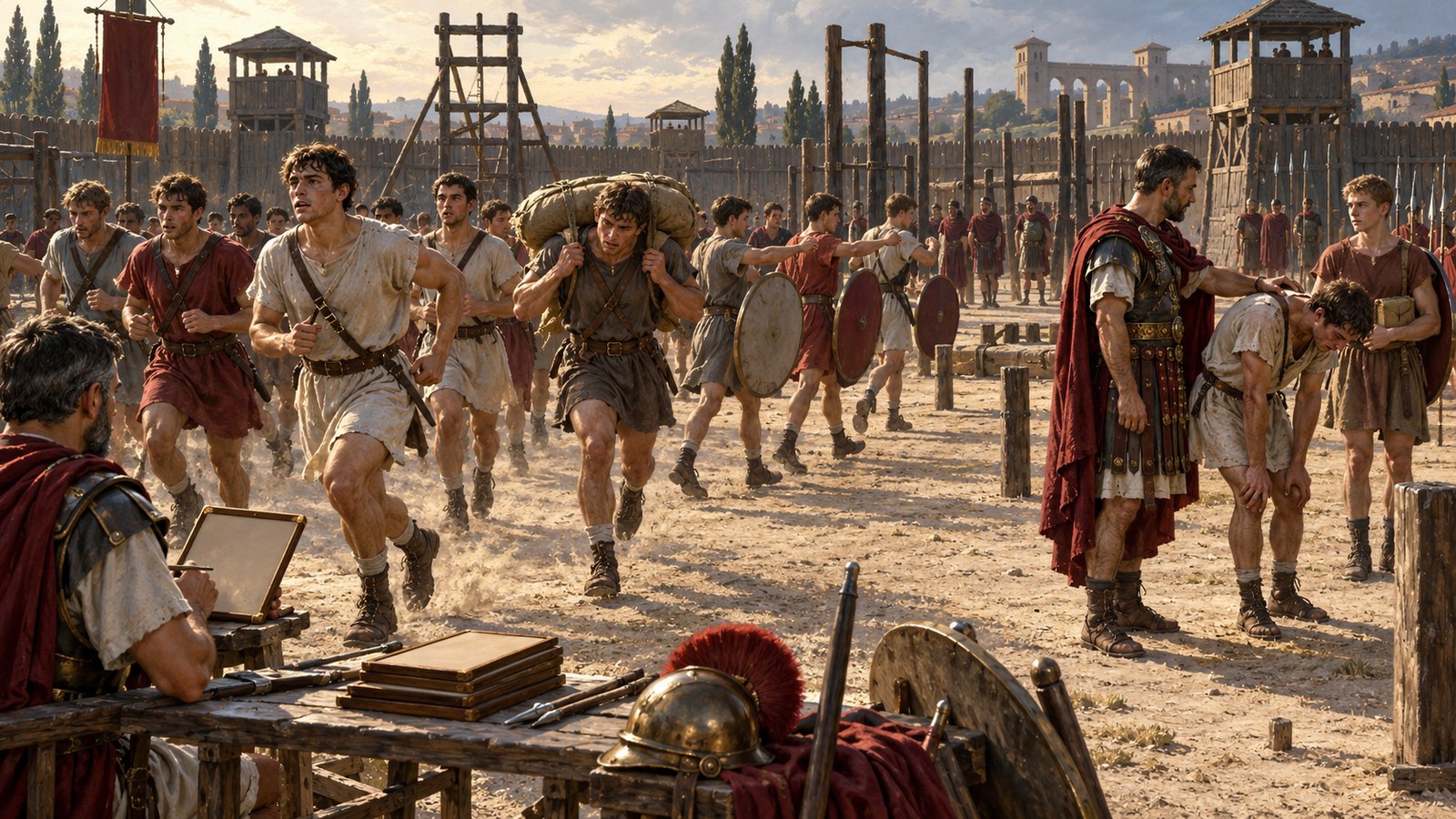
It also places the body in motion. A recruit had to carry, run, jump, dig, march, throw, and hold formation. Height without usable balance or endurance could not perform those tasks.
The archive has already followed the training that came next. A six-foot practice stake gave every recruit a fixed opponent for repeated blows. That drill only makes sense after officials had judged that the person in front of it could withstand repetition.
Likewise, weighted wicker shields made practice harder than service equipment. The heavier training load turned selection’s forecast into a physical test.
Vegetius’s sequence was thus cumulative: background, age, measurement, proportion, occupation, and finally performance.
Four Trades Went Out and Four Came In
The sharpest filter appears in Book I, chapter 7.
Vegetius names fishermen, fowlers, confectioners, and weavers among the occupations he did not want admitted. He contrasts them with smiths, carpenters, butchers, and huntsmen, whom he considered especially suitable.
The division is not an objective catalogue of strength. Fishing can be exhausting, weaving demands coordination, and ancient food production was not effortless. Vegetius was classifying the social meaning of work as much as measuring its actual energy cost.
The favoured occupations share qualities he could translate directly into army needs. Smiths handled heat, weight, tools, and repeated blows. Carpenters measured and built. Butchers worked with blades and animal bodies. Hunters walked difficult ground, observed tracks, and managed risk outdoors.
Each could be imagined as arriving with transferable habits.
That preference also linked selection to the work Vegetius had already praised in country recruits. Digging, carrying, tolerating weather, and living with little were not glamorous signs of victory, but they were repeated conditions of service. A carpenter or smith could be pictured inside that material world before an officer ever watched him drill.
The blacklist performed the reverse operation. It treated an occupation as evidence that the candidate would require too much correction, even though the chapter records no individual test proving that every fisherman or weaver lacked endurance.
The rejected trades were framed differently. Fishing and fowling might look irregular or specialized rather than disciplined. Confectionery suggested urban luxury. Weaving was placed inside Vegetius’s gendered language about work he considered more appropriate to women.
Those judgments tell us about the author’s hierarchy, not the innate courage of everyone who held those jobs.
A recruiting officer using this scheme turned a workshop, shoreline, bakehouse, or loom into a preliminary military record. The candidate’s hands carried a history before the official inspected them.
Vegetius linked that choice to the survival of the state. A badly selected army, he warned, did not become good merely because years passed. Time could extend service without replacing the qualities missed at intake.
This diagnosis also served his reform programme. If recent defeats came from long peace and careless levies, then restoring discrimination at the gate appeared to promise recovery before the first campaign began.
Yet the trade list could only screen. Vegetius still required the recruit himself to prove that the prediction was accurate.
The Military Mark Waited for Probation
Enlistment did not immediately settle membership.
Vegetius says the recruit should not receive the military mark as soon as he was enrolled. First came a trial of activity, strength, capacity to learn duty, and military courage.
This probation is the most important correction to the apparent certainty of his earlier filters.
A tall rural blacksmith with the desired posture could still fail. A promising appearance might dissolve under repeated movement, instruction, fatigue, or fear.
Vegetius explicitly says that some men who looked suitable proved unfit when tested. They were to be rejected and replaced with better candidates.
The mark therefore came after evidence gathered in practice. It did not create fitness; it acknowledged a judgment that the recruit had survived provisional status.
The procedure also protected numbers from becoming the only goal. Replacing one failed candidate with another took time, but Vegetius preferred that delay to carrying an unsuitable man permanently on the strength.
His system could be harsh and prejudicial. It converted origin, body, gendered ideas about labour, and an official’s eye into gates that closed before a candidate could demonstrate much.
At the same time, it was not entirely trapped by those first impressions. Height could yield to strength. Urban habits could be retrained. Attractive appearance could fail probation. Acceptance waited for activity and learning.
That tension gives the chapter its real shape. Vegetius wanted categories because an empire could not test everyone forever. He wanted probation because categories could be wrong.
The fisherman and weaver might be dismissed before that test. The smith and carpenter might be invited forward. Neither invitation nor rejection was simply a statement about muscle.
It was a late Roman theory of how civilian routines became military risk—and of why the army’s first defence stood at the recruiting table rather than the frontier.
Sources
Vegetius, Epitoma rei militaris, Book I, chapters 3–8.