
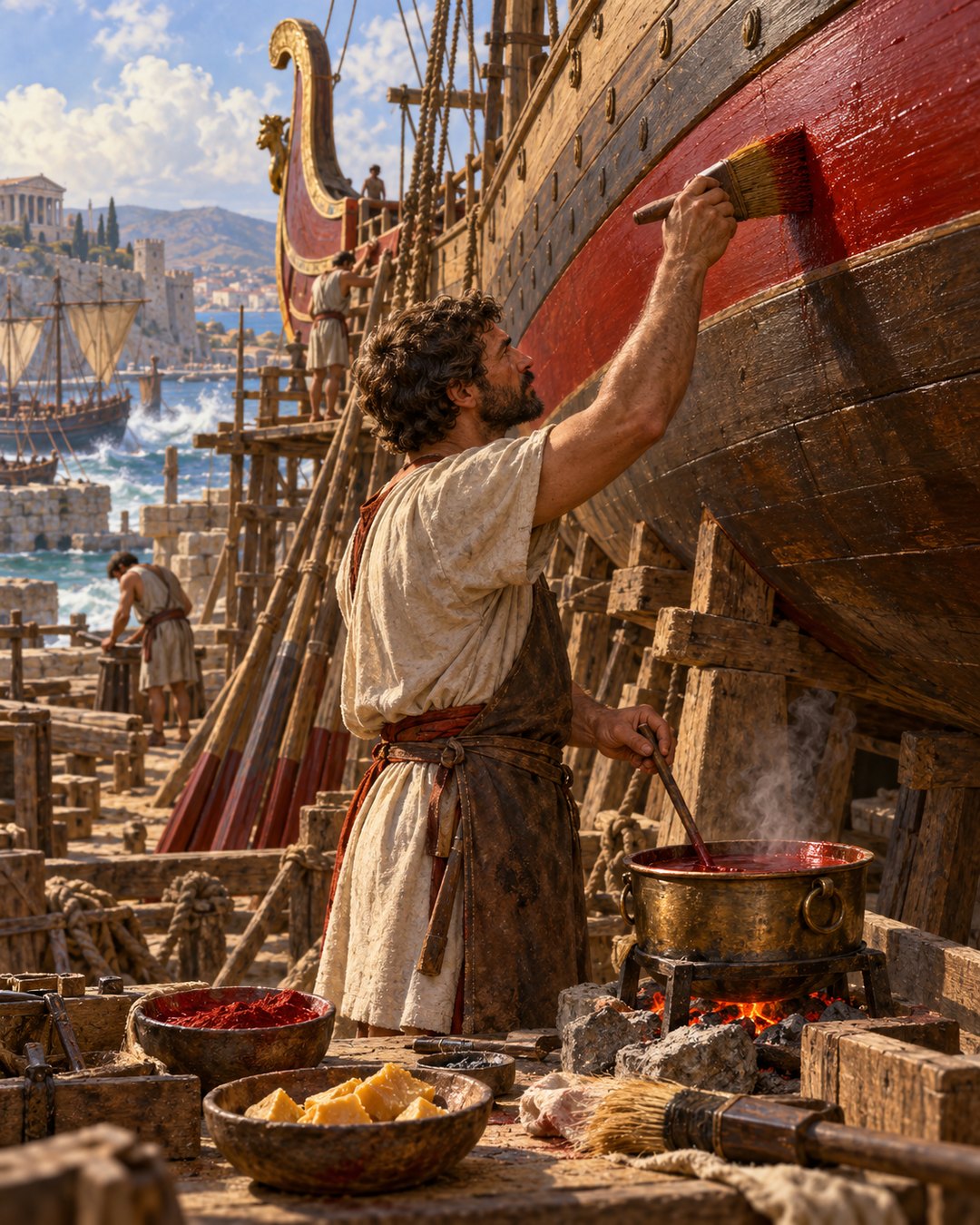
A painted warship had an awkward problem that a painted wall did not. Its surface moved. Sun heated the planks, wind dried them, spray salted them, and every voyage carried the finish into another cycle of wet and dry. Pliny the Elder preserves a compact technical answer: painters melted coloured wax and worked it onto the vessel with a brush while it was hot. He was not describing decoration as a final flourish. He was describing a change of method forced by the place where colour had to survive.
The passage appears near the end of Book 35 of the Natural History, after Pliny has tried to sort painters, inventions, and competing claims of priority. His history is not a modern workshop manual, and its famous names make the story look at first like a catalogue of masters. Yet the movement from pointed tool to hot brush reveals something more practical. Encaustic painting was not one fixed recipe. It became a family of techniques shaped by surface, scale, and exposure.
Before the Hull, Wax Belonged to Small Controlled Surfaces
Pliny begins with disagreement. Some people, he says, credited Aristides with discovering painting in wax and Praxiteles with perfecting it. Then he complicates that neat lineage. Works by Polygnotus, Nicanor, and Arcesilaus of Paros appeared to be earlier. Elasippus even placed an inscription on a picture at Aegina indicating that he had burned it in. The argument matters because the technique was old enough for later writers to inherit rival stories rather than a single remembered beginning.
That uncertainty also warns us not to imagine a lone inventor suddenly producing the whole process. Pliny’s named painters worked in a world where wax, pigments, heat, polished surfaces, and fine tools could be combined in different ways. The term “encaustic” points toward burning in, but it does not by itself tell us exactly what every workshop did. Pliny’s next distinctions are therefore more useful than the disputed pedigree.
He identifies two older methods. One involved wax; another worked on ivory. Both used the cestrum, rendered by his nineteenth-century translator as a pointed graver. The tool suggests a controlled encounter between hand and surface: pressure at a point, a limited area, and marks that could be placed deliberately. Ivory especially invited precision. It was compact, valuable, and visually unforgiving. A pointed instrument made sense where the painter could manage the entire field at close range.
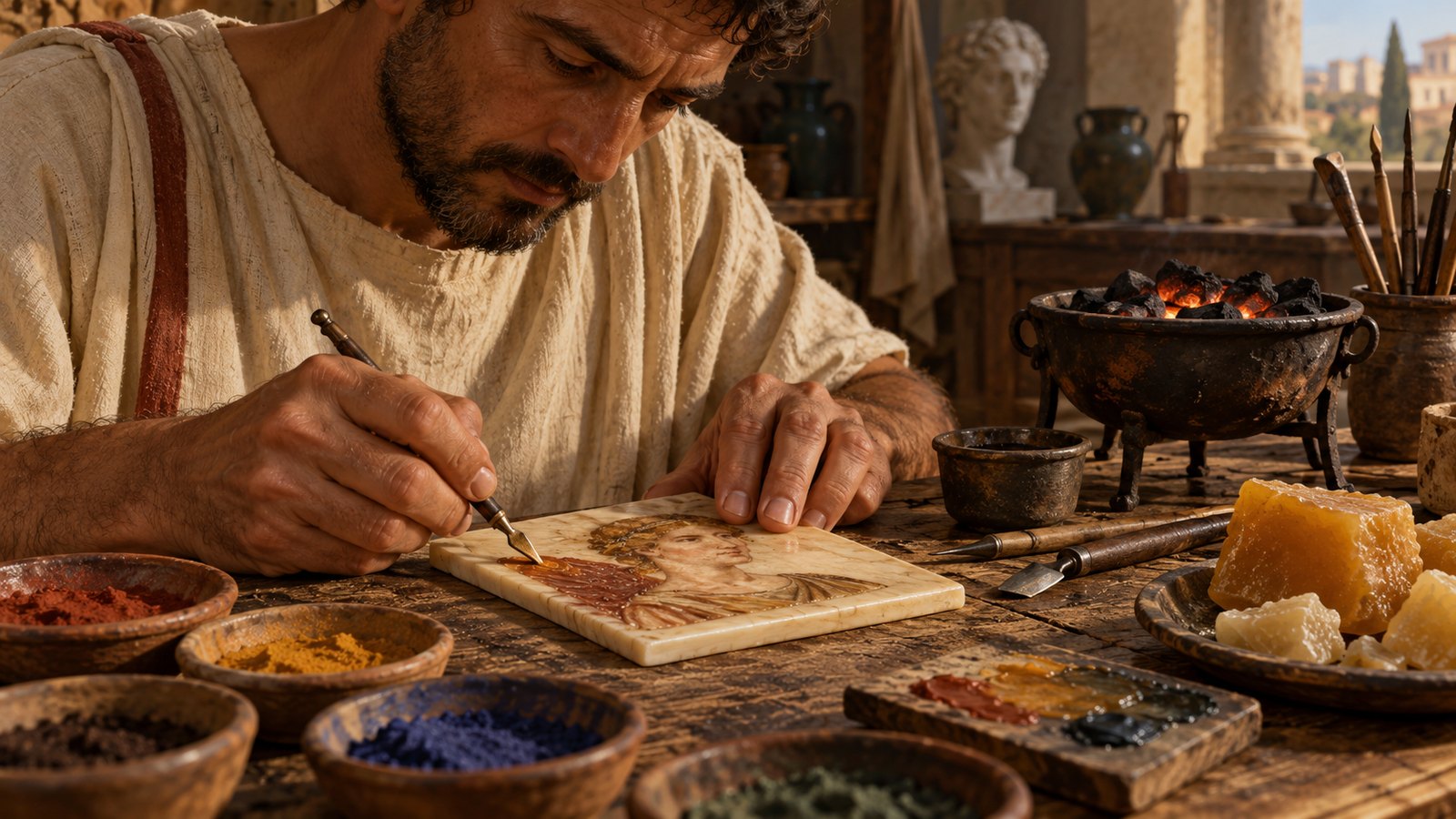
This was closer to the scale logic behind other Roman crafts than to the romantic image of a painter freely covering a huge surface. The care given to tools also appears in the surviving stories behind copper plates exposed to vinegar vapour: material, container, and timing governed the result. A colour was never only a colour. It was a substance that had to be prepared, carried, and made to adhere.
A Warship Turned Technique into a Problem of Scale
A hull removed nearly every advantage of the small panel. It was broad, curved, jointed, and outdoors. Painters could not treat metres of planking as enlarged ivory. A pointed graver would make the work painfully slow, while the timber itself offered seams and grain rather than a smooth little field. Most importantly, the finished surface would not remain in the workshop. It would face weather from the moment the vessel left the yard.
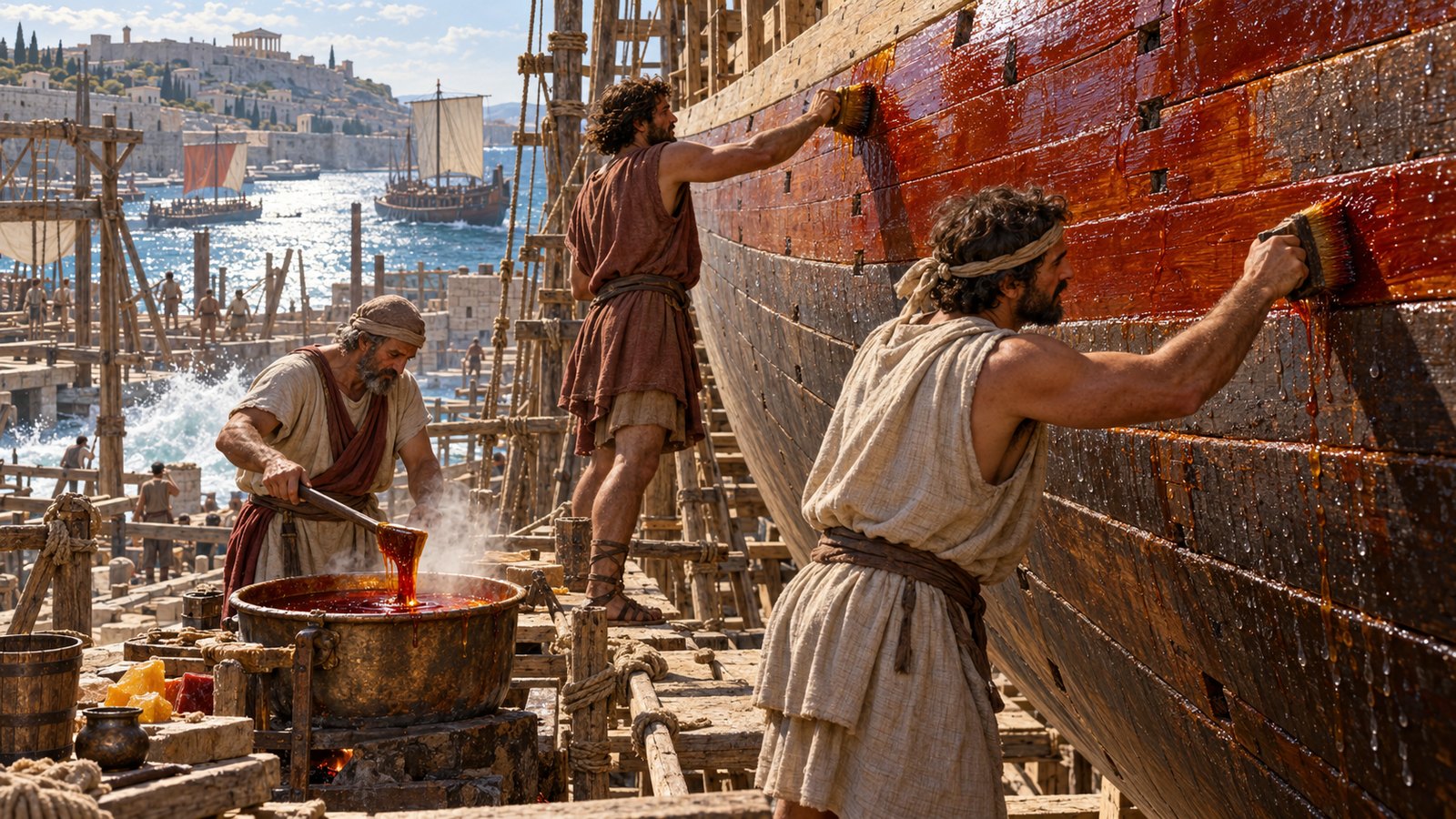
Pliny says that applying encaustic art to ships of war produced a third method. That sequence is the centre of the story. The ship did not merely receive an existing art. Its demands generated another branch of the art. The workers melted wax colours and laid them on with a brush while hot. Each element answered the new conditions. Melting made the coloured material workable; the brush spread it over a larger and less regular surface; heat kept the medium in the state required for application.
The word “warship” also changes how we should picture the labour. This was not a quiet luxury object handled by one celebrated artist for one collector. A military hull sat inside an organised yard with carpenters, caulkers, rope workers, metalworkers, supervisors, and crews waiting on the vessel. Colour had to join that chain without stopping it. Pots needed heat. Pigments and wax needed preparation. Brushes had to reach planks above and below a worker’s shoulders. A finish that took too long or failed on first exposure was not merely ugly; it disrupted a costly piece of infrastructure.
The Brush Carried Heat Across Timber
Pliny’s phrase “while hot” is easy to pass over, but it turns the brush into more than a carrier of colour. The worker managed a narrow window between fluidity and setting. Too cool, and wax would resist the bristles or gather unevenly. Kept workable, it could be distributed over the timber before hardening. The method therefore depended on coordination between the heat source, the pot, the mixture, and the person at the hull.
That coordination would have been visible. One artisan could tend the hot material while another laid it on. A brush returned repeatedly to the vessel, crossing grain and seams. The hull’s curvature forced changes of stance. Drips and thick edges needed attention before they set. None of those actions is individually stated by Pliny, so they should not be mistaken for a reconstructed recipe. They are the practical pressures contained in his three explicit details: melted wax colour, a brush, and hot application.
The colour itself belonged to a broader Roman material vocabulary. Mineral and manufactured pigments demanded their own processes, as the furnace work behind Vestorius’s blue pigment makes clear. On a ship, however, pigment manufacture was only the beginning. The coloured substance had to become a coating capable of travelling with wood. The encaustic medium joined appearance to protection without making Pliny separate those purposes.
Sun, Wind, and Salt Water Were the Real Test
Pliny closes with a three-part durability claim. Painting of this kind on vessels, he says, would not be spoiled by sun, winds, or salt water. Those are not decorative categories. They are the operating environment of a Mediterranean hull. Sun warms and bleaches exposed surfaces. Wind accelerates drying and drives spray. Salt water enters every weakness, then leaves crystals as moisture evaporates. Pliny groups the threats because the ship met them together.
We should read his confidence as an ancient author’s report, not as laboratory data. He gives no thickness, temperature, proportion, or service interval. He does not compare sample panels or describe how crews repaired damage. What he does preserve is a judgement made in the language of use: this finish endured the things that normally attacked a vessel’s colour. That practical claim is why the passage has value even where its procedure remains incomplete.
The method also shows why Roman technical knowledge often hides in a sentence that seems almost incidental. Pliny was writing a vast natural history, not a naval maintenance handbook. He moved quickly from famous painters to tools, then from tools to shipboard durability. A modern reader must slow the sequence down to see the workshop decision inside it. The decisive change was not a new subject painted on the hull. It was the conversion of solid or worked wax colour into a hot, brushable coating.
Once seen that way, the warship becomes evidence for adaptation rather than spectacle. Encaustic painting could leave the panel because artisans altered how it met the surface. The pointed cestrum belonged to controlled work in wax and ivory. The brush belonged to area, speed, curvature, and exposure. Heat connected the medium to the tool long enough for the worker to cover timber. The sea then judged whether the change had worked.
Sources
Pliny the Elder, Natural History 35.39 and 35.41.