
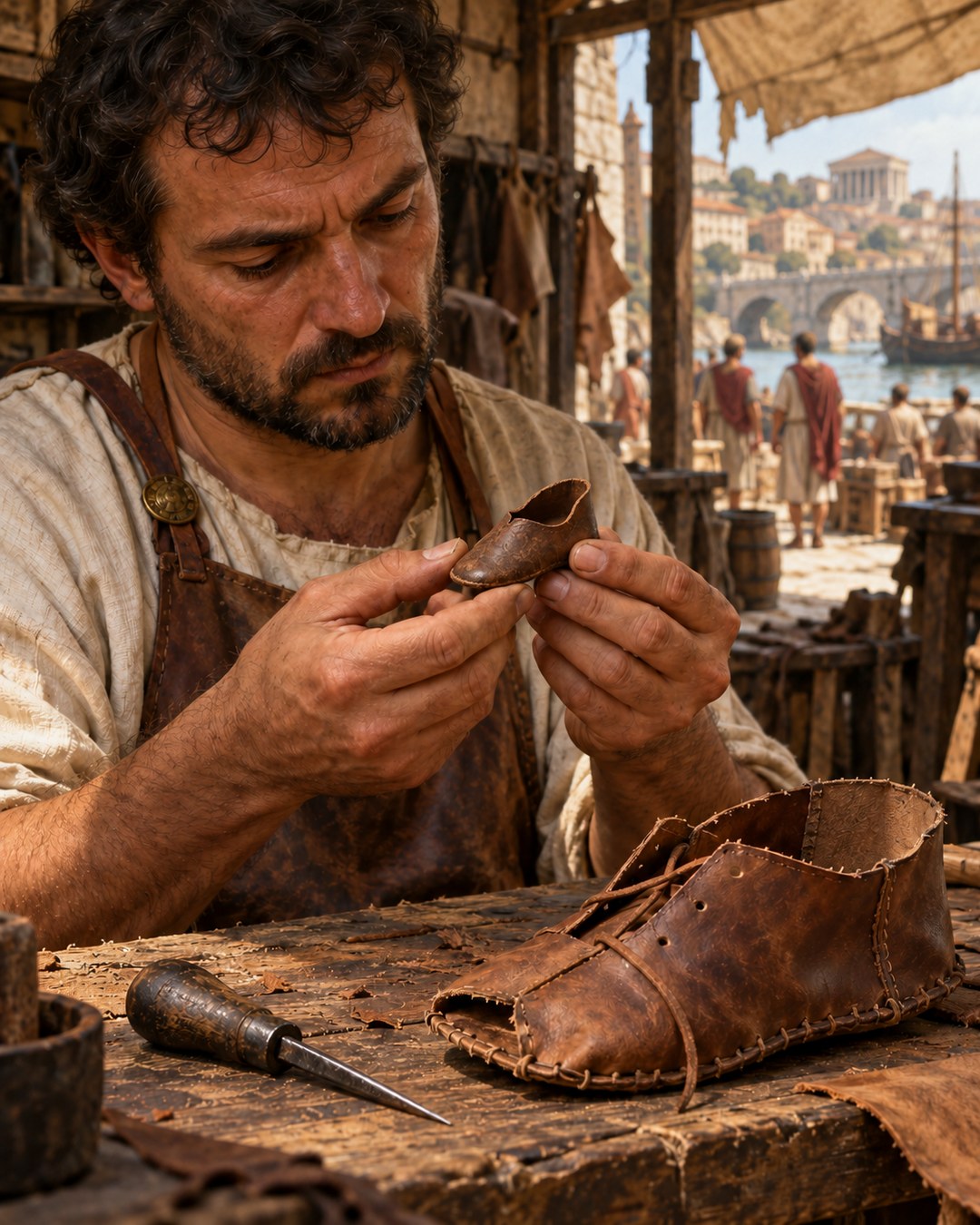
A shoe 70 millimetres long cannot be understood by imagining a small adult. The London Museum’s object is also only 46 millimetres wide and is catalogued plainly as a one-piece miniature shoe. It is leather, Roman and archaeological. Beyond that, its purpose is not supplied with a confident label.
That restraint is useful. Miniature objects invite quick stories: a child’s possession, a votive gift, an apprentice’s trial, a model or a joke. None of those explanations appears in the museum record for this shoe. The secure evidence is more physical. Someone who knew leather made a recognisable shoe form at a scale that removed ordinary wear from the equation.
The small object can still open a large view of work. The museum notes that evidence for shoemaking is common in Roman London. It also separates two parts of the trade geographically: processing leather produced such a strong smell that it belonged in an industrial area away from the centre, while making and repairing shoes happened in workshops fronting main streets.
One piece made the scale unmistakable
The catalogue calls the shoe one-piece. That description matters because it begins with construction rather than interpretation. The miniature was not assembled from a modern doll-shoe kit, nor is it simply a loose fragment that now looks shoe-like. A piece of leather was worked into a deliberate whole.
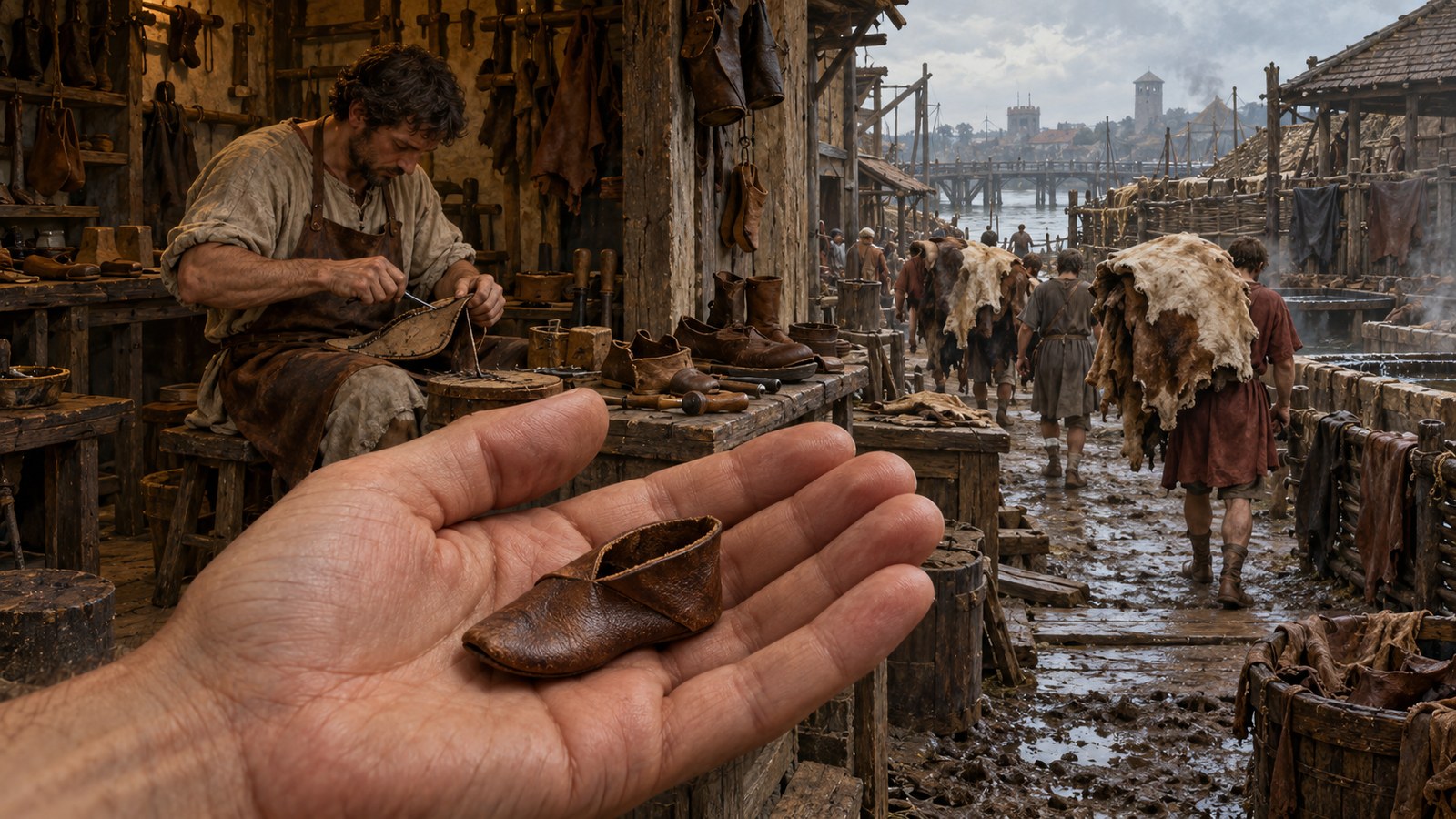
At 70 by 46 millimetres, the object is small enough to sit comfortably in an adult palm. Those measurements prevent the word “miniature” from floating free of evidence. They do not tell us who made it or why, but they establish what ordinary use it could not do. The object reproduced the idea of footwear without supplying footwear for an adult.
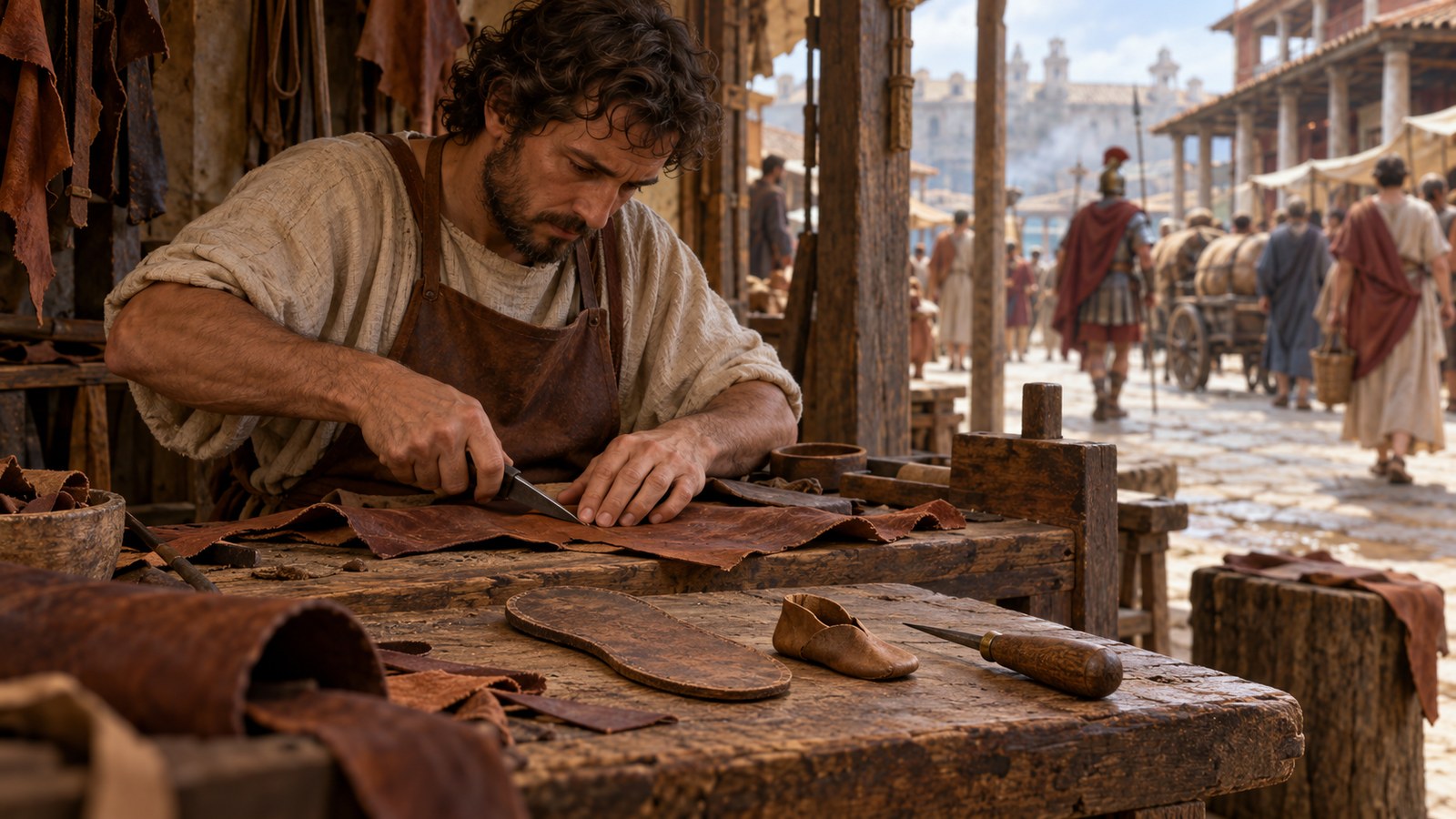
Leather makes the survival especially valuable. Metal and pottery often dominate museum cases because they endure, while organic craft can disappear. Here the material remains attached to a specific act of scaling down. The maker had to manage leather’s thickness and tendency to bend even though the finished object would not behave exactly like a full-sized shoe.
The catalogue identifier, LOW88[691]<964>, anchors the piece inside an archaeological archive rather than a collection of later curiosities. The code does not explain its meaning, but it reminds us that the shoe reached the museum through a recorded excavation context and cataloguing process.
The worst smell and the best frontage belonged to one trade
The museum’s account of Roman London shoemaking draws a revealing urban division. Processing leather was extraordinarily smelly. The early stages therefore belonged in an industrial area away from the centre. Shoemaking and repair, however, took place in workshops that faced main streets.
That was not a contradiction. Raw material preparation and customer-facing craft had different needs. Wet hides and processing waste could create a nuisance. A shoemaker fitting, making or mending footwear needed passing trade and convenient access. The same material chain stretched from an edge-zone process to a visible shopfront.
The miniature helps us hold those two places together. Its leather began as animal skin and passed through unpleasant preparation before it could become workable material. Its finished shape belonged to a trade that city residents encountered along important routes. A clean museum object can obscure that chain unless we restore the work around it.
Repair kept the workshop tied to daily movement
The museum specifically mentions repair as well as manufacture. That distinction puts shoemakers inside the rhythm of daily life. A new pair might be an occasional purchase; damaged footwear could create an immediate problem. Streets, yards and workshops wore leather down, and the repair bench extended an object’s useful life.
The miniature itself does not show a repair. It nevertheless comes from the same technical world. A craftsperson who could recognise where a full-sized shoe failed also understood which curves and folds made the form legible. Reducing that form to 70 millimetres required selecting the features that still said “shoe” when ordinary function was removed.
Another Lost Eagles story follows the famous claim that a shoemaker corrected a sandal in a painter’s work. That anecdote turns specialist knowledge into a boundary: the shoemaker knew footwear, but not every part of the picture. The London miniature offers a material counterpart. Knowledge of footwear could be expressed in leather itself, even at a scale no adult could wear.
The site’s account of folding knives built around pivots and handles shows a different portable craft problem. Both stories reward attention to construction, but the miniature shoe is unusual because it preserves form after practical use has been deliberately withdrawn.
Its unanswered purpose should remain unanswered
What was the miniature for? The honest answer is that this museum record does not say. A ritual explanation would require evidence of deposition and religious context. An apprenticeship explanation would require a connection to training. A child’s object would require more than small size, and calling it a toy would simply rename the mystery.
Refusing those labels does not make the object empty. It changes the question from “Which colourful story wins?” to “What can the surviving construction securely show?” The shoe proves that Roman-period leatherworking in London included a carefully recognisable miniature. Its dimensions are measurable. Its one-piece construction is observable. Its wider craft setting is supported by abundant evidence for shoemaking in the city.
The uncertainty may even sharpen our view of skill. A maker invested time in a form that could not serve an adult foot. Whatever the motive, the action separated craftsmanship from ordinary utility. The object became a statement in leather at 70 millimetres long.
Small leather reconnects the museum to the street
Seen alone, the miniature can look delicate and almost silent. Put back into Roman London’s craft geography, it acquires noise, smell and movement. Hides were processed away from the centre. Finished work and repairs met customers along main streets. Leather travelled between those zones before this tiny object entered the ground and, much later, an archaeological archive.
Its museum categories include Archaeology and Fashion & Style. Both are justified, but neither contains the entire story. Archaeology preserved the object and its record. Fashion explains why a shoe shape was culturally legible. Craft explains how one piece of leather could carry that shape at a fraction of ordinary size.
The miniature does not answer every question. It does something more dependable: it forces us to take a very small piece of work seriously. At 70 by 46 millimetres, Roman London’s leather economy becomes visible in the palm of a hand.
The object’s width deserves as much attention as its length. Forty-six millimetres is broad in relation to a length of 70 millimetres, which makes the surviving form compact rather than needle-thin. The catalogue does not offer a pattern or identify the exact full-sized style being reduced. Its measurements nevertheless let a reader test any visual reconstruction against real proportions instead of picturing a generic tiny sandal.
The one-piece description also keeps the craft story focused. A full shoe might involve several components, joins and repeated repairs. This miniature concentrates the recognizable form in one piece of leather. That does not prove it was easy to make. Small dimensions can make folds, cuts and thickness harder to manage because there is less room for error. The secure point is that the maker selected a construction that the museum can describe as a complete one-piece miniature.
Roman London’s workshop geography supplies the wider consequence. The strong smell of processing did not remove leather from city life; it rearranged where stages occurred. Preparation could be pushed away from the centre while making and repair remained visible on main streets. A finished miniature therefore links zones that modern visitors might experience separately: the industrial handling of animal skin, the customer-facing bench, and the archaeological deposit in which worked leather survived.
Sources
London Museum, “Leather, shoe, miniature shoe”.