
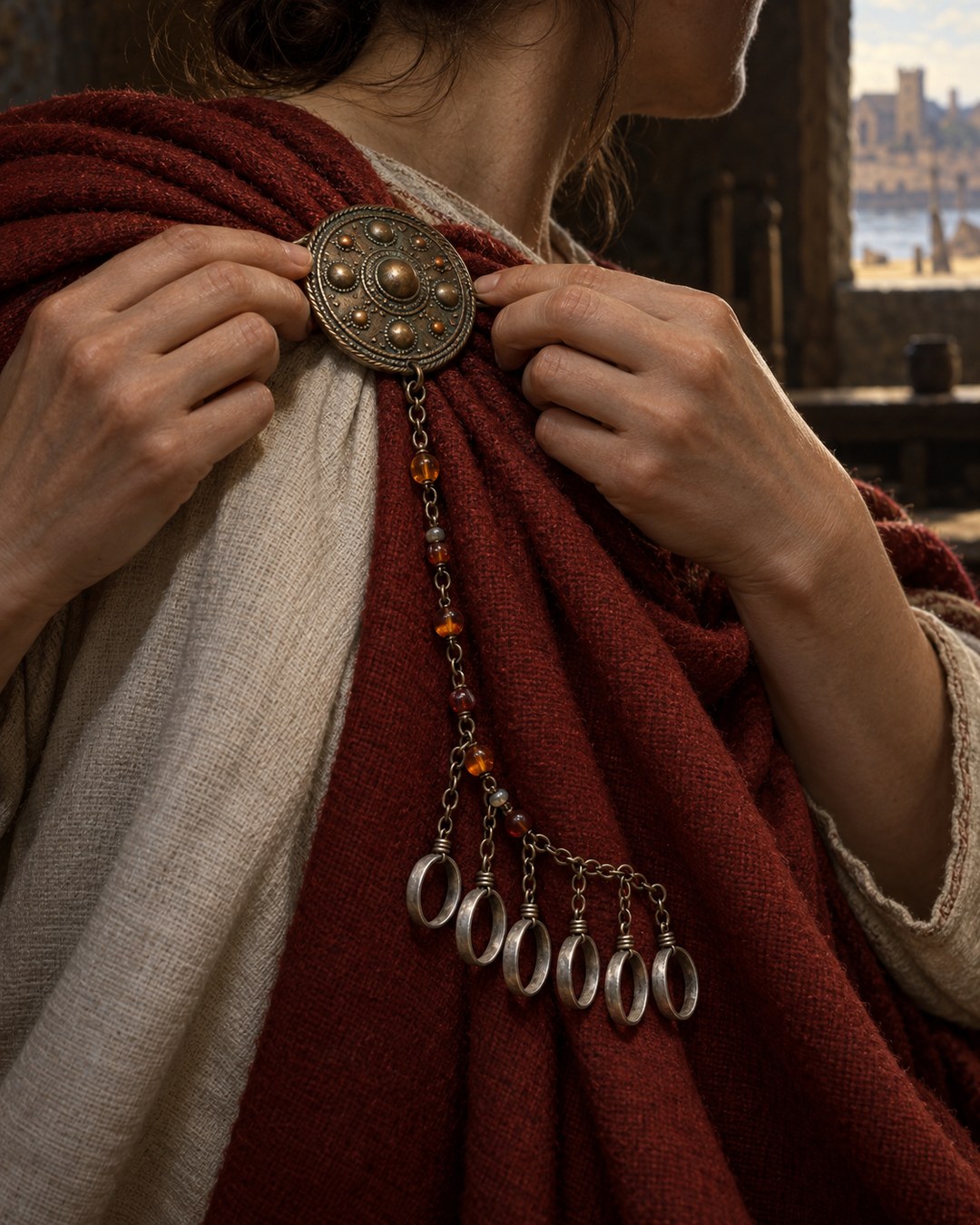
A brooch is easy to reduce to a pin. The late Roman object catalogued by the London Museum refuses that simplification. It combines a brooch with a chain, glass beads, amber beads and six silver rings. Copper alloy, silver, glass and amber all belong to one surviving assembly.
The measurements keep the object at human scale. The brooch is 48 millimetres in diameter and the whole piece is 95 millimetres high. Its chain extends approximately 150 millimetres. This was neither a tiny speck of jewellery nor an enormous ceremonial plate. It occupied a visible area of clothing and introduced movement below the main fastening.
The museum calls it a tutulus brooch and dates it to 350–450. That range places it in late Roman London, a period too often described only through political endings. This object gives the period another texture: metal rings, coloured beads, a chain and a fastening arranged close to a moving body.
The chain made the object more than a fastener
The basic work of a brooch is to hold fabric. Adding a chain changes the object’s behaviour. The 150-millimetre element could hang, shift and respond when its wearer turned or raised an arm. The attached beads and rings would not remain visually fixed in the way a solid disc does.
That does not mean we can reconstruct the exact garment or every attachment point from the catalogue entry alone. It means the surviving assembly was designed with connected parts. The object’s identity lives in their relationship. Remove the chain and it is no longer the same piece; remove the brooch and the chain loses its anchor.
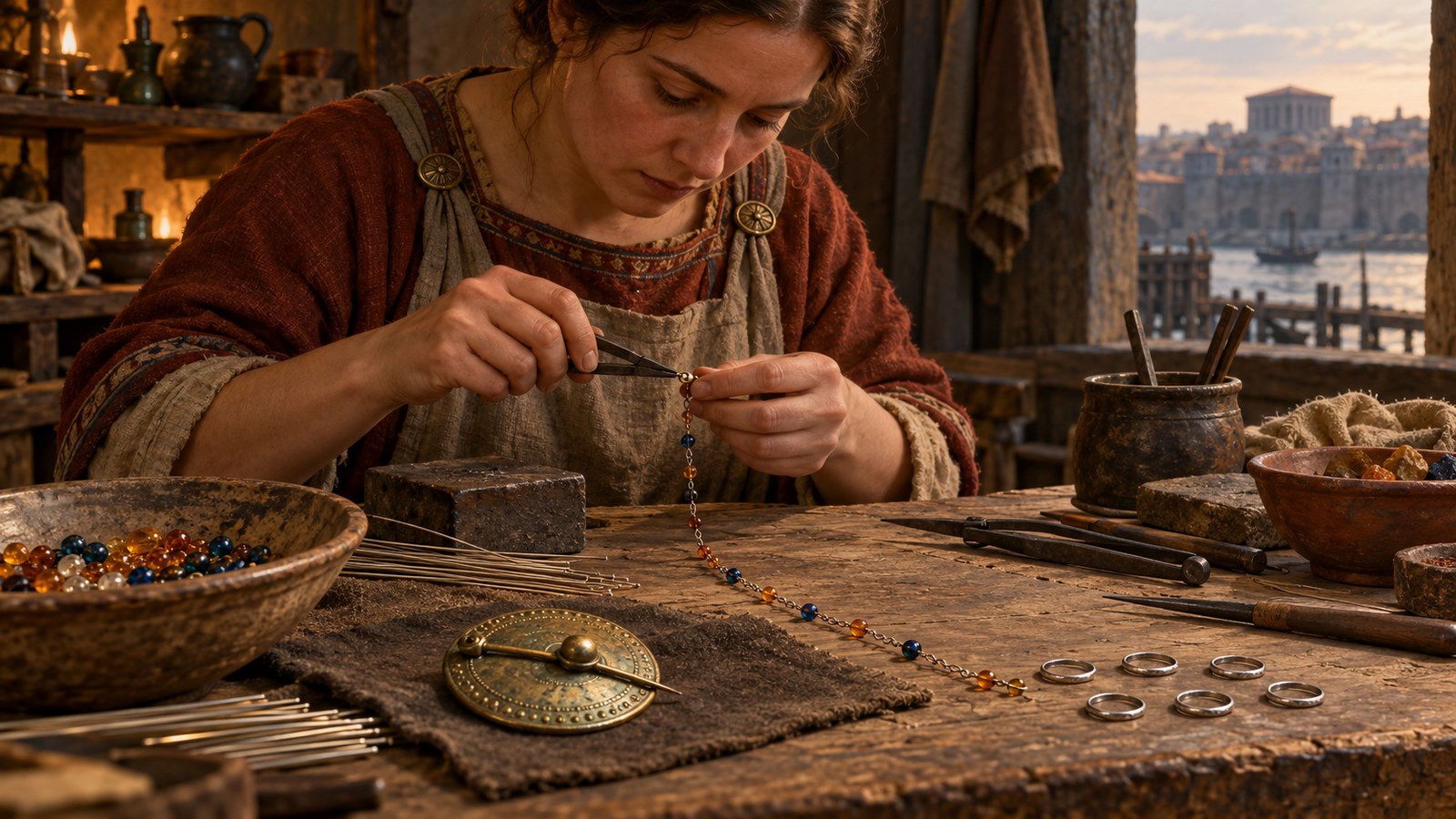
The approximate chain length is especially helpful. At 150 millimetres, it was more than three times the 48-millimetre diameter of the brooch. The visual field therefore extended away from the central fastener. Clothing became the surface on which several materials could be arranged rather than merely the cloth being held shut.
The whole object stands 95 millimetres high, another sign that the museum measured an assembly rather than an isolated pin head. The dimensions describe different axes because the brooch, hanging components and chain do different things.
Four materials created contrast without becoming a treasure list
The museum records copper alloy, silver, glass and amber. Each material could contribute a different colour and response to light. Copper alloy formed the principal metal body. Silver appeared in six rings. Glass and amber supplied beads along the chain.
It would be easy to turn that list into a claim about wealth or rank. The record does not identify an owner and does not provide a price. Material variety is secure; the wearer’s legal status, income and intention are not. We can say that the object brought multiple substances together in a carefully assembled ornament. We cannot use it as a receipt for a complete biography.
Amber and glass also resist the idea that “Roman jewellery” had one visual language. A translucent or coloured bead behaves differently from a metal ring. Six silver rings repeat one shape and material, while beads break that repetition. The design depended on contrast as well as fastening.
Six rings turn a number into construction evidence
The catalogue’s count of six silver rings is a small but unusually concrete detail. It prevents the hanging elements from becoming a vague decorative fringe. There were six recorded rings in this assembly. Their repetition made them a group.
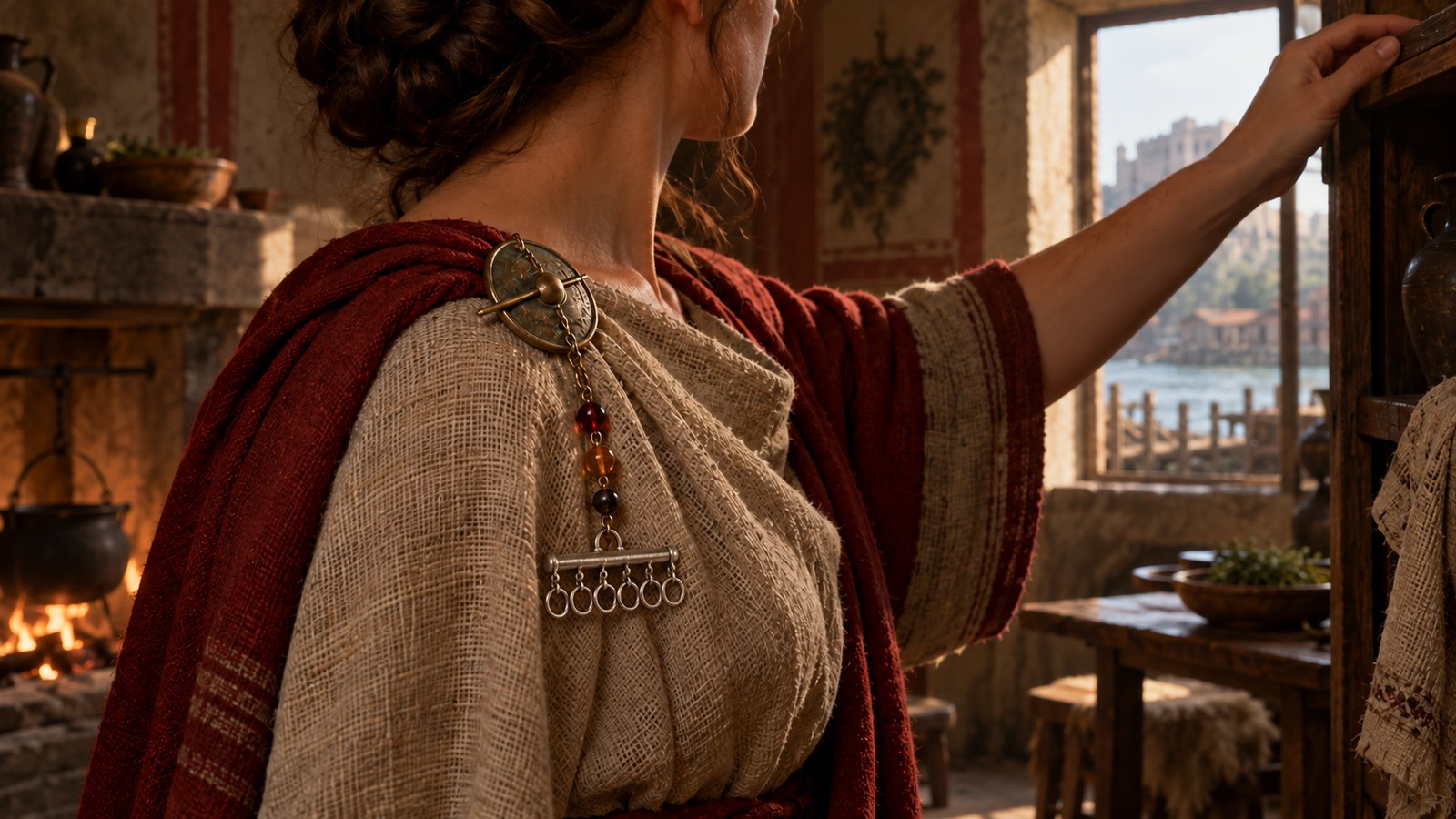
A counted group raises practical questions without pretending to answer them. Rings require joins or attachments. Their weight must be supported by the chain and brooch. If they hung separately, movement could make them shift in relation to one another. If they linked other components, they helped organise the whole. The museum description establishes their presence, while the exact movement belongs to cautious reconstruction.
The Lost Eagles article on Lollia Paulina’s famously valued jewellery concerns wealth displayed through an extraordinary ancient claim. This London brooch points in another direction. It has no named owner and no ancient price, so its strongest story comes from construction rather than spectacle.
A second article follows how a bone hairpin carried an imperial hairstyle into London. Both objects connect adornment and the city, but their mechanisms differ. The pin shaped hair through a compact tool; the tutulus assembly secured or ornamented cloth through a linked set of materials.
The date range crosses a historical boundary that the object ignores
The museum dates the brooch to 350–450. Modern histories often place a sharp conceptual edge inside that century, separating “Roman” from what followed. The object’s range crosses that kind of boundary. Its metal, beads and chain do not come with a label announcing which political chapter the wearer believed they occupied.
This does not make chronology meaningless. The date places the piece in late antiquity and distinguishes it from ornaments centuries earlier. But the range reminds us that material habits can continue, change and mix while administrative structures are under pressure. A wearer still had cloth to fasten and an appearance to present.
The museum associates the find with Tower Hamlets and holds it as part of an archaeological archive. Its identifier, MSL87[376]<183>, preserves the catalogued trail by which a personal-scale object entered a public collection. The archive cannot restore a name, but it keeps the assembly from becoming an unanchored antique.
Late Roman London appears here as movement and maintenance
Jewellery with several linked materials needed care. A chain could snag. A bead could break. A ring could open or disappear. The catalogue does not record a repair history, so no specific repair should be invented. The construction itself nevertheless reveals dependencies. The object worked as a whole only while its links and attachments held together.
That vulnerability is part of its historical value. Monumental stone encourages us to imagine Roman material culture as fixed. A brooch chain does the opposite. It bends, swings and depends on small connections. The six silver rings make those connections countable.
The object also brings the late Roman city close to the body. At 48 millimetres across, 95 millimetres high and with a chain around 150 millimetres long, it could be seen without becoming architecture. It belonged to the scale of dressing, fastening and moving through a room or street.
Nothing in the record tells us the wearer’s name. Yet the surviving construction preserves a sequence of choices: copper alloy for the main object, silver for six rings, glass and amber for beads, and a chain long enough to extend the design. Late Roman London is not an abstraction here. It is an assembly that once moved with cloth.
The measurements also prevent the chain from disappearing behind the more visually obvious brooch. A diameter of 48 millimetres defines the central element, but the approximately 150-millimetre chain creates a longer line. The 95-millimetre overall height records another dimension of the assembled object. Together they show that no single number can represent how it occupied clothing.
Material variety created practical joins. Copper alloy, silver, glass and amber do not all bend, wear or break in the same way. The museum record does not explain the exact manufacturing sequence, and it would be unsafe to invent one. It does establish that a maker or makers brought those materials into one coherent piece. The six silver rings were not merely six isolated finds placed beside a brooch; they formed part of the recorded assembly.
This is a useful counterweight to histories that describe 350–450 only as institutional change. The brooch does not deny that larger transformation. It shows another layer occurring at the same time: beads chosen, rings counted, a chain attached and cloth fastened. Archaeology preserves that scale of history especially well because an unnamed wearer’s object can survive even when no narrative source chose to mention it.
Sources
London Museum, “Brooch, tutulus brooch”.