
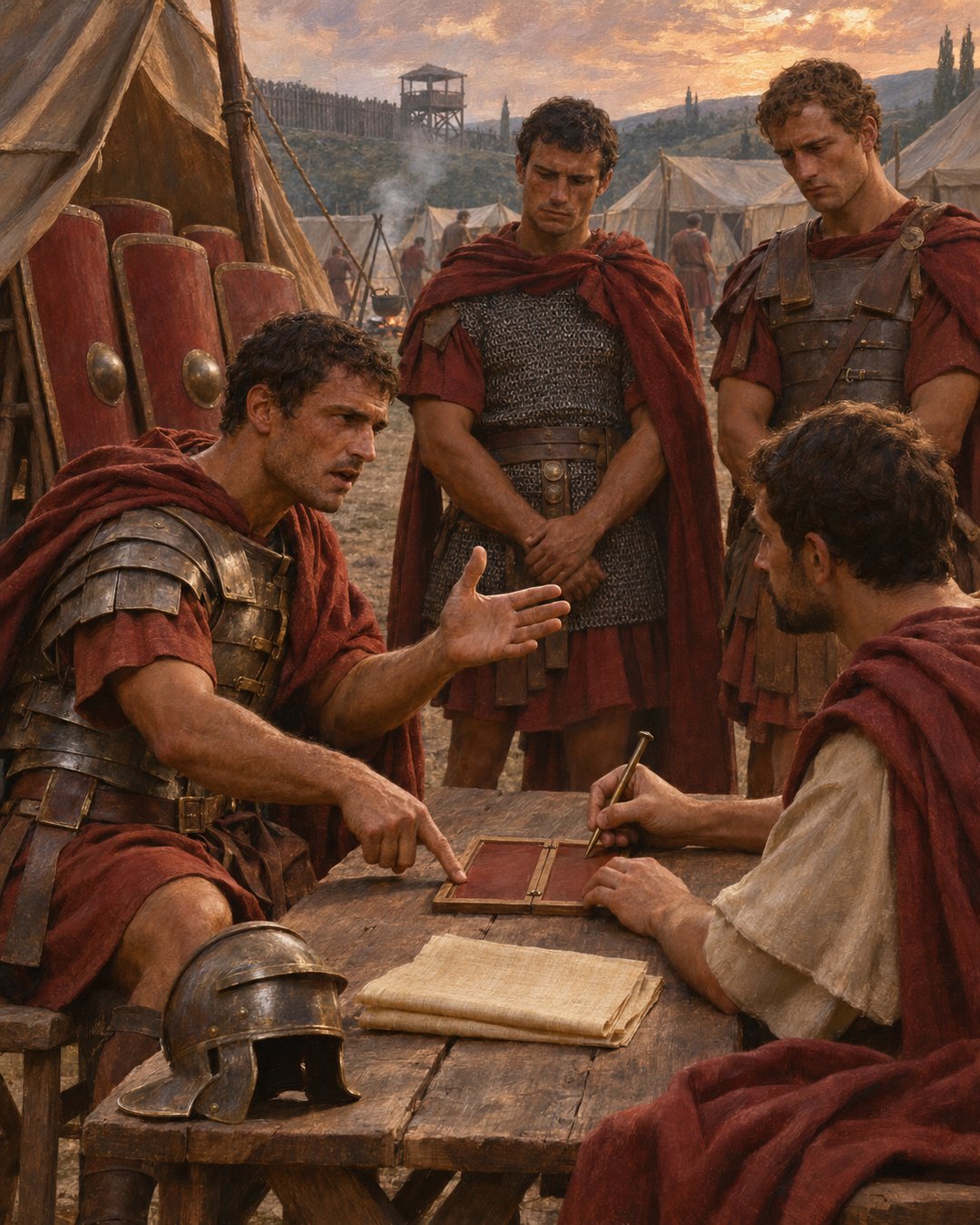
A Roman soldier in camp could make a will in a way that would have been dangerously incomplete for a civilian. He might lack the ordinary number of witnesses. He might not observe the normal sequence of formal acts. His declaration might not even be written. What mattered was not that military life abolished legal proof, but that imperial law allowed a soldier’s deliberate intention to survive a defective form.
Justinian’s Institutes preserves the rule and its limits in unusually concrete terms. Active service opened the privilege. A purposeful declaration could create a binding testament. Casual words could not. Discharge then started a clock: an irregular camp will remained effective for one year, after which ordinary civilian rules regained their force.
The result was neither a legal blank cheque nor a sentimental favour to men in uniform. It was a carefully fenced exception built around evidence, status and time. The same Roman state that made public identity visible through law in the story of Gaia Taracia’s unusual legal voice also asked a more intimate question in a camp: how could a dead soldier’s true intention be separated from a convenient story invented afterward?
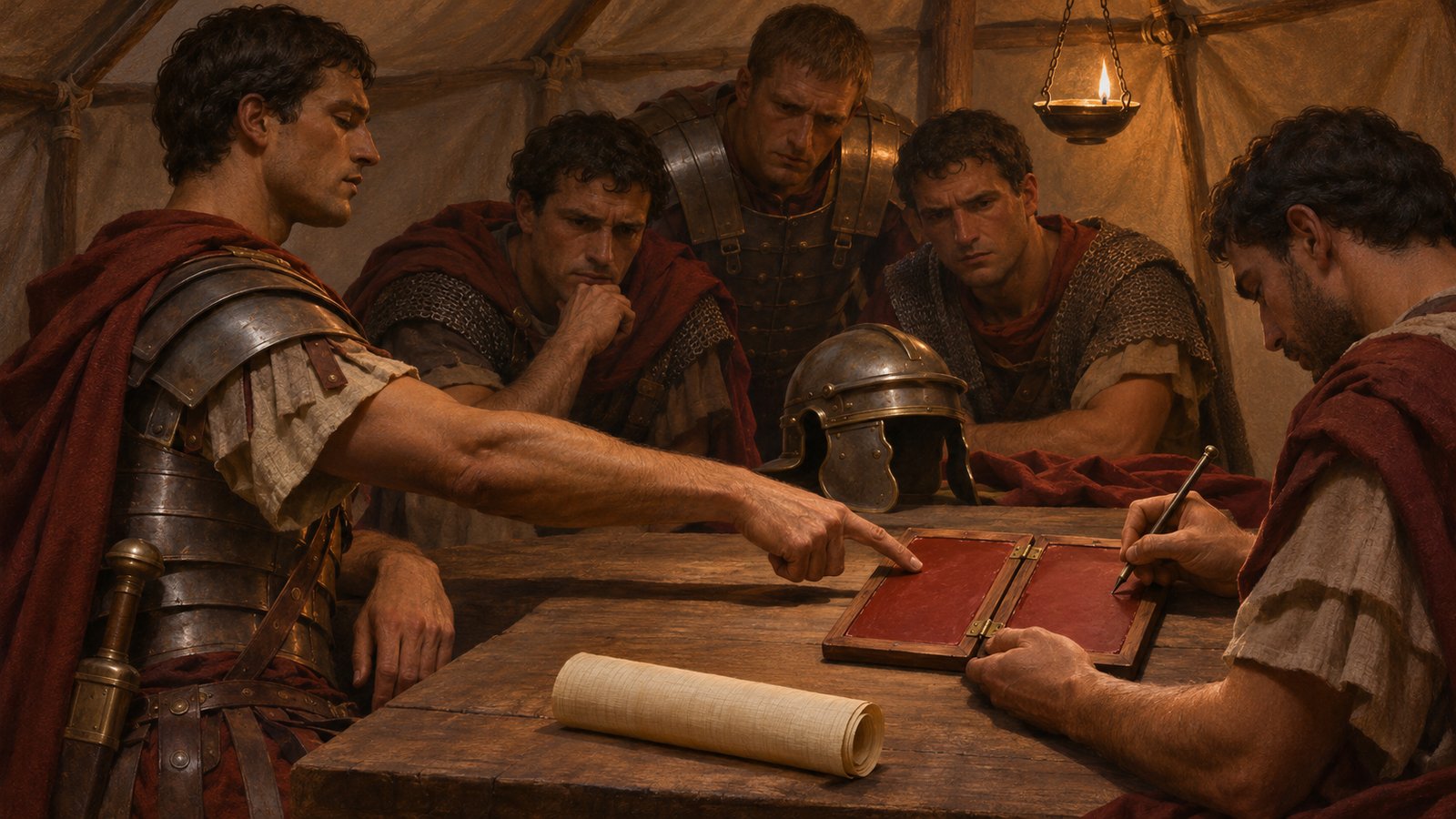
The Camp Relaxed Form, Not Intention
The civilian background was demanding. Immediately before its chapter on soldiers, the Institutes describes an unwritten civilian will made before seven witnesses. The military rule begins by saying that strict compliance with such formalities had been relaxed by imperial constitutions. A serving soldier’s will could remain valid even if he had not gathered the legal number of witnesses or had missed another testamentary formality.
The text gives a blunt explanation: soldiers lacked legal knowledge. That language belongs to the jurists who framed the privilege, not necessarily to the men whose estates it governed. Its practical point is clear. A person living under military discipline, moving with a unit and facing sudden danger should not lose the power to direct his estate merely because he could not reproduce a civilian ceremony.
Yet the exception did not mean that any remembered wish became law. The Institutes says the soldier’s last will was valid “in whatever way” it could be ascertained, written or unwritten, as an expression of his will. The decisive word is expression: there had to be an act that could reasonably be recognized as testament-making.
This distinction made military status useful without making it magical. The soldier received freedom from form, not freedom from meaning. A broken ceremony could be rescued. A missing intention could not.
Trajan Drew a Line Around Casual Speech
The chapter quotes a rescript of Trajan addressed to Statilius Severus. Its example is almost a courtroom reconstruction. If a soldier called people together for the purpose of making a will, named the person he wanted as heir and identified anyone he wished to free, the declaration could count as a binding unwritten testament. The gathering, its purpose and the words all pointed in the same direction.
Trajan then supplied the dangerous opposite. A remark in conversation—“I make you my heir” or “I leave you my property”—was not enough by itself. The emperor’s reason was evidentiary. If loose phrases automatically became wills, witnesses could easily be produced after a soldier’s death to claim that he had left his property to whomever they chose.
That warning reveals the pressure inside the privilege. Ordinary formalities did more than burden a testator; they created a visible record that constrained fraud. Once military law removed some of those safeguards, it needed another test. Deliberate conduct supplied it. Calling people together was different from speaking over dinner. Naming an heir in a recognized testamentary moment was different from using the language of inheritance as a promise, joke or reassurance.
The same tension appears elsewhere in Roman public law. In the repeal of the Oppian law, women filled Rome’s streets to make political pressure visible. Here the audience was smaller, but visibility still mattered. The witnesses did not create intention merely by being present. Their presence helped later judges decide whether a legal act had actually occurred.
Active Service Defined the Privilege
The military exception followed the soldier’s condition. Justinian’s text says it applied while soldiers were in actual service. It also says the privilege was not available when they were living at home or elsewhere exempt from military requirements. A soldier connected to the army could still make a will, including a son under family authority, but outside the privileged setting he had to observe the prescribed civilian formalities.
A later paragraph sharpens the boundary. The concession belonged to men who served and lived in camps. Veterans after discharge, and serving soldiers who made wills while absent from camp, had to comply with the rules common to Roman citizens. The camp was therefore not decorative scenery in the doctrine. It marked the environment in which ordinary legal performance was hardest and the special rule was most defensible.
The chapter extends the accommodation to a deaf or mute soldier. That short provision fits the larger logic. The law was searching for a reliable manifestation of intention rather than insisting that one physical method—spoken words, a complete written instrument or a standard ceremony—was the only possible route.
Even an irregular document made before enlistment could acquire force. If the new soldier later opened it and added or removed something, or otherwise disclosed a new intention to treat it as his will while in service, the Institutes says it should be valid. The old paper did not cure itself. The soldier’s fresh act under the privileged condition did the work.
Discharge Started a One-Year Clock
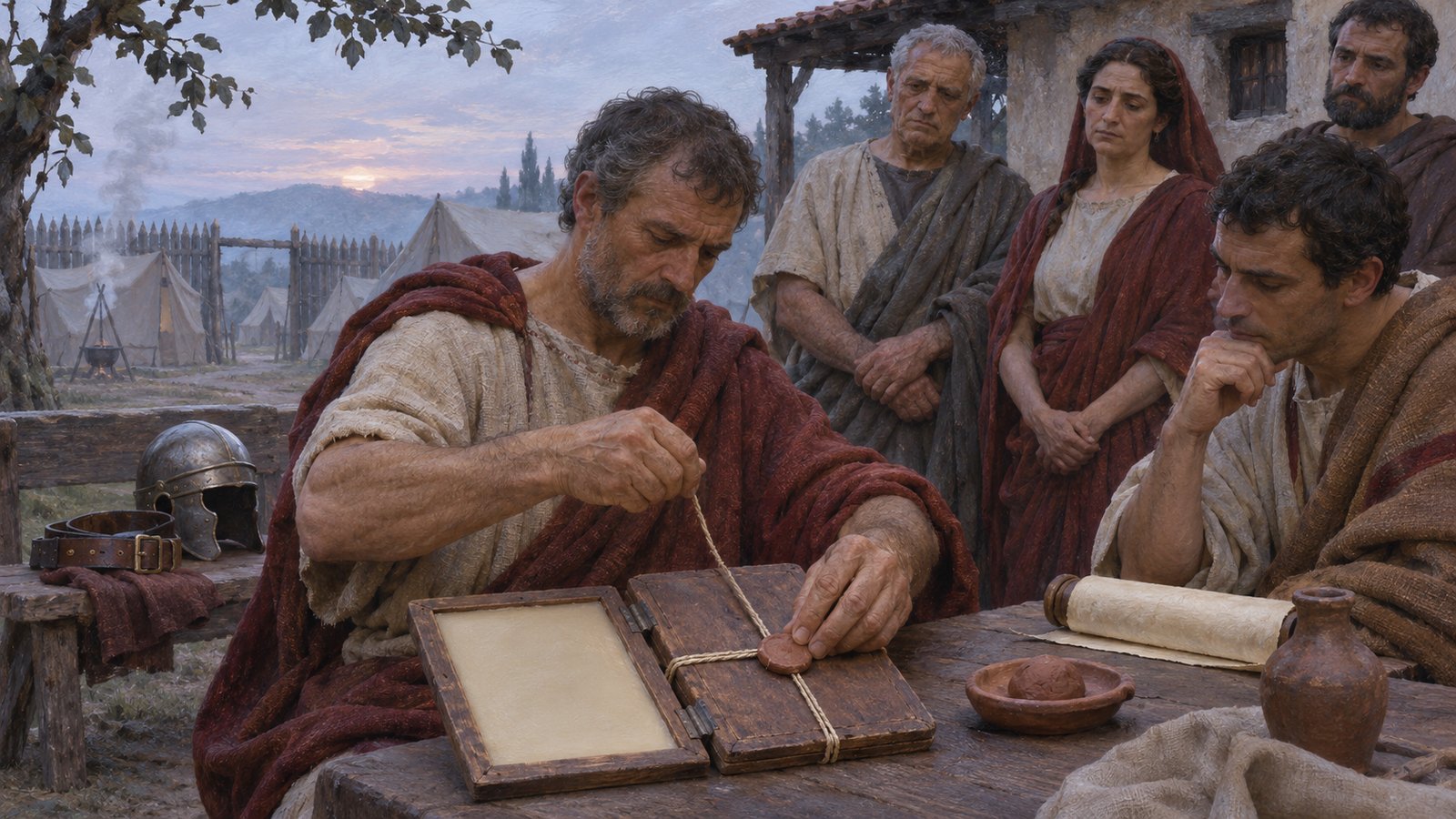
The most striking limit arrived after service. A camp will made without the usual formalities did not vanish on the day of discharge. It remained valid for one year. That interval protected a veteran while also restoring the civilian system’s expectation that he eventually regularize his affairs.
The one-year rule turned status into time. While the soldier served in camp, necessity justified the exception. After he returned to civilian life, necessity weakened. The law allowed a transition rather than an immediate cliff, but the privilege was not meant to become a permanent personal badge.
The jurists then tested the edge of their own rule. Suppose the soldier died within that year, but a condition placed on the heir was fulfilled only after the year had elapsed. Would the testament fail because performance occurred after the privilege’s clock expired? The answer preserved it as a military testament. Death within the protected year fixed the will’s legal character; later fulfilment of the condition did not undo it.
This is why the one-year period should not be described as simple generosity. It was a sorting device. It separated estates still closely connected to service from those that had fully returned to civilian life. It also gave a veteran a practical window in which to replace an improvised camp declaration with an ordinary will.
A Privilege Designed Against Its Own Abuse
Military wills are easy to romanticize as final words before battle, but the preserved legal discussion is more controlled. Its central scene is not combat. It is proof: who was called, what purpose the gathering had, what the soldier actually declared, where he was serving and how much time had passed since discharge.
The exception worked because each relaxation carried a boundary. Missing formalities could be forgiven, but a will still had to be intended. An oral declaration could bind, but ordinary conversation could not. Active service opened the privilege, while absence from camp narrowed it. Discharge did not destroy the will at once, but one year limited its afterlife.
Trajan’s fear of manufactured witnesses explains the architecture. The law wanted to honour a soldier’s intention without making every heirship dispute depend on the loudest survivor. Purposeful assembly, coherent declaration and the soldier’s service condition replaced some of the certainty that civilian ceremony normally supplied.
That balance made the military testament a revealing Roman institution. It shows law changing shape under practical pressure while refusing to abandon verification. The soldier did not escape law at the camp table. Instead, law watched a different set of facts—and then started counting once he went home.
Sources
Justinian, Institutes, Book 2, title 10 and title 11; Trajan’s rescript to Statilius Severus as quoted in Institutes 2.11.1.