
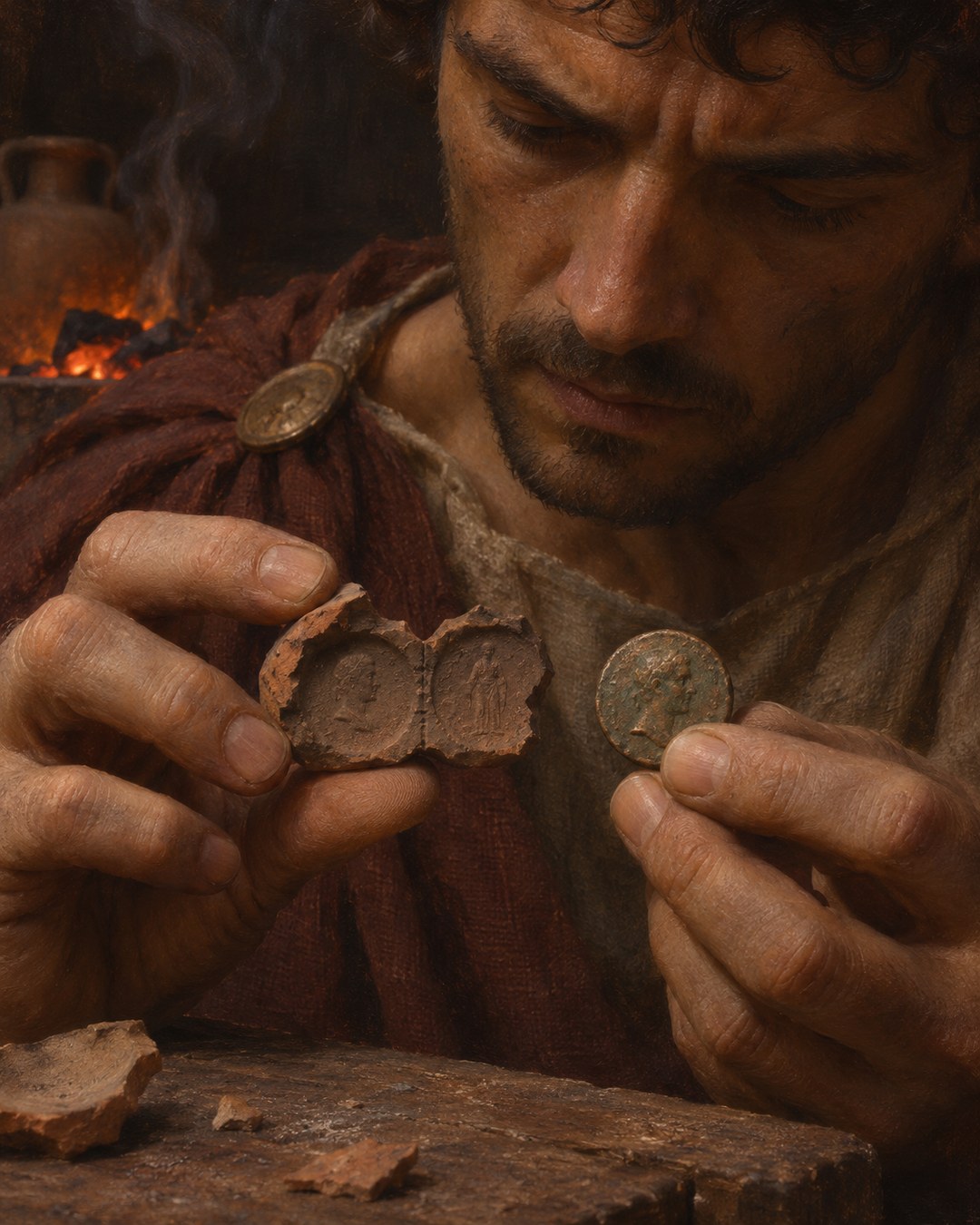
A worn coin of Faustina II was pressed into clay. Its portrait left a negative. On the other face, Laetitia stood with a wreath and anchor, also reversed. The clay was baked, clipped and burnt. What survives is only 22 millimetres across, but it records a production decision with political consequences: an imperial coin had become a pattern for forgery.
The London Museum calls the object a forger’s ceramic coin mould. That description shifts attention away from the finished counterfeit and toward the workshop step that made repetition possible. The mould did not imitate money by drawing it. It captured both sides as working impressions from which new copies could be cast. Its tiny scale made precision essential at every stage.
A Worn Coin Became the Master Pattern
The model was already worn. That detail matters because every weakness on the original could pass into the mould and then into its products. A forger did not need an engraver capable of creating an imperial portrait from scratch. A circulating coin supplied the design, proportions and official visual authority.
Faustina II was the daughter of Antoninus Pius and wife of Marcus Aurelius, but the museum record for this object is more narrowly material. It identifies her coin as the copied source. The surviving obverse preserves only part of its inscription, recorded as “[…] PII AVG FIL.” The missing beginning and worn surface limit certainty while still tying the portrait to an imperial identity.
Pressing a coin into prepared clay creates a reversed cavity. Any cast taken from that cavity returns the image to its readable orientation. The catalogue explicitly calls the impression retrograde, preserving the crucial sign that this fragment belonged to a copying process rather than merely carrying a decorative stamp.
The 22-millimetre diameter kept every stage unforgiving. Clay had to receive the relief without smearing, dry without distorting and survive firing. A tiny misalignment could blur the face or leave a weak edge on every later copy.
Laetitia Carried the Reverse Design
The reverse impression shows Laetitia standing left. She holds a wreath and an anchor. These are not random workshop marks; they belong to the coin type being copied. Even in an illicit mould, official imagery controlled the available design.
The surviving inscription is again partial: “[…] AVG N [S]/C.” Rather than completing uncertain letters, the museum records the fragments and the figure. That separation is useful. Text can be damaged while posture and attributes remain recognisable enough to identify a type.
Because the mould is double-sided, portrait and reverse had to work as a pair. A convincing cast coin required more than one good face. The two impressions needed to align around a thin metal body, while an inlet or channel allowed metal to reach the cavity. The surviving object is incomplete, so the full arrangement cannot be reconstructed from this piece alone, but its paired design preserves the basic ambition.
Laetitia’s wreath and anchor also show why counterfeit production was political craft. The maker copied not only purchasing power but messages issued under imperial authority. A portrait connected the object to a ruling household; a personification carried claims of joy, stability or public fortune. Illicit manufacture borrowed that entire language.
Burning and Clipping Expose the Workshop
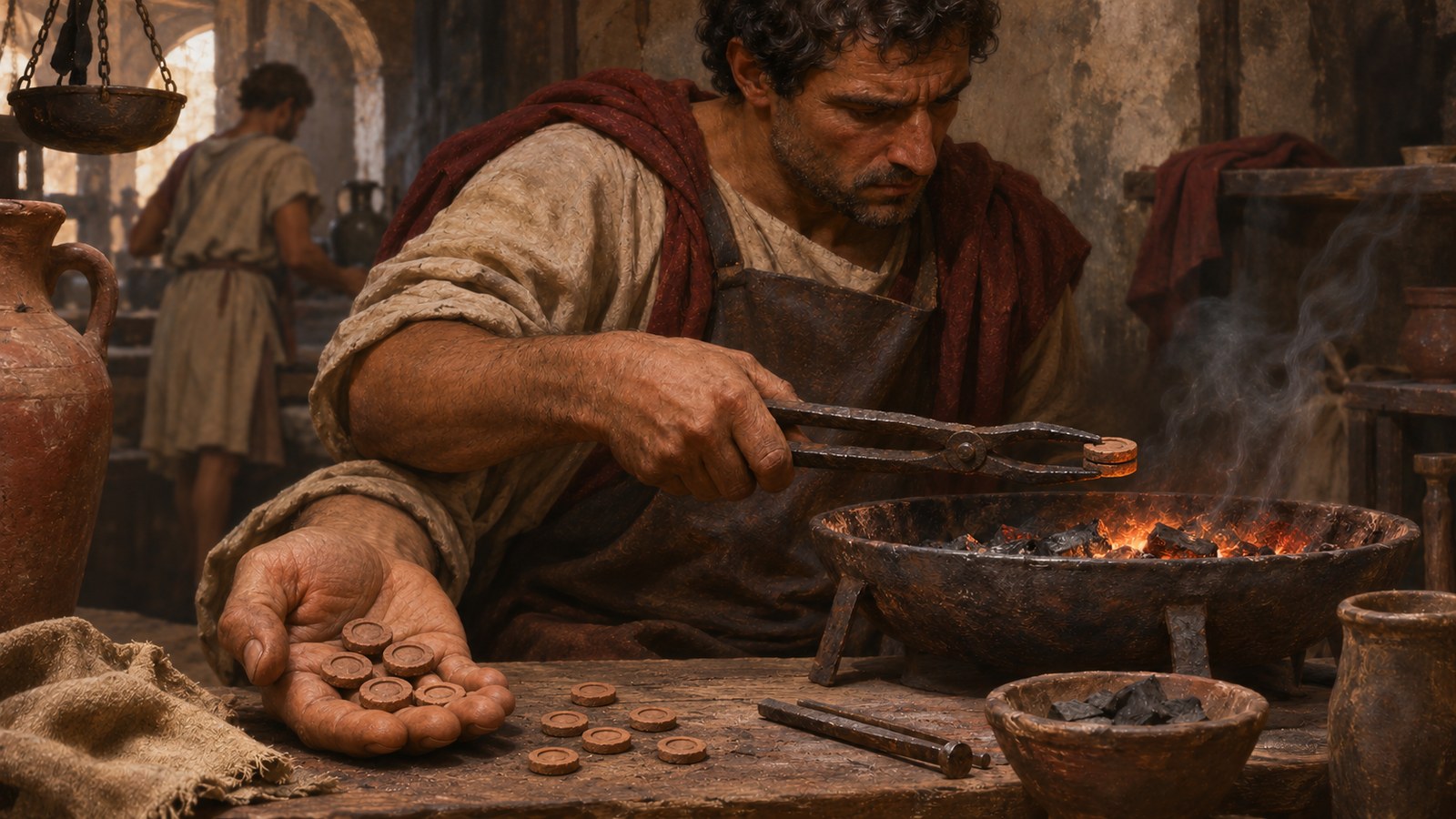
The museum records the clay as baked and the mould as burnt. Firing turned soft impressions into ceramic tools able to receive hot metal. Heat made production possible, yet it could also damage the mould or preserve signs of a failed or discarded batch.
Its edges were clipped. That trimming may reflect how individual mould units were shaped to fit into a larger casting arrangement, though the fragment alone does not prove the exact stack. What is secure is the physical sequence visible in the record: impression, baking, double-sided use, burning and edge modification.
Those traces make the object different from a coin that merely looks suspicious. The mould belongs to manufacture. It catches the counterfeiter before circulation, at the bench where official imagery was converted into reusable negative space.
Roman workshops routinely depended on moulds for legitimate production. A recent Lost Eagles article followed how a brickmaker’s records emerged from organised manufacture. The coin mould shows the same broad advantage of repeatability turned toward an unauthorised product.
Counterfeiting Reused Ordinary Craft Knowledge
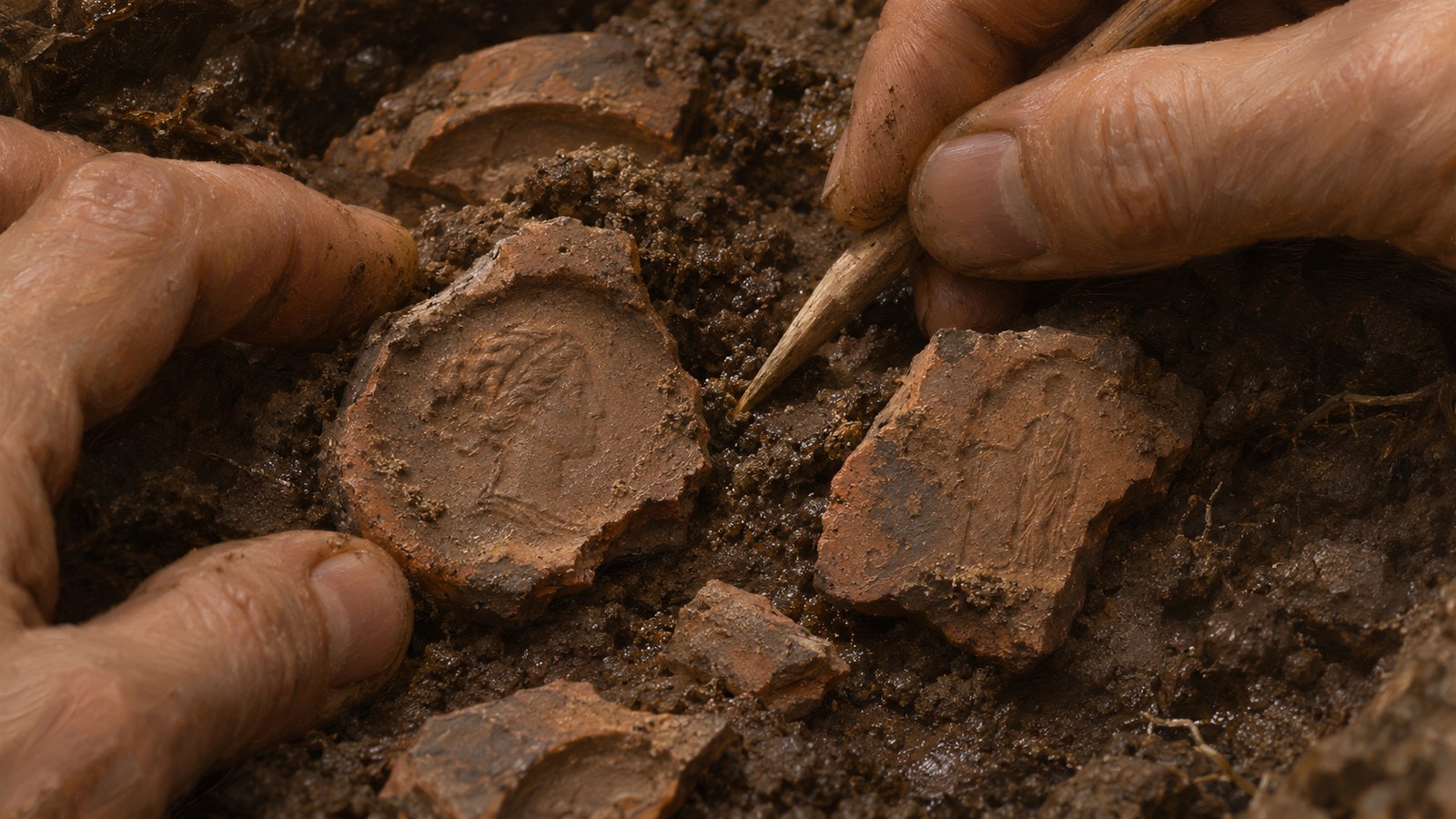
Nothing in ceramic technology was inherently criminal. Preparing clay, taking impressions, firing moulds and controlling small pours belonged to wider craft traditions. The illicit purpose came from the object being copied and the intended claim of the products.
This helps explain why the mould is historically valuable. Law codes and literary accusations describe counterfeiting from above, as an offence against authority. Workshop debris shows it from below, as a sequence of solvable physical problems. How can a portrait be copied? How can two faces align? How can hot metal fill a cavity only 22 millimetres wide?
The choice of a worn copper-alloy coin may have lowered expectations for sharpness. A cast copy did not have to rival a fresh die-struck issue if it resembled money already softened by circulation. Wear on the model could become camouflage for weakness in the copy.
Yet repetition also multiplies defects. A damaged letter or shallow feature in the master impression would recur. As with a dog’s print preserved in wet Roman clay, a soft surface could capture an instant and carry it through firing. Here the captured instant was deliberate, and its repetition challenged the monopoly behind the imperial image.
What the Fragment Proves
The object identifier 2009.62/29 anchors the piece in the museum’s permanent collection. The catalogue gives a Roman date, ceramic material, 22-millimetre diameter and direct identification as a forger’s mould. It names Faustina II, records partial legends, identifies Laetitia and her wreath and anchor, and notes retrograde impressions, two-sided construction, incompleteness, burning and clipped edges.
Those facts do not identify the forger, workshop, quantity produced or value lost. They do not prove that any cast from this particular mould entered circulation. A responsible account stops short of inventing a raid, arrest or hidden gang.
What the mould proves is already vivid. Someone took a worn official coin and treated it as a manufacturing tool. Imperial portraiture became an impression. Laetitia became a cavity. Clay converted authority into a repeatable negative.
The result is smaller than many modern coins, but its implications are larger than its diameter. Rome’s monetary order depended on people accepting metal, image and inscription together. The forger’s craft exploited that dependence. In this burnt, clipped fragment, the state-facing surface of money meets the private mechanics of copying.
The fragment also preserves a chain of copying. An official die first struck the copper-alloy coin. Circulation then wore its relief. Soft clay received that worn surface as a negative, and firing fixed the negative into ceramic. Any cast produced from it would become another positive, carrying both imperial design and accumulated loss.
That sequence explains why the word “retrograde” is more than catalogue jargon. Reversal locates the object within production. A finished coin presents portrait and legend for viewing; a mould must hold them backwards so the cast emerges forwards. The reversed impression is evidence of intention even where the surrounding workshop has vanished.
Clipped edges likewise draw attention to arrangement rather than display. The fragment was shaped for work, not framed for admiration. Its incomplete state may frustrate a viewer hoping for a perfect portrait, but broken workshop tools often reveal process more clearly than polished products. Here damage leaves the method exposed.
Sources
London Museum, “Mould, coin mould”