
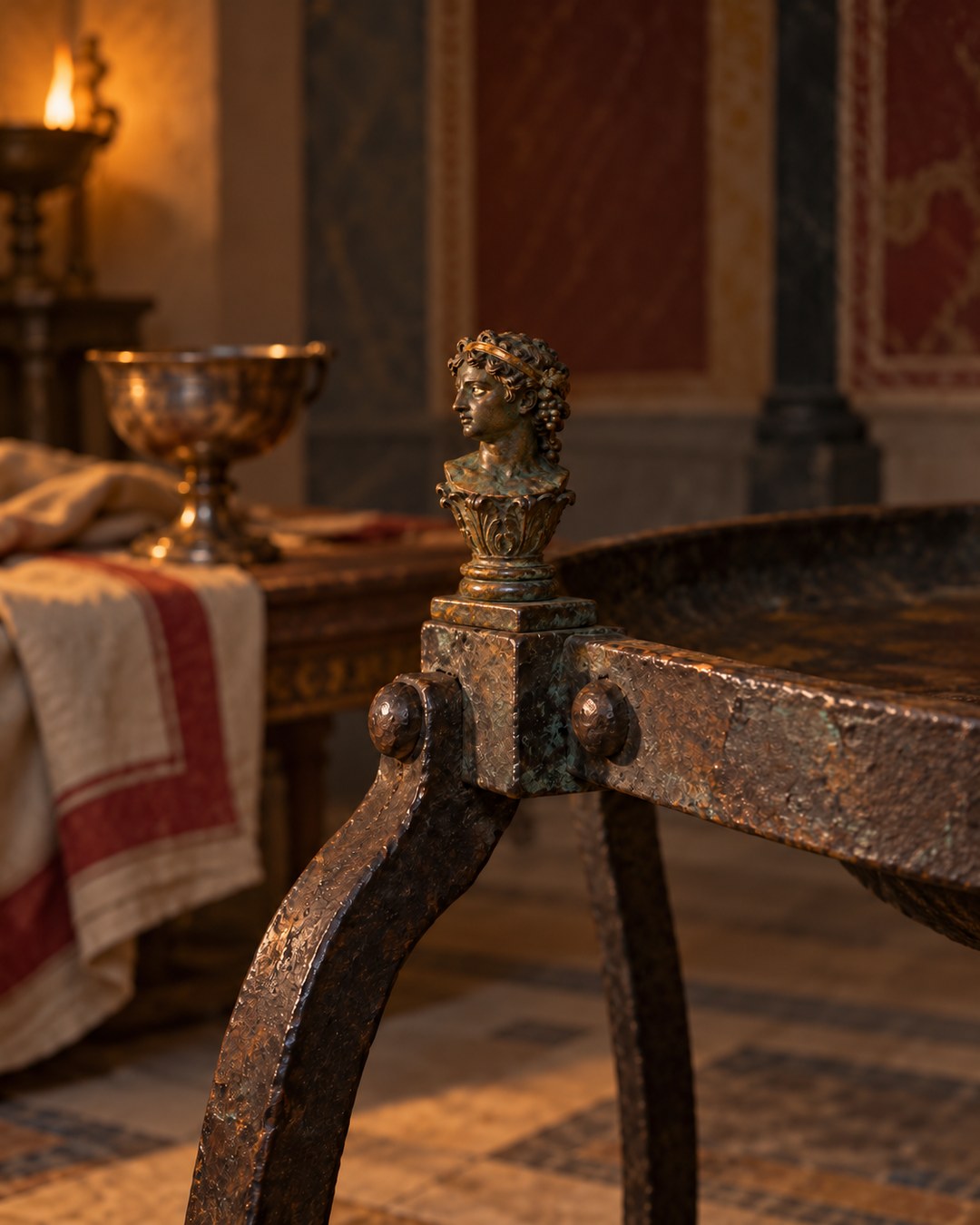
Two tiny silver eyes interrupt the brown-green surface of a copper-alloy face. The head turns left. Flowing hair rises beneath a diadem, while the bust emerges from an acanthus calyx fixed over a square hollow base. This is not a freestanding household god. It is a mount from an iron tripod.
The London Museum dates the fitting to AD 200–300 and identifies the figure as Bacchus or a bacchante. At 68 millimetres high, 36 millimetres wide and 27 millimetres deep, it transformed a structural junction into a concentrated image of wine, vegetation and the afterlife. The support did not merely hold furniture together. It watched the room.
A Hollow Base Joined Image to Iron
The square base provides the first clue to function. Its hollow construction allowed the copper-alloy mount to meet part of an iron tripod rather than stand independently. Horizontal mouldings decorate three sides, so the maker expected the fitting to be visible from more than one angle while still recognising a hidden or attached rear face.
That combination of ornament and attachment is central. Roman metal furniture could distribute labour across materials: iron supplied strength, while copper alloy carried a surface easier to cast and finish into complex imagery. The surviving mount preserves the decorative shell even though the complete tripod no longer frames it.
The object’s small dimensions keep the engineering believable. A 68-millimetre bust could mark a joint without overwhelming the legs or basin above it. It was large enough for a viewer nearby to notice the face and silver eyes, but small enough to remain part of the furniture’s architecture.
Another Lost Eagles object shows how a tiny metal component joined a much larger working assembly. The armour scale and tripod mount served different purposes, yet both warn against judging Roman craft only by complete monuments.
Acanthus Turned the Junction into Growth
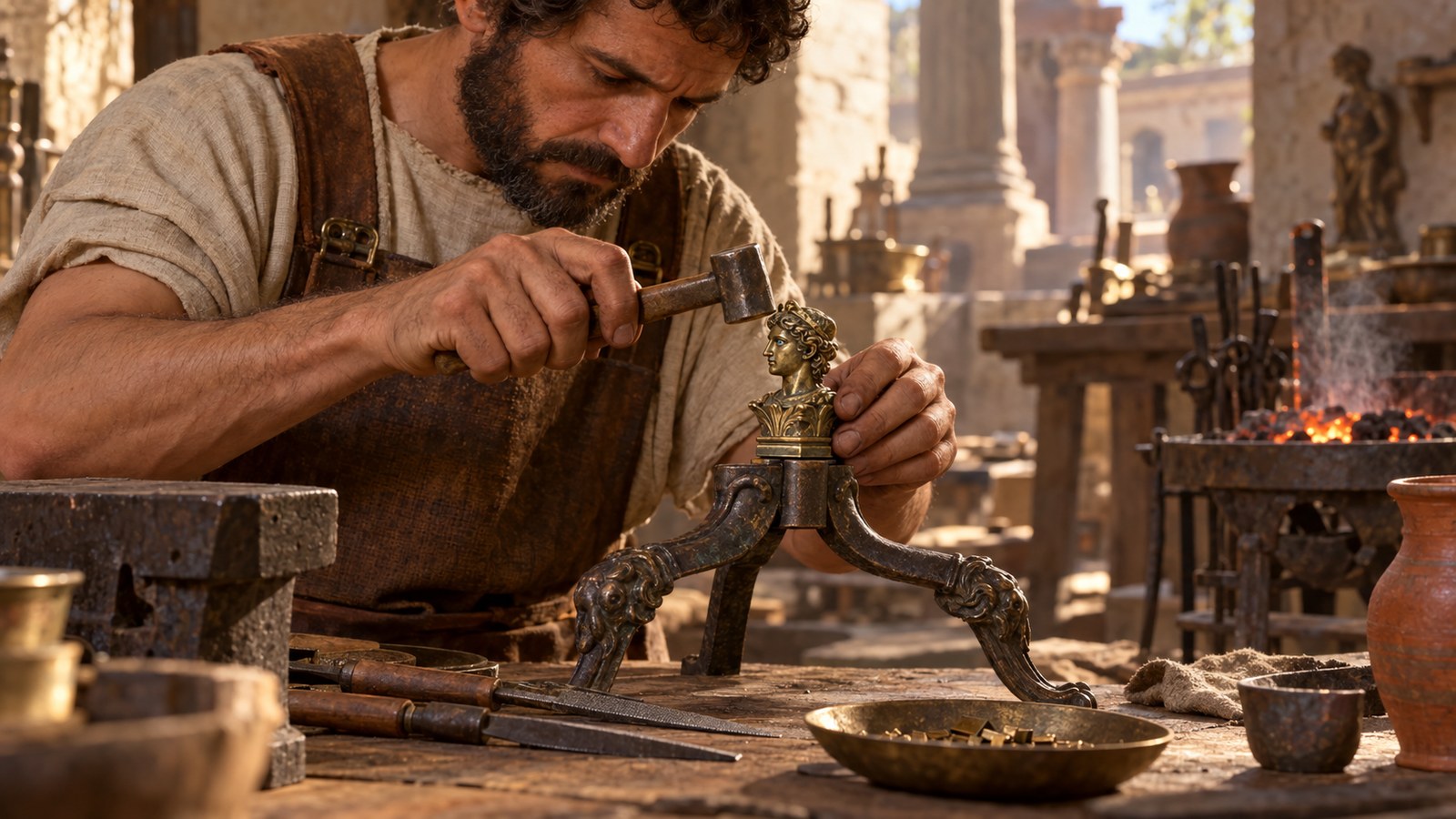
The bust does not rise directly from the square base. It sits within a calyx of acanthus that springs upward from it. This botanical transition softens the jump from geometric hardware to a human head. Leaves make the figure appear to grow out of the tripod.
Acanthus ornament had a long architectural and decorative life in the Roman world, but here it works at hand scale. The museum’s description supports the specific construction: base, calyx and bust form a vertical sequence. The plant is not background filler. It is the device that visually connects support to deity.
The mouldings on three sides reinforce that upward movement with horizontal bands. A viewer’s eye meets the squared base, crosses repeated lines, enters the leaves and reaches the face. Even without the full tripod, the mount preserves a deliberate order of looking.
The figure may be Bacchus himself or a bacchante, and the catalogue retains that uncertainty. The youthful face, flowing hair and diadem suit a Dionysiac setting, but the responsible reading does not force certainty where the record allows two possibilities. Ambiguity was compatible with recognisable atmosphere.
Silver Made the Eyes Behave Differently
The mount’s most striking material detail is easy to state: the eyes were inlaid with contrasting silver. The face is copper alloy, but the eyes catch light through another metal. That contrast would have changed as a lamp flame moved or daylight crossed the room.
Inlay required more than modelling the head. The maker had to prepare recesses, shape the silver inserts and secure them so that two very small elements remained aligned. The result concentrated expense and attention at the exact place where viewers instinctively look for animation.
Silver eyes did not make the object literally alive, yet they gave the face a different visual rhythm from the surrounding mount. Copper alloy could darken or develop a patina while the inlays retained a pale flash. From across a dining room, details in the hair might disappear before the gaze did.
This selective use of precious material resembles the logic behind six silver rings added to a multi-material brooch. Silver did not need to dominate an object to control how it moved or where attention landed.
Bacchus Entered a Furnished Room
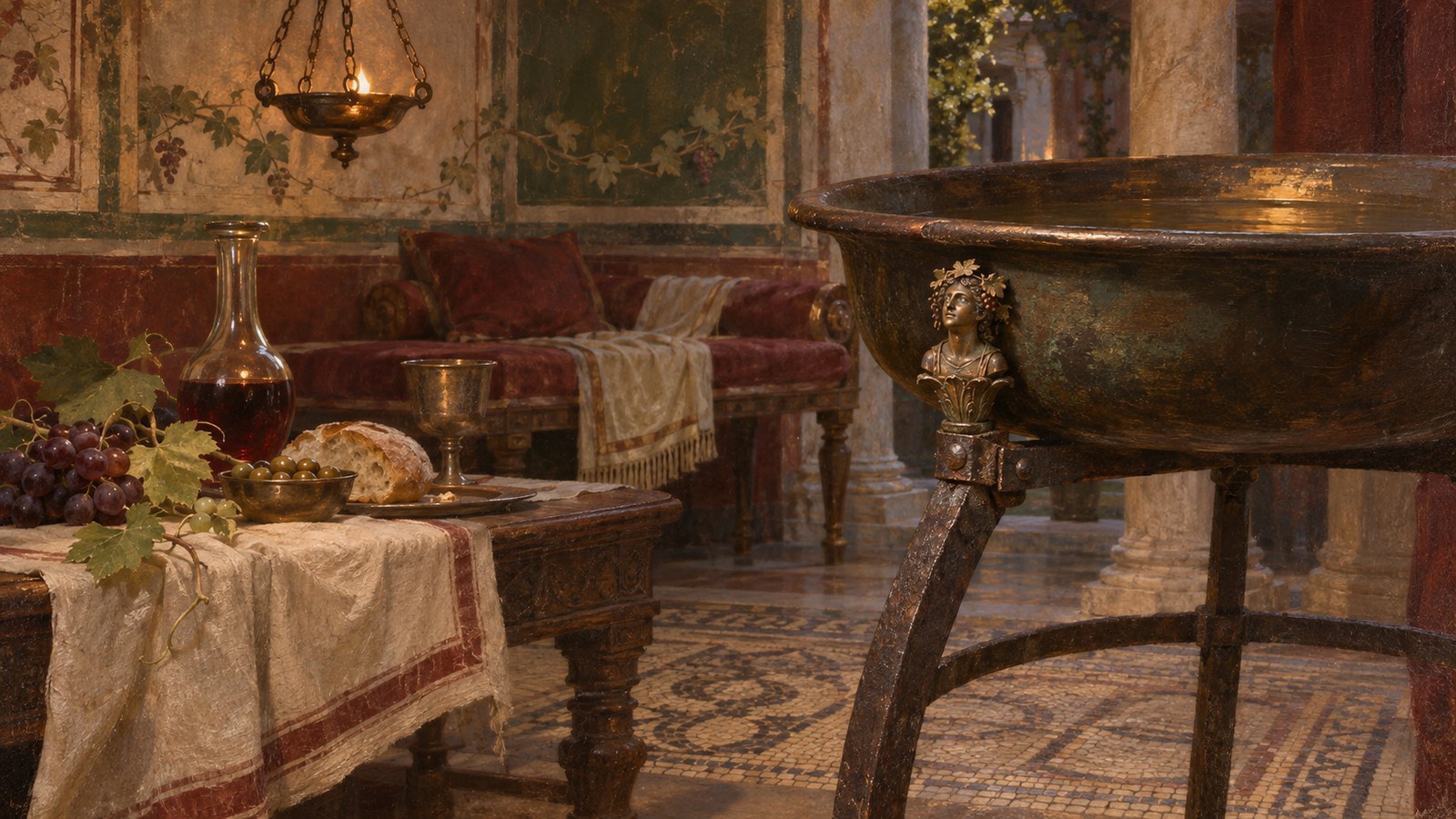
The museum describes Bacchus as the god of wine and guardian of the eternal souls of the dead. Both associations deepen the choice of figure. A tripod used in a furnished interior could stand near vessels, light, food or ritual activity, though the catalogue does not specify the complete tripod’s use. The mount invited Dionysiac associations without fixing one reconstructed scene.
Wine was not merely a drink in Roman visual culture. Vines, cups, revelry and transformed states gave artists a broad language for sociability and danger, pleasure and loss of control. The acanthus calyx and youthful head could make an iron support participate in that language.
The funerary dimension named by the museum is equally important. Bacchus as guardian of eternal souls prevents the image from being reduced to dining-room decoration. Roman viewers could encounter the same deity through overlapping domestic, festive and mortuary meanings.
A mount is especially suited to such overlap because it belongs to an object rather than a single fixed architectural programme. Furniture can be moved. It can change rooms, owners and uses. The image travels with the iron frame, bringing its associations wherever the tripod is set down.
The Missing Tripod Still Shapes the Evidence
Object 77.217 survives in the museum’s permanent collection, but the catalogue entry describes it as a mount from an iron tripod. That phrase asks the reader to imagine absence responsibly. The iron structure explains the hollow base, scale and attachment, even when the whole assembly cannot be seen.
We should not invent the tripod’s precise height, basin, owner or room. The mount itself supports firmer claims. It dates to the third century, combines copper alloy with silver inlay, measures 68 by 36 by 27 millimetres and organises a square base, three-sided mouldings, acanthus calyx, youthful head, flowing hair and diadem into one fitting.
Those details reveal a workshop comfortable with both structure and theatre. The base had to fit. The bust had to read. The inlays had to hold. The complete result had to survive as the tripod was handled. Decoration was not applied after engineering had finished; it was engineered into the junction.
That is why the silver eyes matter. They preserve the instant where furniture becomes presence. A person entering the room might first see an iron frame and whatever it supported. Moving closer, they would meet the pale gaze of a tiny Bacchus set among leaves. Hardware had become a spectator.
The mount also demonstrates how close viewing and distant viewing could be designed together. From across a room, the bust, leaves and bright eyes formed one compact accent. At arm’s length, the square base, three decorated sides and different metals became legible as separate craft decisions. The object rewarded movement around the tripod.
Its orientation mattered. The head gazes left, so the fitting was not visually neutral. When attached, it directed attention across the furniture and into the surrounding room. A maker or assembler had to consider which face of the tripod the mount would present and how lamplight might reach the inlaid eyes.
The contrast between surviving copper alloy and missing iron is instructive as well. Different metals corrode, detach and enter collections unevenly. What seems today like a complete small artwork was originally a dependent component. Reading the hollow base as evidence of attachment prevents the mount from being isolated from the larger object that gave it height and use.
Sources
London Museum, “Bacchus”