
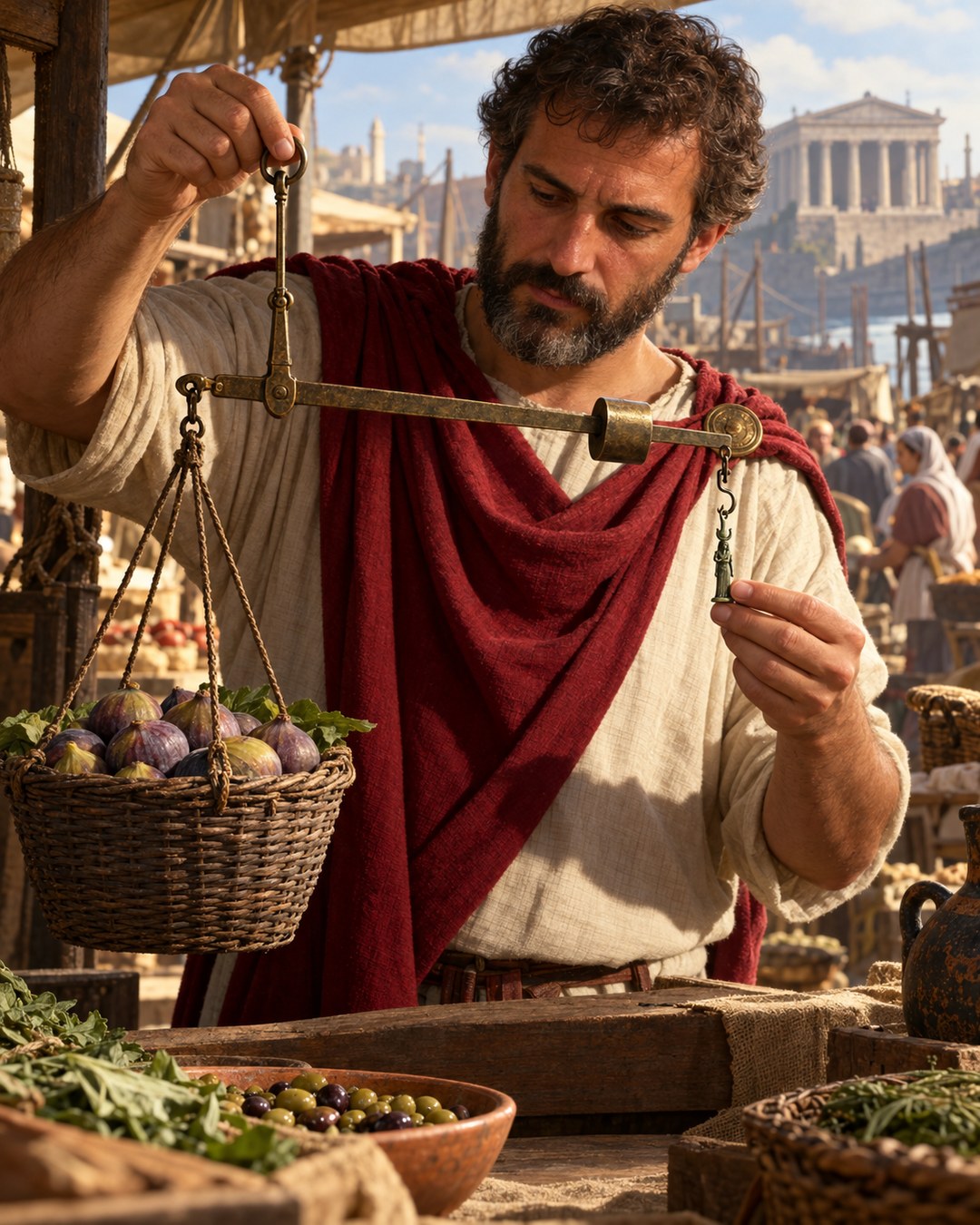
A trader lifts a bronze beam while a basket hangs below it. On the longer arm, the counterweight is not an anonymous lump. It has been cast as Isis. The surviving object in the London Museum is only 54 millimetres long, 35 millimetres wide and 22 millimetres high, but those dimensions were enough to give a working instrument a divine silhouette.
The object brings two systems into the same hand. A steelyard translates goods into balance through unequal arms and a movable or selectable weight. A religious image translates a distant goddess into a recognisable presence. In Roman London, those systems did not have to occupy separate rooms. The city’s market, workshop and sanctuary could meet in one copper-alloy object.
A Rare Weight, Not a Small Statue
The museum catalogues the piece as both a weight and a steelyard weight. That classification matters because the figure’s job was mechanical. It belonged to equipment for comparing an unknown load with a known counterweight. Its shape did not cancel that practical role; the shape was built into it.
At 54 by 35 by 22 millimetres, the figure could fit easily within an adult palm. Its small scale separates it from a cult statue intended to dominate a shrine. The museum also calls it rare, a useful warning against imagining every Roman balance hung from a deity. This is evidence for a possibility, not a universal rule.
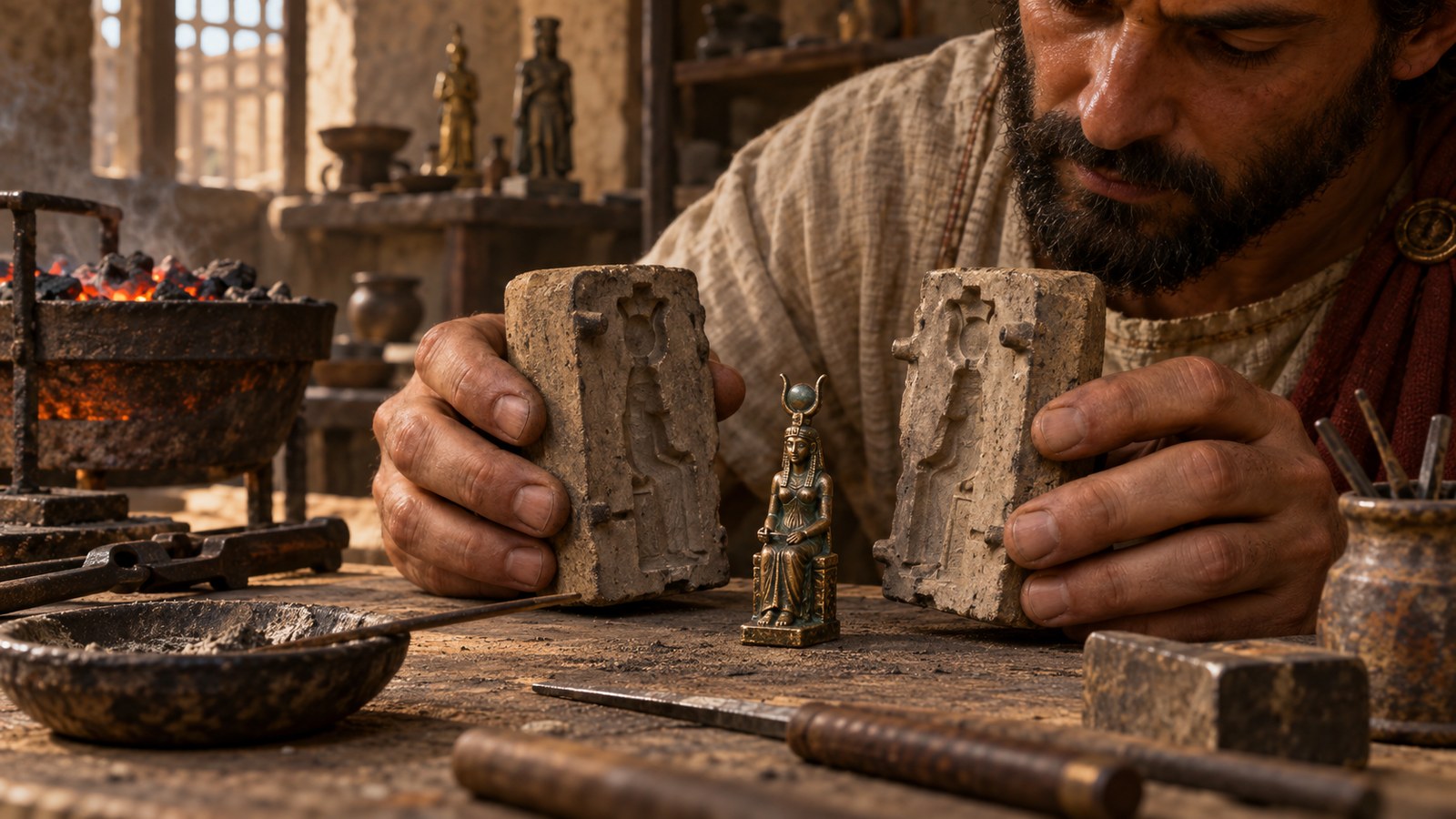
The copper alloy would have concentrated useful mass in a durable form. The catalogue says the object was made using a mould. Casting could reproduce the outline and major features of the goddess while creating a compact body suitable for suspension. A craftsperson therefore had to solve representation and weight together: the finished figure had to look like Isis, survive handling and perform consistently on a beam.
The Mould Fixed Identity into Metal
A mould made repetition possible, but it also imposed limits. At only a few centimetres long, fine detail could disappear into the casting or wear away in use. Recognition depended on a compressed visual language: silhouette, posture and attributes had to do more work than the subtle modelling available to a larger sculpture.
The museum’s record does not supply the mould itself, the precise alloy recipe or the workshop address. It does establish the production principle. Molten copper alloy entered a prepared cavity and emerged with the goddess’s form already part of the weight. Finishing could clean seams and prepare a point of attachment, but the primary identity was created at casting.
This distinguishes the piece from an ordinary mass later scratched with a symbol. Isis was not an afterthought added to completed measuring equipment. The figure and the counterweight were materially one. Every time the object moved along or hung from the steelyard, the divine image moved as part of the calculation.
Isis Had a Place in Roman London
The museum identifies Isis as an Egyptian goddess worshipped across the Roman Empire and notes that a temple was dedicated to her in London. That local fact prevents the object from being treated as a stray exotic curiosity with no urban setting. People in the city had a framework in which the figure could be recognised.
Recognition did not require every user to hold the same beliefs. Roman London gathered soldiers, officials, traders, craftspeople, migrants and families whose religious practices overlapped without becoming identical. A figurine weight could carry different emphases for different observers: protection, identity, familiarity, fashion or simply the accepted form of a useful object.
The small weight also complements the city’s more monumental remains. Temples and inscriptions announce organised public or communal acts, while portable objects show religion travelling through ordinary gestures. A user did not have to enter a sanctuary to handle a divine image. A market transaction could put Isis at the exact point where a load came into balance.
This portable scale of belief recalls how another London find made imperial fashion travel on a carved bone hairpin. In both cases, a large cultural system became tangible in something held between fingers.
Balance Was a Public Performance
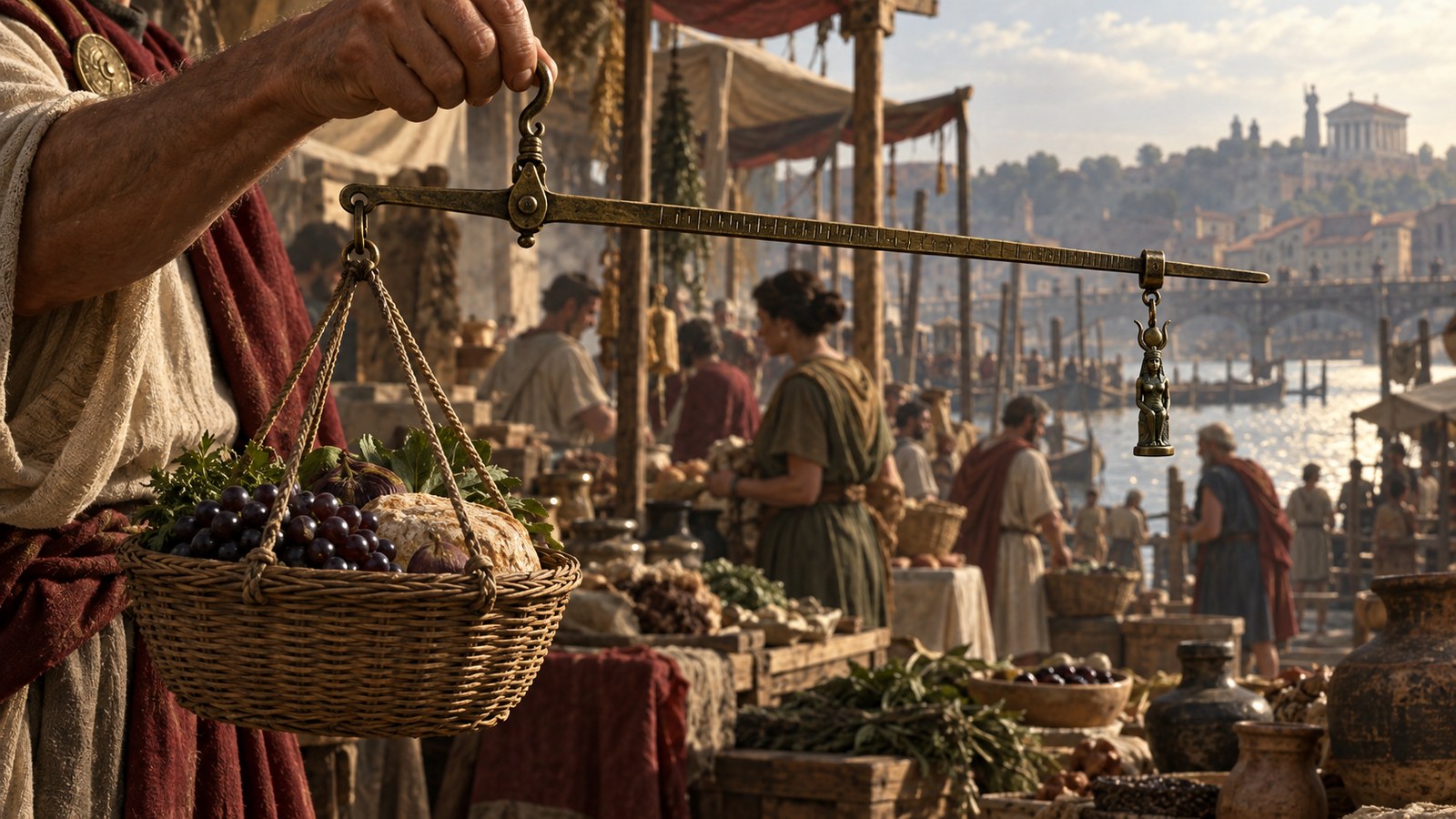
A steelyard did more than produce a number. Its beam, load, cord and counterweight made the process visible. Buyer and seller could watch the instrument settle. The known weight gave meaning to the unknown goods, while the point of suspension and the unequal arms turned distance into leverage.
The Isis figure therefore occupied a conspicuous place in an act that depended on trust. The museum record does not say who owned the instrument or what it weighed, so it would be wrong to invent a particular merchant or commodity. Yet its object type firmly connects it to measurement. The goddess’s body was not merely displayed near commerce; it served within commercial technology.
That fusion changes how the object should be pictured. It was not necessarily placed upright and admired. It hung, shifted, knocked against metal, passed through hands and accumulated wear. Its most characteristic pose may have been motion followed by stillness: the beam dipping, the counterweight changing position, then the assembly reaching equilibrium.
A related Lost Eagles article shows how a copper pan made quantity visible. The Isis weight adds another layer. Measurement could be technically legible while its hardware also carried a sacred personality.
What the Small Figure Can and Cannot Tell Us
The catalogue gives secure anchors: copper alloy, mould manufacture, steelyard function, dimensions, Roman date, Isis form and permanent-collection identity A17640. It also gives a wider religious setting by noting both imperial worship and a London temple. Those facts support a strong interpretation of joined measurement and imagery.
They do not reveal the object’s exact date within the Roman centuries, the name of its maker, its original owner, its calibrated mass or the goods measured with it. Nor can the figure prove that a transaction was a ritual. The safest conclusion is more precise: Roman technology could embody religious imagery without ceasing to be technology.
The object’s rarity makes that conclusion more interesting, not less. A rare survival exposes a design choice that ordinary summaries of Roman weighing often omit. Someone selected Isis, prepared a mould and produced a counterweight whose form was recognisable across an empire and locally meaningful in London.
When the beam finally levelled, belief did not replace arithmetic. Copper alloy, leverage and a known weight still did the physical work. But the thing that made the calculation possible had a face. In a city with a temple to Isis, a 54-millimetre goddess could help decide when a basket held enough.
The scale of the piece also changes the social range of the evidence. Monumental religion normally points toward institutions able to command stone, land and labour. This weight points toward a much smaller investment that could circulate through a stall or storeroom. Its significance came through repeated handling rather than architectural size. Each use joined the remembered identity of Isis to the ordinary need for an agreed quantity.
Wear would gradually simplify the figure. Raised details could soften, attachment points could polish and impacts could mark the alloy. None of that would remove the object’s calibrated role immediately. A familiar outline may have remained effective after subtle features became hard to see, especially for users who already knew what the figure represented.
The museum’s permanent-collection status gives the object a modern stillness that contrasts with this earlier mobility. Behind glass or in storage, it can look like a miniature sculpture. Restoring the steelyard context puts tension back into it: the figure once answered a load through gravity, leverage and position. Its meaning emerged when suspended.
Sources
London Museum, “Isis”