
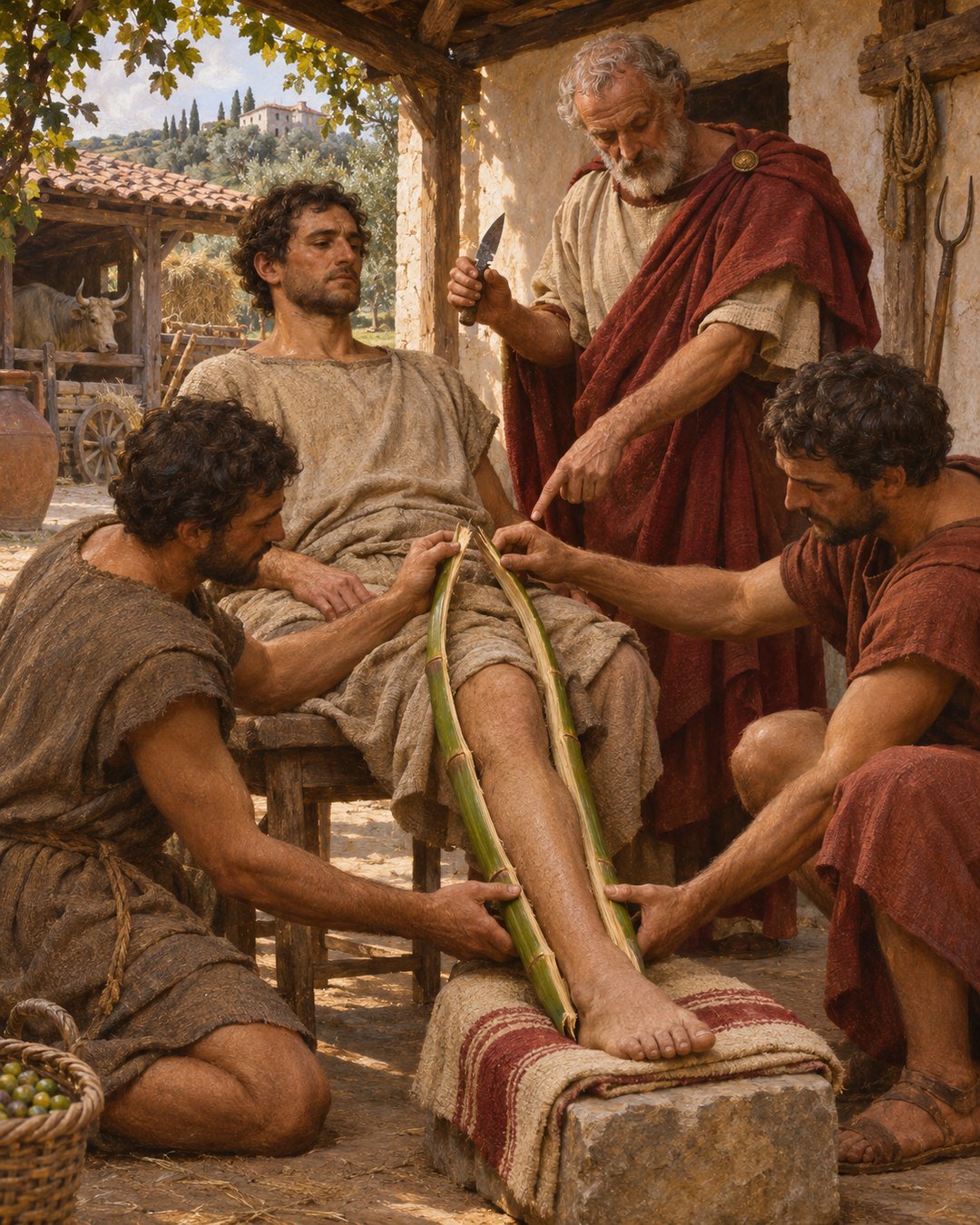
A green reed four or five feet long, two helpers, a knife and a sequence of spoken sounds formed one of Cato’s most startling farm remedies. The procedure was meant for a dislocated or fractured bone. It did not begin with a drug. It began by splitting the reed from end to end and arranging human bodies around the injured person.
Cato’s De Agricultura gives the instructions with the same compact confidence it applies to crops, livestock and food. Two men were to hold the split pieces against the patient’s hips. A chant began. The free ends moved slowly together while a knife passed above them. Once the reeds touched, they were cut and bound over the injury. The words were then repeated every day.
This is not evidence that the method repaired bone in a medically effective way, and it is not advice for treating an injury. It is evidence of how one Roman author made a cure imaginable. Material, movement, sound and repetition were all assigned a place. The broken reed was manipulated before its pieces were fixed to the broken body.
The Remedy Started with a Measured Reed
The first instruction is unusually physical. Cato calls for a green reed four or five feet in length. Freshness mattered because a green stalk could be split and moved without immediately crumbling. Its length made it an object that two people had to manage rather than a small charm hidden in one hand.
The reed was divided down the middle. That action created a pair from one stalk, but the halves were not taken straight to the injured limb. Two men held them against the patient’s hips. The arrangement turned treatment into a small coordinated scene: patient at the center, helpers to either side, operator directing the sequence.
The text does not explain why the hips were the starting point or specify which bone had been hurt. It moves from the general condition—dislocation—to a fixed performance. That silence matters. Cato was preserving a procedure, not offering an anatomical discussion like the one behind the ancient argument about the skull’s vulnerable construction.
Because the reed had a stated length and had to be split, held and brought together, a household could tell whether the sequence had been followed. The remedy’s authority rested partly in reproducible actions. Anyone watching could see if the stalk was green, whether two pieces existed and whether their ends met.
Two Helpers Turned Treatment into a Performance
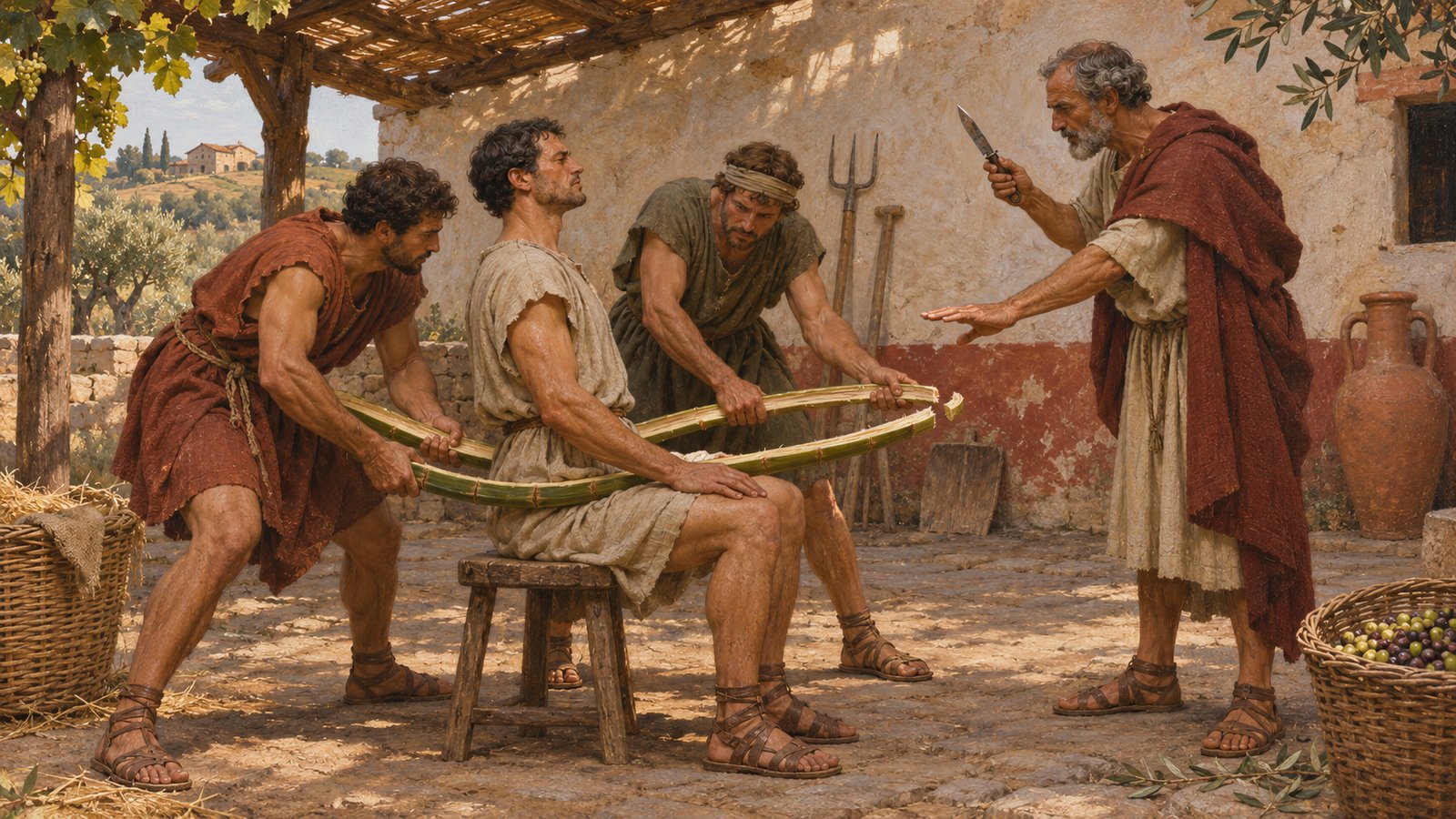
The presence of two men is more than background. Their hands kept the long pieces positioned while the operator spoke and used the knife. A single healer improvising beside a bed would not match Cato’s instructions. The cure required distributed work.
That made the injured person part of a visible social act. The helpers’ bodies supplied symmetry. Each controlled one half of the reed, and both had to move slowly enough for the free ends to approach together. The procedure therefore converted a private injury into a carefully witnessed operation.
Roman ritual often gave ordinary substances force through placement and sequence. Water, ash, cloth, grain and branches could become significant because someone carried, poured, bound or burned them at the proper moment. The same logic appears in the way a pointed vessel controlled the Vestals’ handling of sacred water. Shape and handling did not merely decorate the act; they defined it.
Here the reed connected the helpers to the patient before it touched the injury as a binding. Its movement created a temporary frame around the body. Cato does not say that the helpers needed a priestly title. The necessary qualification visible in the text is procedural: they had to hold and move the pieces as directed.
The Knife Moved before It Cut
While the reed ends approached, the operator waved a knife above them. Only after the pieces touched did the knife perform its ordinary cutting function. Cato says to seize the reeds and cut them on the right and left. The tool therefore moved in two modes: first as an object traced over the action, then as an edge that shortened the material.
The order resists a purely practical explanation. A knife was obviously useful for dividing reed, yet the initial lengthwise split had already occurred before the helpers took their places. Waving the blade above the converging pieces added a gesture that was not necessary merely to manufacture splints.
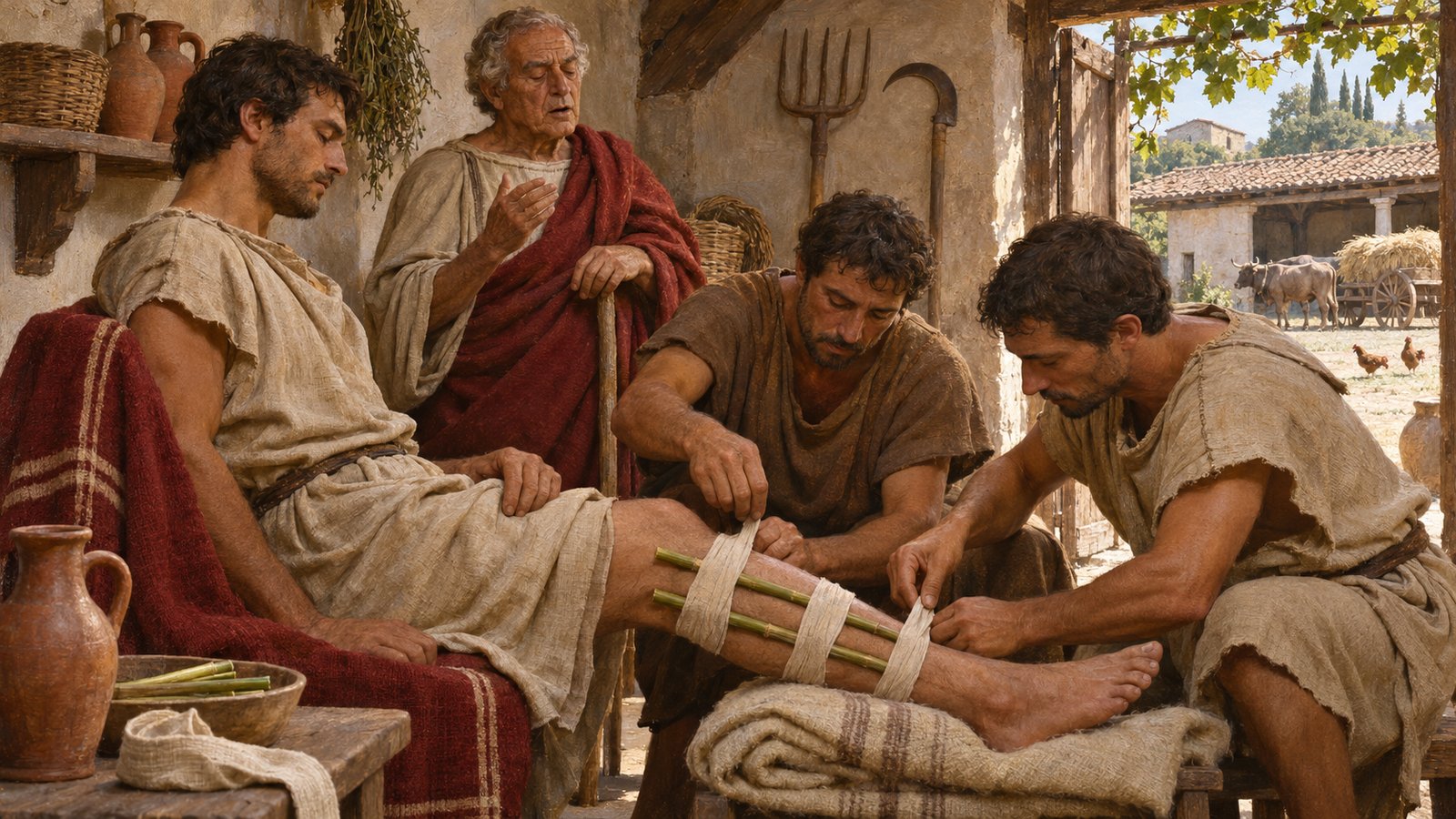
Once the reeds met, however, the sequence returned to tangible construction. The operator grasped them, cut on both sides and retained pieces that could be bound upon the injured area. The resulting material may look familiar to a modern reader as a kind of support, but Cato’s claim cannot be separated from the actions that preceded the binding.
The physical and verbal elements did not compete. The knife did not replace the chant, and the chant did not remove the need to handle the reed. The procedure joined them. That combination is precisely why the passage is richer than a stray magical phrase copied without its setting.
The Spoken Formula Controlled the Pace
Cato records a first formula beginning “In Alio” and continuing through strings such as “Daries Dardaries Astataries.” Its sounds are difficult to convert into a simple statement. The text does not provide a translation or explain them as ordinary conversational Latin.
What the instructions do make clear is timing. The chant begins while the reed pieces are held and continues as their free ends come slowly together. Speech measures the operation. The helpers do not snap the halves into contact; movement unfolds under the duration of repeated sound.
This protected the formula from becoming an isolated quotation. To follow Cato, the operator had to speak while others acted. The words belonged to a performed cure, not to a page alone. Their strangeness may have marked the moment as different from everyday farm talk, but the surviving instruction anchors them to hands, reed and knife.
Cato also offers a second formula, beginning “Huat Hanat Huat Ista Pista Sista.” The alternative did not eliminate repetition. One formula or the other was to be used every day. The existence of an option suggests that exact practice could vary while the broader architecture—spoken words renewed over the bound material—remained stable.
Daily Repetition Kept the Cure Active
After the cut reed pieces were bound over the dislocated or fractured bone, the procedure was not finished. Cato directs the user to repeat the incantation daily. The first performance created the binding; subsequent performances maintained the verbal side of the remedy.
That schedule placed healing in time. A damaged limb does not recover in a single instant, and the text’s ritual answer was repeated attention. Someone had to return, look at the binding and speak again. Even if the claimed cure cannot be accepted as medical evidence, the instructions reveal an expectation of continuing care rather than abandonment after one dramatic act.
The passage also shows why “Roman medicine” is too simple a label for every response to injury. This recipe sits in an agricultural manual. Its agents are reeds, helpers and household action. It crosses categories that modern readers often separate: practical support, inherited formula, ritual gesture and confidence in a written authority.
Cato’s reed remedy is memorable because it makes resemblance do work. A single stalk is split, its halves are brought back into contact, and the resulting pieces are attached to a divided or displaced body. The text never states that symbolism explicitly. It simply instructs people to enact it, day after day, until the body is declared sound.
Sources
Cato, De Agricultura 160.