
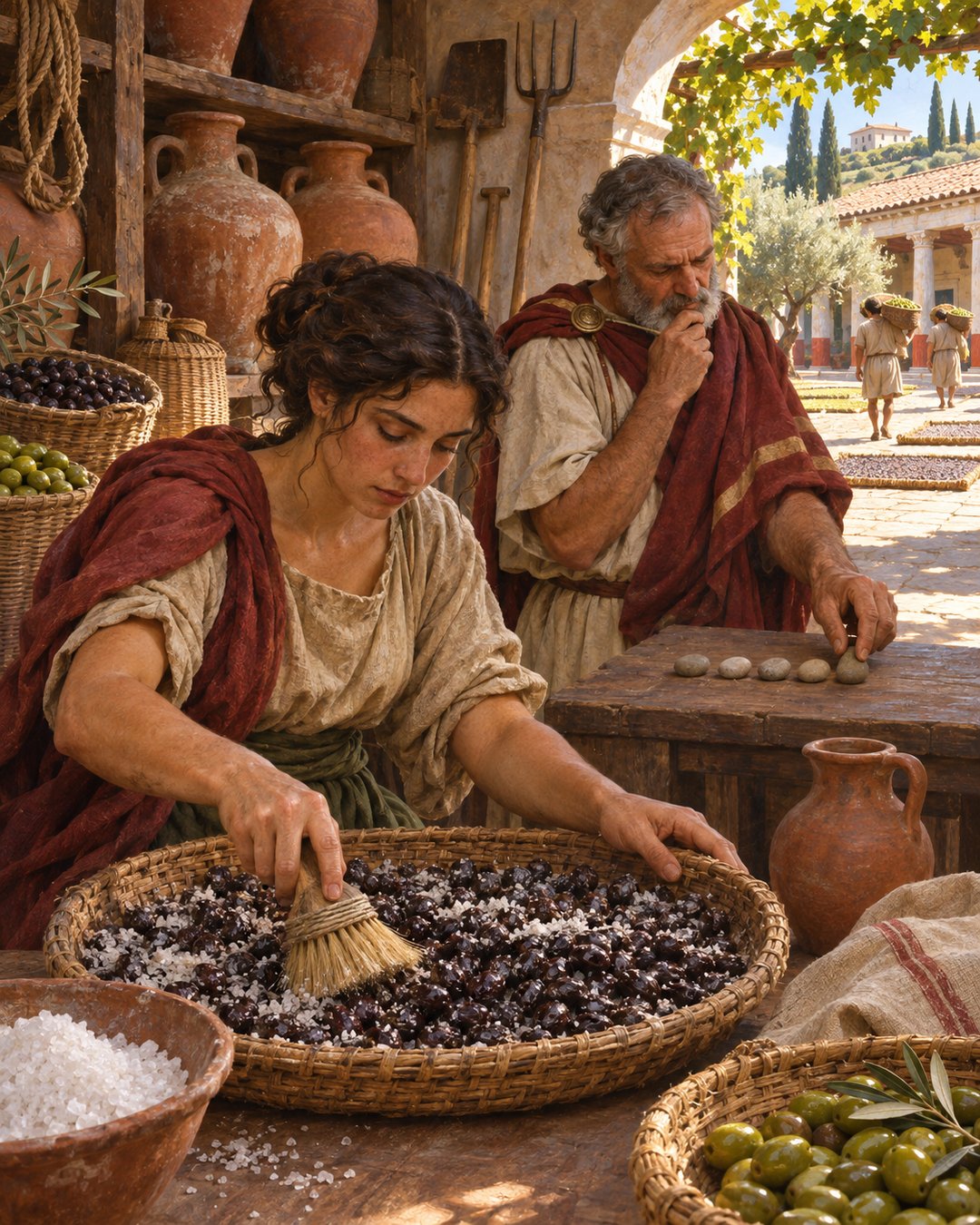
Five days in salt and two days in sunlight could determine whether a batch of round olives kept its dark appearance. Varro preserves the sequence in a short section on farm storage, attributing the advice to Cato. The olives were packed, uncovered, brushed clean and then moved into the sun. Nothing in that order was accidental.
The same passage does not offer one universal recipe. Round and bitter-berried table olives could go into brine whether they were dry or green. Bruised fruit called for mastich oil. Round olives intended to retain their black colour could take the timed salt-and-sun route, or they could be submerged in grape must reduced to one-third of its original volume.
That compact list turns preservation into a problem of classification. A farm had to notice variety, ripeness, damage and desired result before choosing a container. Salt, oil, brine, sun and concentrated must were not interchangeable ingredients. They belonged to separate treatments for separate fruit.
The Store Room Began with Sorting
Varro calls these “table olives,” which places the passage after harvest but before serving. The fruit under discussion was not simply an undifferentiated olive crop. Some olives were destined for pressing, while these were being retained in forms that people could eat. Preservation protected that second value.
The first division named in the text is between round olives and bitter-berried kinds. Both could be kept in brine, but naming them separately shows that the person doing the work was expected to recognize what had arrived. The recipe began in the hand and eye before it began in a jar.
Condition mattered as much as variety. Varro says brine served olives when they were dry and when they were green. That range is broad, yet it is followed immediately by a narrower warning: bruised olives were better put into mastich oil. A damaged surface changed the treatment.
Roman farm writing repeatedly treats visible condition as operational information. A worker did not need an abstract theory of preservation to separate intact fruit from fruit crushed in handling. That practical habit resembles the attention given to containers in the instructions for keeping meat and fruit in distinct layers of honey. Before storage could work, the material had to be read correctly.
Five Days Gave Salt a Deadline
The route for dark round olives is striking because it is measured in days. The fruit was packed in salt for five days, not buried indefinitely. A household or estate had to remember when the batch entered the container and return at the proper point.
That deadline made preservation a scheduled task. Salt did not end the work when it was poured. Someone still had to open the vessel, remove the fruit and brush the crystals away. The sequence demanded a second intervention after a known interval.
Varro’s stated purpose was to let round olives retain their black colour. The surviving instruction therefore connects process to appearance. These were table olives, and the look of the finished fruit mattered alongside its survival. The desired dark surface was something labour tried to preserve.
Five days also distinguished this operation from other salted products. Cato’s agricultural instructions could use salt for different foods and for different lengths of time. The number here belongs to this olive treatment. It cannot safely be turned into a general Roman preservation rule.
The measured interval would have shaped the store room. A batch placed in salt needed an identity and a beginning, even if the record existed only in memory or in the overseer’s routine. When several harvest tasks overlapped, forgetting the fifth day meant failing to follow the preserved method.
Brushing Changed the Process
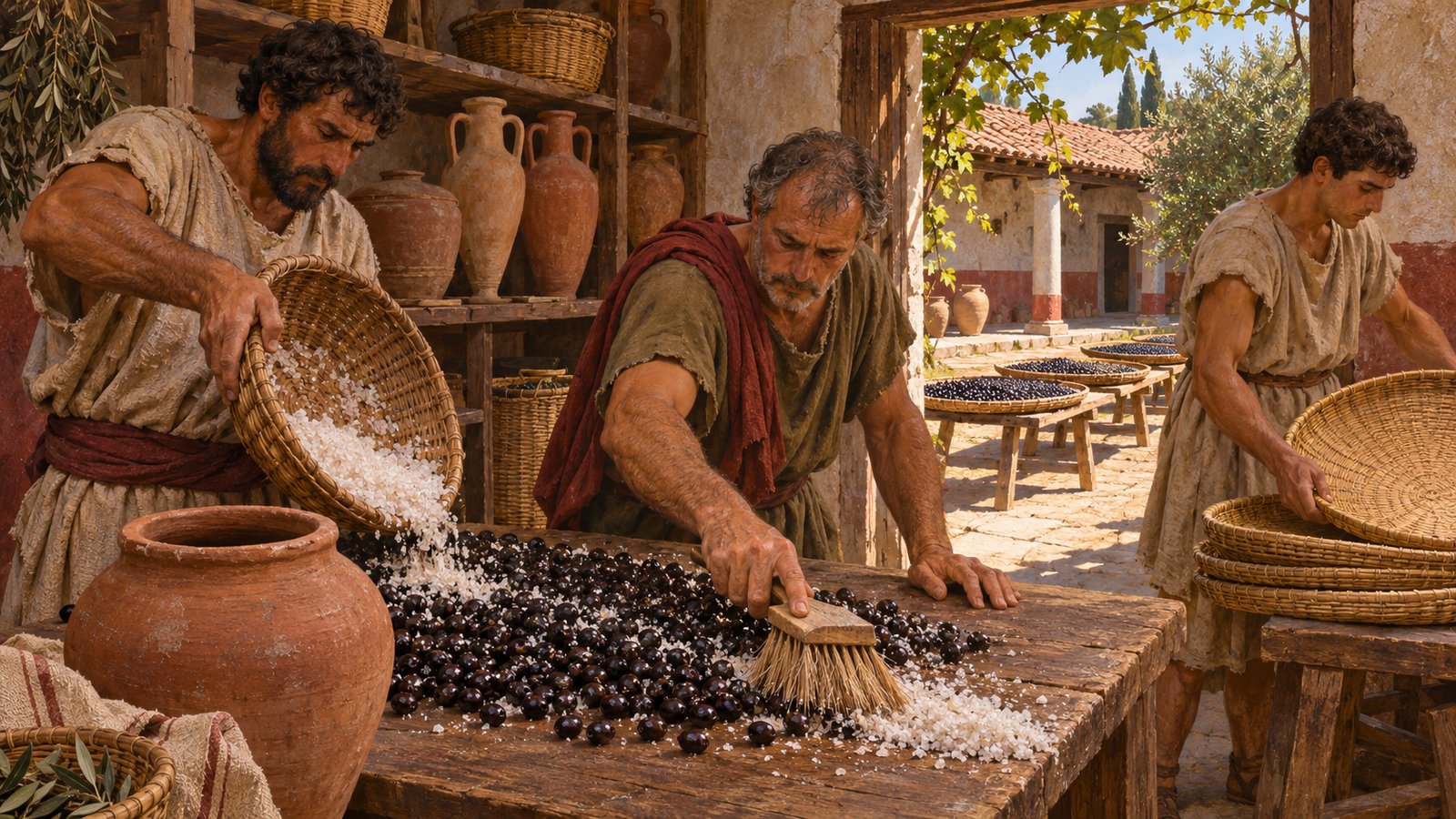
When the five days ended, the salt was brushed away. That small action is easy to skip when the recipe is summarized, yet it marks a genuine transition. The fruit did not travel from salt directly to the table, and the salt did not remain as the permanent storage medium.
Brushing required handling each mass of olives again. It removed the material that had surrounded them and prepared their surfaces for the next environment. The instruction implies a dry, physical operation rather than rinsing the fruit and adding another liquid.
This step also separates packing from finishing. During the first phase, salt enclosed the olives. During the second, workers exposed the treated fruit. The same batch moved from a confined container to open air, and the removal of salt made that change deliberate.
Such transitions are characteristic of craft knowledge. A substance may be useful only until it has done a particular job. The workers behind the salted opening stage of purple dye production also had to treat timing as part of material control, although their shellfish and outcome were entirely different. Salt was a tool whose effect depended on sequence.
Two Days of Sun Finished the Dark Olives
After brushing, the olives spent two days in the sun. The text does not merely say to dry them. It names exposure and duration. The farm therefore needed weather, space and attention enough to lay the fruit out and recover it after the second day.
This finishing stage reversed the protected character of storage. Instead of closing the olives away from the outside world, workers deliberately placed them beneath sunlight. The method used enclosure first and exposure second.
The two-day period was shorter than the five-day salt stage, creating a seven-day sequence with a clear division in the middle. A batch changed location and treatment after day five. That rhythm made the result depend on labour returning twice: once to brush, once to collect.
Sunlight introduced risk as well as usefulness. Olives left outside could not be forgotten. Rain, animals or excessive delay would interfere with the prescribed course. Varro does not list those hazards here, but the insistence on two days tells us that open exposure remained bounded rather than casual.
The finished appearance was not presented as a natural quality that survived by itself. Black colour was retained through work: sorting, packing, waiting, brushing and timed exposure. A dark table olive embodied a week of decisions that a diner might never see.
Reduced Must Offered a Salt-Free Route
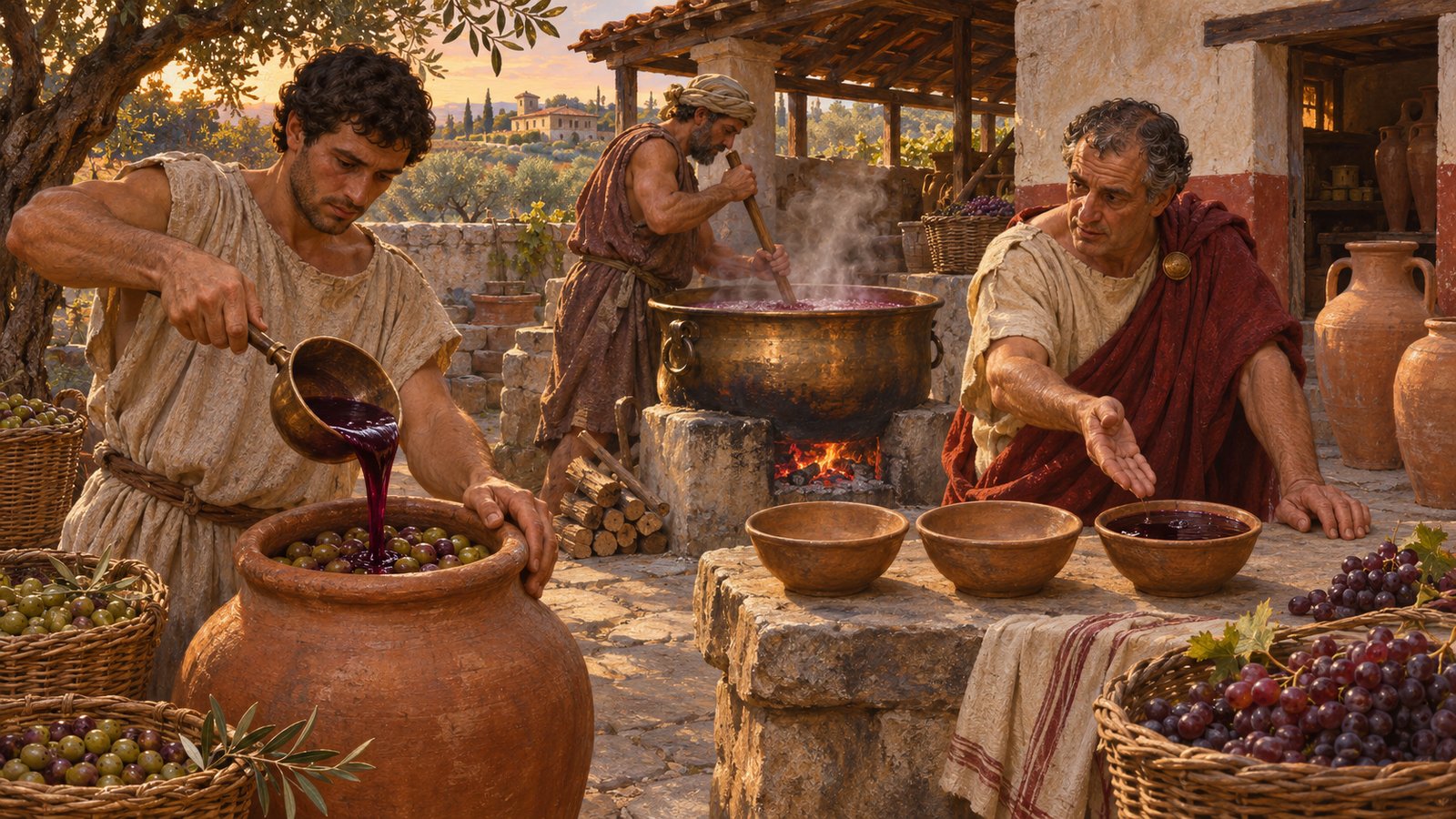
Varro closes the olive passage with an alternative. Round olives could be preserved in grape must boiled down to one-third, without salt. This route exchanged the dry packing and sun schedule for a concentrated liquid made from another harvest.
Boiling to one-third was itself a substantial operation. The must had to lose two-thirds of its starting volume before it reached the named concentration. That required fuel, a vessel, supervision and a judgment about volume. The preservative arrived only after another farm product had been transformed.
The alternative joined the olive and grape economies inside one store room. A vineyard product could protect orchard fruit. This was not evidence that every farm used the same method, but it shows why mixed agricultural production created options. One harvest supplied a treatment for another.
Most importantly, Varro explicitly says this method worked without salt. The reduced must was not an extra flavour poured onto salted olives; it replaced the salt route. That distinction prevents two separate instructions from collapsing into an invented combined recipe.
The whole passage is brief because it assumes practiced hands. Yet its branches are precise. Brine for round and bitter-berried table fruit, mastich oil for bruised olives, five days of salt plus two days of sun for a dark finish, or one-third must without salt: each route begins with a different reading of the crop. Roman preservation lived in those choices, long before the jar reached the table.
Sources
Varro, Rerum Rusticarum 1.60.