
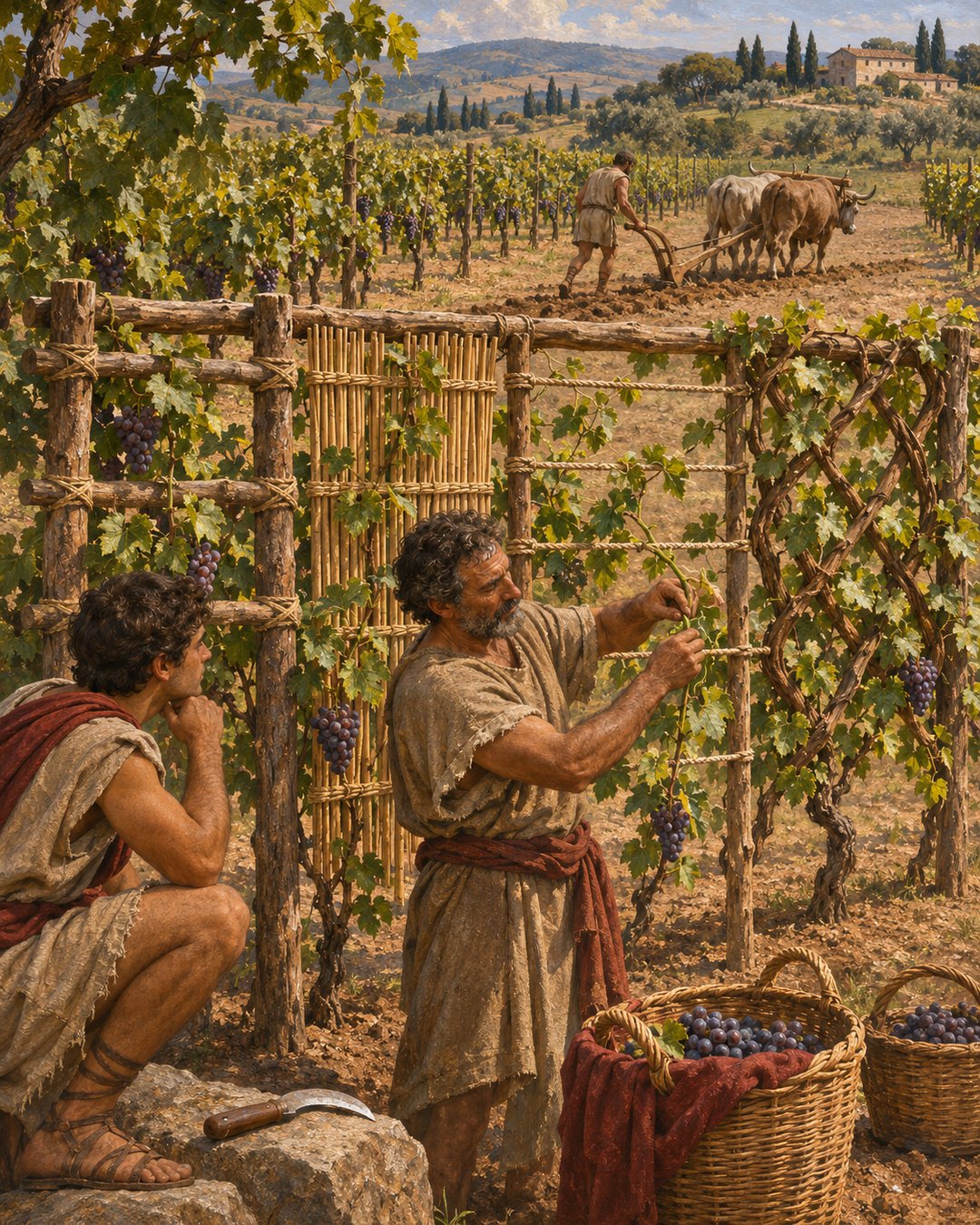
A Roman vineyard could rise on poles, reeds, ropes or living vines. Varro names all four supports and attaches each to a different Italian place: poles at Falerum, reeds at Arpinum, ropes at Brundisium and vines themselves at Mediolanum. The list is not decorative geography. It shows a crop being fitted to local materials.
Support also determined movement through the vineyard. Vines could stand separately on props or join one another on a trellis, an arrangement Varro calls “marrying the vine.” They could be trained upright or crossed and interwoven. Whatever the form, the framework had to reach roughly a man’s height while leaving enough space below and between supports for a yoke of oxen to plough.
The result was both biological and architectural. A climbing plant needed wood, reed, fibre or another plant to occupy the air above a working field. The farmer had to build that vertical space without blocking animals on the ground or making maintenance consume the value of the crop.
Training Turned Growth into Layout
Varro begins with vines that climb. Left alone, such growth would not automatically create an orderly vineyard. Stems needed to be directed onto a structure, and that structure had to decide where the canopy rose, crossed and left openings.
The simplest distinction was between a vine trained separately on a prop and vines trained together on a trellis. One arrangement treated each plant as its own vertical unit. The other connected plants across intervals and made the support system continuous.
Calling the second method “marrying the vine” captured that connection. The phrase did not mean that plants literally reproduced through the support. It described how one vine was joined with another in a shared arrangement. Their stems occupied a framework rather than isolated stakes.
This was different from moving a young tree with soil around its roots, as in the basket method for transporting Roman nursery stock. Transplanting protected a plant during relocation. Training managed where an established plant continued to grow.
Once that difference is clear, the trellis becomes part of farm planning. Rows were not merely lines of vines. They were repeated spans, joins and clearances that affected pruning, harvesting and ploughing long after the first support went into the soil.
Four Regions Used Four Support Materials
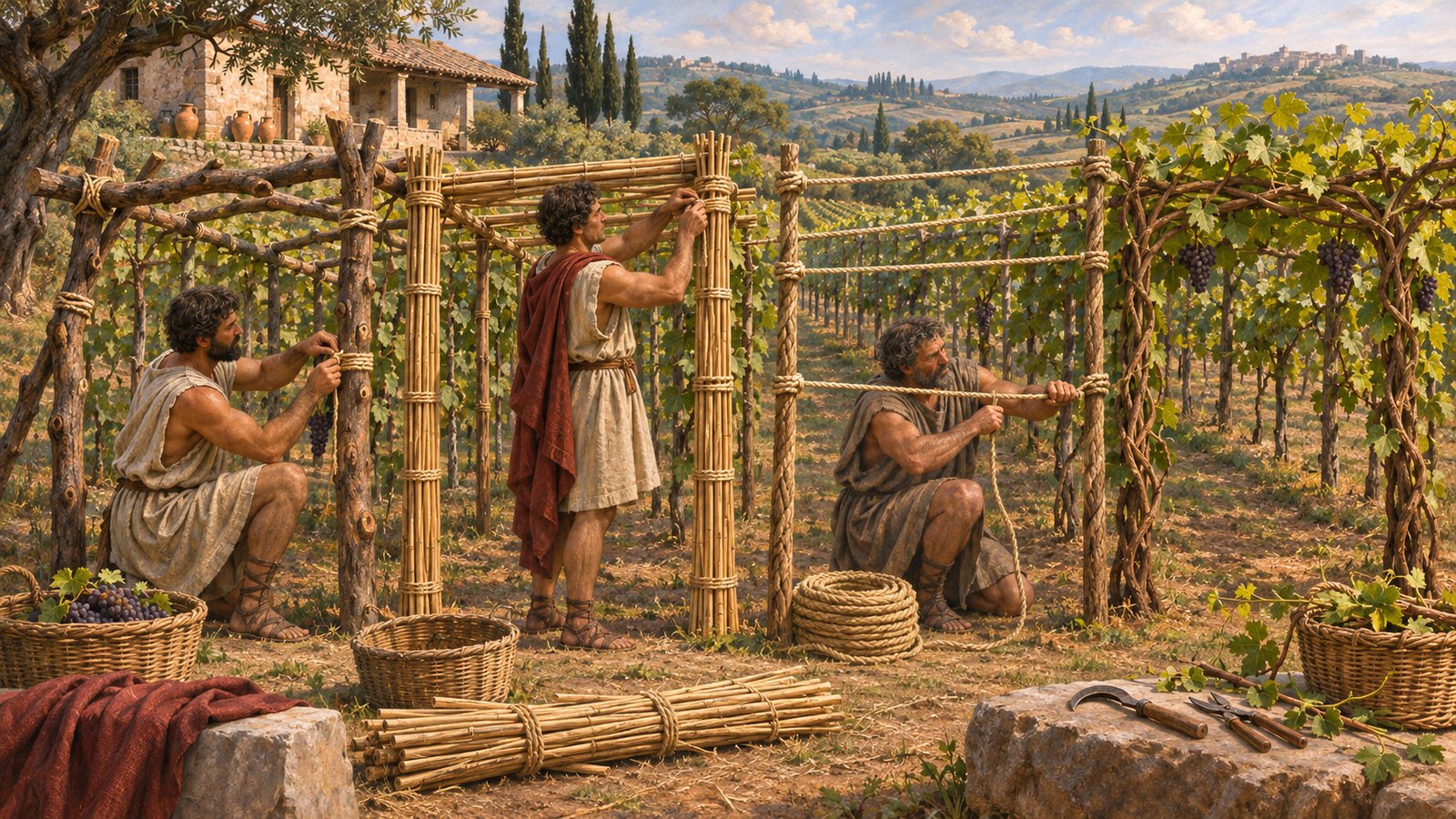
Varro’s four-part list is unusually concrete. Falerum used poles. Arpinum used reeds. Brundisium used ropes. Mediolanum used vines themselves. Instead of presenting one ideal trellis for the whole peninsula, he mapped several workable answers.
Poles offered rigid individual members. A farmer could place them where a span or upright needed dependable shape. Their usefulness depended on access to suitable timber and on the labour of cutting, moving and setting it.
Reeds were lighter and belonged to a different material economy. They could be harvested from wet ground and bundled or arranged into supports. Varro’s association with Arpinum shows that a trellis could be made from comparatively slender plant material rather than heavy wood.
Rope changed the structure again. At Brundisium, fibre under tension could connect fixed points without filling every span with a rigid rod. The material had to be made, tied and kept taut. It was flexible in the literal sense, but its usefulness still depended on careful placement.
Mediolanum’s vines made the crop participate in its own framework. Varro does not give a construction manual in this sentence, so the arrangement should not be embellished beyond his wording. What survives is the important contrast: some vineyards relied on supports brought to the plant, while another regional form used vines themselves in the trellis.
Upright and Interwoven Systems Shaped the Canopy
Material did not settle the full design. Varro next separates two methods of training: one upright, the other crossed and interwoven. A vineyard could use a familiar substance yet organize it into a different geometry.
He associates upright training with the country of Canusium. The word directs attention vertically. Plants and supports rose in a form distinct enough for Varro to name it as a regional practice.
The crossed and interwoven arrangement was more widespread. Varro says it was practiced generally throughout Italy. Stems or supporting elements passed across one another, turning a row into a linked fabric rather than a series of solitary lines.
Interweaving demanded repeated decisions. A worker had to choose which growth went across, where it met another element and how much open space remained. The finished canopy therefore recorded maintenance as much as initial construction.
This is where “marrying” becomes materially useful rather than merely picturesque. A connected trellis let neighbouring growth share a designed span. But connection could not become uncontrolled tangling. The vineyard still had to preserve access for people, tools and animals.
The same attention to joining appears in the clay, bark and knife used for grafting fruit trees, though the mechanism was different. Grafting united living tissues. Trellising directed separate growing stems across a support. Both depended on skilled handling, but they solved different problems.
A Man and a Yoke Set the Working Scale
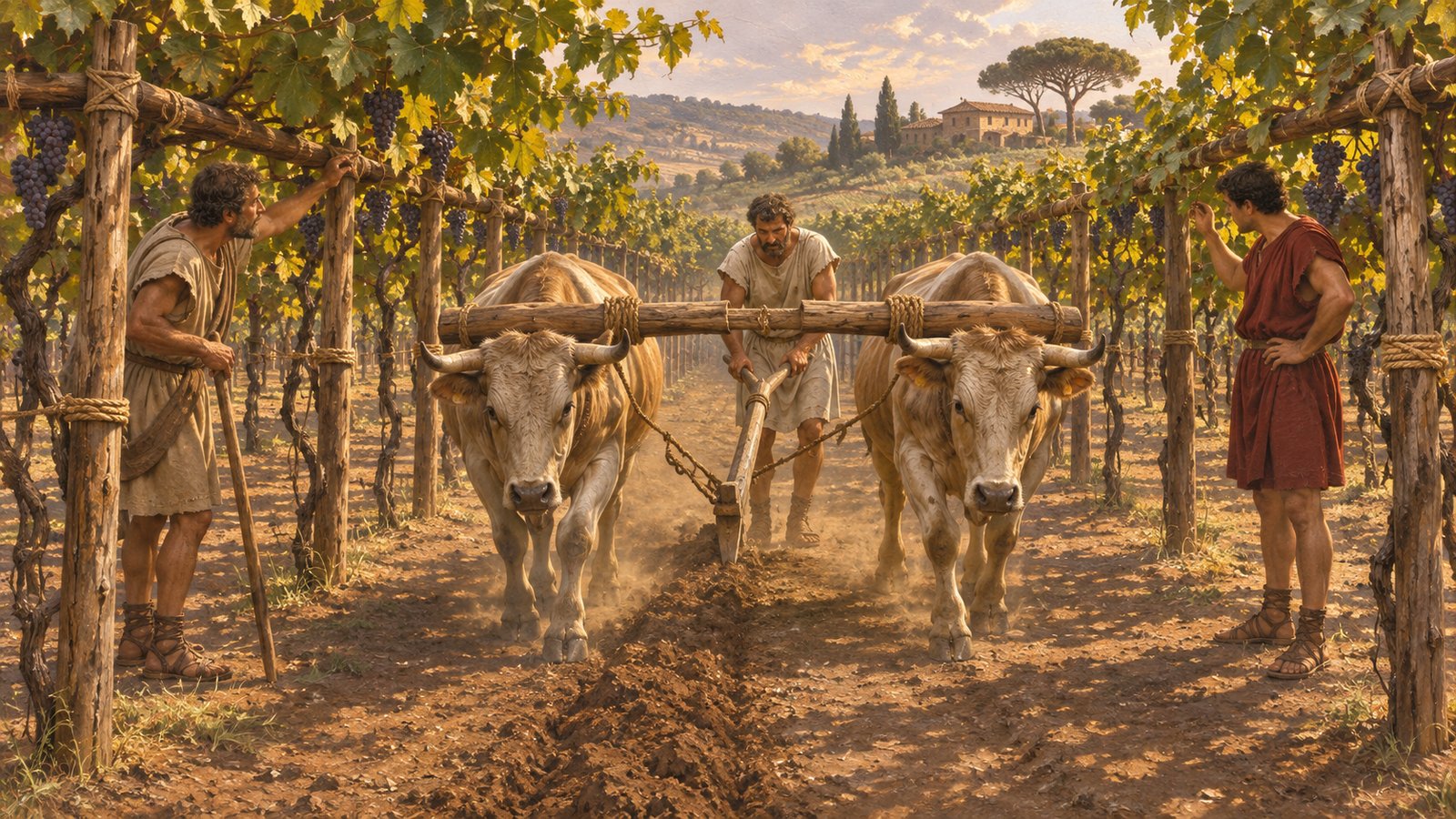
Varro gives the vineyard two human and animal measures. Vines should be trained to the height of a man. The interval between props should allow room for a yoke of oxen to plough. Those instructions tied the aerial canopy to bodies moving beneath it.
“The height of a man” was a practical scale rather than a standardized modern unit. It placed the trained growth where workers could approach it while keeping it above the soil. The vineyard’s vertical dimension came from reach and use.
The ox-yoke requirement governed horizontal space. Two animals joined side by side needed a corridor wider than a single person. If supports crowded that corridor, cultivation between the vines became difficult regardless of how well the canopy carried fruit.
Plough clearance also made the trellis part of an annual system. Supports installed once continued to affect repeated passes through the vineyard. A bad interval would not create only a construction inconvenience; it could obstruct later soil work season after season.
These measures explain why the structure could not be designed from the vine alone. The plant climbed upward, but the farm operated on the ground. A successful arrangement balanced foliage above with traction, turning and labour below.
Local Supply Controlled the Cost of Height
Varro closes the discussion of these trellises with cost. If a farmer obtained the material from his own land, maintaining that kind of vineyard could be negligible in expense. Even material procured from a neighbour need not be burdensome.
That judgment gives the regional list an economic edge. Poles, reeds, rope and living growth were not simply four visual styles. Their value depended on how readily a farm could secure and replace them.
Home supply did not mean the supports required no labour. Trees still had to be cut, reeds gathered, rope made or acquired, and vines trained. Varro’s point concerns expense within the farm’s material system. A resource already present on the property did not demand the same cash outlay as distant purchases.
Neighbouring supply extended that logic beyond the boundary. A farm without enough of one material might still obtain it nearby without making the vineyard uneconomic. Local exchange could support a trellis just as surely as local vegetation.
The four regional forms therefore reveal adaptation rather than a ladder from primitive to advanced. Each converted available material into height, connection and clearance. The framework had to carry vines, survive maintenance, fit human reach and admit a plough team. Varro’s vineyard was not held up by a single Roman solution. It was held up by whatever a particular landscape could supply and skilled hands could keep in order.
Sources
Varro, Rerum Rusticarum 1.8.