
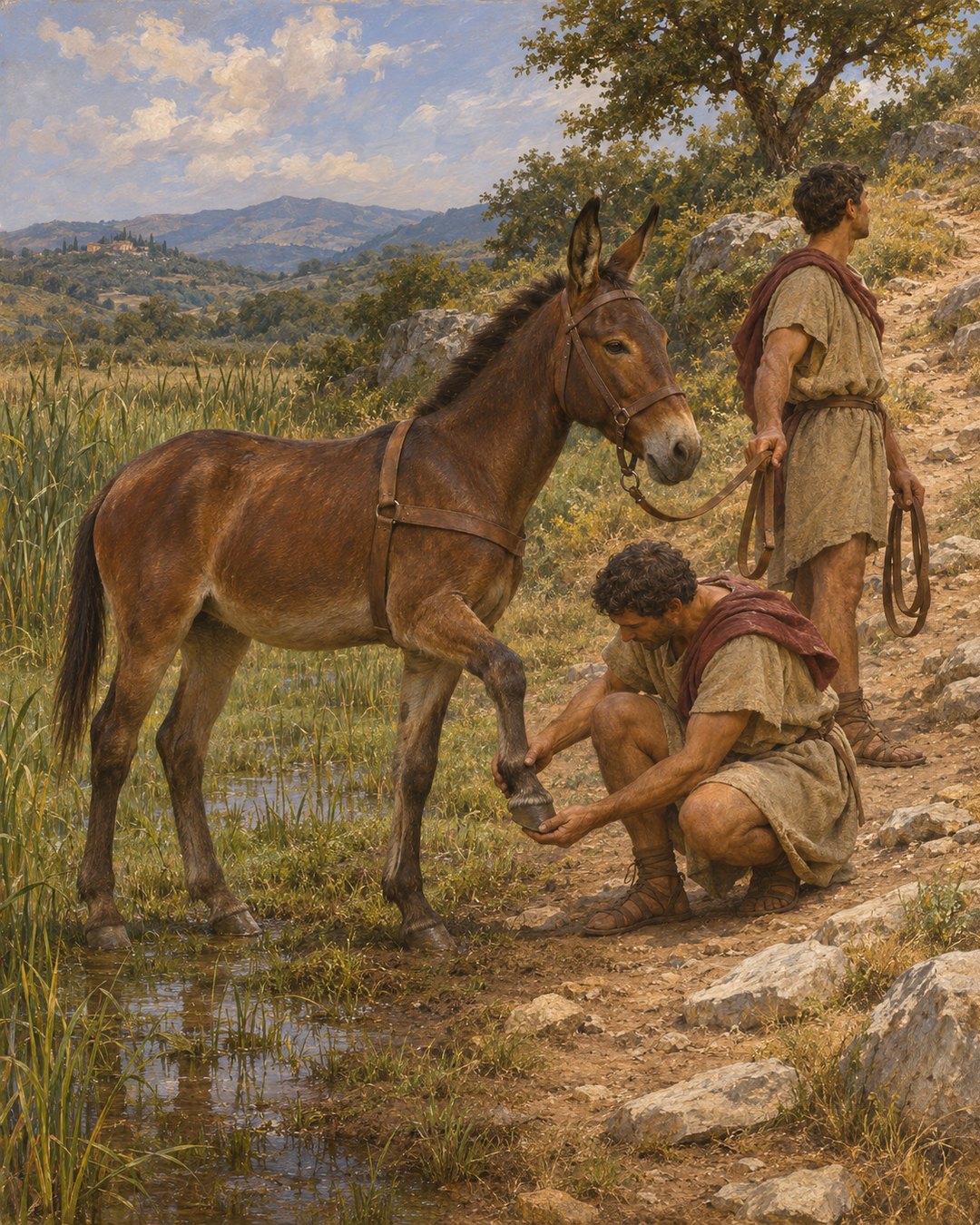
A mule foal born in marshy country carried its landscape in its feet. Varro says that young mules raised in swampy ground developed soft hooves. At Reate, the answer was movement: drive them into the mountains during summer, and their hooves would harden.
The instruction reduces a large husbandry system to one memorable contrast—wet lowland and stony height—but the surrounding passage shows how much planning supported it. Breeding jacks could cost tens of thousands of sesterces. Feed increased before breeding. A stud groom handled the male. Buyers later judged each mule’s age and shape against the work expected from it.
The mountain drive was therefore not a picturesque excursion. It was part of producing a durable working animal. A mule had to carry or pull, keep its footing and remain valuable after the breeder’s investment had become a buyer’s responsibility. Terrain was used as a training surface.
Reate Sold More than a Famous Name
Varro reports that Arcadian asses had once been celebrated, but knowledgeable men of his own day preferred the breed of Reate. A breeding jack from there might bring thirty or forty thousand sesterces. The price treated reproductive quality as capital: one animal could shape many future mules.
The buyer was told to choose the largest and most handsome jack available. Appearance was not the whole decision, because the sale also used stipulations and guarantees like those applied to horses. The breeder combined visible form, regional reputation and legal assurance.
Once purchased, the jack was fed chiefly on hay and barley. His ration increased during the breeding season, and a stud groom handled him. Those details keep the expensive animal from becoming a decorative status object. Value had to be converted into controlled breeding through food, timing and skilled labour.
Reate’s reputation also rested on an environment in which animals could move between different kinds of ground. Low, wet pasture produced one physical problem; summer mountain country supplied the proposed correction. The region offered not just breeding stock but a landscape used in finishing that stock.
Marsh Ground Left a Soft Hoof
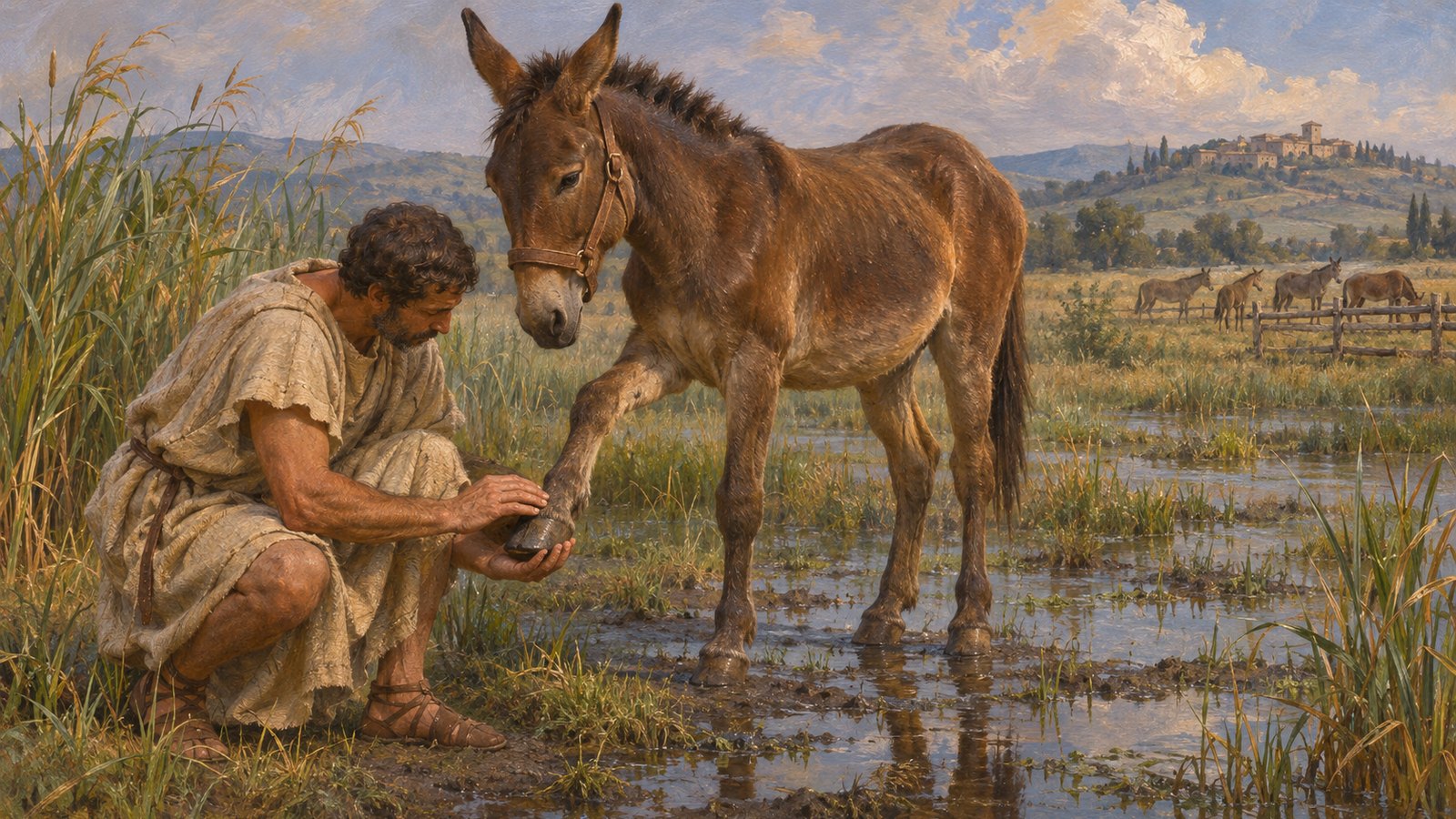
Varro’s statement begins after the foal is born: when a mare dropped a mule colt or filly, it was brought up with care. Foals from marshy or swampy country were said to have soft hooves. The observation connected the condition of the foot to the ground under it.
A hoof is the working boundary between animal and road. Softness mattered because the mature mule would be valued for labour under load. A weakness at that boundary could limit every other advantage produced by breeding, feeding and size.
The passage does not describe a hoof disease, prescribe a medicine or offer a numerical measure of hardness. It records a stockman’s environmental classification. Wet ground and soft feet belonged together in the practical memory of the Reatine breeder.
Roman infrastructure depended on this kind of attention to contact surfaces. Stone, timber, leather and animal tissue all met the road differently. The same practical world appears in the tension that kept a Roman wheel together. A wagon’s construction mattered, but its animals still had to survive each mile beneath the load.
Summer Turned the Mountain into a Training Yard
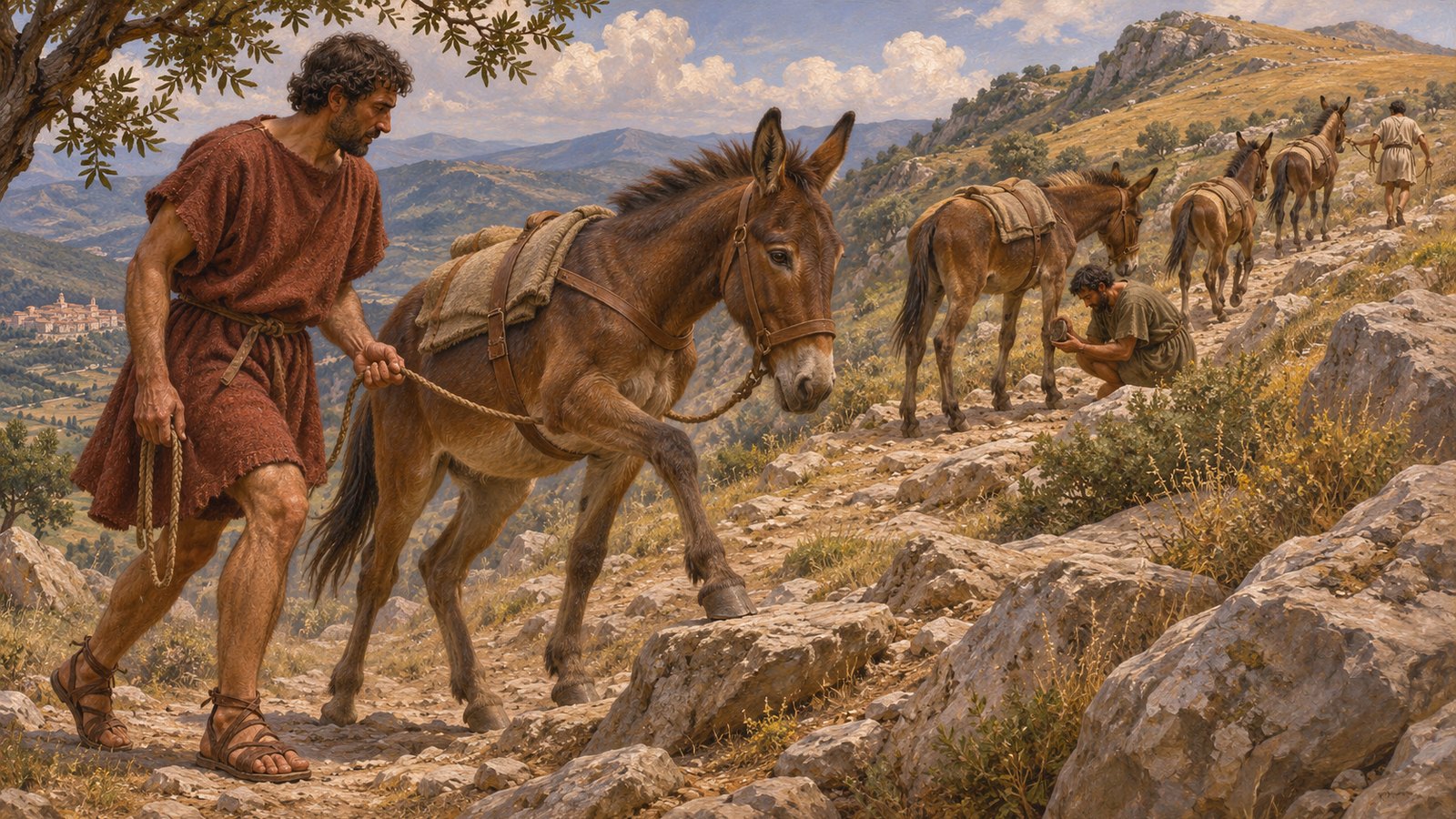
The corrective movement was seasonal. Varro says that at Reate the young mules were driven into the mountains in summer. There their hooves became hard. Time, terrain and repeated movement replaced a treatment applied inside the stable.
Summer made the contrast workable. The passage does not describe forcing newborn foals onto winter rock. It places the drive within a managed annual cycle, when upland movement could combine pasture with conditioning. The animals encountered firmer, rougher ground as part of ordinary husbandry.
The mountain acted gradually. Every step loaded the hoof and required the animal to balance on a surface unlike the marsh. Varro does not explain the biological mechanism, so it would be wrong to supply him with a modern veterinary theory. His claim is narrower: breeders observed the softness, changed the environment and expected a harder result.
The drive also required labour that disappears if the sentence is read only as a proverb. Someone selected the young animals, kept them together, guided them away from wet pasture and watched them on unfamiliar ground. Summer conditioning used shepherding skill as surely as breeding used the stud groom. Terrain could shape the hoof only because people put the foal in contact with it.
Nothing in the passage suggests that every marsh-born mule was discarded. The whole point was intervention. Softness identified a stage to manage, not a permanent verdict on the animal. The breeder had already invested in the mare, the jack, feed and handling; changing pasture protected that investment before a buyer tested the result.
That use of movement distinguishes conditioning from repair. The goal was not to wait until a working mule failed on the road. It was to shape the young animal before sale and heavy labour. The breeder tried to build resilience into the hoof through where the animal spent its summer.
Buyers Read Age and Conformation together
When mules reached the market, buyers considered age and conformation. Varro assigns a purpose to each judgment. Age indicated whether the animal could continue working under a load. Conformation mattered partly so that looking at the mule gave pleasure.
The second standard may sound superficial, but it shows that utility did not erase appearance. A costly team represented its owner while it worked. Symmetry, size and bearing could share the price with strength. The Roman buyer expected a good mule to be serviceable and satisfying to see.
Varro claims that two good mules could draw any kind of wagon on the road. The phrase praises the team rather than specifying a tested maximum. It nevertheless identifies the intended result of all the earlier care: animals whose combined power could be trusted in transport.
The road made hidden preparation visible. A soft hoof, poor match or weak animal could turn a journey into delay. A conditioned pair converted breeding and summer movement into reliable motion, just as mules and fixed transport budgets supported Roman administration on a larger scale.
A matched pair also multiplied the consequences of selection. The animals had to contribute together rather than merely look impressive one at a time. Age, condition and pace affected the team’s balance. The summer route through the mountains was one early step toward making separate young animals dependable partners in front of the same wagon.
A Hinny Revealed That Parentage Still Mattered
Varro closes this part of the discussion by distinguishing a hinny from a mule. The hinny came from a horse and a she-ass. He describes it as smaller and usually redder, with ears like a horse but the mane and tail of an ass.
Those traits turned parentage into something visible. The categories were not interchangeable simply because both animals combined horse and ass. Direction of breeding mattered, and stockmen expected different form from the result.
Varro also gives the hinny a twelve-month gestation and says its age could be judged by its teeth. Once again the animal was read through a set of bodily signs: colour, ears, mane, tail and dentition. Husbandry depended on making those signs answer commercial questions.
The mountain drive belongs to the same habit of close observation. Breeders noticed where a foal had been raised, inspected what that ground had produced, and altered the animal’s seasonal route. A Roman mule’s value was not fixed at birth. It was cultivated through feed, handling, terrain and time.
That is the practical force of Varro’s brief remark. Marsh and mountain were not just scenery around a rural estate. They were tools in a production system. The breeder used one landscape to raise the foal and another to prepare its feet for the road.
Sources
Varro, De Re Rustica 2.8.