
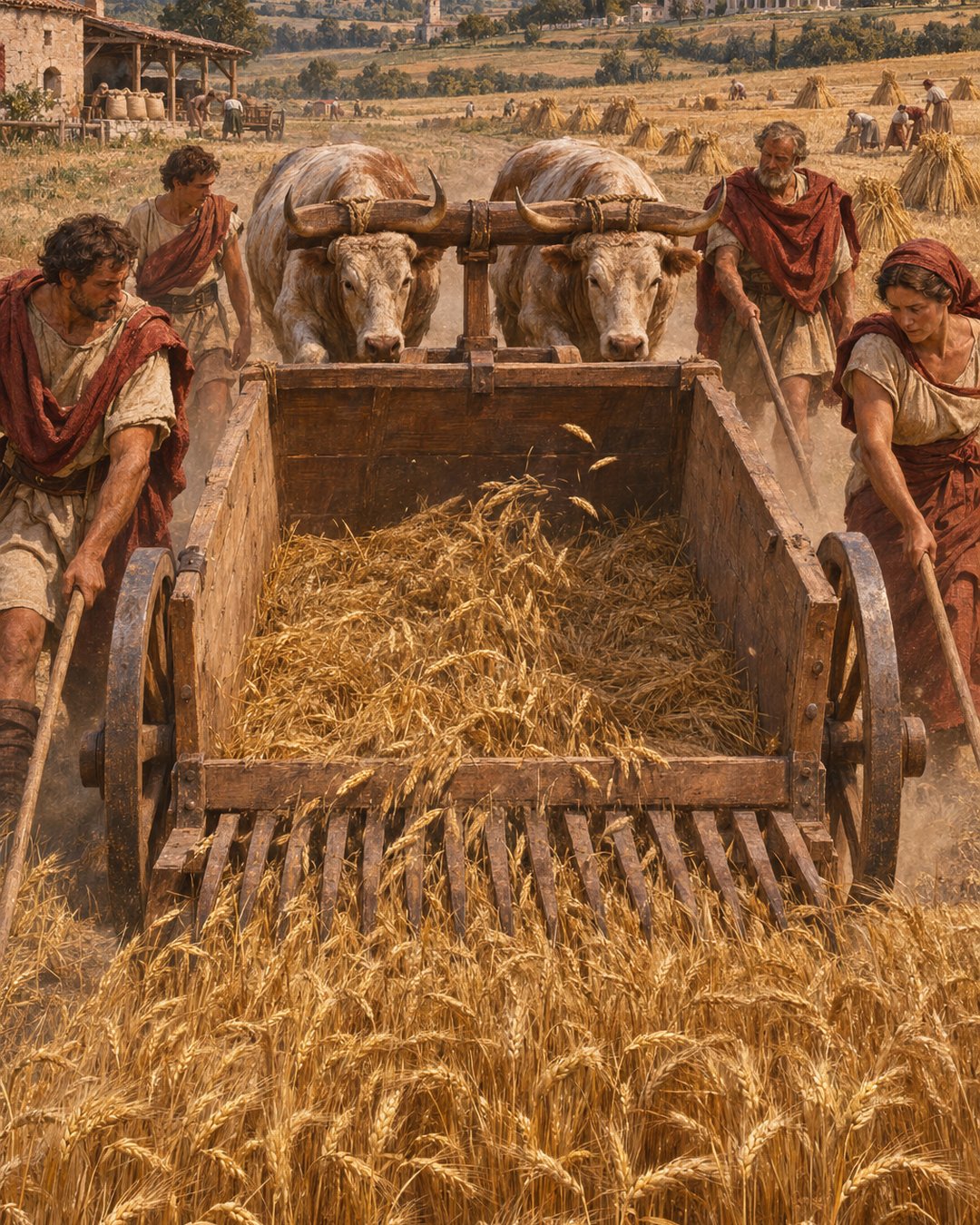
On a large estate in Roman Gaul, the animal did not pull the harvesting machine. It walked behind it.
Pliny the Elder describes a hollow frame on two wheels, armed with teeth and driven into standing grain. As the team advanced from the rear, the teeth stripped the ears and dropped them into the box. The arrangement sounds backwards only if we imagine every farm tool as a plough. Here the crop had to meet the working edge first, while the animal supplied pressure from behind.
The surviving paragraph is brief, but its mechanics are unusually clear. It also sits inside a catalogue of sharply different harvest systems. Pliny’s real subject was not a single Roman method. It was the way land, labour, straw, fodder and scale made different methods sensible in different places.
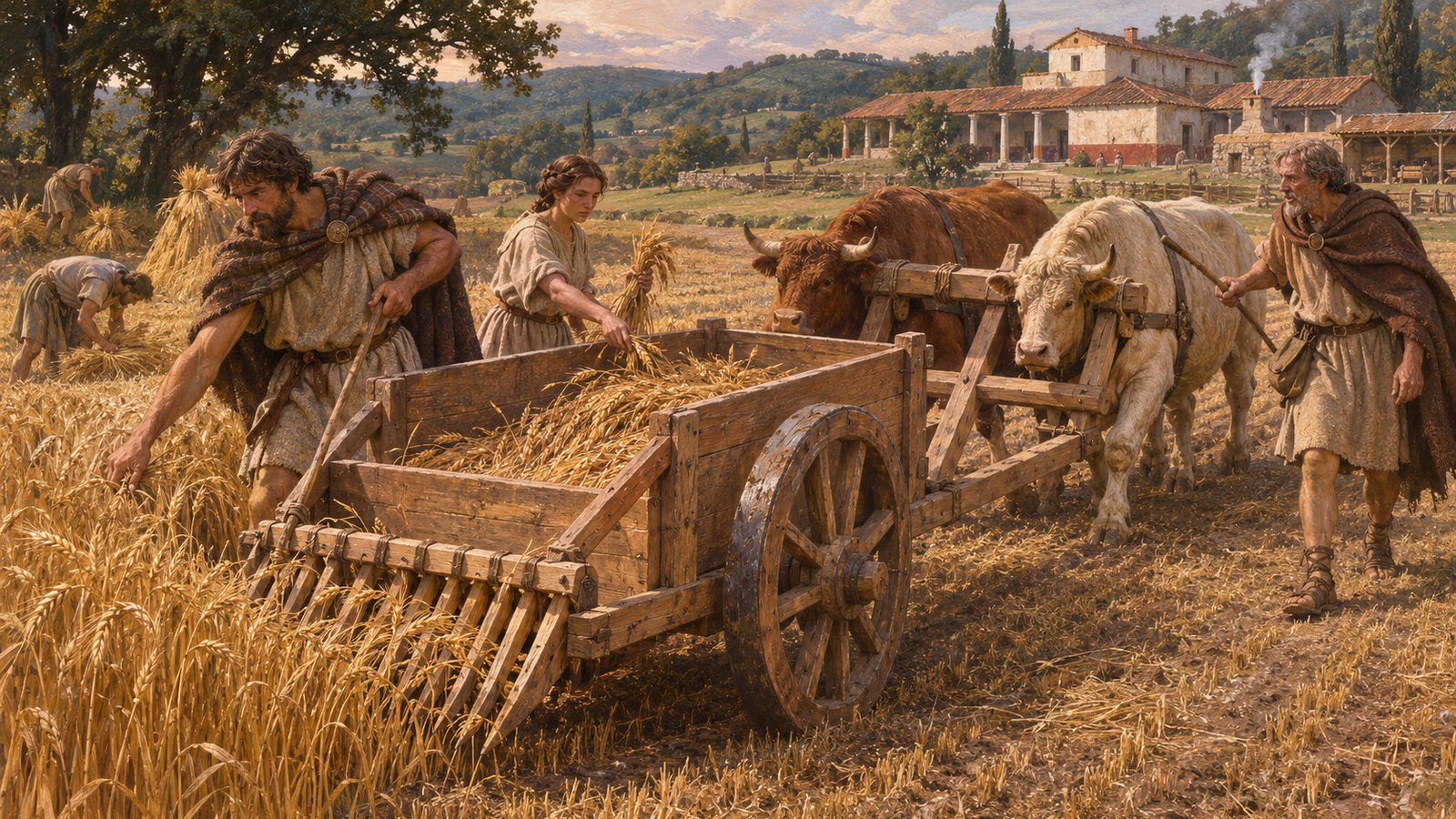
The teeth met the grain before the animal did
Pliny locates the wheeled frame on the vast properties of the Gallic provinces. He gives it three structural features: a hollow body, teeth and two wheels. He then supplies the detail that explains how they worked together. The beasts were yoked behind the device, which was driven through standing corn.
That position mattered. A team in front would enter the crop before the teeth and could trample or scatter what the frame was meant to collect. A team behind could push the teeth into the ears while the box occupied the cleanest path through the stalks. The ears were torn free and fell directly inside. Cutting the full stalk was not the immediate task.
The source does not provide dimensions, construction timber, tooth spacing, operating speed or the number of animals. Those gaps should remain gaps. A vivid reconstruction can show a broad wooden box moving through grain, but it should not turn one paragraph into a technical drawing. What Pliny securely preserves is the relationship among teeth, wheels, crop, container and rear-yoked draft power.
That relationship separates the machine from the threshing systems that separated grain after cutting. The Gallic frame began the harvest by taking ears from standing plants. Later processing still remained. It changed the first movement in the chain.
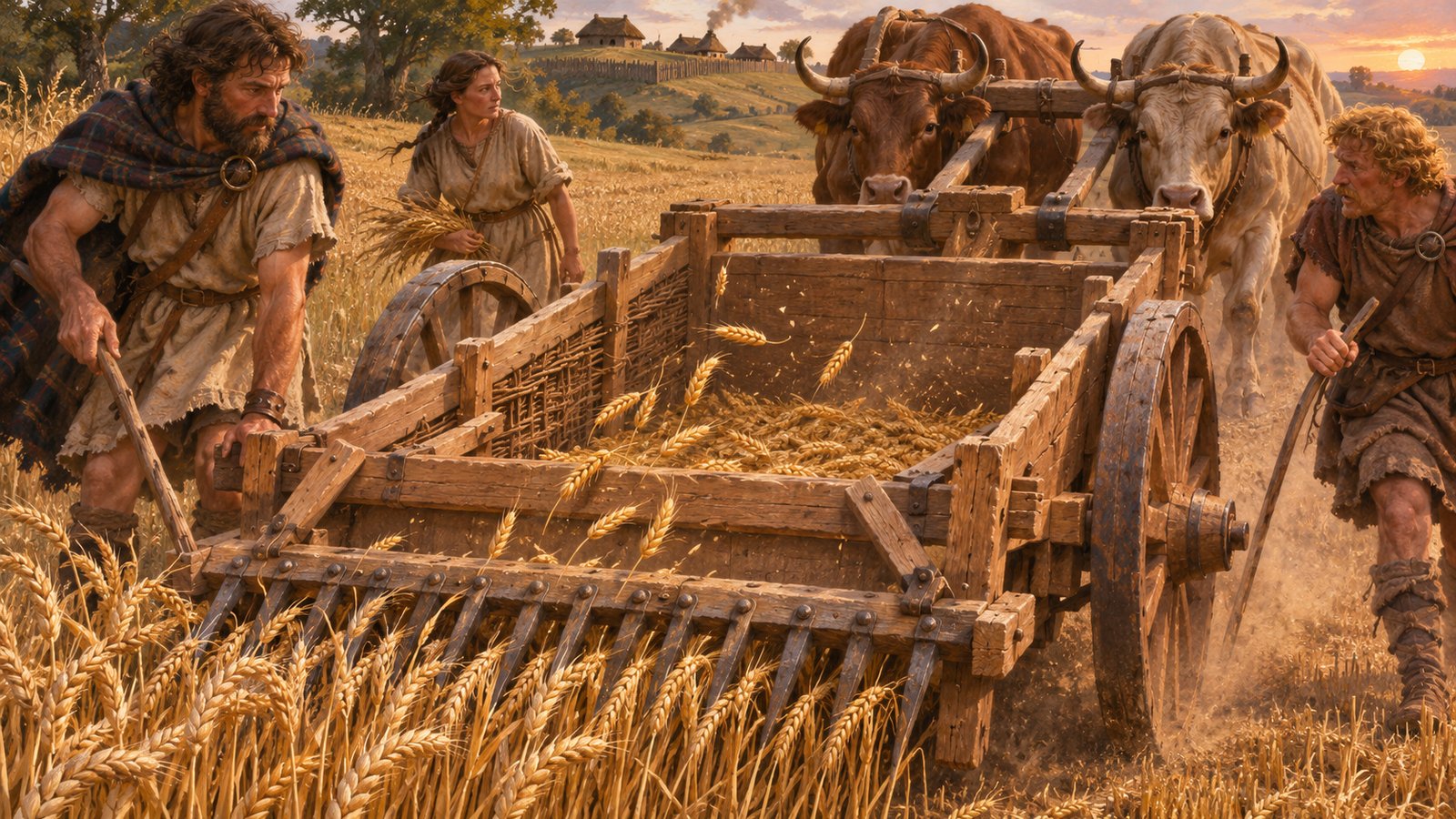
A hollow frame replaced several hand movements
Elsewhere in Pliny’s survey, workers cut stalks midway with sickles and then separated the ears with tools he describes as paddle-forks. In other places they pulled plants up by the roots. Each method required hands to grip, cut, lift or sort individual portions of the crop.
The wheeled frame combined movement and collection. Its teeth performed the stripping action as the box crossed the field, and its hollow body received what came off. The worker still had to guide the operation, manage animals and unload the gathered ears, but the repetitive encounter with each stand of grain shifted from a hand-held blade to a moving edge.
This was not automation in a modern sense. Animals, drivers and field conditions still governed every pass. Nor does Pliny say that it was universal even in Gaul. He ties it to very large domains. Scale is part of the evidence, not background decoration. A broad device becomes more useful when long runs of crop justify turning, guiding and unloading it.
The machine also implies selectivity. It gathered ears rather than the longest possible straw. That could be an advantage or a cost depending on what a farm needed after harvest. Pliny’s catalogue repeatedly returns to those secondary uses, because a field produced building material, bedding and animal feed as well as grain.
Straw could decide which harvest made sense
Some communities kept long stalks because roofs needed thatch. Where hay was scarce, straw became litter. Barley straw was valued as food for oxen, while Pliny says other kinds might be burned or treated differently. A method that saved labour at the ear could be less attractive if it left a household without the stalk length it required.
This makes the Gallic machine more interesting than a simple story of technological progress. It solved one problem inside a web of other needs. The best harvest was not automatically the one that removed grain fastest. It was the one that delivered the desired combination of ears, straw and residue at a tolerable labour cost.
Roman farm writing often makes this accounting visible. The logic also appears in Cato’s concern with tools, stores and losses on a working estate. Implements belonged to a managed system. Their value came from fitting fields, workers, animals and later tasks.
Pliny even notes that Gallic workers gathered panic and millet ear by ear with a hand-held comb. The same broad region could therefore support a large wheeled collector and a small tool carried in one hand. Crop form and local purpose mattered more than a neat ladder from primitive to advanced.
Labour price stood beside field size
At the end of the chapter, Pliny names two forces behind harvest diversity: the extent of the crop and the price of labour. That sentence gives the wheeled frame an economic setting. Large acreage multiplied repeated hand movements. Expensive or scarce labour increased the value of transferring some of those movements to animal power and a toothed box.
The machine did not eliminate labour. It reorganized it. Someone had to build and maintain the frame, hitch and control the team, choose a workable path, prevent loss at turns, clear jams and move the collected ears onward. Specialized work could replace a larger quantity of cutting and carrying.
Field shape probably affected operation, although Pliny does not discuss it and no exact claim should be invented. His wording only allows a cautious inference: a two-wheeled frame driven through standing crop needed room to move. The association with vast domains is therefore both economic and physical.
Pliny’s comparison with sickles, root-pulling, hand combs, mares and flails prevents us from treating “Roman harvesting” as one fixed procedure. The empire joined environments with different crops, estate sizes and labour markets. Agricultural knowledge consisted partly in recognizing that variation.
The machine survives as a set of relationships
No instruction manual accompanies Pliny’s frame. What survives is more modest and, in one respect, more useful: a compact account of what the parts did. Teeth entered standing grain. Wheels carried a hollow body. Ears detached and fell inside. Animals behind supplied the motion.
Those relationships should control any reconstruction. The animals must not appear in front like a normal plough team. The teeth must meet standing ears rather than churn already cut sheaves. The box must be able to receive the crop instead of serving as a decorative cart. A scene that misses those points may look Roman while reversing the ancient mechanism.
Pliny was not praising Gaul as the inventor of a universal future. He was showing why harvests differed. Two days too late could harden grain; straw might be needed for a roof; barley residue might feed oxen; a huge estate might make hand cutting costly. The wheeled frame belonged to that practical arithmetic.
Its strangest feature is therefore its most revealing. Putting the animal behind the blades was not an eccentric reversal. It aligned power, crop and container in the order the task required.
The comparison also protects us from a familiar mistake: treating the most machine-like method as the only one worth noticing. Pliny placed it beside sickles, forks, hand combs, root-pulling, trampling and flails because each answered a different combination of crop and circumstance. The large Gallic frame is evidence for ingenuity, but so is the choice to preserve a long stalk for thatch or barley straw for oxen. Technique included choosing what not to mechanize.
For the people in the field, the distinction was immediate. One method filled hands with cut stalks; another sent mares across a threshing floor; this one made a toothed box advance before its team. The Roman harvest was not one timeless tableau. It was a sequence of local decisions, and the rear-yoked harvester makes that diversity impossible to overlook.
Sources
Pliny the Elder, Natural History 18.72