
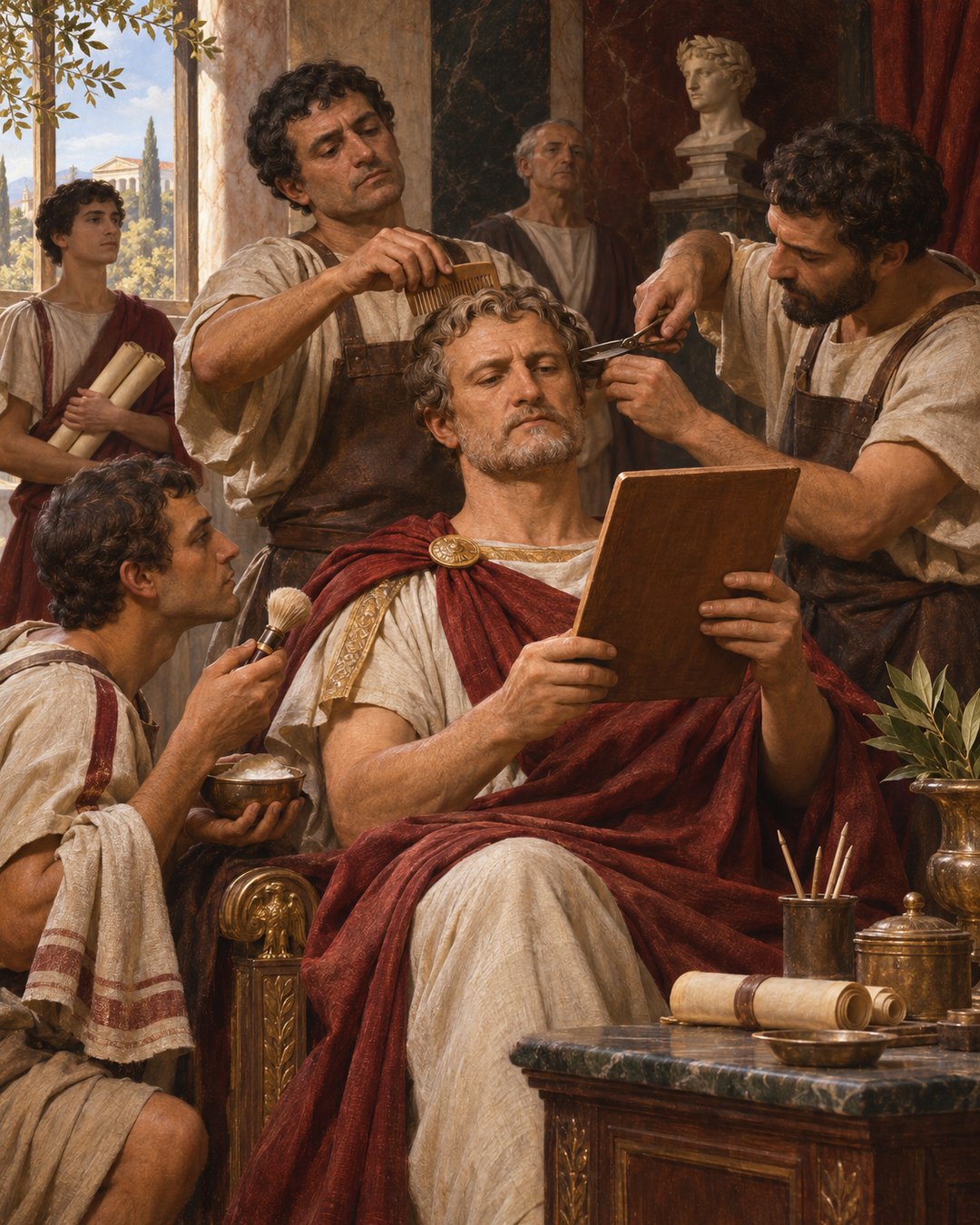
Augustus did not stop working when the barbers arrived.
Suetonius says several of them arranged the emperor’s hair at the same time because the job was done in haste. His beard might be clipped or shaved, and while hands and blades moved around his head, Augustus read or wrote. The scene is intimate, practical and slightly precarious. It also compresses the public image of Rome’s first emperor into a workshop of time.
The biographer surrounds this grooming detail with a physical portrait: calm expression, carefully noticed eyes, slightly curling hair, joined brows, small ears and an aquiline nose. Yet the barber scene prevents the portrait from becoming a motionless bust. Augustus’s appearance was maintained while attention remained fixed on documents.
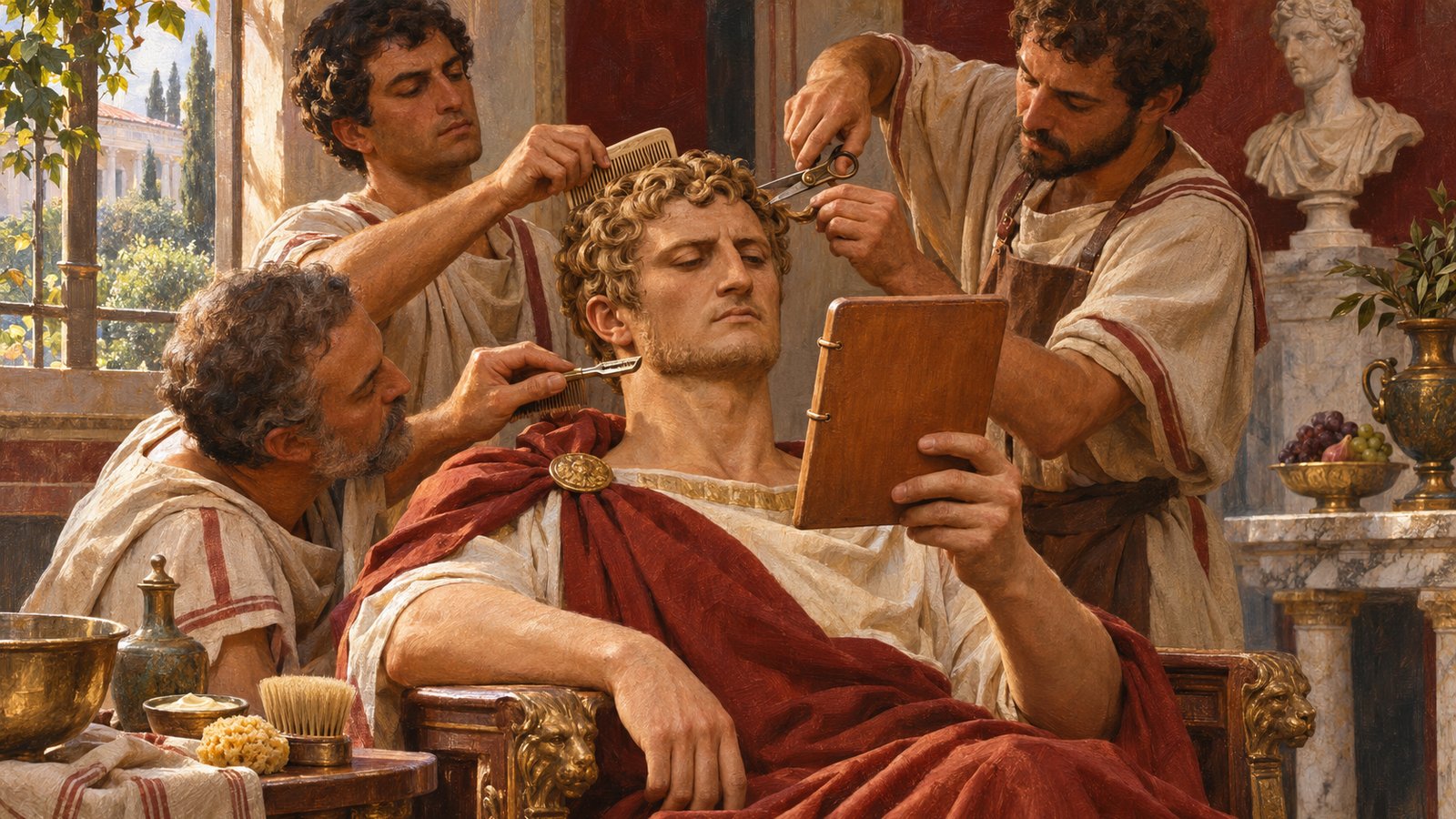
Several barbers turned grooming into a timed operation
Suetonius calls Augustus careless about dressing his hair. The phrase does not mean that nobody attended to it. It means the process was hurried. Several barbers worked at once, an arrangement that converted personal grooming into a coordinated task.
More hands could shorten the interval, but they also required control. One person working near a temple, another arranging locks and another attending to the opposite side would need to avoid collision. The source does not tell us their exact positions or tools, so a reconstruction should not pretend to know a choreography. It should show the basic constraint: multiple workers close to one seated head.
The beard added another decision. Augustus sometimes had it clipped and sometimes shaved. Suetonius does not give a calendar or explain why one treatment was chosen over the other. The variation is useful because it shows grooming as repeated maintenance rather than one fixed ceremonial look.
Nothing in the passage suggests that Augustus considered the session leisure. The haste is explicit. So is the fact that he kept reading or writing. The barbers were folded into a working interval rather than granted exclusive possession of the emperor’s attention.
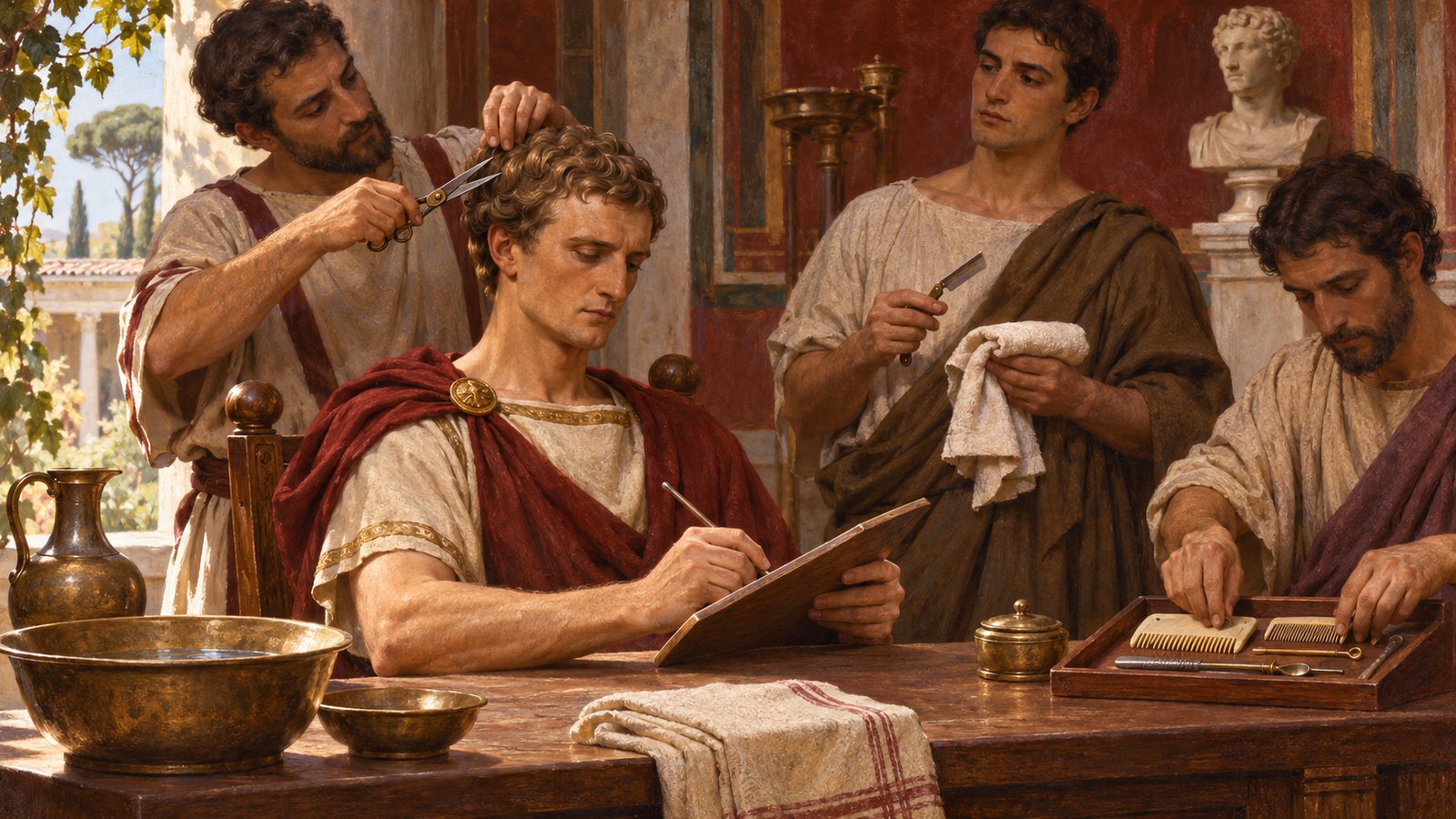
A document occupied the emperor’s eyes and hands
Reading while hair was being arranged required relative stillness, light and a surface or object that could be held within view. Writing demanded even more: a stable hand while workers touched the head and face. Suetonius gives no document type, and it would be unsafe to decide that Augustus was signing decrees, composing letters or editing a speech in this particular scene.
The point is the overlap itself. Grooming and literacy happened together. Court labour made that possible. Barbers accepted the awkwardness of a client whose attention was elsewhere, while attendants could supply writing materials or texts, though Suetonius does not describe them here.
This use of small intervals fits the wider picture of imperial information work. Augustus depended on written communication, memoranda and prepared words, but the barber anecdote reduces that system to a body in a chair. Authority did not float above daily maintenance. It had hair to cut and a beard to manage.
The scene can be read beside Augustus’s effort to organize the Senate’s meeting calendar. In both cases, time became something arranged. One reform structured institutional attendance; the other let private maintenance occupy the same minutes as reading or writing.
The calm face was part of Suetonius’s portrait
After describing the barbers, Suetonius lingers on Augustus’s expression. Whether speaking or silent, his face appeared calm and serene. The biographer tells a dramatic anecdote about a prominent Gaul whose hostile intention supposedly dissolved when he approached Augustus and saw him. The story flatters the power of presence, and it should be treated as biography’s character-making rather than measured evidence.
The eyes receive even more attention. They were bright and penetrating, and Augustus liked others to imagine divine force in them. He reportedly enjoyed seeing people lower their faces under his steady look as though facing sunlight. The comparison presents a ruler actively cultivating the effect attributed to his body.
That makes the barber scene sharper. The gaze that subjects were expected to find overwhelming could, in private, be directed at a page while several workers adjusted the hair around it. Public charisma and ordinary upkeep occupied the same head.
Another Lost Eagles article follows the changing images on Augustus’s seal rings. Those devices projected authority through selected symbols. Suetonius’s physical portrait does similar work in prose, but the hurried haircut introduces friction between image and routine.
Proportion concealed what comparison revealed
Suetonius inventories features with the confidence of an author building a recognizable figure. Augustus’s hair curled slightly and inclined toward yellow. His brows met. His ears were small, his nose aquiline and his teeth small, unevenly spaced and rough in appearance. The list brings the reader close enough to inspect rather than merely admire.
Height becomes a problem of comparison. Suetonius calls Augustus low in stature while citing the freedman Julius Marathus for a specific figure rendered as five feet nine inches in this translation. Ancient and modern units should not be collapsed casually, and the biographer’s main observation is visual: good bodily proportion concealed shortness until a taller person stood nearby.
That observation matches the portrait’s broader method. An emperor could appear different depending on setting, distance and comparison. Seated among barbers, he was the fixed centre of coordinated labour. Standing beside a taller man, a trait normally hidden by proportion became visible.
Suetonius also records deterioration with age, including weakened sight in the left eye. The portrait is not a timeless official statue. It allows the body to change. Hair, beard, vision and scale all resist the permanent perfection claimed by idealized images.
Haste reveals the household behind the ruler
The several barbers are unnamed. That anonymity is normal in elite biography, which preserves the ruler’s habits more readily than the workers’ identities. Yet the scene cannot function without their skill. They had to work quickly, close together and around a client engaged in another task.
Their labour belonged to the imperial household’s management of access and time. A barber came physically closer to Augustus than most senators ever would. That proximity did not confer political equality, but it required trust and practiced routine, especially when a blade approached the face.
We should not romanticize the scene as cheerful teamwork. Suetonius says nothing about the workers’ legal status, compensation or feelings. Some may have been enslaved or freed members of a household, but the passage does not identify them. The secure claim is simply that several barbers performed the task simultaneously.
That narrow fact changes the scale of the portrait. Augustus’s famous gaze depended on eyelids, age and eyesight. His recognizable hair depended on hurried hands. His documents occupied minutes shared with personal care. The emperor appears neither ordinary nor superhuman, but supported by a household capable of making two activities fit into one interval.
A still statue cannot show that arrangement. Suetonius can. Several workers gather around, a page stays open, and the most powerful man in Rome refuses to give his haircut the whole of his time.
The anecdote also warns against reading efficiency as simplicity. Combining tasks required more people, not fewer. The emperor saved an interval because several workers absorbed the difficulty of acting quickly around him. His concentrated attention rested on distributed labour: someone managed hair, someone handled the beard, and the written object remained available to read or mark.
Suetonius does not praise that arrangement as a management lesson. He offers it as character. Augustus cared little enough about grooming to hurry it, yet enough work still surrounded the appearance of the ruler. The contradiction is the point. Public calm, recognizable hair and relentless paperwork could coexist because a household turned personal maintenance into a coordinated operation.
Sources
Suetonius, Life of Augustus, physical portrait section (Perseus edition chapter 77)