
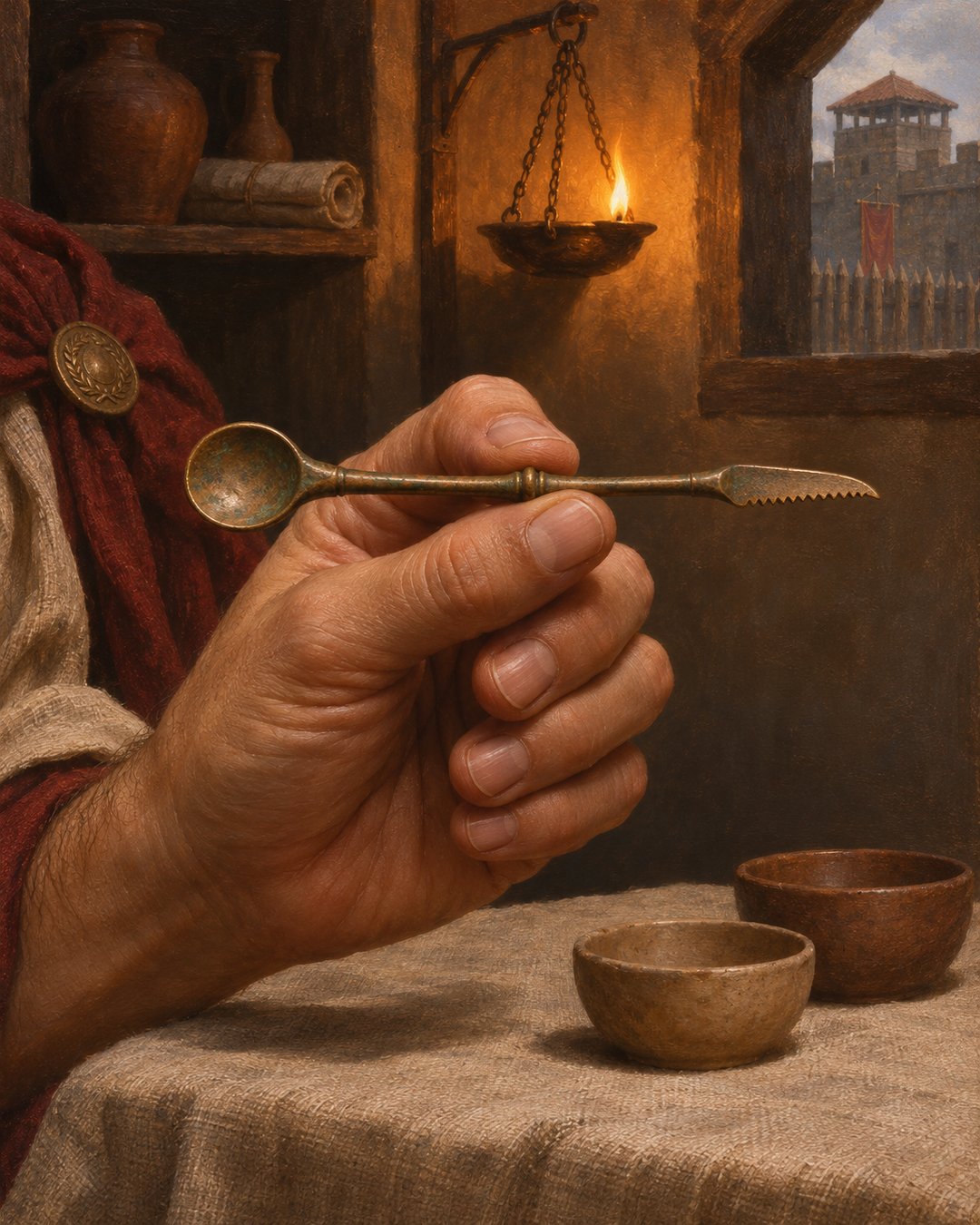
The copper-alloy object is only 103 millimetres long. One end is shaped like a small saw-edged knife. The other opens into a spoon bowl 19 millimetres across.
London Museum catalogues it as an implement or tool and says it was likely surgical. Yet the same record preserves a warning from Roman medical specialist Ralph Jackson: its medical status is uncertain.
That qualification makes the object more informative, not less. The two ends are real, measured and deliberately joined. What remains open is the exact task that made this combination worth carrying.
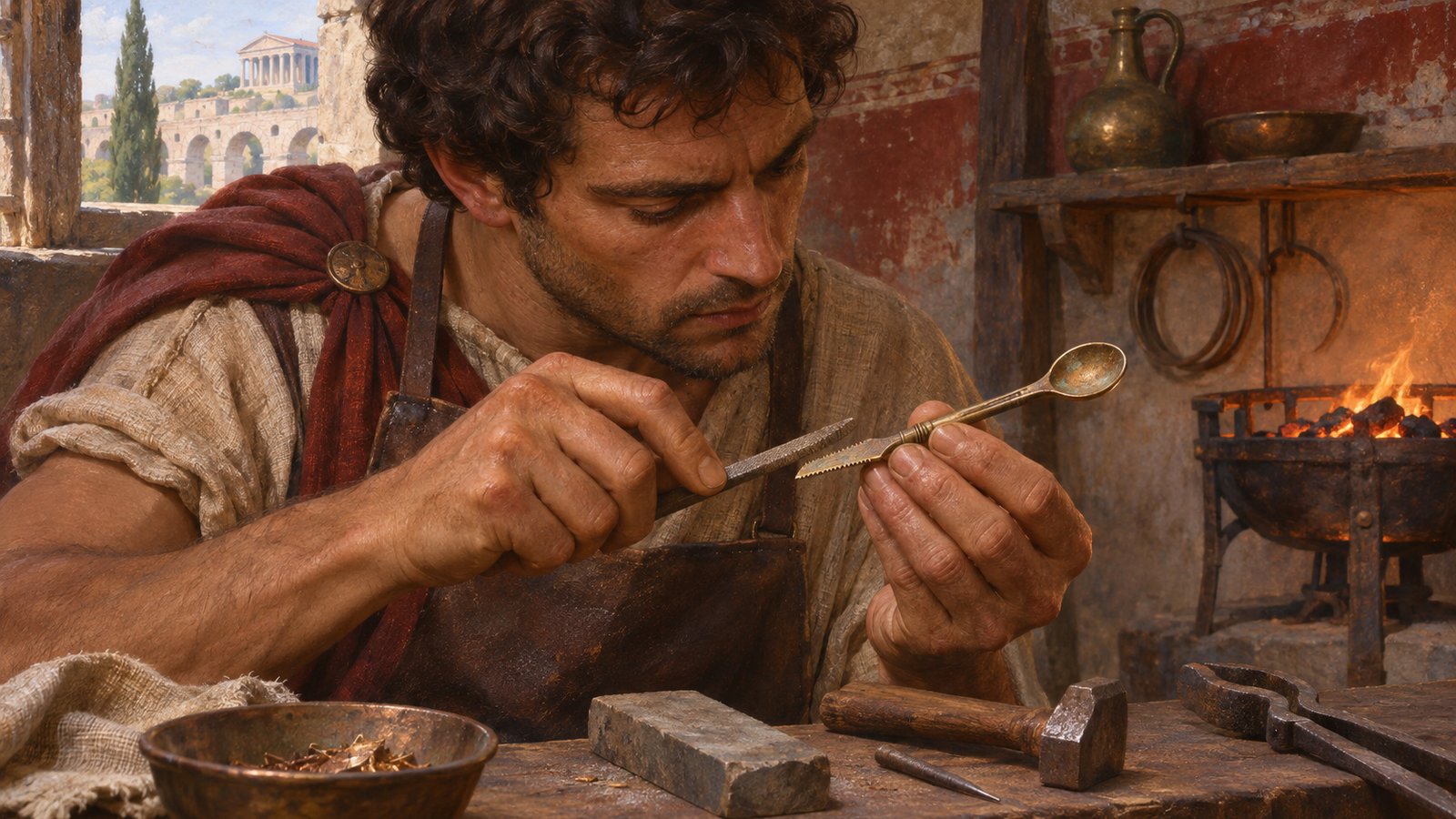
A Spoon and Saw-Knife Shared Ten Centimetres of Metal
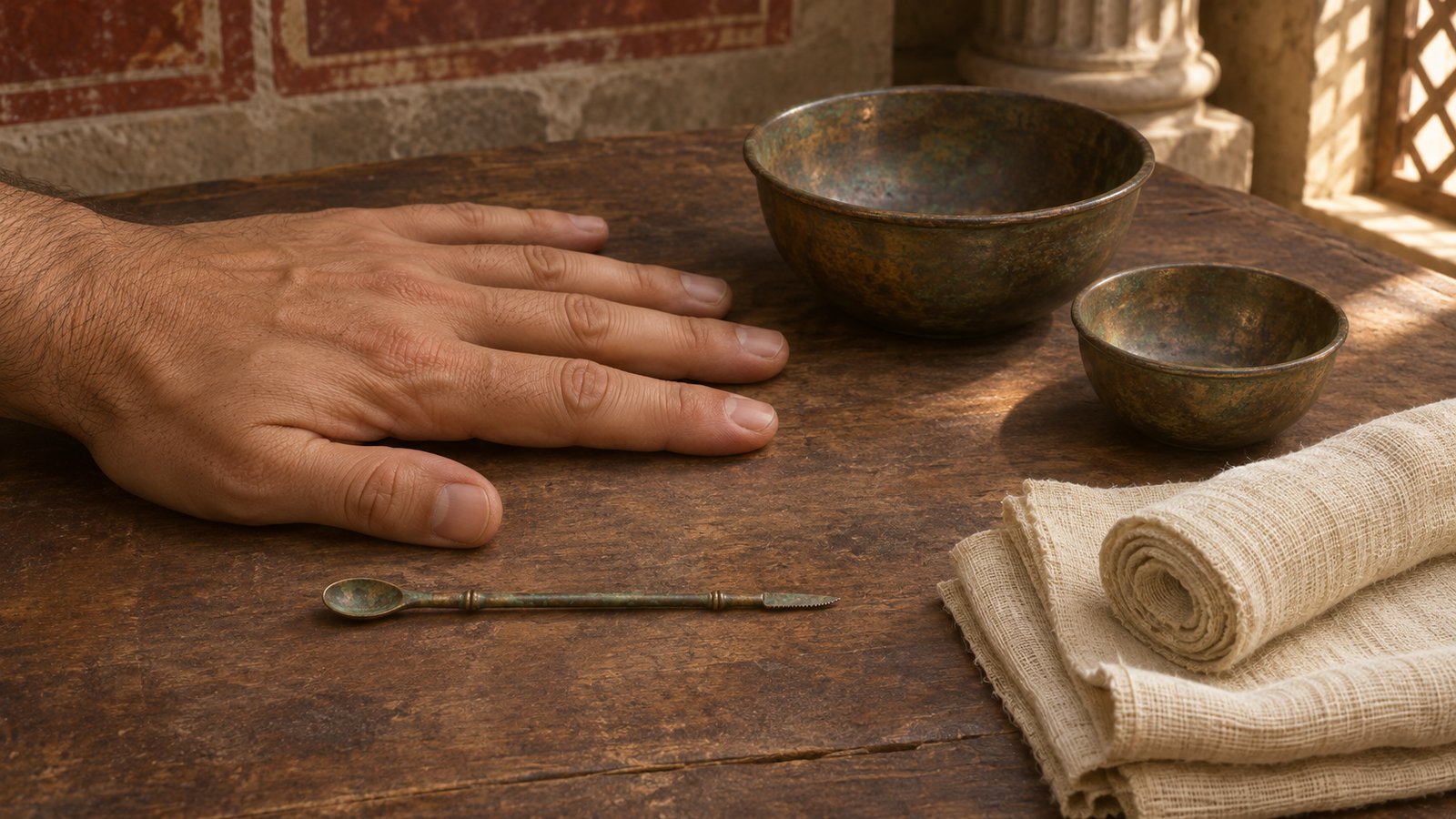
At 103 millimetres overall, the tool fits within the span of a hand. Its spoon bowl accounts for 19 millimetres of width, leaving the rest of the object to connect that rounded working end with the narrow saw-like knife.
The compact scale matters. This was not a kitchen ladle joined to a carpenter’s saw. The museum’s description uses diminutives implied by the measurements: a small saw-like knife and a spoon that would hold only a modest quantity.
Combining them removed the need for two separate handles. Turn the object one way and the bowl could scoop, carry or present material. Reverse it and the toothed or saw-like edge could cut, scrape or work against something firmer.
The two ends also imposed a design constraint. A separate spoon can finish in any handle comfortable for scooping, while a separate knife can be balanced around its blade. This object needed a central body that served both directions. The bowl could not be so deep that it made the cutting end awkward to hold, and the knife could not be so long that it overwhelmed a tool only 103 millimetres from end to end.
Those verbs describe possibilities of form, not a recovered instruction manual. No inscription survives to name the user. The tool’s design proves that two different actions were meant to remain close together; it does not by itself prove the exact sequence in which they occurred.
The object therefore asks a practical question. What activity required a small amount of material at one moment and a controlled cutting edge at the next? Medicine is one plausible answer because Roman medical kits often joined specialised shapes to compact handles. The catalogue carefully stops before turning plausibility into certainty.
The Museum Keeps “Likely Surgical” Beside “Uncertain”
The collection record describes the implement as likely to be a surgical tool. It also cites Jackson’s 2008 study, Imagining Health-Care in Roman London, which calls it an “object of uncertain medical status” and a combined saw-knife and spoon.
The attribution matters because it identifies the source of caution. The uncertainty is not a vague disclaimer added because the catalogue lacks detail. It comes from a specialist considering health-care objects in Roman London and declining to place this form securely inside medicine. The record preserves both the proposed context and the reason not to overstate it.
Those statements are not contradictory. “Likely” ranks an interpretation; “uncertain” defines its limit. The pairing of a cutting edge and spoon can fit medical work, but the form alone does not identify a named operation, practitioner or patient.
That distinction is essential when an unusual object looks more specialised than it can be documented. A dramatic label such as “surgical saw” would invite a vivid scene, but the museum does not say that this implement cut bone or performed any particular procedure. Its wording remains broader: saw-like knife.
The caution differs from the evidence behind the Roman surgical hook whose shape matches a described intervention. There, a hooked point and ancient procedural context can be compared more tightly. Here, the double-ended design supports a medical possibility without closing other craft uses.
Uncertainty is therefore part of the provenance. It records the distance between surviving metal and lost practice. The tool can be classified by material, dimensions and shape while its occupational home remains provisional.
The Nineteen-Millimetre Bowl Set the Scale of the Task
The spoon end is measured at 19 millimetres in diameter. That number makes the tool’s limits visible. The bowl was suited to a small quantity, not bulk transfer. Whatever it carried had to fit within a circle narrower than two centimetres.
Set against the 103-millimetre overall length, the bowl occupies less than one fifth of the tool’s long dimension. It is large enough to be a deliberate working surface but small enough to leave room for a connecting body and the opposite knife. The two measurements describe a compact instrument rather than two full-sized utensils awkwardly attached together.
A small bowl could handle powder, paste, liquid or tiny fragments, but the record does not identify residue. It is safer to read capacity before contents. The implement was built for controlled amounts.
The opposite end adds a different kind of control. A saw-like knife multiplies contact along an edge instead of concentrating it at one smooth point. Its presence suggests that the object was designed not merely to transport material, but also to alter, separate or scrape something.
Both ends reward close handling. A user had to orient a ten-centimetre implement, keep the inactive end clear and apply pressure without losing the contents or damaging the edge. The shared shaft made one end the temporary handle for the other.
This reversible logic can be compared with Roman folding knives that stored a blade inside a shaped handle. The folding knives solved portability by movement. This implement solved it by placing two fixed working forms at opposite ends.
Copper alloy also made the entire outline legible in one surviving object. The museum does not describe separate organic grips or attachments. What remains is enough to show that the spoon and saw-knife belonged to the same design rather than becoming associated after burial.
A Low Record Quality Still Preserves Hard Measurements
London Museum assigns the record a quality figure of 40 percent. That administrative measure should not be confused with a claim that 40 percent of the object survives or that the identification is 40 percent true. It signals that the catalogue entry itself has limits.
The distinction protects two kinds of evidence from being blurred. Catalogue completeness concerns how much documentation has been entered. Object survival concerns the metal itself. Interpretation concerns what that form once did. A low record-quality figure can coexist with exact dimensions and a complete description of both ends, while the function remains debated for entirely different reasons.
Within those limits, several facts are firm. The implement belongs to the Roman category. It is copper alloy. It measures 103 millimetres long. The bowl measures 19 millimetres across. One terminal is spoon-shaped; the other resembles a small saw-like knife.
The permanent collection also keeps the interpretive history visible. The catalogue does not silently upgrade Jackson’s uncertainty into certainty. It places the likely surgical reading beside the specialist’s cautious phrase.
This is valuable because archaeological labels can harden with repetition. Once an object is called medical, later viewers may imagine a complete clinic around it. Returning to the description restores proportion: compact double-ended tool, plausible surgical association, exact operation unknown.
The surviving form still tells a story of economy. Roman craftworkers made one short implement perform at least two distinct mechanical actions. A small bowl and a saw-like edge were kept one turn of the wrist apart.
Its most honest name may therefore be the museum’s plainest one: implement. The word leaves room for what is measured, what is inferred and what has disappeared. The copper alloy preserves the combination; responsible interpretation preserves the question.
Sources
London Museum, “Implement” collection record; Ralph Jackson, Imagining Health-Care in Roman London (2008), as cited by the museum.