
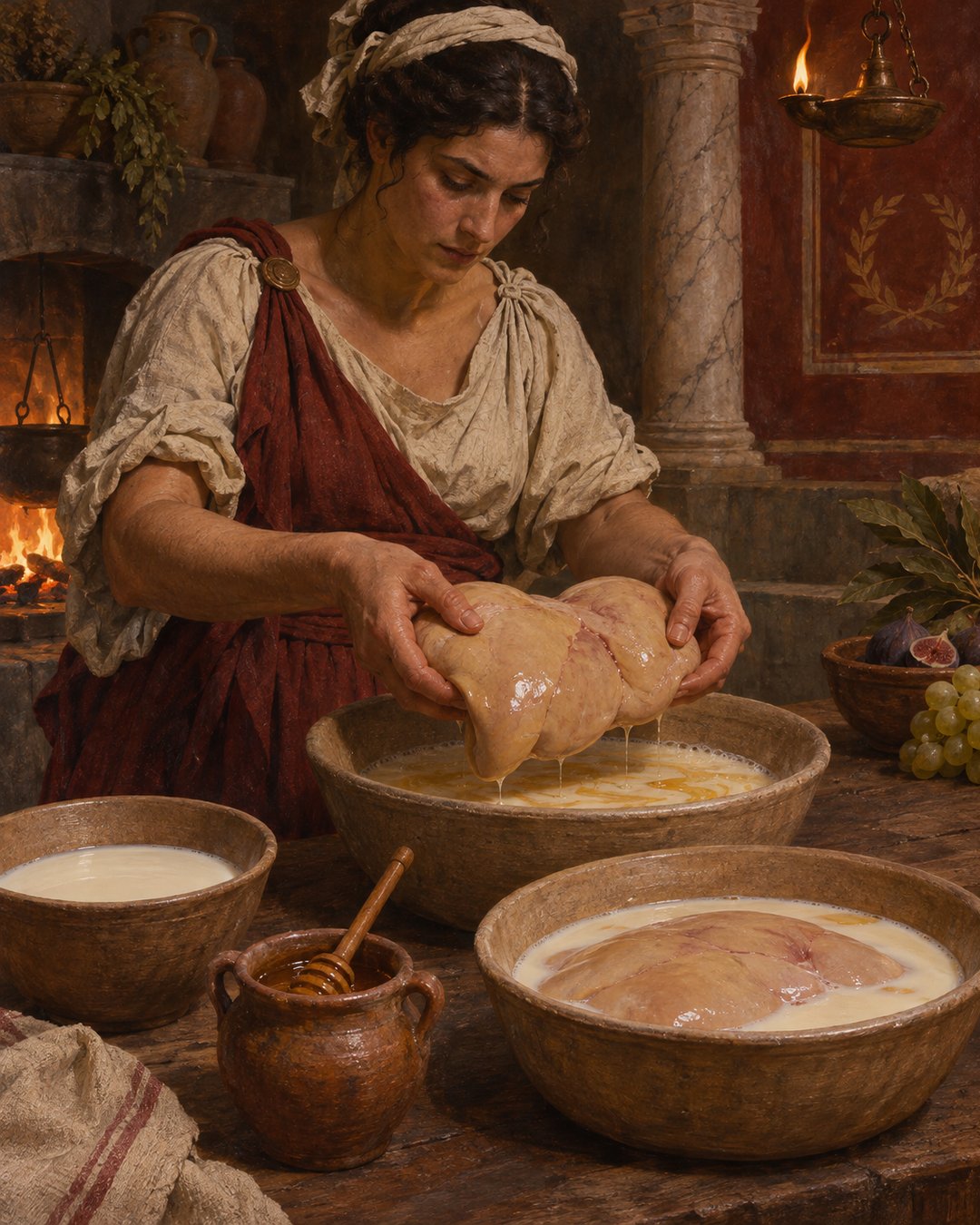
Pliny the Elder describes a luxury ingredient that did not reach its final size when the bird died. First, a goose was stuffed with food until its liver grew unusually large. Then the organ was removed and soaked in milk sweetened with honey, which Pliny says made it larger again. The recipe is short, but its sequence exposes a deliberate Roman process: growth was engineered in the living bird and then extended at the kitchen bench.
The passage is not a neutral modern description of animal husbandry. Pliny calls the enlarged liver an excellence and treats its invention as a cultural achievement. He even asks which elite Roman should receive credit. That tone belongs to a society in which rarity, labour and excess could turn food into reputation. Yet behind the boast lies a chain of practical decisions involving feed, timing, slaughter, soaking and service.
The Ingredient Began Before the Kitchen
Pliny’s first operation was stuffing the goose with food. The aim was not simply to fatten the whole bird. He names the liver as the desired result and says forced feeding made it grow to a great size. The ingredient was therefore manufactured through the animal’s body before a cook could season it. Husbandry and cuisine were parts of one production line.
This matters because Roman luxury food is often imagined only at the dining couch, after the labour has disappeared. Pliny’s sentence puts the labour back. Someone had to obtain the birds, confine or handle them, supply repeated food, recognise when the liver had enlarged, and coordinate the killing with the meal or preservation process. A grand dish began in repetitive work far from the guest.
Geese already carried a different kind of Roman fame. The story of the birds that warned the Capitol made them guardians in civic memory, a tradition explored in the geese that woke Manlius during the Gallic attack. Pliny’s kitchen passage turns the same species into material for controlled abundance. Sacred memory and appetite could attach themselves to the same bird without cancelling each other.
Feeding Made Size a Designed Quality
The phrase “stuffing the bird with food” is brutally direct. Pliny presents enlargement as the expected mechanical consequence of excess feeding. Size was not a lucky discovery inside an ordinary carcass; it was a quality pursued in advance. The cook’s desired texture and prestige reached backward into how the animal was kept.
Pliny does not provide a feed schedule, vessel design or number of days in this short section. We should not fill those gaps with later practice and call it Roman evidence. What the text securely supplies is the causal sequence: intensive feeding, a greatly enlarged liver, removal, then another treatment. That is already enough to show planned transformation rather than accidental consumption.
The attraction of the result was inseparable from visible excess. An organ larger than expected could be displayed, divided and discussed. Roman elite cuisine repeatedly converted biological limits into talking points. The extraordinary size announced that ordinary feeding, ordinary expense and ordinary patience had been exceeded.
Milk and Honey Continued the Enlargement
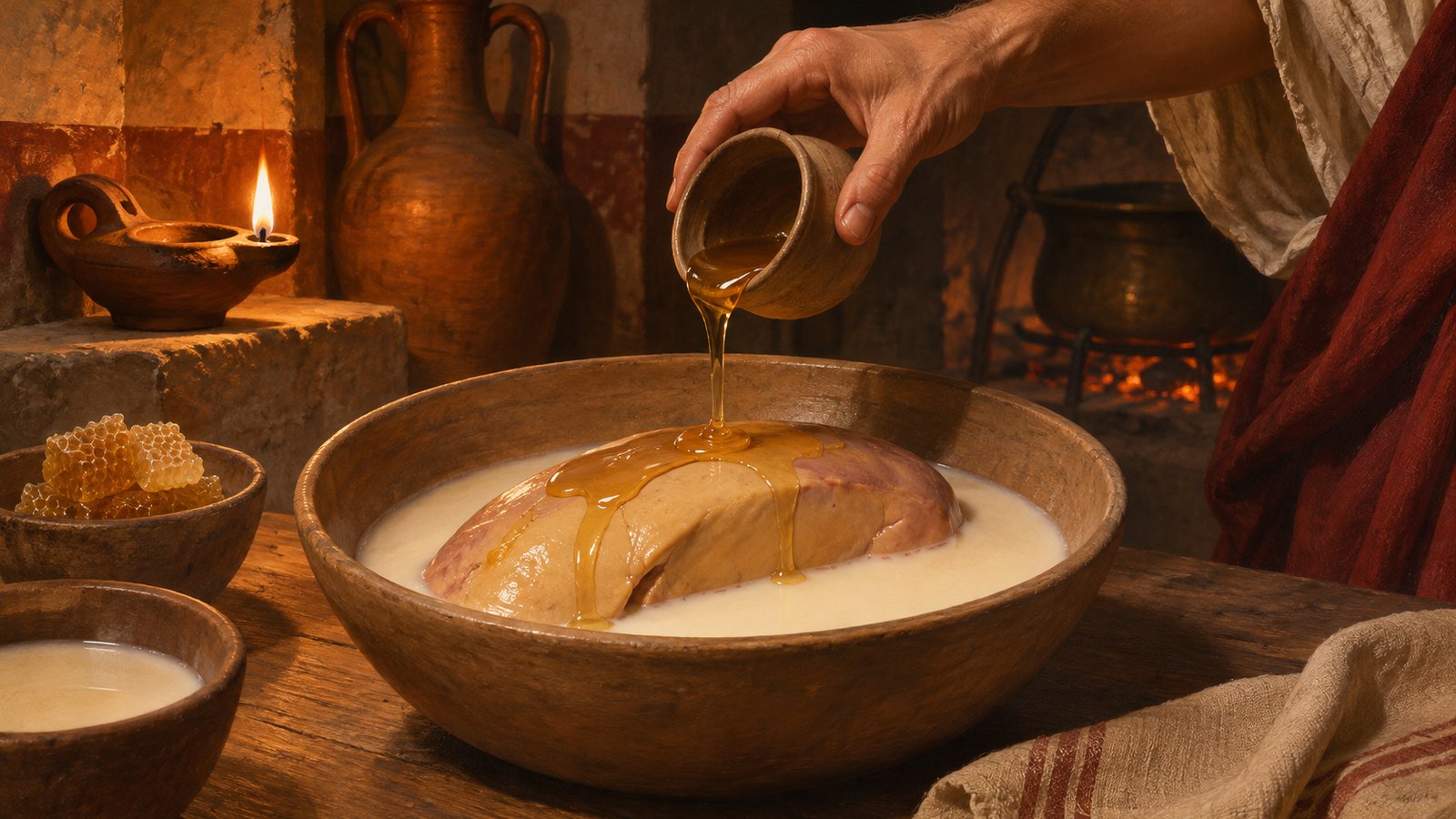
After removal, Pliny says the liver was soaked in milk sweetened with honey. He explicitly links this second treatment to further enlargement. The detail is striking because the animal’s growth had ended, but the cook’s manipulation had not. Liquid could change the organ’s volume, surface and likely its perceived richness before it reached the table.
Milk and honey also changed meaning as well as size. Both carried associations of sweetness and abundance. In this procedure they were not merely poured over a finished dish. They formed a bath in which the central ingredient rested. The soak blurred the boundary between preservation, seasoning and physical transformation.
Pliny does not specify the duration, temperature or exact ratio. Those missing measurements warn us against pretending to reproduce the dish from this sentence alone. The historical evidence is a method, not a complete recipe: sweetened milk, immersion, enlargement. It tells us what Roman observers thought the treatment accomplished and what quality they valued.
Roman Authors Turned Recipes into Rival Claims
Pliny then asks who discovered this “boon.” He names Scipio Metellus, a former consul, and Marcus Seius, a Roman knight, as rival possibilities. Culinary credit is attached not to an anonymous kitchen worker but to elite men whose status could survive in literature. The uncertainty mattered enough to record because invention itself had prestige.
The same paragraph awards another innovation to Messalinus Cotta: removing the feet of geese, grilling them and pickling them with the combs of domestic cocks. Pliny jokes that he will award the palm carefully to each man’s culinary achievement. The humour depends on treating extravagant recipes like public victories with named winners.
That naming practice hides as much as it reveals. The daily handling, feeding and cooking would have depended on workers whose names Pliny does not give. The elite inventor entered the record; the hands that repeated the process did not. A similar gap appears in commercial poultry raising, where the surviving account of a thrush house valued for enormous profit foregrounds revenue while leaving most labour in the background.
A Long Walk Made the Goose a Trade Good
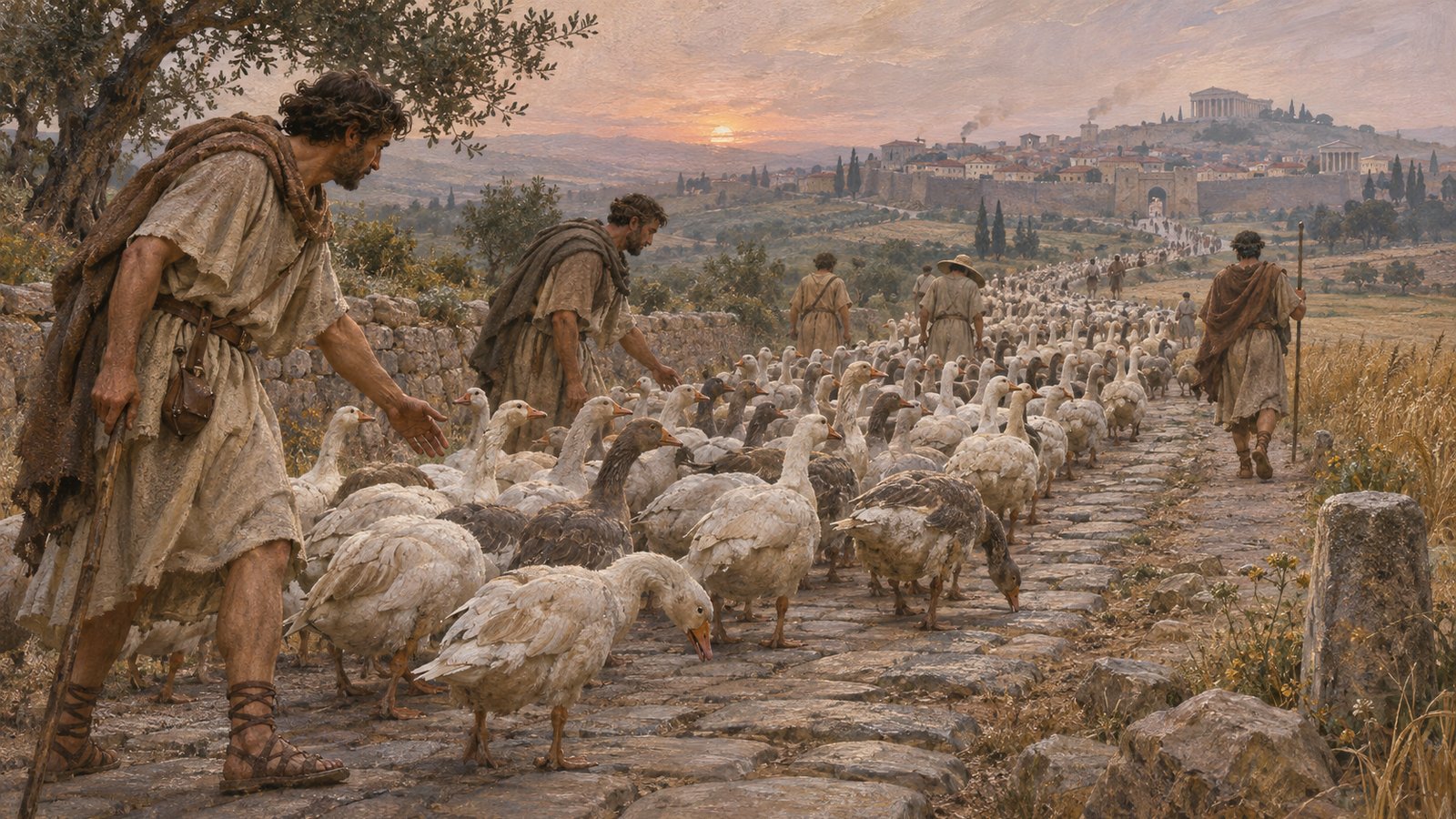
Pliny closes with a logistical image. Geese came to Rome on foot from the Morini in Gaul. When some became tired, they were moved to the front so that the birds pressing from behind drove them onward. The detail moves the chapter from kitchen technique to supply. Roman demand could pull living animals over a long route before any liver reached milk and honey.
The arrangement of the flock turned collective pressure into transport. A lagging goose at the rear could fall away; placed at the front, it was pushed by the movement behind it. Again the source offers a compact mechanism rather than a general theory. The birds themselves became part of the machinery that delivered them.
Taken together, the passage is not simply a curiosity about rich diners. It links provincial movement, animal management, bodily transformation, kitchen soaking and elite authorship. The liver grew twice because Roman luxury was built twice: first through controlled feeding, then through a sweet liquid treatment that made the result more conspicuous. By the time it appeared at dinner, the dish carried distance, labour and a competition over who deserved credit for excess.
The sequence also complicates the modern habit of separating “ingredient” from “recipe.” The goose was already being shaped for a specific dish while alive. Removal of the liver did not end that shaping, because the milk-and-honey bath continued it. What arrived before the diner was neither untouched nature nor a transformation confined to the cooking fire. It was an ingredient whose desired condition had been produced across multiple settings.
Pliny’s enthusiasm should not erase the animal cost. His praise makes forced feeding sound clever because the enlarged result pleased elite taste. Reading the mechanism plainly restores what the celebratory tone suppresses: repeated human control over the bird’s feeding and movement. The same sentence can document Roman ingenuity, appetite and indifference to suffering without asking us to admire all three.
Nor should the named inventors be treated as the first people ever to notice or prepare enlarged liver. Pliny reports a Roman argument about credit. Such claims often reveal who possessed enough status to have a culinary novelty attached to his name, not every earlier experiment by farmers, cooks or enslaved workers. The attribution belongs to the social history of the dish as much as to its technique.
Sources
Pliny the Elder, Natural History, Book 10, section 27.