
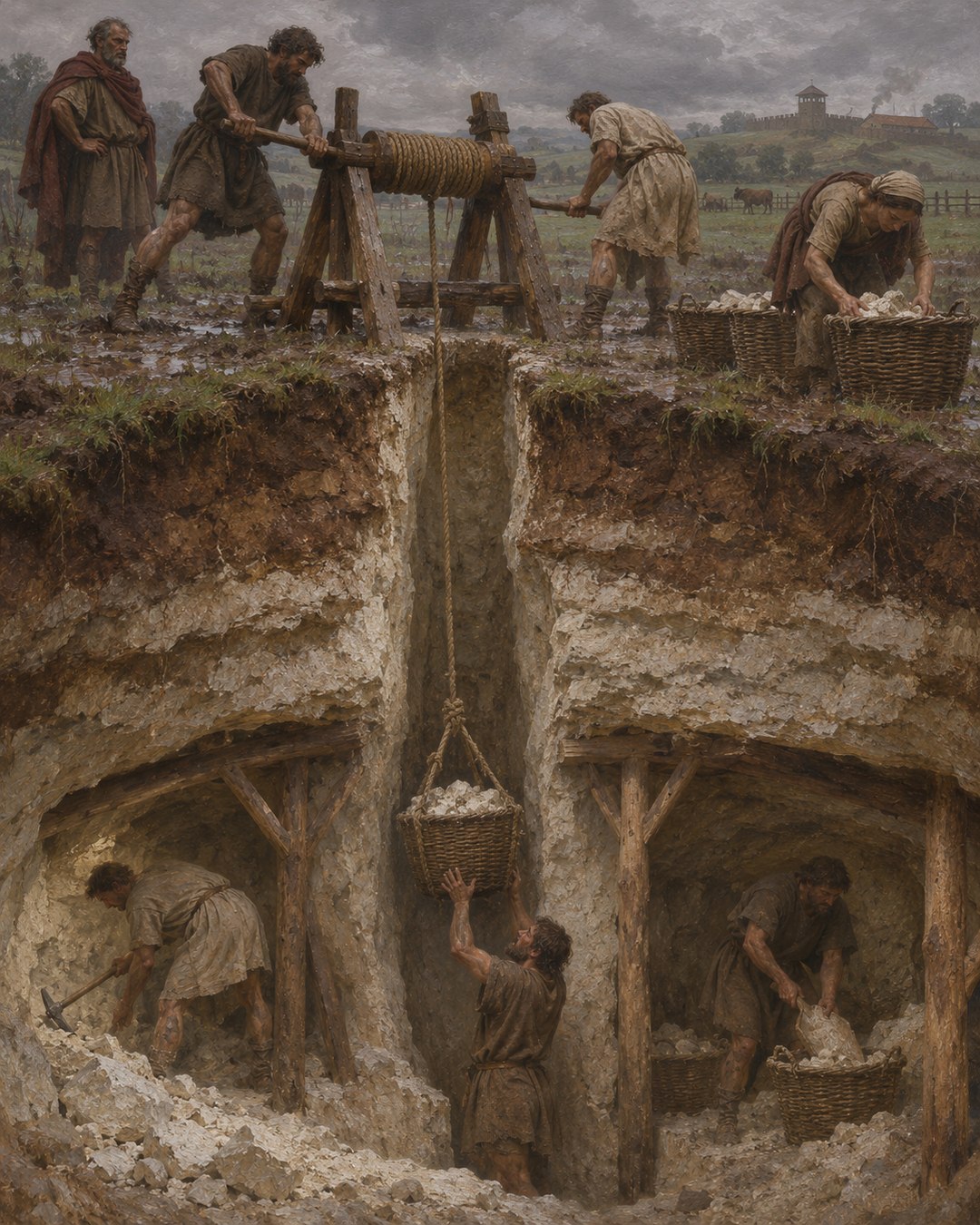
A Roman-period farmer in Britain could improve a field by beginning one hundred feet below it. Pliny the Elder describes a white marl dug from pits with narrow mouths and shafts that widened underground, “as is the practice in mines.” The pale material was not a harvest. It was chalky earth carried upward so that another soil could work better.
The depth makes the operation sound wildly expensive, yet Pliny gives the calculation that made it sensible. He says the treatment remained effective for eighty years. In his telling, nobody had to scatter this marl on the same land twice within one lifetime.
That claim turns an agricultural amendment into infrastructure. The pit, ropes, baskets, carts and labor belonged to one difficult season; the return was supposed to reach children and perhaps grandchildren who never saw the shaft opened.
White Marl Was More Than One Material
Pliny does not use “marl” as a loose name for any pale dirt. He separates varieties by color, texture and effect. The chief greasy marl was white, but even white marl had several forms. One was a chalk used to clean silver. Another, called glisomorga, was fuller’s chalk and worked better for pasture than for grain.
Those distinctions mattered because the wrong material or dose could damage a field. Pliny says glisomorga might support a heavy hay crop after grain had been taken, but a layer spread too thickly could choke the soil like plaster. Improvement required diagnosis rather than a wagonload dumped wherever the ground looked tired.
The passage belongs to a technical discussion of soils, not a celebration of a single miracle powder. Dry marl suited damp land; greasy marl suited dry land; either could suit medium soil. The farmer had to match material to ground before calculating the labor of extraction.
Roman agricultural writers often turn observation into practical tests and sequences. A related method used sealed trenches as a long-term claim about exhausted ground. The British marl pit belongs to the same world of commitments made now for fertility expected much later.
The Pit Opened Narrow and Widened Below
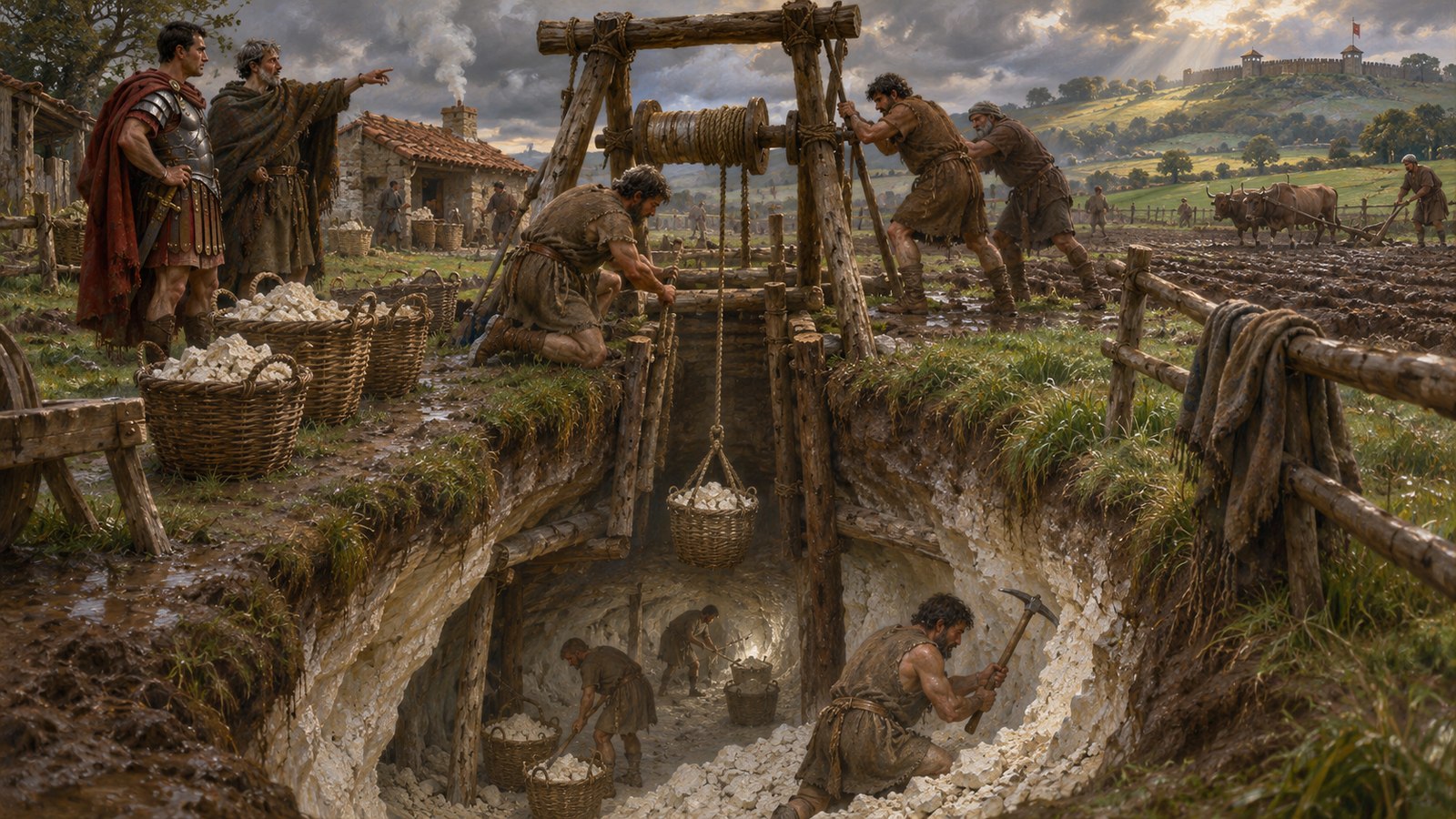
Pliny’s geometry is precise enough to picture. The opening stayed narrow, limiting the surface cut, while the interior expanded as workers reached the deposit. He compares the arrangement directly with mining. This was not ordinary shallow digging with a mattock at the edge of a field.
A hundred-foot shaft demanded organized lifting. The source does not describe the rig, supports or workforce, so those details should not be invented as certainties. What it does establish is the vertical problem: material had to be loosened far below, brought through a constricted mouth and moved onto agricultural land.
The narrow entrance also changes how we imagine the landscape. A major intervention could begin at a surprisingly small surface point. Underneath, the widened working space followed the useful seam. Above, the farmer still needed room for spoil, transport and people moving baskets away from the mouth.
Pliny says the chalk was chiefly used in Britain. He does not claim that every British farm owned such a pit, nor does he name an estate. The sentence records a regional practice at the scale of natural history. Its value lies in the conjunction of place, depth, shape and use.
Eighty Years Changed the Meaning of Labor
The eighty-year effect is the passage’s economic center. A treatment that lasted only one crop would have to repay the shaft almost immediately. A treatment credited with eight decades could be understood as a capital improvement to land rather than an annual input.
Pliny sharpens the duration with a human measure: he knew no case of anyone marling the same plot twice in one lifetime. That phrasing does not provide a controlled yield series. It tells us how users remembered the interval. Reapplication belonged beyond an individual farmer’s normal horizon.
Long duration also made knowledge transmissible. A person inheriting the field might know that an earlier generation had spread marl without having watched the work. Boundaries, local memory and estate records could become as important as the visible surface, because the treatment itself disappeared into the soil.
The claim should remain Pliny’s claim. Ancient agronomy combines observation, inherited practice and confident generalization. We can report that he assigns the effect eighty years without pretending a modern experiment proved an identical result in every British soil.
Application Still Needed Restraint
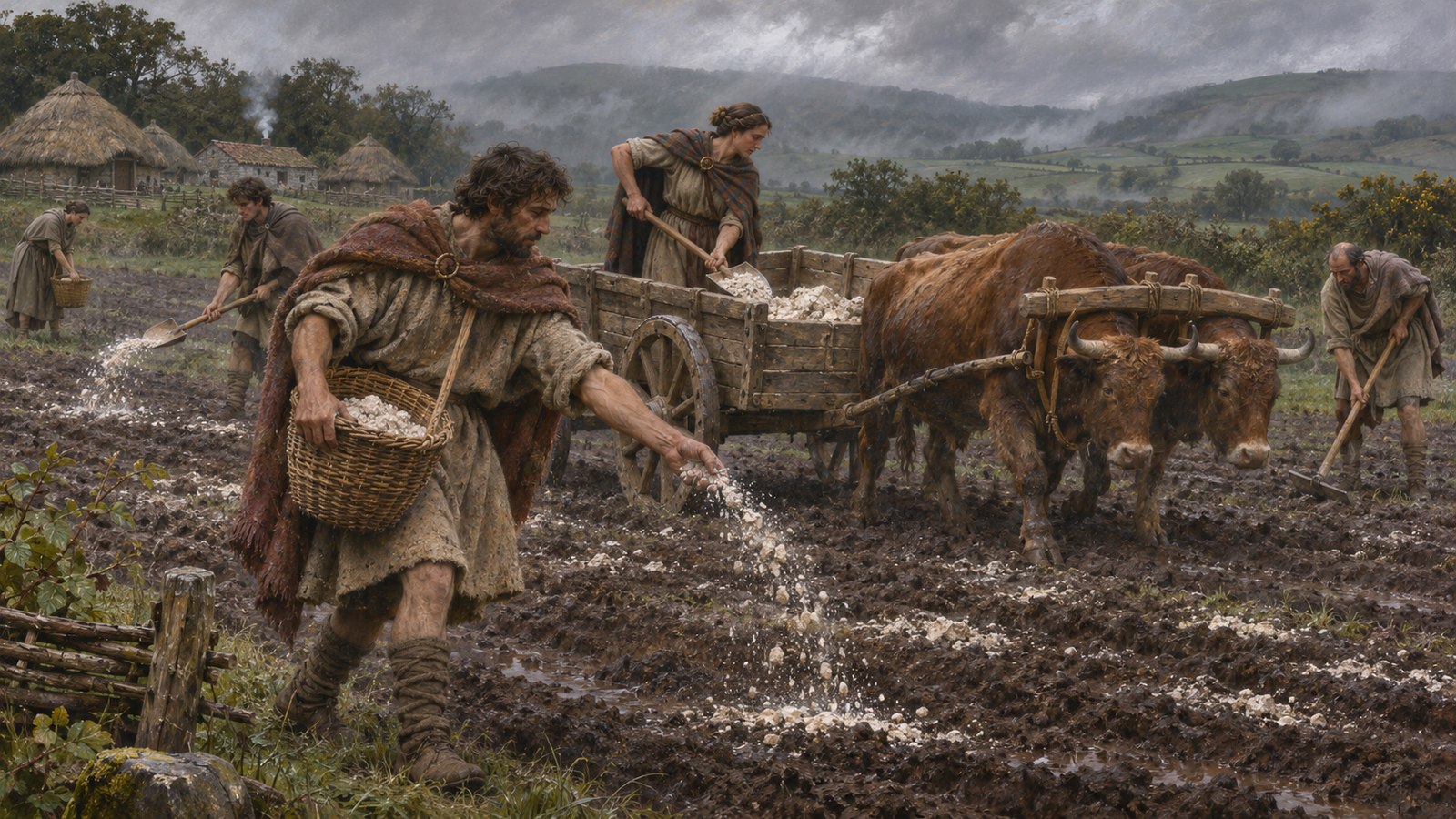
Deep extraction did not authorize careless spreading. Pliny instructs that marl should go onto land after ploughing so that what he calls its medicinal properties could be absorbed. He also recommends a moderate amount of dung because fresh marl was initially rough and did not immediately diffuse into vegetation.
That sequence makes the amendment part of a broader field system. First came ploughing, then marl, with manure used to soften the transition. The result was not necessarily instant. Pliny warns that even with dung, marl did not promote fertility in the first year.
This delay matters. A farmer could complete the hardest visible work and still wait for the promised response. The practical knowledge was therefore partly knowledge of patience: how thickly to spread, which soil to choose and how long not to judge the result.
Another Roman farm process stored manure before use in two purpose-built pits. Marl and dung were different materials, but both show soil fertility as managed preparation rather than a lucky consequence of sowing.
The Shaft Bound Mining to Farming
Calling the pit mine-like collapses a modern division between extraction and agriculture. The object taken from underground was valuable because of what it did to the surface. Workers were effectively mining future harvests, though the useful substance looked like chalk rather than metal.
The practice also made distant layers of a landscape interact. Material formed below one place could be lifted, carted and spread over another. The topsoil a farmer cultivated was not treated as fixed; it could be deliberately altered with earth selected for texture and chemical behavior as ancient observers understood them.
Pliny’s classification shows that this was not merely brute labor. White, dove-colored, sandy, dry and greasy varieties had different reputations. The farmer needed local material knowledge before the first basket came up. A deep pit dug into the wrong deposit would magnify error.
That combination of depth and discrimination is why the British example deserves attention. The hundred-foot figure is dramatic, but the operation was not dramatic for its own sake. Its purpose was a quieter change in how soil carried crops over decades.
The narrow mouth is the visible beginning of that bargain. Below it, workers widened the shaft to reach the marl. Above it, the farm accepted pale earth that could look rough in the first year. Pliny then stretches the result across eighty years, long enough for the people who opened the pit to vanish while their decision remained active in the field.
The operation also linked danger to timing. Pliny gives no accident report and no instructions for supporting the shaft, so we cannot reconstruct a safety system from this paragraph. We can still see why extraction could not be improvised casually between routine field tasks. A constricted opening and enlarged underground chamber required people to coordinate work above and below while useful material moved upward through the same limited passage.
Once the marl reached daylight, transport became the next constraint. A hundred-foot pit did not improve the field by existing; every effective load had to cross the surface and be spread after ploughing at a controlled thickness. The eighty-year claim bundled those separate labors into one long return.
Sources
Pliny the Elder, Natural History, Book 17.