
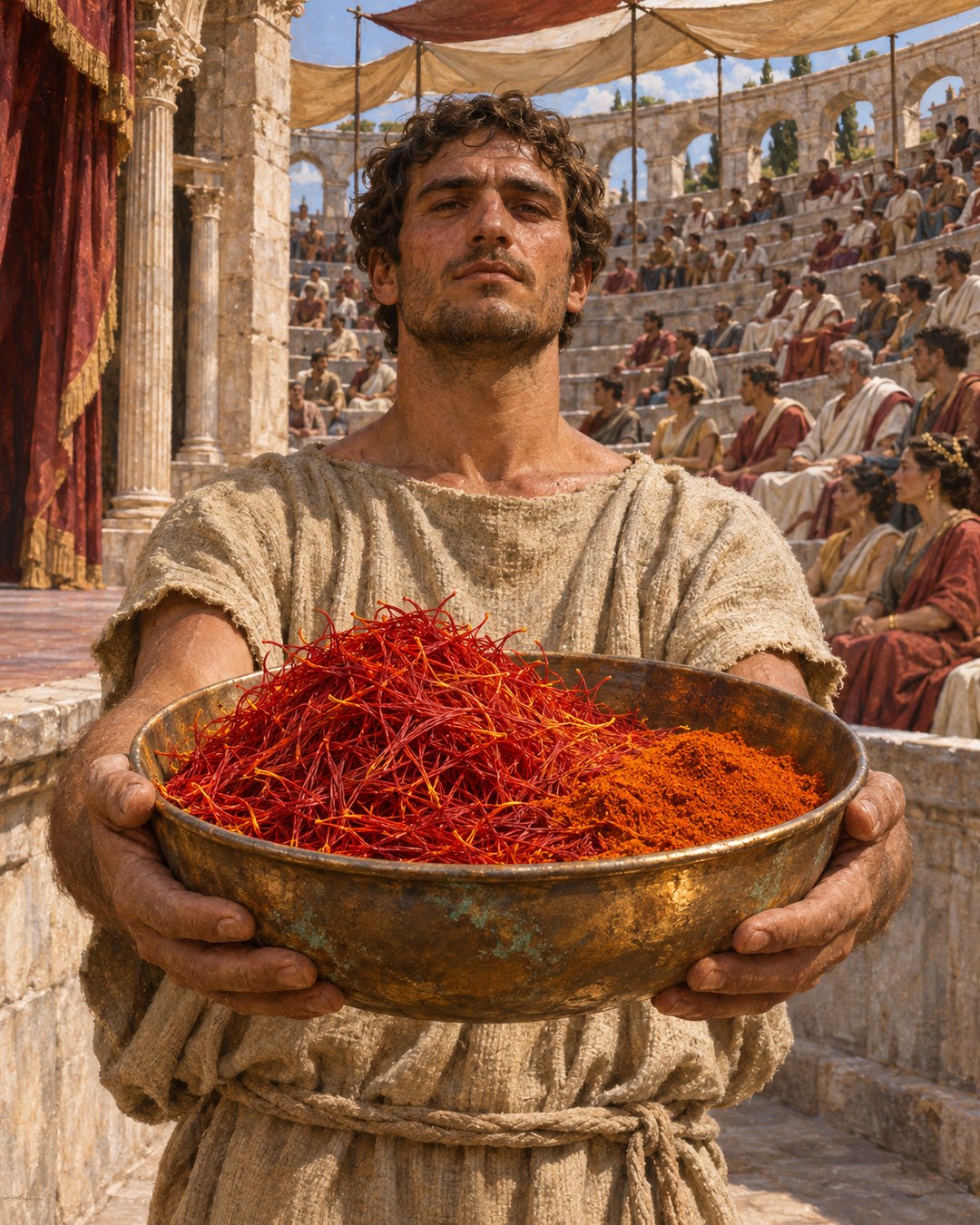
A Roman theatre could work on the nose before an actor delivered a line. Lucretius asks his reader to imagine a stage freshly sprinkled with Cilician saffron, its fragrance rising beside incense from an altar. The image appears in a philosophical argument about the tiny shapes that make sensations pleasant or harsh, but the setting is remarkably concrete: imported plant material, a crowded performance space, and scent released as part of the event.
This was more than a wealthy host passing perfume around a dining room. Powdered saffron entered one of Rome’s largest machines for collective attention. Stone seats, coloured awnings, voices and music organized what spectators saw and heard. Saffron added another layer that moved through the air and reached people who never touched the costly spice. The result was an ancient form of atmospheric design, built from a fragile harvest and judged by the human face, fingers and nose.
Cilicia Supplied a Fragrance Worth Naming
Pliny the Elder did not treat all saffron as interchangeable. He gave first place to Cilicia and, within Cilicia, to Mount Corycus. Saffron from Mount Olympus in Lycia followed, then material from Centuripa in Sicily, though he knew an alternative ranking that put Phlegraea second. Lucretius also specifies Cilician saffron in his theatre scene. Geography therefore carried practical meaning. The name told a Roman reader what sort of fragrance and prestige the poet wanted him to imagine.
The ranking mattered because the product was difficult to trust. Pliny calls saffron exceptionally prone to adulteration. A buyer could press it between the fingers: good material should snap, while dampened strands stayed limp. He also describes touching it to the face, where genuine saffron produced a slight caustic sensation around skin and eyes. Short filaments, an oily feel and the absence of a musty smell supplied further clues.
Those tests make the theatre fragrance begin at a market counter rather than on a stage. Someone had to distinguish a valuable aromatic from watered or stale material before it could perfume a public building. Rome’s sensory luxury depended on the same kind of scrutiny seen in the city’s other trades. The process resembles the patient layering used by a Roman perfumer working oil and flowers, but saffron brought its own signs of quality: brittle strands, concentrated smell and a colour strong enough to name.
A Few Harvest Days Fed a Public Spectacle
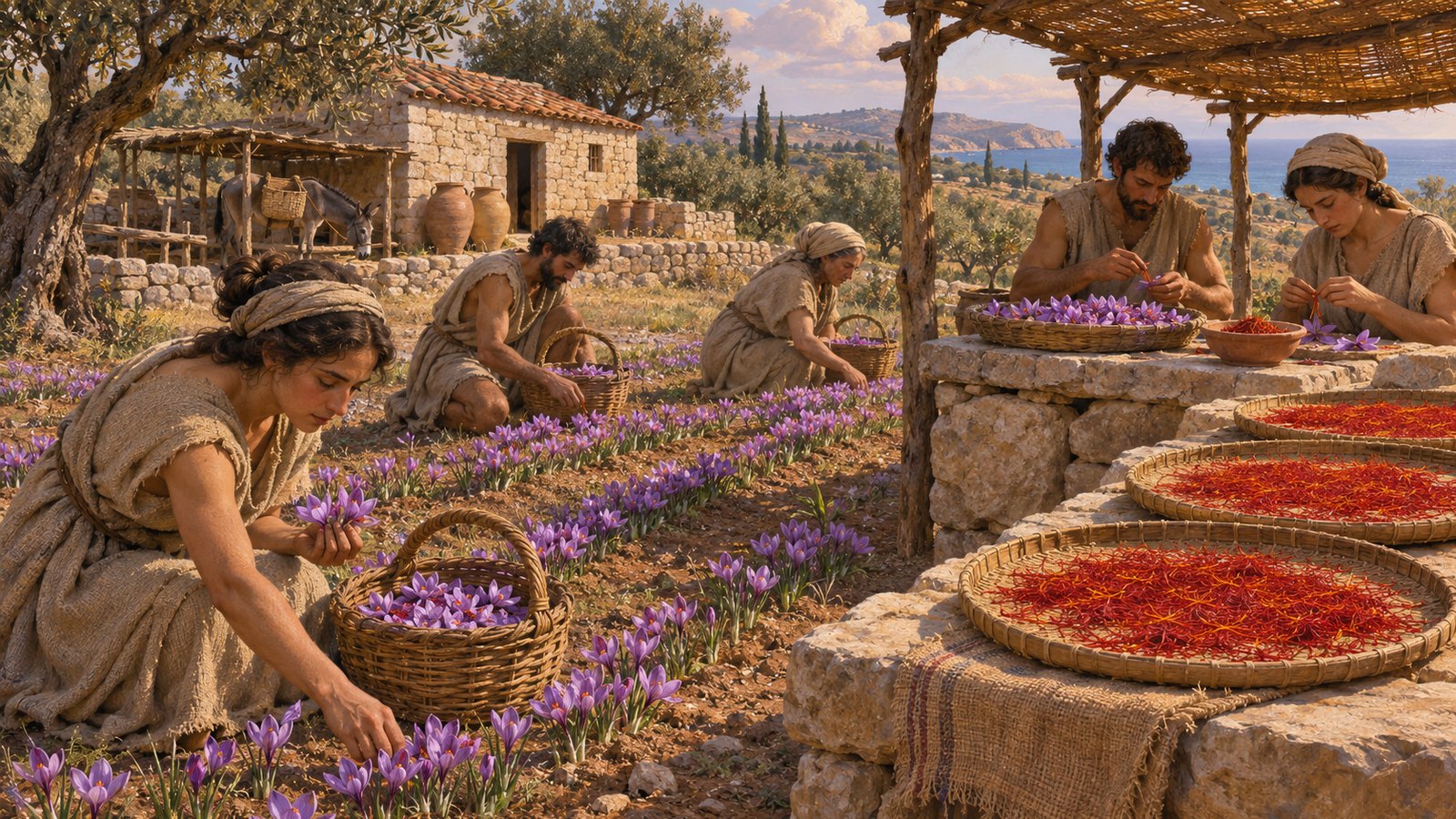
Pliny’s plant did not offer a forgiving schedule. He says it flowered around the setting of the Pleiades for only a few days, and his translator notes how easily part of the crop could be lost. The material was gathered around the winter solstice and dried in shade. He preferred winter drying. A scent that seemed effortless inside a theatre began with a narrow agricultural window and careful handling after the flowers were cut.
The crop also demanded long-term attention. Mucianus, whom Pliny cites, reported that Lycian growers moved saffron to prepared ground after seven or eight years to keep it from declining. Pliny adds the memorable claim that the plant prospered near paths and fountains because trampling helped it. Whether every botanical detail satisfies a modern grower is less important here than the chain of work preserved in the account: maintain the beds, catch the brief flowering, gather the useful parts and dry them without ruining their strength.
Cultivated saffron looked larger and finer than the wild kind, Pliny says, but he credited the wild plant with greater efficacy. That distinction warns against reading Roman luxury as a simple preference for the biggest or brightest specimen. Appearance, strength and origin could pull in different directions. The theatre needed scent that would survive preparation and dispersal, not merely flowers attractive in a basket.
The Stage Became a Delivery Surface
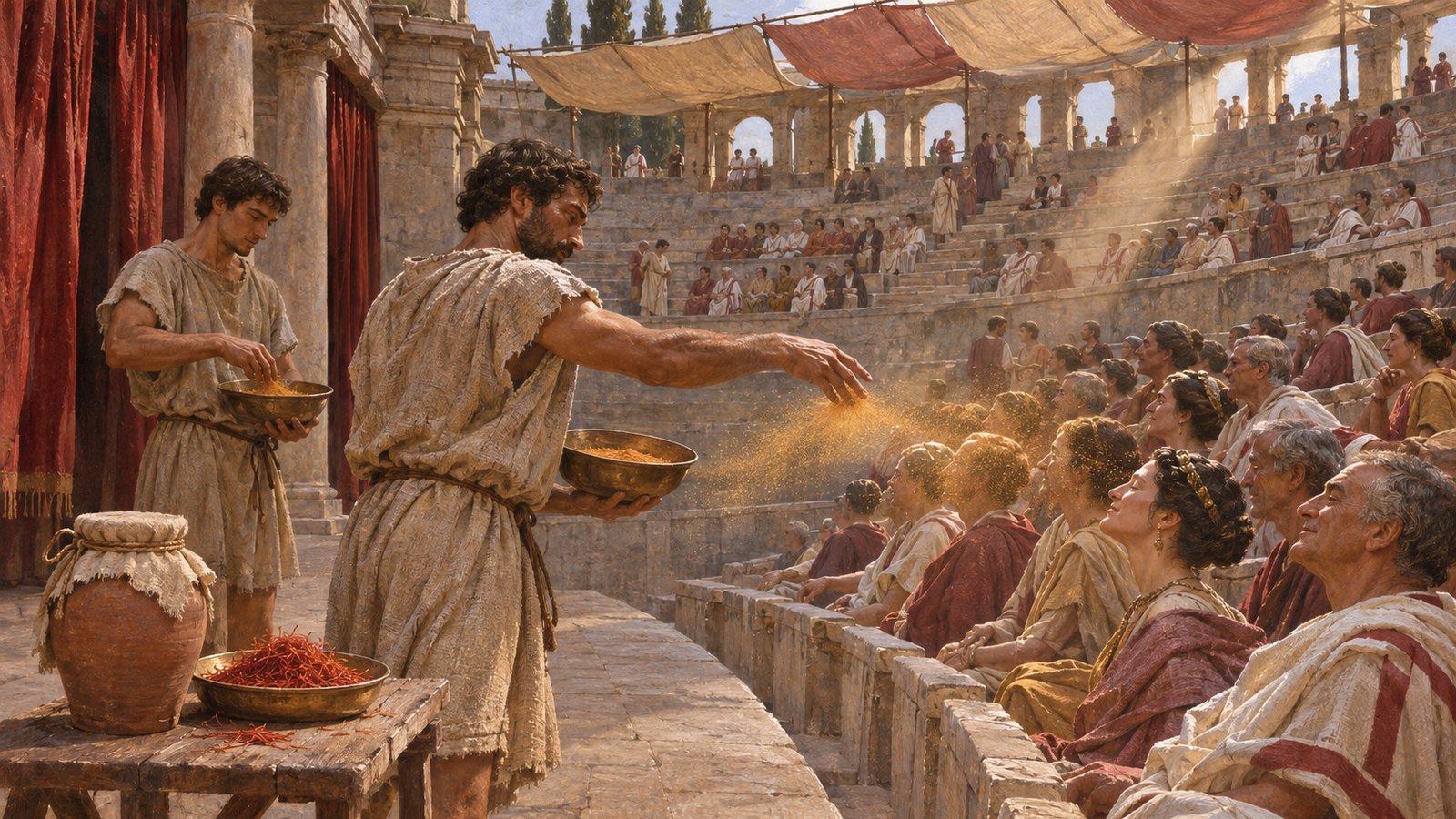
Pliny’s ancient text states the essential operation plainly: saffron was reduced to powder and used to perfume theatres. Lucretius supplies a second view when he describes the stage as freshly sprinkled. The two passages place the aromatic inside the architecture of performance. It was not only worn as an individual ornament or opened privately from a container. It was distributed across a shared zone.
The nineteenth-century editors John Bostock and H. T. Riley explain Pliny’s phrase with a more elaborate mechanism. Their note describes saffron-water sent through very fine-bore pipes so that it fell on spectators as a fine spray; they also mention wine as a possible ingredient. That detail belongs to the editors’ commentary and should be labelled as such, rather than passed off as Pliny’s own sentence. Even with that caution, it shows how generations of readers understood the practical problem: expensive scent had to be divided into droplets or particles small enough to travel through a large venue.
Architecture shaped that journey. A Roman theatre brought thousands of bodies into a steep semicircle, often under fabric that changed shade, colour and airflow. The same public culture that experimented with shelter when rain struck a theatre crowd could treat the air itself as part of presentation. Saffron did not replace the actor, music or scenery. It made arrival and atmosphere legible through another sense.
The Audience Received Luxury Without Owning It
A spectator did not need to purchase a box of Cilician strands to encounter their value. Once powdered or dispersed, the saffron became collective but temporary. Everyone within reach could smell it, yet nobody carried away the original commodity. Public display converted concentrated material into a brief environmental effect.
That conversion helps explain why Lucretius chose the theatre for his example. He was distinguishing sensations produced by smooth particles from those experienced as rough or painful. A freshly scented stage offered an image his audience could recognize immediately: fragrance moving from prepared material into many noses. Beside it, altar incense reinforced the contrast between an agreeable odour and the stench of a burning corpse. Philosophy borrowed the memory of a managed venue.
The material had to be strong enough to remain perceptible after dilution. Pliny says saffron combined especially well with sweet wine, which may help explain why later commentary imagined wine in a theatre mixture. Yet the central point does not require reconstructing a single universal recipe. Powder, water or wine could represent different preparations, occasions or interpretations. The secure evidence is that Romans connected saffron with theatrical perfuming and that Cilician origin sharpened the image.
One Scent Joined Farming, Trade and Performance
The theatre effect lasted minutes; its supply chain stretched across seasons and seas. Flower beds had to be maintained for years. A short bloom had to be harvested and dried. Merchants and buyers judged strands for moisture, smell, texture and origin. Only then could workers reduce the aromatic and apply it to a venue where it ceased to look like a precious cargo at all.
This is what makes saffron more revealing than a list of Roman luxuries. It joined several kinds of expertise that are often studied separately. Growers knew the soil and flowering window. Dealers knew how adulteration changed a strand. Venue workers understood distribution. Poets knew that an audience would recognize the finished sensation. None of those roles alone explains the scented stage.
Pliny ends his account by pushing saffron’s prestige back toward Homer, who named it with lotus and hyacinth. That literary antiquity added dignity, but the Roman theatre depended on immediate physical facts: a strand that snapped, a harvest measured in days, a powder released into occupied air. Cilician saffron reached the crowd because people turned a difficult flower into an engineered moment. Rome’s spectacle was not only marble, costume and voice. For a short time, it could be something breathed.
Sources
Pliny the Elder, Natural History, 21.17
Lucretius, On the Nature of Things, 2.416–417
John Bostock and H. T. Riley, commentary to Pliny, Natural History 21.17