
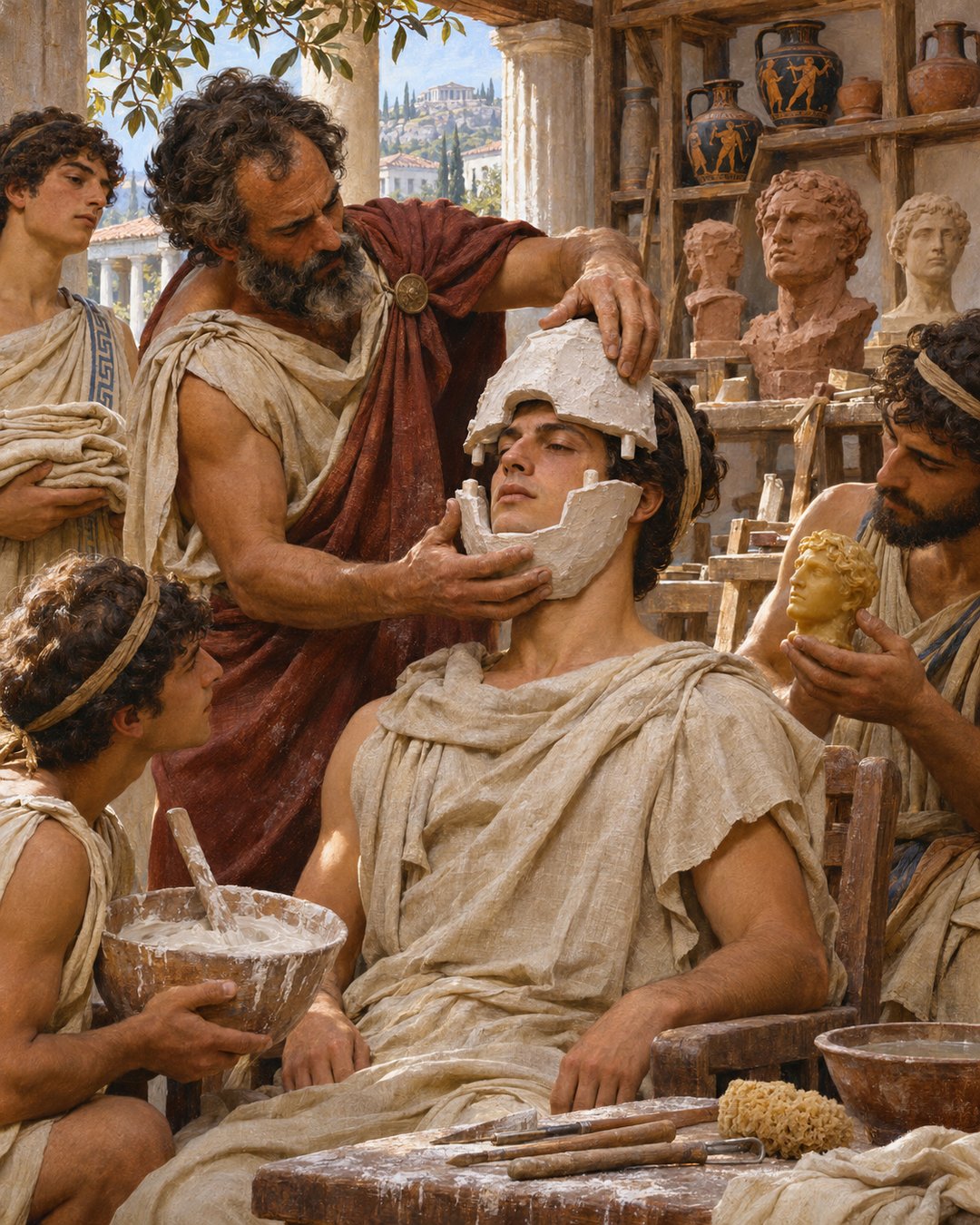
A sculptor searching for an exact likeness could ask the sitter to hold still while wet plaster touched the face. Pliny the Elder credits Lysistratus of Sicyon with this change in portrait making: instead of beginning from an artist’s preferred version of beauty, he took an impression from living features.
The mould was not the finished portrait. Pliny says Lysistratus poured melted wax into the plaster cast and then improved the result. The face supplied a physical record; the artist still interpreted, repaired and prepared it for the next stage.
That combination made the procedure important. It did not remove skill from portraiture. It changed where skill entered, giving the workshop a measured starting point before clay, wax, bronze or stone carried the likeness elsewhere.
A Living Face Became the First Workshop Surface
Pliny identifies Lysistratus as the brother of Lysippus and calls him the first to express human features by fitting a plaster mould directly upon the face. The claim is compact, but its physical implications are unusually vivid. Portraiture began with contact rather than a distant gaze.
A sitter had to remain still enough for the mould to register the brow, cheeks, mouth and other planes. The material had to take an impression and come away with those relationships intact. Pliny does not tell us how long this took, how breathing was managed, or what preparation protected hair and skin, so modern reconstructions should not fill those gaps with certainty.
What he does specify is the sequence. The mould received the face. Melted wax then went into the resulting negative. The wax became a positive image that could be adjusted. Each transfer reversed the surface while preserving the spatial information gathered from the sitter.
This was a workshop instrument, not a magical duplication. Small failures in the mould, seams, bubbles and the demands of a final material still required judgment. Yet the first decisive geometry came from the person’s own features.
Wax Preserved Evidence That Beauty Could Erase
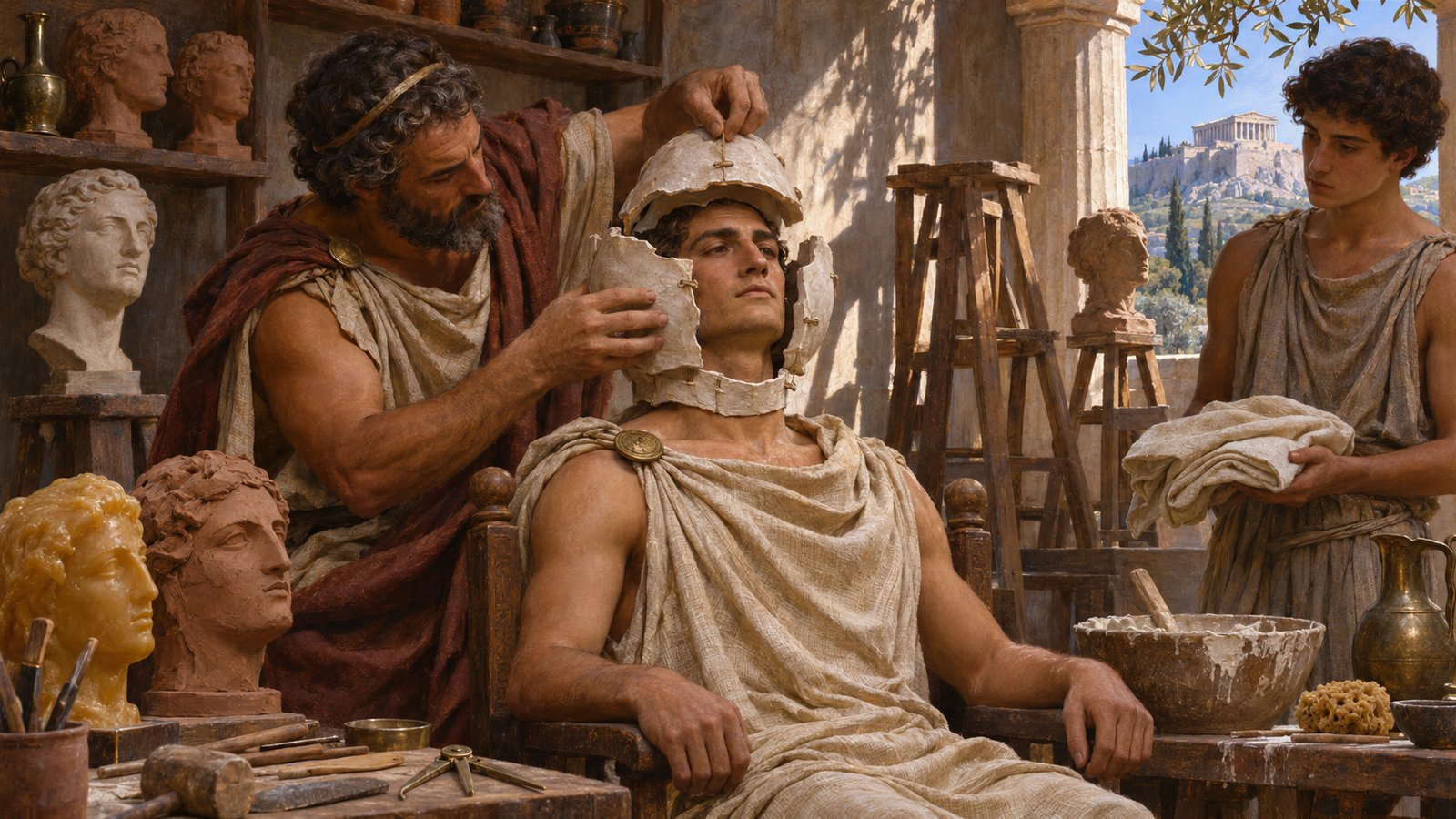
Pliny attaches an aesthetic argument to the technique. Lysistratus, he says, made faithful likeness his study, while earlier artists concentrated on making portraits as handsome as possible. The contrast is Pliny’s broad history, not a neutral census of every earlier portrait, but it shows what he thought the mould changed.
A flattering portrait could lengthen a neck, smooth a line or regularize asymmetry before the work had acquired a stable form. A direct impression resisted some of that early drift. It retained proportions that an idealizing eye might instinctively correct.
The wax cast did not force the finished statue to remain untouched. Pliny explicitly says Lysistratus improved it. The important distinction lies between revising from recorded features and inventing the features while looking at the sitter. Correction followed evidence rather than replacing it at the beginning.
Roman viewers knew that faces could be manufactured through grooming, polished surfaces and public presentation. Another Lost Eagles article follows the labour required before a Roman mirror could return a face clearly. Lysistratus’s method pursued a different kind of return: not reflected light, but a surface carrying the face’s relief.
The Portrait Needed a Chain of Positive and Negative Forms
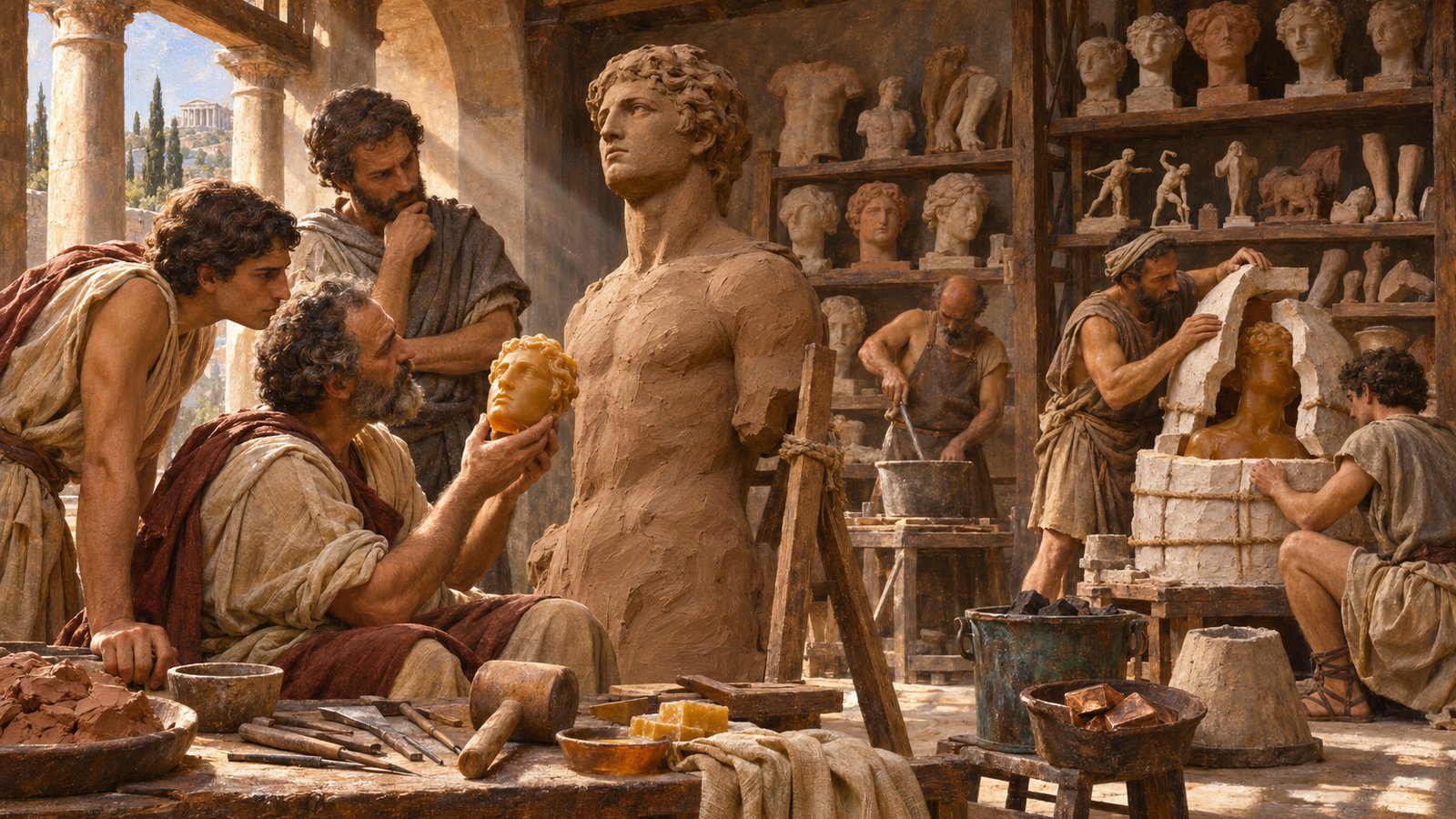
The process makes more sense when followed as a chain. A face is a positive form. A mould laid over it receives a negative cavity. Wax poured into that cavity becomes positive again. A clay model or later mould could continue the sequence toward bronze.
Every link had a separate purpose. Plaster recorded. Wax could be retouched. Clay could establish the whole figure, pose and drapery. A casting mould could then translate that model into metal. The same face therefore moved through materials with different working properties.
Pliny says Lysistratus was also the first to make models for statues. He then makes a larger claim: the method became so universal that no figure or statue was produced without a clay model. The portrait innovation belonged to a broader reorganization of planning.
A model let sculptors solve balance and silhouette before committing expensive bronze. It also gave patrons and workshop members something concrete to inspect. Decisions could be made in an adaptable material, while the final object remained uncast.
This helps explain Pliny’s conclusion that modelling in clay was older than moulding in bronze. Clay was not merely an inferior substitute for metal. It was the preparatory language through which metal sculpture became possible.
Butades Began with a Shadow Rather Than Contact
Pliny places Lysistratus after another origin story. At Corinth, the daughter of the potter Butades saw the lamp-lit profile of a young man who was about to leave on a long journey. She traced the shadow on a wall. Her father pressed clay over that outline, created a face in relief, and fired it with his pottery.
The story begins with threatened absence. A departing lover’s profile became a line, the line became relief, and the relief became a fired object. Pliny says it remained in Corinth’s Nymphaeum until the city was destroyed by Mummius.
He also records a rival claim: Rhoecus and Theodorus of Samos invented modelling earlier. The disagreement matters. Ancient technical histories often arrived as competing names, local traditions and memorable anecdotes rather than securely dated patent records.
Butades’s tale and Lysistratus’s procedure solve related problems by opposite routes. The traced shadow reduces a face to its edge. The plaster mould receives the face across a full surface. One catches silhouette; the other captures relief.
The distinction also changes the sitter’s role. In the Corinthian story the young man need only stand where lamplight throws his profile. In Lysistratus’s method the sitter’s skin becomes part of the operation. Portrait making moves from observation to controlled physical contact.
Clay Models Carried Likeness Beyond One Body
Once a likeness existed in wax or clay, it no longer depended on the sitter remaining present. The workshop could compare, revise and translate it. Assistants could work from a shared model. A larger statue could preserve facial relationships first gathered at human scale.
That portability matters for public memory. Rome filled its shared spaces with portraits whose placement could become political. A recent Lost Eagles article shows how censors removed unauthorized statues from the Forum. Before a likeness could compete for such a setting, however, a workshop had to turn a person into an object that could be multiplied, enlarged and installed.
Pliny’s next examples show how valuable models themselves became. He says the plaster models of Arcesilaus sold among artists for more than other people’s completed works. Pasiteles, skilled in several branches, reportedly made nothing without first modelling it. The preparatory object had acquired its own authority.
That does not prove every Roman portrait began as a face cast. Pliny’s universal language concerns clay models, while the direct facial mould is specifically attached to Lysistratus. The safe conclusion is narrower: his technique represented an influential route to faithful likeness, and modelling became foundational workshop practice.
The procedure changed portraiture’s argument with beauty. A face no longer had to enter art only through what an artist selected while looking. Its surface could leave evidence of itself. Wax held that evidence long enough for judgment to begin.
Pliny remembers Lysistratus not because plaster finished the portrait, but because it disciplined the start. The mould made the sitter physically present inside a process that would soon move through other hands and materials. Faithfulness became something a workshop could build from, not merely something a viewer hoped to recognize at the end.
Sources
Pliny the Elder, Natural History, Book 35, chapters 43–45.