
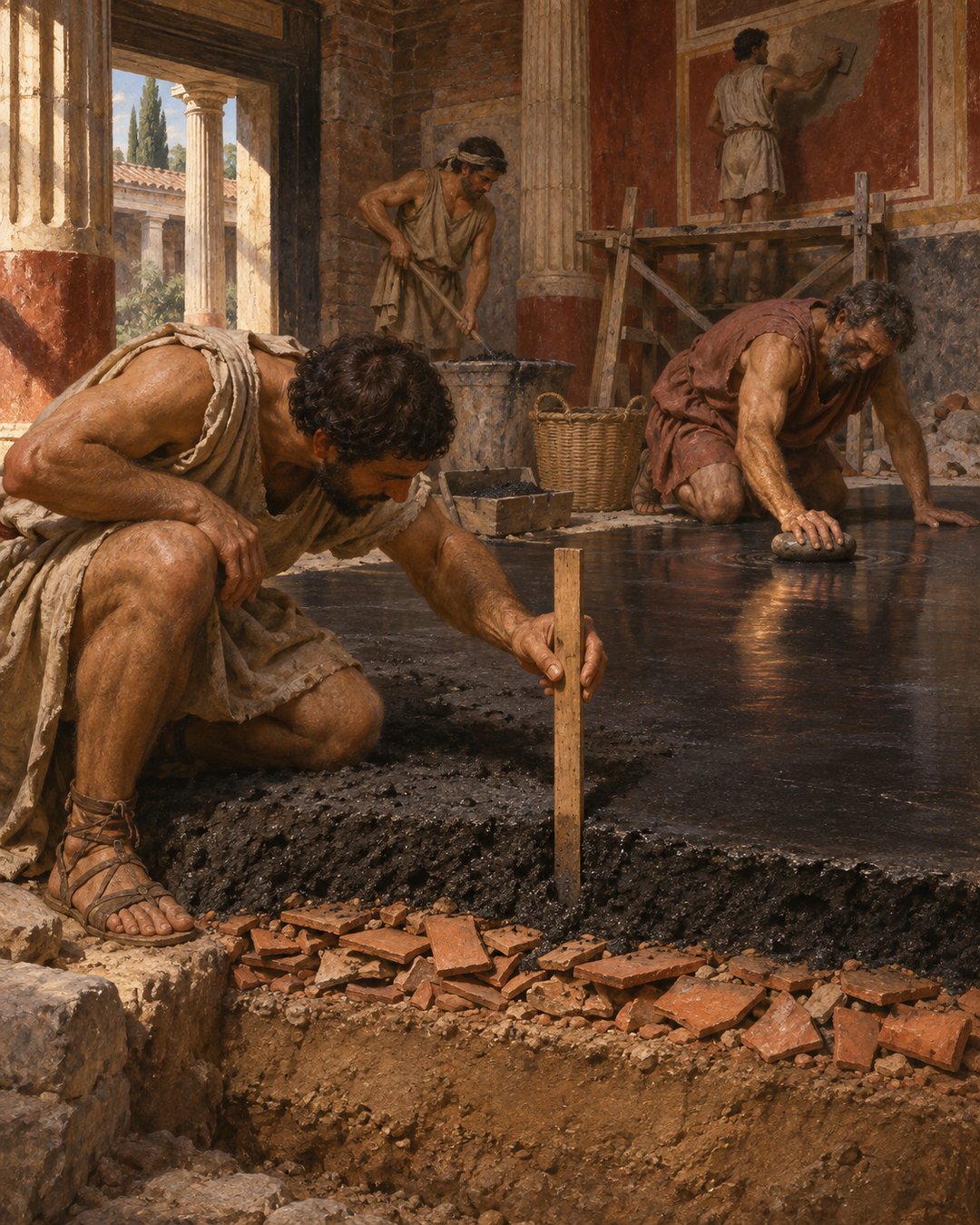
The floor begins with a contradiction. Builders spread charcoal over compacted material, tread it down with sand, lime, and ashes, and make the surface look like ordinary earth. Only after rubbing it with a polishing stone does Pliny say the work takes on the appearance of a black pavement.
Nothing in that sequence depends on a single luxurious slab. The result comes from order: ram the ground, choose a lower bed, add charcoal, control the thickness, compact the mixture, and finish the surface. A dark floor is built through process before it becomes a visual effect.
Pliny calls the method “Graecanic.” His description in Natural History is brief, but it preserves enough measurements, materials, and tools to reconstruct the logic of the job. The floor does not become convincing because the ingredients sound impressive. It becomes convincing because every layer is made to behave differently from the loose material that entered the site.
The Pavement Starts Before Any Finish Is Visible
Pliny begins below the part anyone would admire. The ground has to be well rammed. That first instruction turns disturbed soil into a controlled base. If the foundation remains loose, everything above it inherits the movement. The black appearance at the end therefore depends on work that disappears completely.
Over the compacted ground, builders have an alternative. They can lay rough-work or use broken pottery. Pliny does not force one universal lower bed. He identifies two routes to the next stage, which suggests that the named pavement is defined less by one exclusive ingredient than by the sequence and treatment of its layers.
Broken pottery deserves attention because its role is structural rather than decorative. Fragments that might look like debris become selected building material once they are placed as a bed. The floor turns pieces into a mass, just as another Roman roof recipe turned crushed pottery, lime, timber, and plant matter into a carefully ordered terrace. That more elaborate stack can be seen in the crossed-board roof built from chaff and pounded pottery.
The Graecanic pavement is shorter in Pliny’s telling, but it follows the same practical habit: control begins at the interface between layers. The visible surface is the last consequence of decisions made against the ground.
Charcoal Becomes a Building Layer
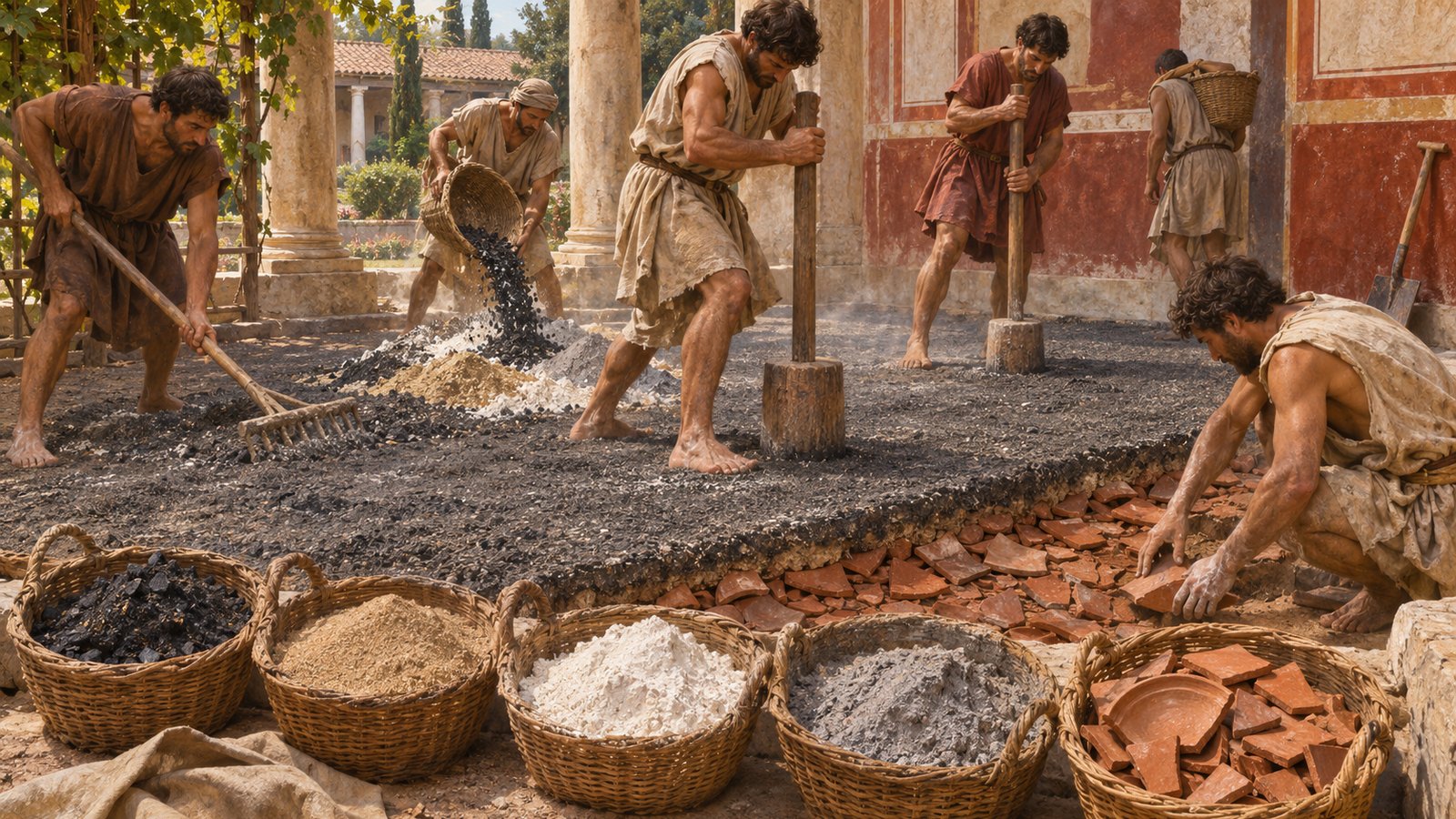
The most surprising material comes next. A layer of charcoal is placed over the lower bed. In another context charcoal is fuel, a residue of burning, or a substance carried in baskets. Here it is neither a flame nor a loose heap. It becomes part of the floor.
Pliny says the charcoal is well trodden down with a mixture of sand, lime, and ashes. Each word points away from casual dumping. The workers combine materials, spread them, and use repeated pressure to transform the layer. Feet are tools in the process because broad, repeated loading can compact an area more evenly than a single blow.
The ashes make the recipe look at first like a collection of leftovers: burnt wood, broken pottery, and fine residue. That impression misses what construction does. The ingredients are not valuable because they are pristine. They are valuable because their sizes and behaviors can be organized. Charcoal contributes to the dark body of the work; sand, lime, and ash enter a mixture that can be trodden into a consistent bed.
Pliny does not give a modern explanation of the chemistry, and the passage should not be forced to provide one. What it securely gives us is the builders’ operational knowledge. They knew the sequence, the desired thickness, the need for compaction, and the visual result that proper finishing could produce.
Line and Rule Control Half a Foot
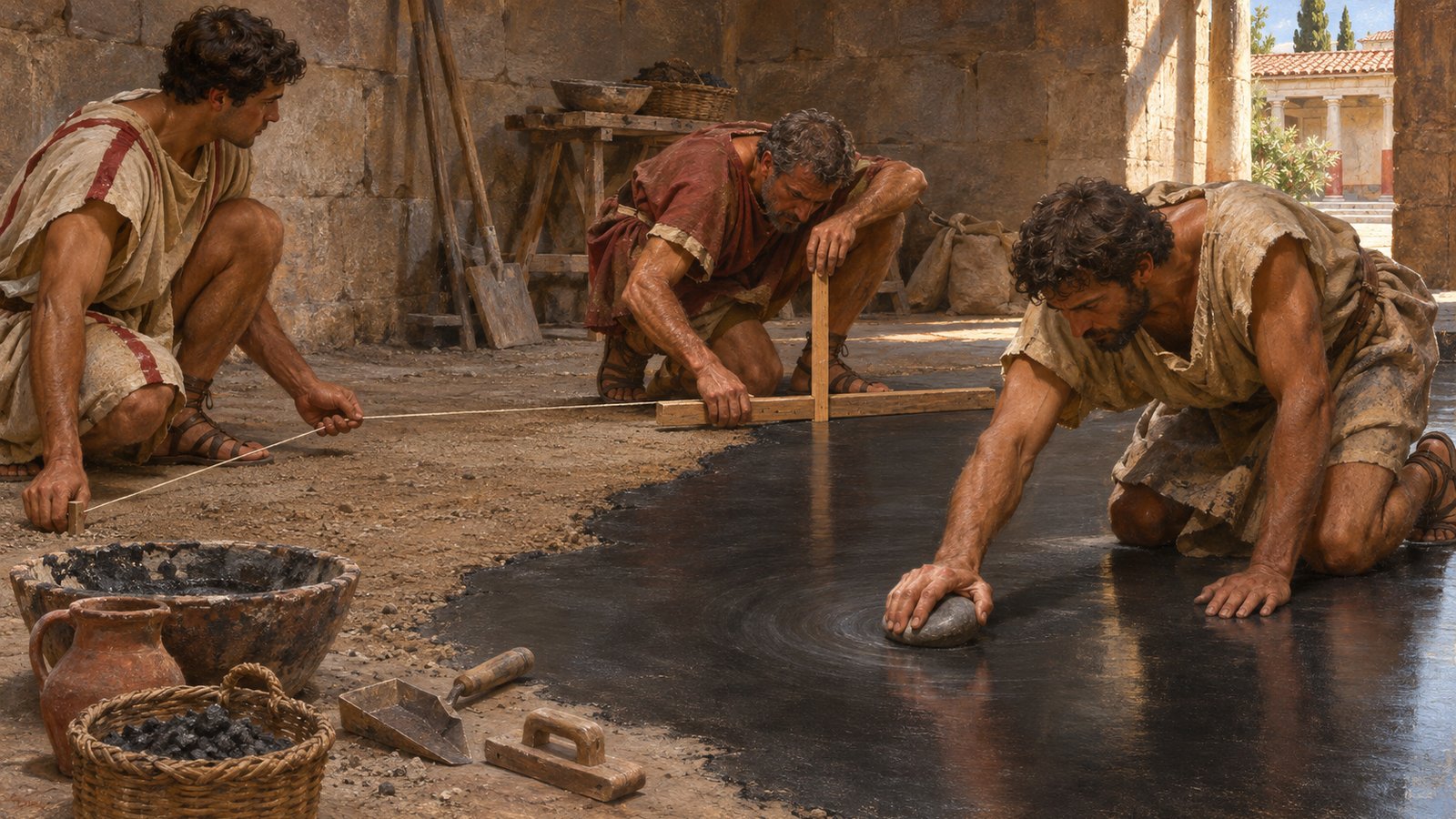
The layer is not judged by eye alone. Pliny specifies line and rule. Those simple controls matter because the target is a uniform thickness of half a foot. The floor must not merely contain the right materials; it must distribute them predictably across the area.
A line can reveal a level or alignment over distance. A rule can check depth at a particular point. Used together, they turn a broad surface into a set of repeatable comparisons. One worker’s sense that an area “looks about right” is replaced by a physical standard another worker can test.
Half a foot is thick enough to make the charcoal mixture a substantial construction layer, not a stain brushed over a finished floor. That measurement changes how the pavement should be imagined. Its black appearance is supported by depth, compaction, and a lower bed. The polish at the end works on material that has already been made uniform beneath it.
The measurement also joins appearance to labor. A uniform six-inch-equivalent depth over a room demands more material and more treading wherever the floor extends. Pliny’s short phrase therefore implies repeated work: spreading, checking, correcting low areas, reducing high ones, and compacting again until the line and rule agree.
Polishing Changes Earth into Pavement
Before the last operation, Pliny says the surface has the ordinary appearance of ground. That is the hinge of the whole description. The expensive-looking outcome is not obvious during most of the work. A visitor arriving too early might see a dull, earth-like expanse and miss what the builders had prepared below.
The polishing stone changes the reading of the surface. Rubbing compresses and smooths the top, reducing the visual noise of separate particles. When the work is done well, Pliny says it has all the appearance of a black pavement. His wording is about perception: a layered, trodden mixture comes to present itself as a coherent finished floor.
That emphasis places the Graecanic method beside other Roman arts of controlled illusion without making them identical. Sosus could make a clean mosaic imitate the scraps of an unswept banquet, as shown in the famous unswept-floor composition. The charcoal pavement produces a different effect. It does not picture another object. It makes humble particles read as one dark architectural plane.
Both depend on disciplined making. Illusion is not the opposite of technique. It is often the reward for technique repeated so consistently that the viewer stops noticing the separate operations.
A Recipe Is Evidence, Not a Universal Label
Pliny’s passage is unusually useful because it combines a name, an order of operations, a measurement, tools, and a promised appearance. Those details allow a floor to be discussed as work rather than as a photograph of a surviving surface. Builders ram, carry, spread, tread, measure, and polish.
Yet the description also has limits. It is a textual prescription, not a laboratory report for every dark floor found by archaeologists. A black pavement cannot be assigned to this recipe merely because the color seems similar. The lower bed, charcoal layer, associated materials, thickness, and finish would all matter before making that connection.
“Graecanic” also tells us how Pliny categorized the method, not necessarily where every workman learned it or how consistently the name was used on building sites. Technical labels can travel farther than the practices they summarize, and practices can vary while a writer compresses them into a clean sequence.
What survives without overclaiming is the logic of the recipe. The ground is stabilized first. Rough-work or broken pottery creates a bed. Charcoal is not sprinkled but made into a substantial compacted layer with sand, lime, and ashes. Line and rule enforce half a foot. The unfinished surface remains ordinary-looking until a stone rubs it into a visual whole.
The black floor is therefore not a single material pretending to be valuable. It is a construction process making several common materials act as one. Pliny’s few sentences preserve the moment when earth-like roughness becomes architecture—one measured, trodden, polished layer at a time.
Sources
Pliny the Elder, Natural History 36.63