
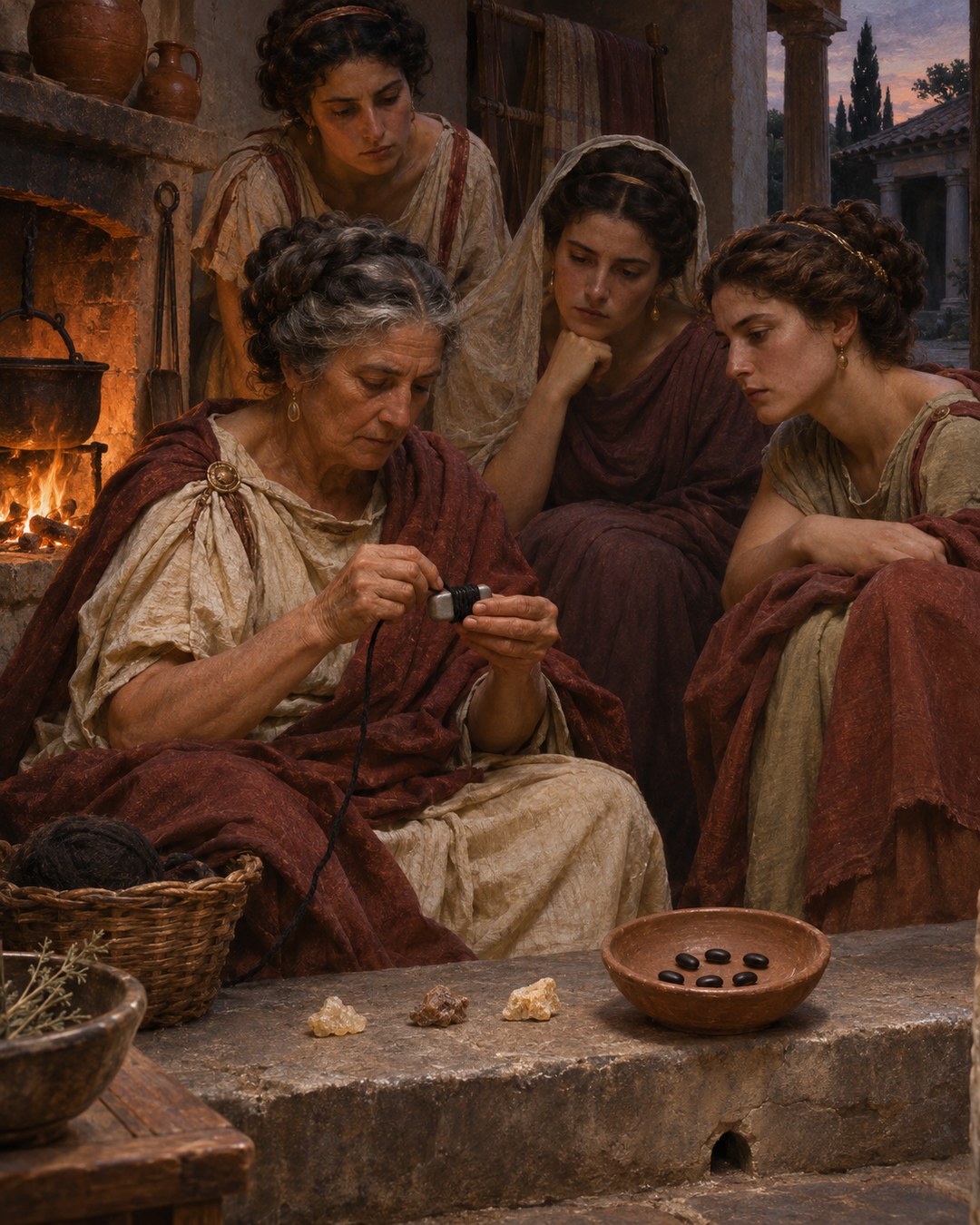
On the last day of Rome’s festival for the dead, Ovid turns away from tombs and public offerings. He leads his reader to a threshold, a mouse hole, and an old woman who cannot stop talking while she serves a goddess defined by silence.
Her equipment is small enough to fit around a hearth: three pieces of incense, thread, dark lead, seven black beans, a fish head, pitch, a bronze needle, and wine. Yet every action aims at a problem larger than the objects. Someone has been speaking with hostility. The rite is meant to make those words go nowhere.
This is not a tidy handbook for Roman religion. It is a sharply staged scene in Ovid’s Fasti, complete with numbered gestures, domestic textures, and a comic final drink. Read carefully, it shows how a Roman poet imagined harmful speech becoming something that could be handled, pierced, sealed, and bound.
The Feralia Ends at a Working Threshold
Ovid places the scene on the Feralia, the final day devoted to propitiating the dead. That calendar position matters. The boundary between households and the dead has already become unusually active, and the poet has just described offerings owed to ancestral spirits. His next ritual does not take place at a monumental altar. It begins under the entrance to a home.
An old woman sits among girls and performs rites for Tacita, the Silent Goddess. The first joke is immediate: the celebrant herself is not silent. She talks, mutters, and eventually pronounces the result of her work. Silence here is not the absence of ritual language. It is the result that ritual language tries to impose on somebody else.
Using three fingers, she pushes three pieces of incense beneath the threshold. Ovid makes the route precise. A mouse has opened a hidden passage there. The detail shrinks the action to floor level, where cracks, burrows, and doorways connect spaces that people otherwise try to keep apart. In a scene about dangerous words crossing social boundaries, the physical boundary of the house becomes part of the argument.
The setting also distinguishes this scene from the formal control surrounding a public prayer. A Roman prayer could depend on exact wording and supervised repetition, as the ritual described in the four-person chain guarding a magistrate’s words demonstrates. Ovid’s old woman works with the same confidence that form matters, but her stage is a domestic threshold rather than a civic ceremony.
Thread and Lead Give Speech a Body
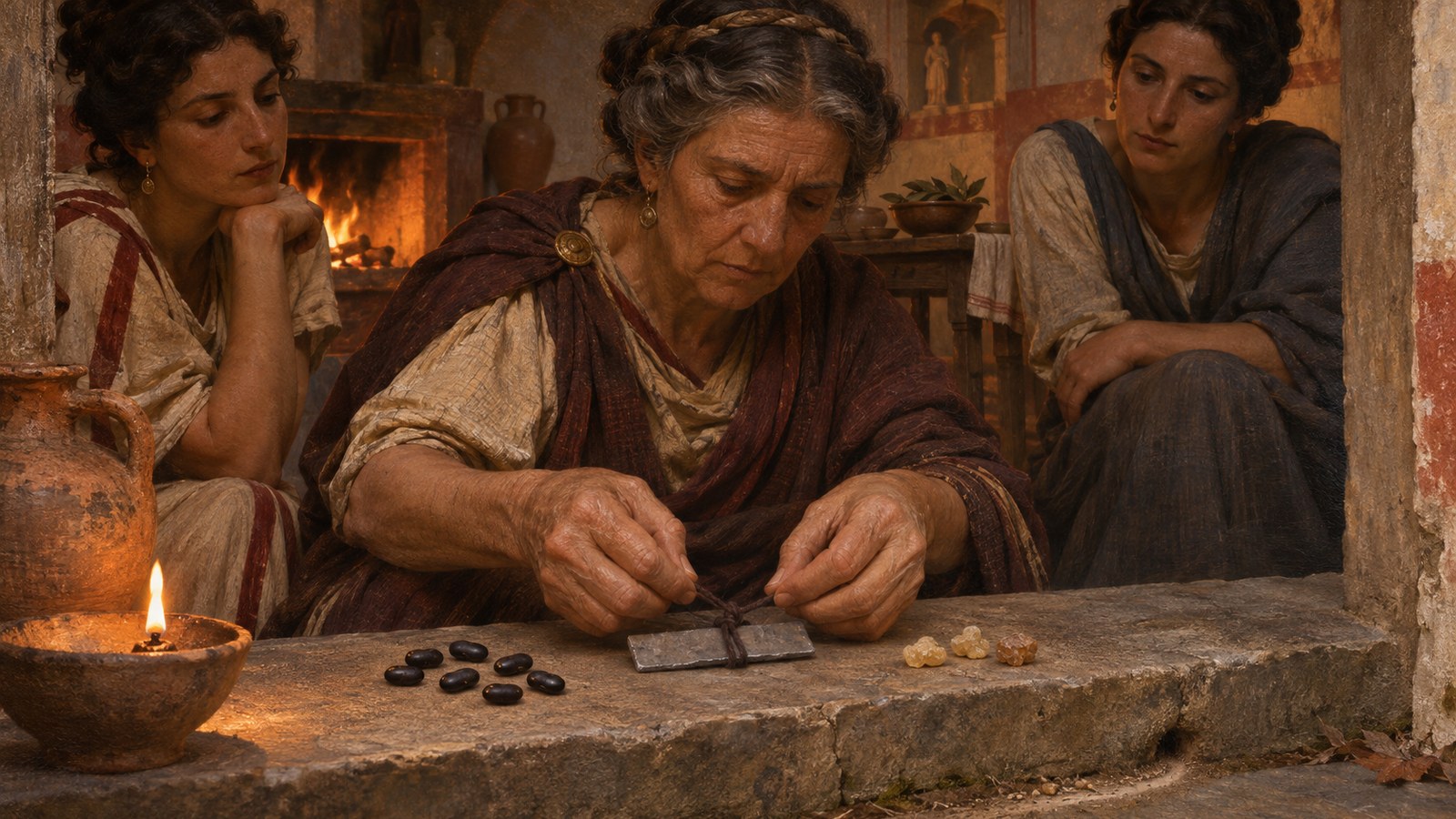
The rite then moves from a concealed opening to materials that can be twisted and fixed. The woman binds enchanted threads together with dark lead. Thread can knot, join, and restrain. Lead is heavy, dull, and easy to mark or shape. Ovid does not pause to explain a theory behind the combination. He lets the materials perform the idea.
Hostile talk is normally invisible. It travels from one person to another and cannot be seized once it has left the mouth. The ritual answers that problem by making an analogue. Threads stand in for connections that can be tightened; lead gives those connections weight. What could not be grasped becomes an object in the celebrant’s hands.
That material logic is more important than calling the scene merely “superstition.” The label would flatten the mechanism. The old woman is not randomly collecting strange things. Every major action turns speech into a physical condition: hidden beneath a boundary, tangled in thread, weighted with metal, trapped in a mouth, punctured, sealed, and heated.
Ovid’s sequence also gives the celebrant authority. No priest enters to correct her. No magistrate supplies a formula. The girls watch while she knows where the incense goes, how the thread is bound, and which materials follow. Whether the scene reproduces a common household practice or an artfully intensified literary one, the knowledge belongs to the older woman.
Seven Beans Fill the Mouth Before the Fish Is Sealed
Next come seven black beans. Ovid says the woman mutters with them in her mouth. The act makes her own speech difficult at the moment she is working against the speech of others. Her mouth becomes a temporary model of obstruction: occupied, darkened, and forced to produce words through a physical barrier.
The number is not incidental in the narration. Ovid counts three fingers, three pieces of incense, and seven beans. Repetition makes the rite memorable and gives its gestures a controlled rhythm. The reader can almost follow the sequence by hand and mouth before the action shifts to the fire.
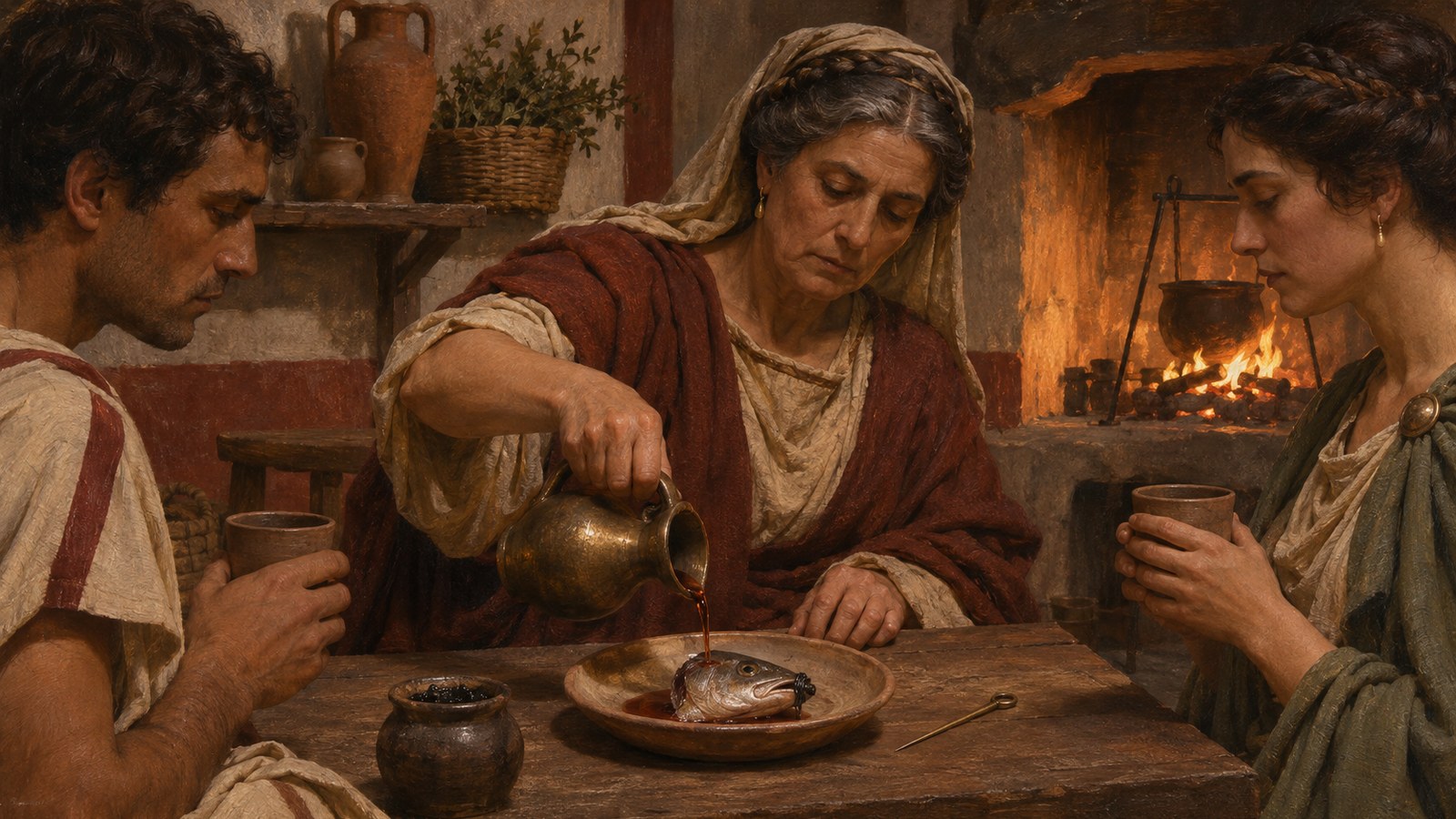
The central object is the head of a small fish. Its mouth has been sewn shut. Pitch fastens the closure, and a bronze needle pierces the head through and through. The object does not merely symbolize silence in a vague way. Its speaking opening is physically closed, the closure is sealed, and the whole thing is transfixed so that the condition cannot easily be reversed.
Then the fish head is roasted. Fire completes a sequence that has already denied movement and voice. The rite’s target remains human speech, but the target is never named. Instead, the fish receives the treatment intended for “hostile tongues and unfriendly mouths.” The substitution allows aggression to be acted out on a manageable object rather than directly on a rival.
Wine Turns the Binding into a Social Scene
Wine is poured over the fish head, but not all of it is consumed by the rite. The woman and her companions drink what remains. Ovid adds that she takes the larger share. A scene that could have ended with a grimly sealed mouth becomes social and slightly unruly.
That shift is not decorative. The celebrant has an audience, helpers, or companions around her. The ritual belongs to a small group that watches the sequence and shares the leftover drink. Knowledge, performance, and sociability sit together. The old woman’s authority is serious enough for the work, yet Ovid refuses to present her as a solemn official.
As she leaves, she finally states the desired result: hostile tongues and unfriendly mouths have been bound. The declaration is a verbal seal placed after the physical ones. She says that the work has succeeded, turning the collection of actions into a completed claim.
Then the poet delivers his last comic stroke. The old woman departs drunk. It is tempting to let that detail dismiss everything that came before it, but Ovid has spent too much precision on the rite for the scene to be only mockery. The comedy and the ritual competence coexist. His reader is allowed to smile at the celebrant while still seeing how carefully the objects have been arranged.
Ovid Makes Silence from Contradictions
The passage is built from opposites. A talkative woman serves Silence. She mutters with her mouth obstructed. She closes another mouth in order to stop unseen speakers. Wine offered in the rite also loosens the tongue of the person performing it. The threshold is a barrier, yet a mouse has already found a route through it.
Those contradictions explain why the scene is more revealing than a simple list of magical ingredients. Rome’s calendar did not separate family memory, fear of the dead, household boundaries, malicious talk, and comic storytelling into modern categories. Ovid can move from the Feralia’s obligations to ancestral spirits into a rite against enemies’ words because both concern relationships that continue to press on the household.
The larger festival cycle matters here. Roman observances for the dead were not only abstract statements about belief. They organized days, food, movement, and family memory. The wider setting described in the Parentalia’s place on Rome’s calendar helps explain why Ovid’s readers could recognize a last day of offerings before he narrowed the view to one threshold.
There is still a limit to what the poem proves. Ovid gives a literary performance, not a census of household behavior. We should not turn his old woman into every Roman woman or assume that every Feralia ended with an identical fish head. What the passage securely preserves is the poet’s exact construction: domestic materials, counted acts, female ritual knowledge, and a physical answer to speech that felt dangerous.
In that construction, silence is not passive. It has to be made. Incense crosses a hidden path, thread tightens around lead, beans crowd a mouth, a needle passes through a fish head, pitch fixes the seam, and fire finishes the object. Only then can the celebrant announce that hostile words have been stopped—and take the larger share of wine on her way out.
Sources
Ovid, Fasti 2.533–616