
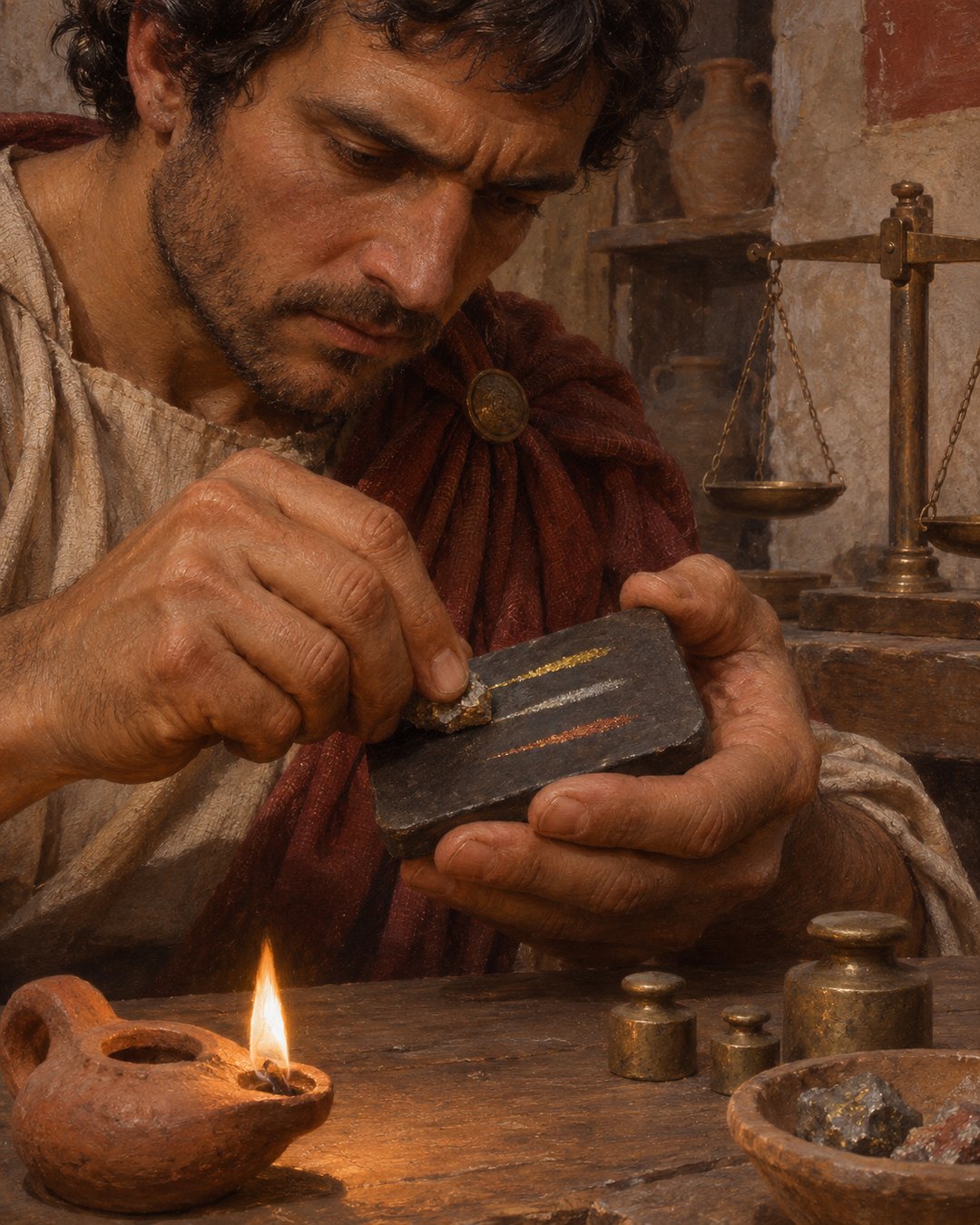
A lump of ore did not arrive with its composition written on the surface. Gold, silver, and copper could occupy the same material, while colour alone offered an uncertain guide. Pliny the Elder described the answer as a stone small enough to hold in one hand. An experienced tester rubbed the ore against it and read the resulting trace so closely that Pliny said the proportions could be judged to a scruple.
The remarkable part is not simply that Romans possessed a touchstone. It is the chain of practical distinctions packed into Pliny’s short account: one face of the stone was preferred over the other, its useful pieces had a size limit, and the operator needed experience. The assay depended on a prepared surface, a controlled action, and trained comparison. This was measurement without a dial, but it was not measurement without a method.
The Stone Had Two Names and an Older Geography
Pliny called the testing stone coticula. He also recorded two alternative names: some people called it the Heraclian stone, while others called it the Lydian stone. Those labels matter because they show that a working material could travel through more than one vocabulary. A trader, metalworker, or writer might recognize the same tool under a regional or inherited name.
Pliny connected its earlier geography to Theophrastus. According to that older authority, the stone had once been found nowhere except in the river Tmolus. By Pliny’s own day, however, it was found in numerous places. His sentence preserves a change in availability rather than presenting the material as eternally rare. The technique was no longer tied, at least in his telling, to one river landscape.
That shift would have practical consequences, though Pliny does not spell them out. A tool found in more places is easier to place in more hands. It can move from a geographical curiosity toward a repeatable part of commerce. This is an inference from his contrast between “former times” and the present, not a claim that every Roman market possessed a touchstone.
Four Inches by Two Defined the Working Piece
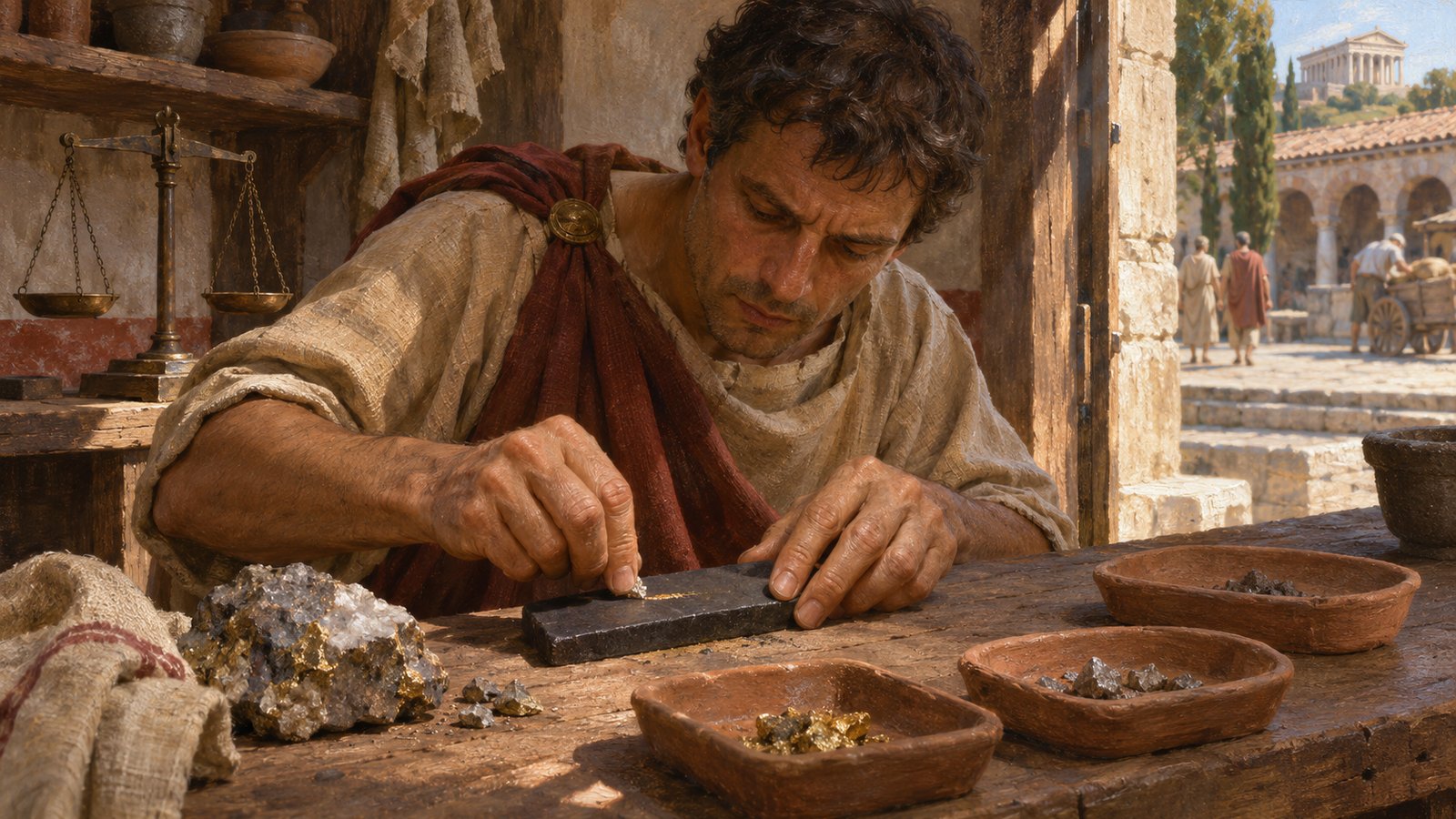
The stone did not appear in unlimited slabs. Pliny said it came in pieces of moderate size and never exceeded four inches in length by two in breadth. His dimensions turn an abstract mineral into a handheld object. The maximum was narrow enough for a bench, a pouch, or a tester’s palm rather than an architectural surface.
Size was only one part of selection. Pliny distinguished between the side that had faced the sun and the side that had lain next to the ground. The sun-facing side was superior. He does not explain the mineral reason, and the account should not be expanded into a modern geological theory that his words do not supply. What survives is the workshop rule: orientation before collection affected which face the tester preferred.
This detail makes the tool less simple than “pick up a dark stone and rub metal on it.” The useful object had a bounded size and a better face. Selection happened before testing began. A poor surface could not be made equivalent merely by following the same hand motion.
The Ore Left a Trace Like a File Would
Pliny described experienced people scraping a particle from the ore with the stone “as with a file.” The phrase identifies an action, not passive inspection. The tester created evidence by abrasion. A small amount of the material met the selected face and left something that could be evaluated.
The comparison with a file also places the test among ordinary hand skills. Pressure, angle, and the condition of the surface would all matter in practice, even though Pliny does not provide an operating manual. His emphasis falls on experienced operators. The stone was the instrument, but trained use turned the instrument into a result.
That distinction appears elsewhere in Roman material culture. A tool may look modest while the knowledge around it carries the precision. The Roman story of copper consuming gold treated metals as visible signs in a very different setting; the touchstone instead made a controlled mark for judgment. Both depended on close attention to material change, but only one was presented as an assay.
One Mark Separated Three Metals
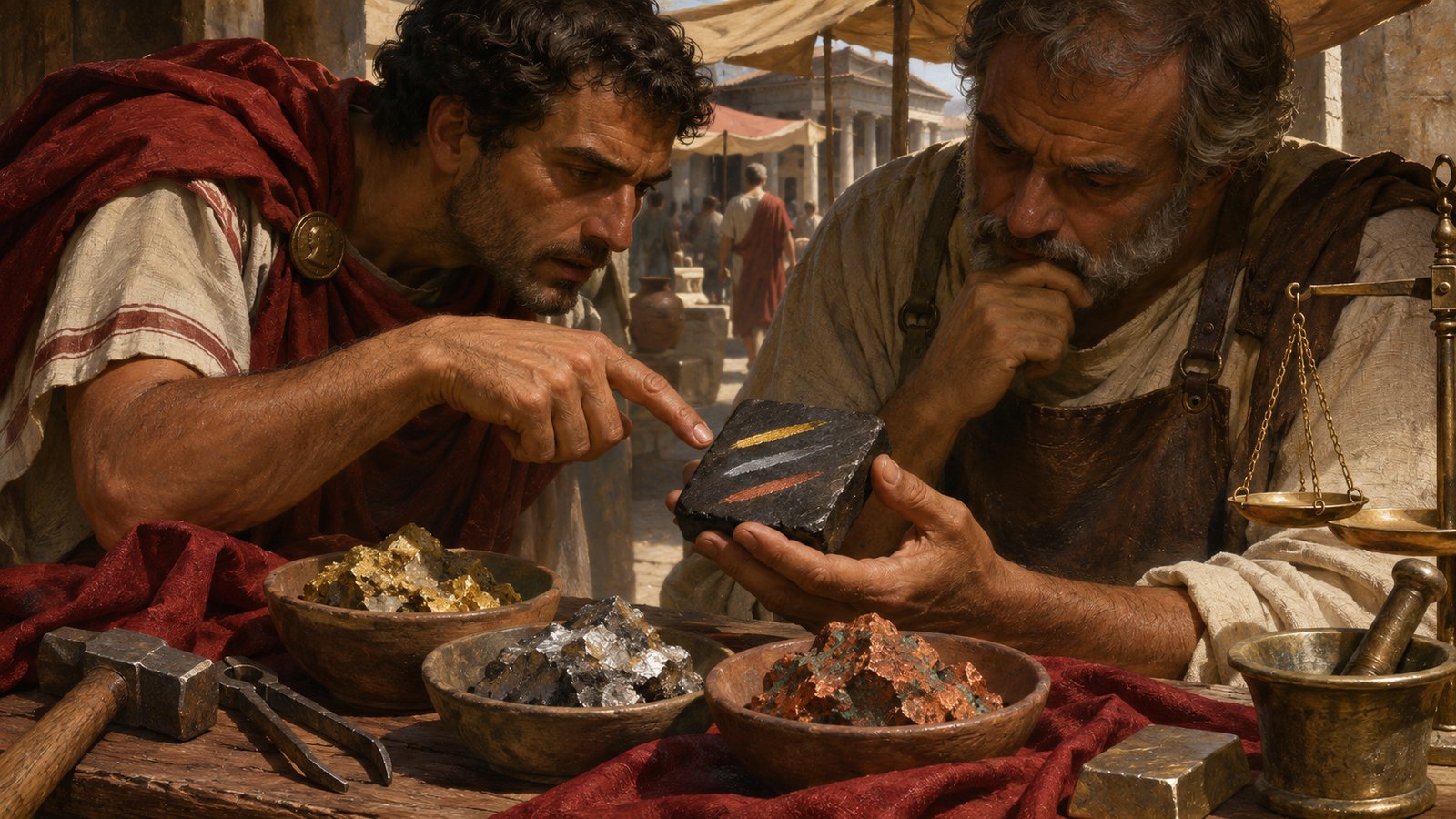
The tester’s task was not merely to announce “gold” or “not gold.” Pliny said skilled people could tell the proportion of gold in the ore, how much silver, and how much copper. The same trace therefore carried a three-part question. Purity was not binary. The valuable metal had to be understood alongside the other metals mixed with it.
Pliny’s wording brings the technique close to the problems of exchange. A buyer and seller could agree that a piece looked golden while disagreeing sharply about how much gold it contained. The touchstone offered a shared physical procedure, although Pliny does not describe contracts, prices, or legal enforcement around it. It made composition discussable through an observed mark.
That does not mean fraud disappeared. The archive contains another example in which pepper’s most easily adulterated form also commanded a stated price. Roman markets repeatedly joined value to expert discrimination. In the touchstone passage, the expert looked for metallic proportions rather than botanical substitutions.
A Scruple Was the Claim That Made the Test Extraordinary
Pliny gave the test a precision threshold: experienced operators could judge the metals to a scruple. He then praised their accuracy as marvellous and said they were never mistaken. That final language belongs to Pliny’s admiration and should be read as such. It is evidence for the reputation of the specialists, not a modern blind trial proving zero error.
Even with that caution, the scruple matters. Pliny did not celebrate a vague impression. He attached a named small unit to the result. The reader is meant to picture an operator moving from a streak on stone to a quantified composition with startling speed—“in a moment,” in the account.
The entire method fits inside a compact sequence. Choose a moderate piece of coticula. Prefer the side that faced the sun. Scrape the ore against it like a file. Read gold, silver, and copper from the mark. Express the result to a scruple. None of those stages requires a monumental machine, yet each narrows uncertainty.
The account also separates portability from simplicity. A portable test could be repeated wherever the tester and stone travelled, but the result still rested on distinctions that a novice might miss. The better face had to be recognized; the abrasion had to expose the ore; and the streak had to be interpreted as a mixture rather than admired as a colour. Pliny’s repeated attention to experienced people keeps human judgment at the centre of the procedure.
Nor was the test destructive on the scale of melting an entire object. Pliny speaks of scraping a particle from ore. That small intervention was enough, in his description, to answer questions about three metals. The passage does not tell us whether the tested material was a mine sample, a trading parcel, or something brought to a specialist, so those settings should remain possibilities rather than facts. What it does show is a method designed to obtain information from a limited trace.
That is why the little stone deserves attention. Its importance did not come from splendour. It came from making a valuable mixture legible before someone had to trust its appearance. Pliny’s touchstone joined geology, hand skill, metrology, and trade on a surface no larger than four inches by two.
Sources
Pliny the Elder, Natural History, Book 33, chapter 43.