
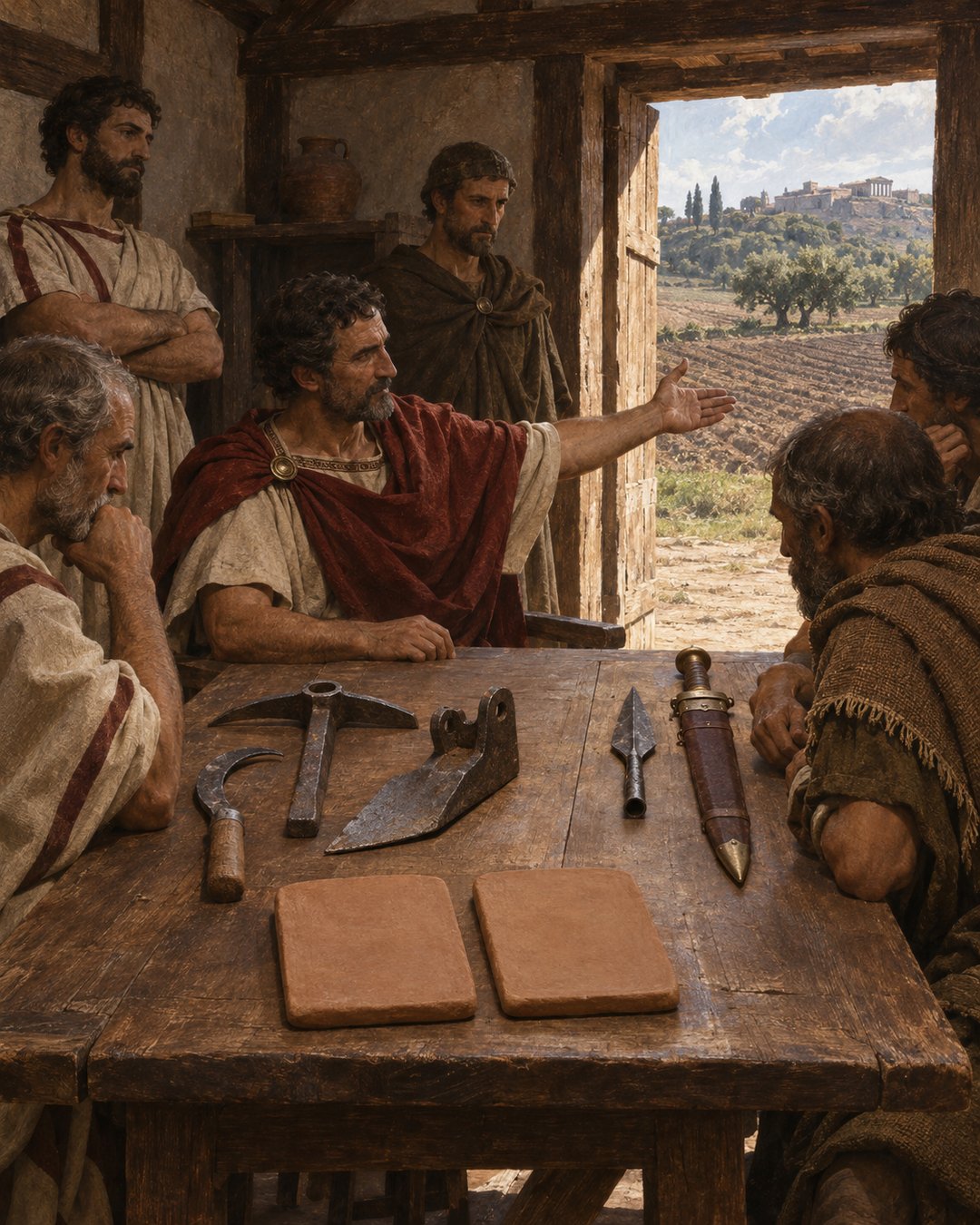
Iron does not arrive in Pliny’s account as a weapon. It arrives in a field. It opens soil, plants trees, cuts away the dead wood of a vine, helps construct a house and cleaves rock. Only after that inventory does the metal turn toward war. The order matters because Pliny is not describing two substances. He is asking how the same material could support ordinary work and carry death.
His sharpest evidence is legal rather than technical. In a treaty associated with King Porsena, Roman iron was supposedly reserved for cultivation of the fields. Much later, during disorder after the death of Clodius, an edict prohibited anyone from retaining a weapon in the City. Pliny places those restrictions around a meditation on responsibility: iron did not teach itself to fly.
The Treaty Drew a Line Through a Material
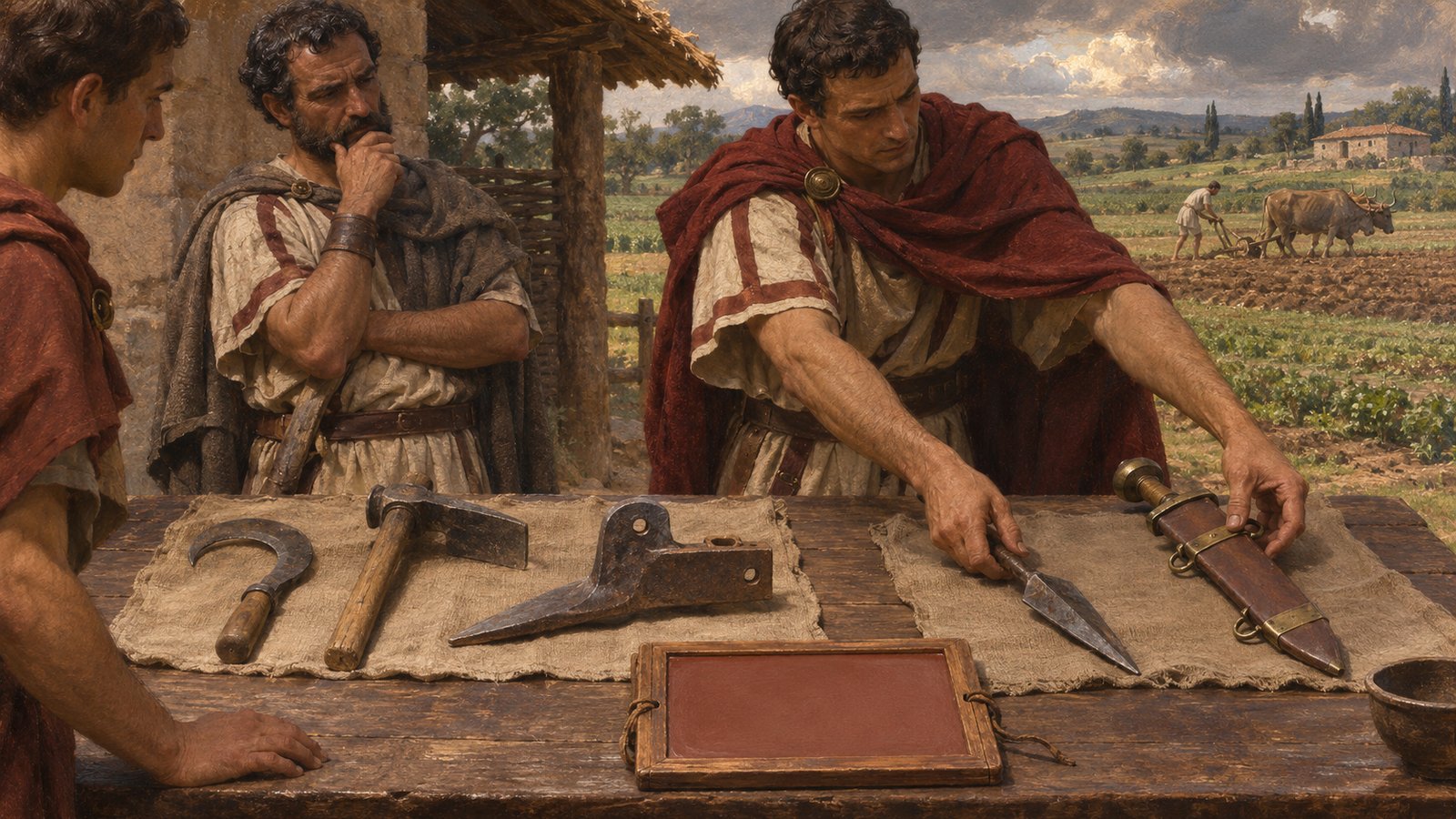
Pliny locates the treaty after the expulsion of Rome’s kings. He says Porsena granted terms to the Roman people and that one stipulation expressly confined iron to farming. The wording, as he presents it, is startlingly broad. It does not merely ban a named sword or remove spears from one assembly. It classifies the acceptable purpose of the material itself: iron may serve cultivation.
That claim should be handled as Pliny’s report about an old treaty, not as a complete surviving legal code. He gives no schedule of inspections, penalties or exemptions. What survives in his passage is the boundary. A plough fitting, mattock or pruning hook belongs on one side. An iron object intended to wound belongs on the other.
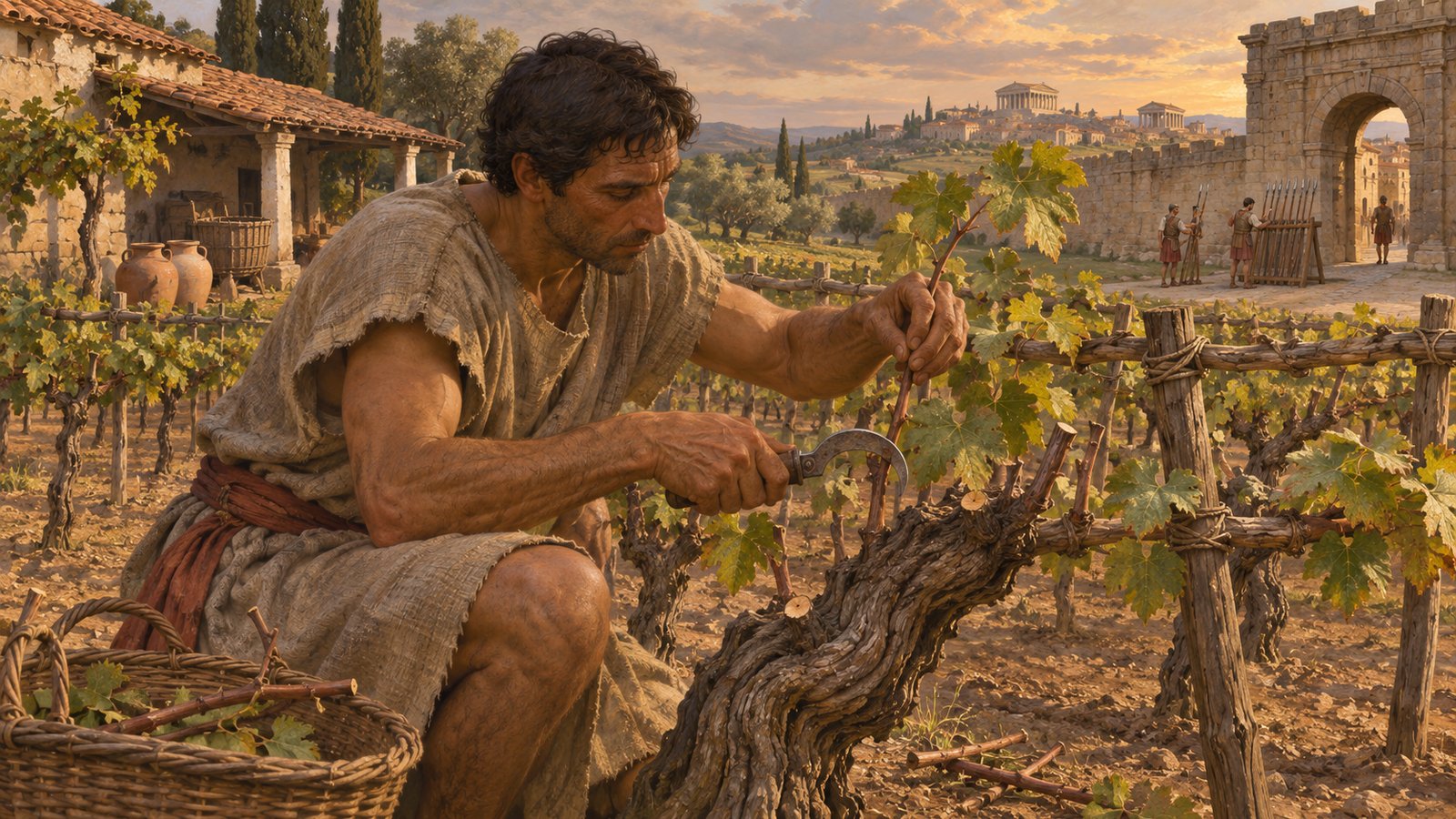
The boundary also makes sense of Pliny’s agricultural opening. Iron “lays open” the ground, helps plant trees and prepares vineyard trees. The vineyard detail is especially specific. Vines regain youth each year when decayed branches are cut away. In his sequence, an iron edge can produce renewal before it produces injury.
This is not the only Lost Eagles story in which a material’s expected role is overturned. Roman stoneworkers could use sand rather than an iron blade to cut marble slabs. Here the reversal is legal and moral: iron remains useful, but usefulness is conditional on what a person asks it to do.
A Pen Could Fall on the Wrong Side
Pliny adds an odd detail from Rome’s oldest writers: in those days, it was considered unsafe to write with an iron pen. He does not explain whether the danger was practical, symbolic or political. The restraint matters. The source supports the existence of the report; it does not supply a hidden ritual or a precise enforcement mechanism.
Even so, the pen widens the problem. A rule about iron could reach beyond obvious weapons. A pointed writing tool was small, domestic and useful, yet its material and shape made it uneasy enough to remember. The anecdote shows how difficult it is to regulate a versatile substance by appearance alone.
Pliny’s own list keeps multiplying that versatility. Iron builds houses. It cleaves rocks. It works the ground. None of these tasks is marginal to settled life. A blanket rejection of iron would therefore erase the very benefits with which he begins. The treaty’s reported solution is not abolition. It is purpose: the fields define innocent use.
Pliny Made Flying Iron the Moral Turning Point
When Pliny turns to violence, he moves outward from the hand. Iron enables war, murder and robbery at close range. Then it travels farther: missiles are launched from engines, hurled by an arm or fitted with feathers. The last device draws his strongest condemnation. Humans, he says, gave wings to iron and taught it to fly.
The phrase compresses a mechanism into an accusation. Feathers stabilize a missile and let a sharp point travel through space, but Pliny does not offer a neutral engineering note. Distance and speed intensify his judgment. The tool no longer waits at the worker’s hand. Design has extended its reach.
He then refuses to blame Nature. That qualification is essential to the article’s thesis. Iron possesses no moral category on its own. Human arrangement produces the difference between pruning a vine and launching a projectile. In Pliny’s framing, responsibility follows intention, design and use.
His argument also keeps the peaceful object visible. The same chapter that condemns winged weapons still remembers annual pruning. The contrast is not “metal versus nature.” It is one human decision against another.
Pompey’s Edict Moved the Boundary Inside Rome
The second restriction belongs to a later political crisis. Pliny says an extant edict was issued in Pompey the Great’s third consulship, amid tumults following Clodius’s death. Its rule prohibited any weapon from being retained in the City.
Again, Pliny supplies the prohibition but not a procedural handbook. We should not invent searches, confiscation teams or a catalogue of permitted tools. What can be said is narrower and more revealing: the city itself became the protected space, and “weapon” became the forbidden status.
The change from Porsena’s treaty is instructive. The treaty, as quoted by Pliny, defines legitimate iron through agriculture. Pompey’s edict defines an urban object through weaponhood. One rule starts with material and use; the other with object and place. Both attempt to stop ordinary versatility from becoming political danger.
Rome’s public memory often depended on durable material, as the effort to rebuild three thousand lost bronze records makes clear. Pliny’s iron passage shows the inverse anxiety. Durability and utility could serve order, but a portable edge could also disturb it.
The Field and the City Asked Different Questions
Pliny’s chapter is not a modern theory of arms control. It is a Roman moral history of a material, supported by two remembered restrictions. Its power comes from the sequence: field, vineyard, house and rock; then murder, engine and feathered missile; then treaty and edict.
The field asks what iron can make possible. The city asks what iron may become when carried as a weapon. Between them stands the human decision Pliny refuses to transfer to Nature.
That is why the old treaty detail is more than an antiquarian curiosity. By reserving iron for cultivation, it imagines a society trying to preserve the tool while excluding the wound. Whether every practical edge could ever fit that boundary is left unanswered. The boundary itself is the historical fact Pliny wanted his readers to notice.
The chapter’s verbs make that boundary unusually tangible. People open earth, plant trees, prepare vines, construct houses and cleave rock. Each action changes material in order to sustain a field or settlement. Violent iron changes direction: it is launched, hurled and furnished with feathers. Pliny’s contrast is therefore not only between objects. It is between motions, destinations and the results designers seek.
The old treaty and Pompey’s edict also operate at different scales. One looks back to Rome after kings and imagines the acceptable economy of an entire metal. The other responds to a named urban crisis and controls the presence of weapons inside the City. Pliny can place them together because each asks where utility ends. Their answers are not identical, but both refuse to treat an iron implement as politically neutral once its intended use is violence.
His warning about the pen sharpens the uncertainty at the edge. A pen belongs to writing, yet an iron point could still appear unsafe. This does not prove a general ban on literacy tools, and Pliny does not claim one. It shows why purpose-based rules are difficult: form can suggest one use while permitting another. The anecdote belongs in the article precisely because it frustrates an easy catalogue of harmless and harmful objects.
Pliny’s final moral allocation remains clear despite those practical complications. Nature provided the substance; humans selected the form and destination. The field and city restrictions matter because they are attempts to turn that moral judgment into a boundary people could recognize. Iron’s double career was not an accident hidden in the ore. It emerged from work performed on the metal and decisions made about where it should go.
Sources
Pliny the Elder, Natural History, Book 34, chapter 39.